
GEOL 222 Final, Spring 1997
American University of Beirut · Sedimentology · 5 pages

More GEOL 222 files
Show the text of this final exam
meee
. nina:
AMEETOUN DN VE SEry
LIBRARY
OF RECT
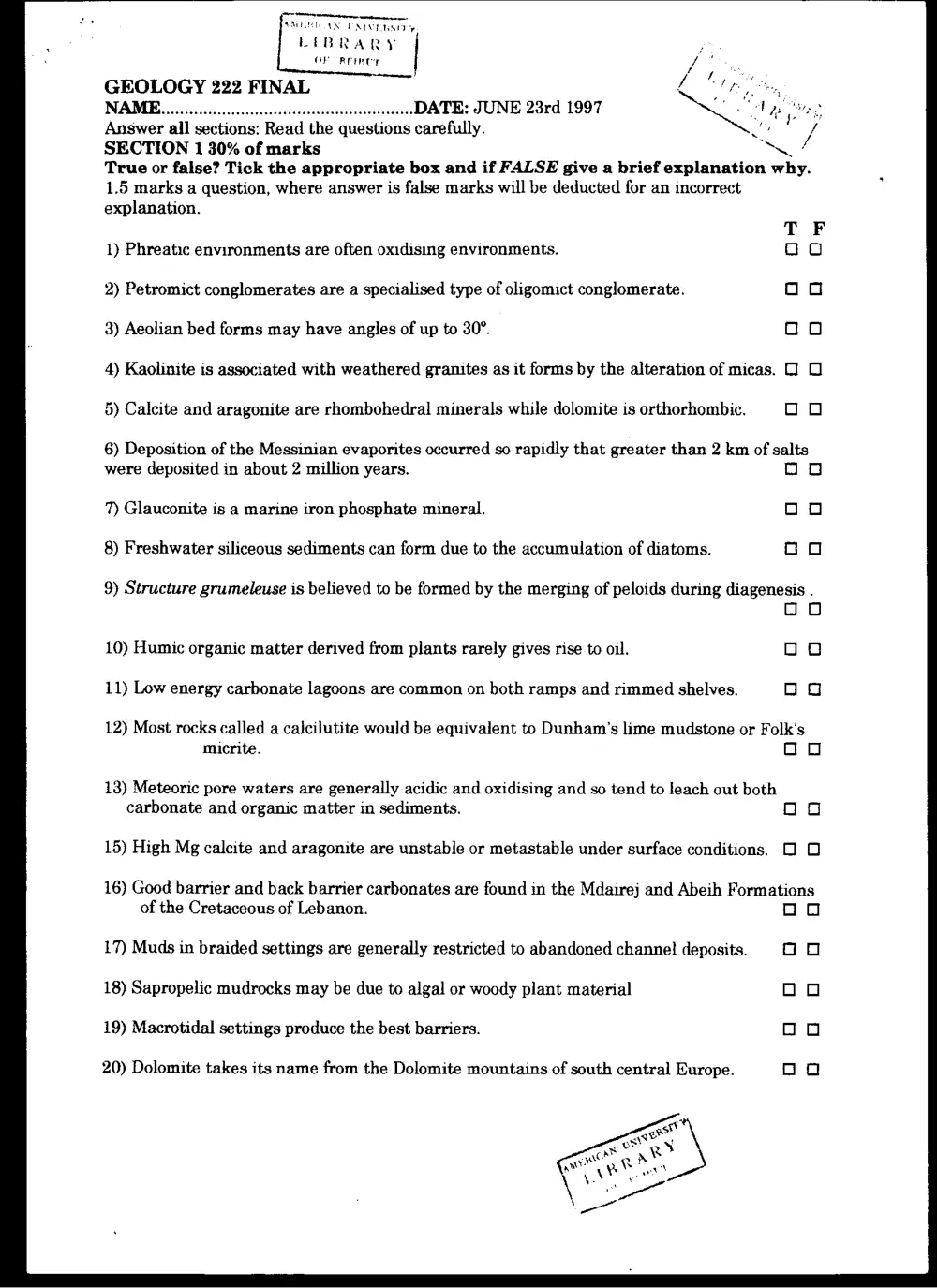
GEOLOGY 222 FINAL ney,
NAME....csccscesssssesssssesseseenseenestenset DATE: JUNE 23rd 1997 SA eS
Answer all sections: Read the questions carefully. a ! /
SECTION 1 30% of marks er
True or false? Tick the appropriate box and if FALSE give a brief explanation why.
1.5 marks a question, where answer is false marks will be deducted for an incorrect
explanation.
T F
1) Phreatic environments are often oxidising environments. i |
2) Petromict conglomerates are a specialised type of oligomict conglomerate. oa
3) Aeolian bed forms may have angles of up to 30°. oa
4) Kaolinite is associated with weathered granites as it forms by the alteration of micas. O O
5) Calcite and aragonite are rhombohedral minerals while dolomite is orthorhombic. oo
6) Deposition of the Messinian evaporites occurred so rapidly that greater than 2 km of salts
were deposited in about 2 million years. oo
7) Glauconite is a marine iron phosphate mineral. oo
8) Freshwater siliceous sediments can form due to the accumulation of diatoms. oa
9) Structure grumeleuse is believed to be formed by the merging of peloids during diagenesis .
oo
10) Humic organic matter derived from plants rarely gives rise to oil. 00
11) Low energy carbonate lagoons are common on both ramps and rimmed shelves. oa
12) Most rocks called a calcilutite would be equivalent to Dunham’s lime mudstone or Folk’s
micrite. og
13) Meteoric pore waters are generally acidic and oxidising and so tend to leach out both
carbonate and organic matter in sediments. od
15) High Mg calcite and aragonite are unstable or metastable under surface conditions. O O
16) Good barrier and back barrier carbonates are found in the Mdairej and Abeih Formations
of the Cretaceous of Lebanon. o0Q0
17) Muds in braided settings are generally restricted to abandoned channel deposits. ogo
18) Sapropelic mudrocks may be due to algal or woody plant material oa
19) Macrotidal settings produce the best barriers. oa
20) Dolomite takes its name from the Dolomite mountains of south central Europe. oa
Formation Description
Formation Y
Algal laminated mictites and dolomites. Mudcracks,
ostracads.
Formation X
Base has wavy and tenticular bedding. Mid to top
interbedded shales and quartz wacke hummocky
bedded sands.
Marine fosalis common to abundant in the shales.
Formation W
Quartz arenite. Gently dipping laminations. Oscillation
pples and cross beds common. Skailthoa traces.
Pormation V
Quartz conglomerates interbedded with coarse
grained, targe planar crosa bedded quartz arenites
/ {L-Bat/T-Bar sequences). Sequences tend to thin
and fine toward top of section.
Formation U
Quartz arenite. Gently dipping laminations. Skollthoa traces.
Formation T
Green shales with lenticular bedding at base. Thin
hummocky sequences In the middle, which thicken
and change inta megactoes bedded medium sands
attop. Marine tossils common in places.
Formation S$
Feldspathic lithic wackes. Lithics include radiolarian
chert, quartzite, carbonates, feldspars, and
metamorphic fragments.
Cycles of planar bedded coarse pebbly sands
passing upwards into finer sands with ripples and
then shales.
Formation R
Base interbedded bieck micrites and shales. Micrites!
contain broken, Wansported fossils. Shaies thicken
and dominate upgection. Graptoiltes in shales.
Formation Q
Micritea, biomicrites, packed fossiliferous micrites. Small
Patch reete of fossil boundstone (crincids, bryozoans,
calcareous algae, cephalopods, etc.). Some megarippled
blosparmicrites. Limestonea darken upsection, black at top.
Medium gray
to dlack at top
Formation P
Very thick sequences of algal laminated micrites and
dolomites. Stromatoilites, intramicrudites (fat pebbie
conglomerates), pelmicrites, prism (mud) cracks
common.
Rare quartz arenite beds. Occaslonai herringbone
cross bedding,
Light gray
Formation O
Quastz arenite, minor teldapathic arenite. Skalithoa
abundant, cross bedding common.
Derk gray } Green we] wie | ni | een vant arey
Strip Log
SSeS
iESEEE:
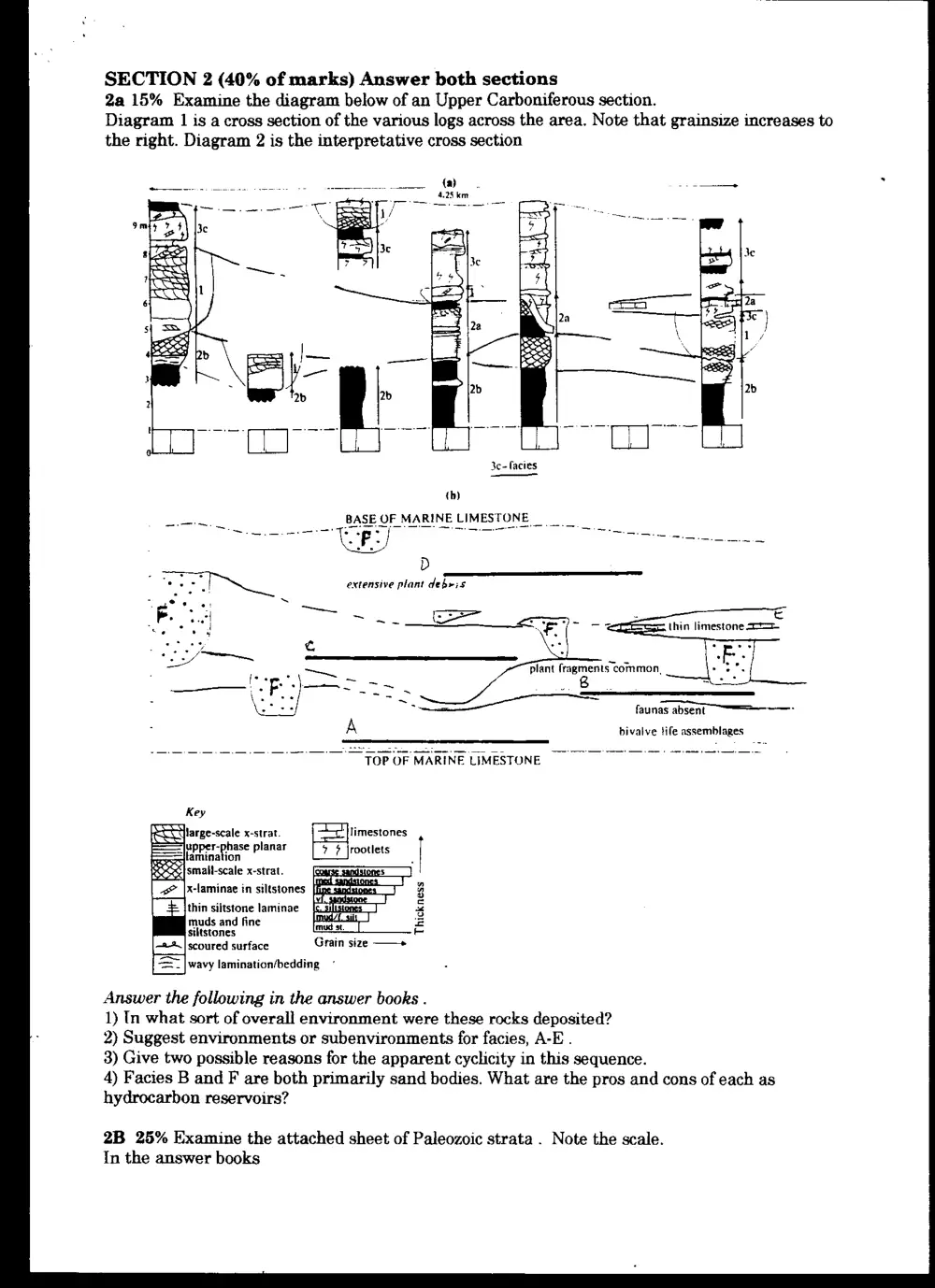
SECTION 2 (40% of marks) Answer both sections
2a 15% Examine the diagram below of an Upper Carboniferous section.
Diagram 1 is a cross section of the various logs across the area. Note that grainsize increases to
the right. Diagram 2 is the interpretative cross section
(a)
4.25 km
3c- facies
th)
BASE OF MARINE LIMESTONE.
c
thin limestone ==
faunas absent
bivalve tile assemblages
TOP OF MARINE LIMESTONE
Key
large-scale x-strat. {limestones
Epper-phase planar
taminatio:
small-scale x-strat.
x-laminae in siltstones
thin siltstone laminae
muds and fine
siltstones
scoured surface Grain size ——+
rootlets
Thickness
a & a
wavy lamination/bedding
Answer the following in the answer books .
1) In what sort of overall environment were these rocks deposited?
2) Suggest environments or subenvironments for facies, A-E .
3) Give two possible reasons for the apparent cyclicity in this sequence.
4) Facies B and F are both primarily sand bodies. What are the pros and cons of each as
hydrocarbon reservoirs?
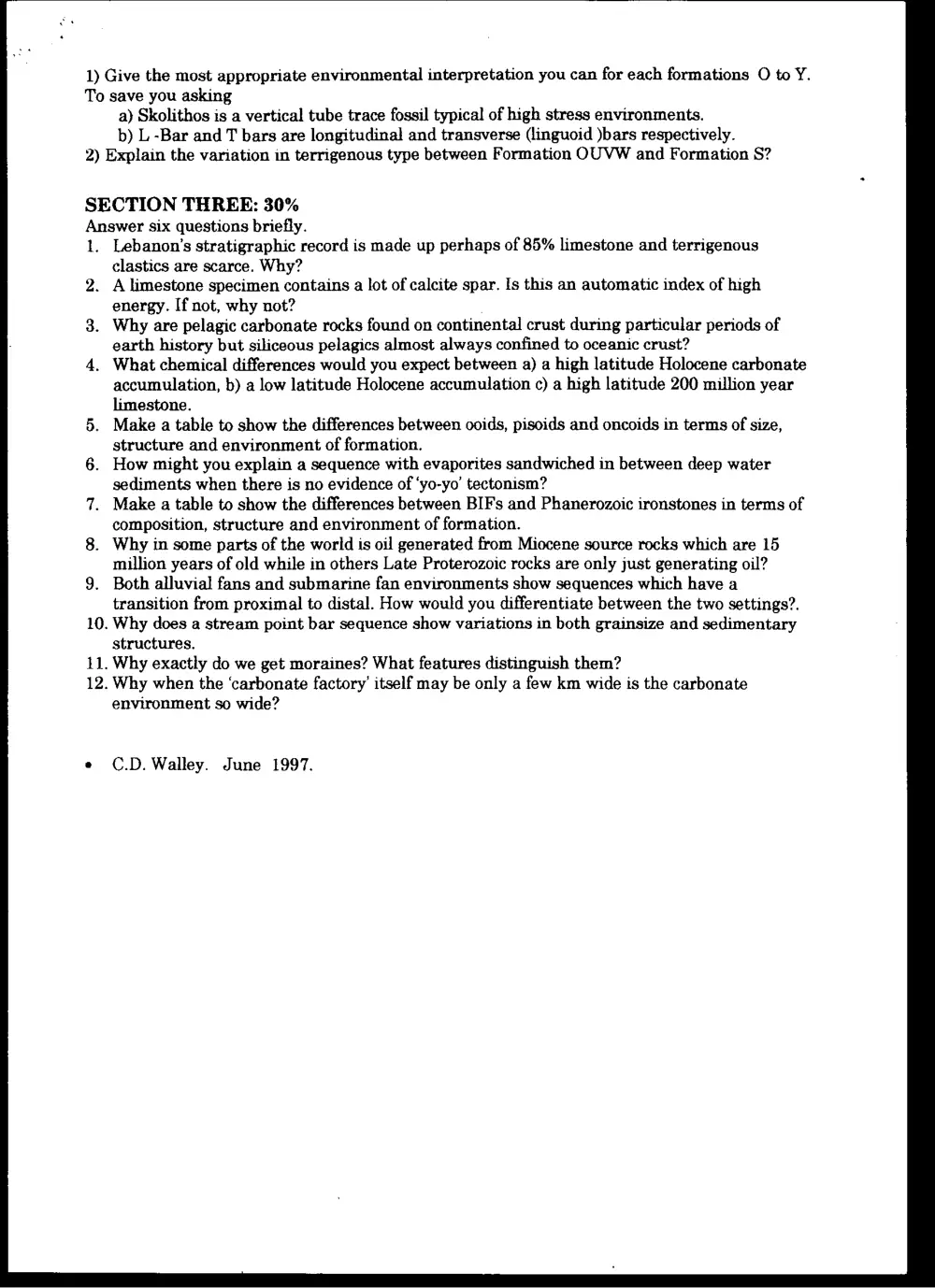
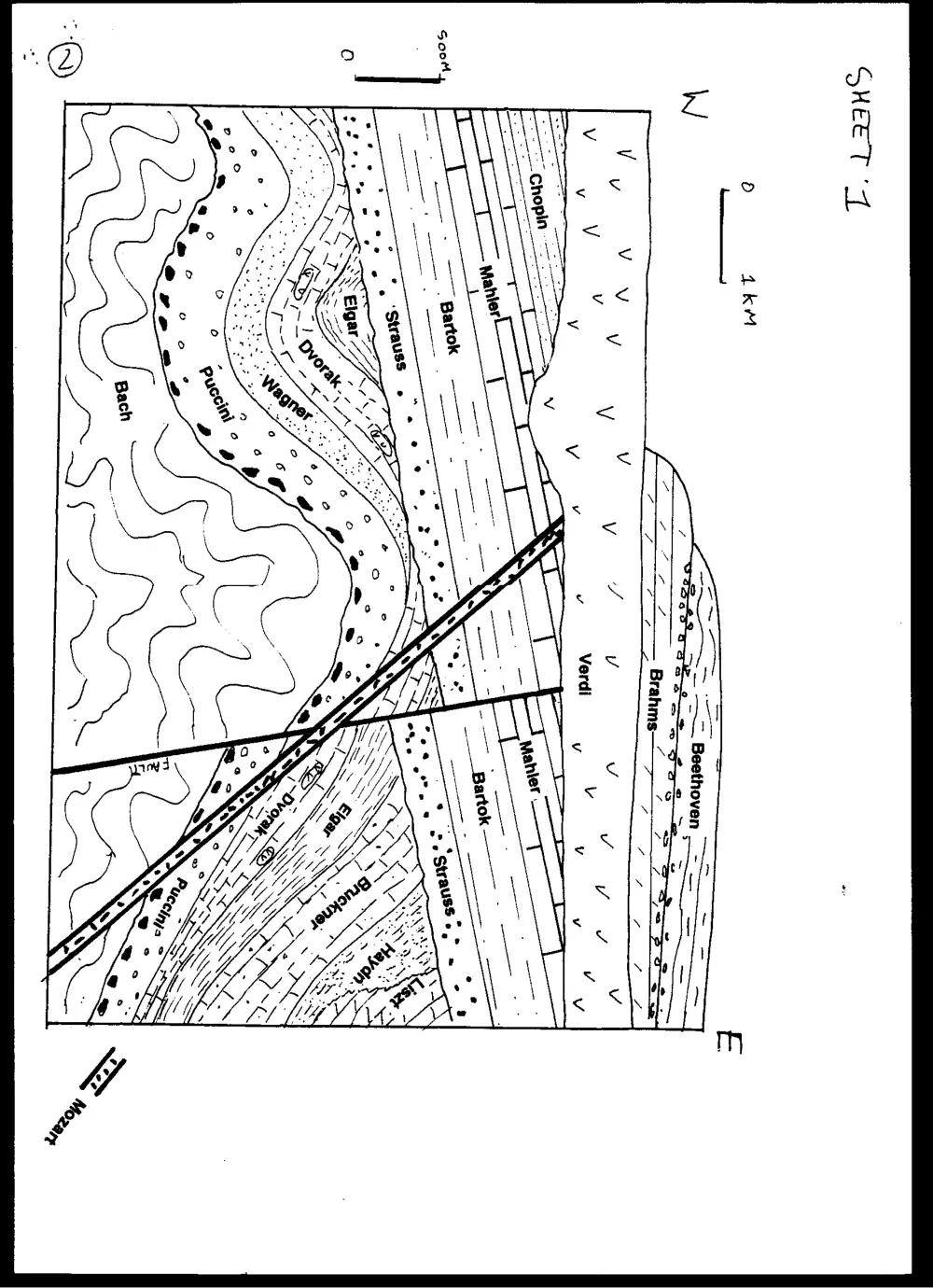
2B 25% Examine the attached sheet of Paleozoic strata . Note the scale.
In the answer books
1) Give the most appropriate environmental interpretation you can for each formations O to Y.
To save you asking
a) Skolithos is a vertical tube trace fossil typical of high stress environments.
b) L -Bar and T bars are longitudinal and transverse (linguoid )bars respectively.
2) Explain the variation in terrigenous type between Formation OUVW and Formation S?
SECTION THREE: 30%
Answer six questions briefly.
1. Lebanon’s stratigraphic record is made up perhaps of 85% limestone and terrigenous
clastics are scarce. Why?
2. A limestone specimen contains a lot of calcite spar. Is this an automatic index of high
energy. If not, why not?
3. Why are pelagic carbonate rocks found on continental crust during particular periods of
earth history but siliceous pelagics almost always confined to oceanic crust?
4. What chemical differences would you expect between a) a high latitude Holocene carbonate
accumulation, b) a low latitude Holocene accumulation c) a high latitude 200 million year
limestone.
5. Make a table to show the differences between ooids, pisoids and oncoids in terms of size,
structure and environment. of formation.
6. How might you explain a sequence with evaporites sandwiched in between deep water
sediments when there is no evidence of ‘yo-yo’ tectonism?
7. Make a table to show the differences between BIF's and Phanerozoic ironstones in terms of
composition, structure and environment of formation.
8. Why in some parts of the world is oil generated from Miocene source rocks which are 15
million years of old while in others Late Proterozoic rocks are only just generating oil?
9. Both alluvial fans and submarine fan environments show sequences which have a
transition from proximal to distal. How would you differentiate between the two settings?.
10. Why does a stream point bar sequence show variations in both grainsize and sedimentary
structures.
11. Why exactly do we get moraines? What features distinguish them?
12. Why when the ‘carbonate factory’ itself may be only a few km wide is the carbonate
environment so wide?
e C.D. Walley. June 1997.
aa
—
——o
* uaroyjeeg