
GEOL 330 Final, Fall 2005
American University of Beirut · Selected Topics in Advanced Geology · 3 pages
More GEOL 330 files
Show the text of this final exam
1
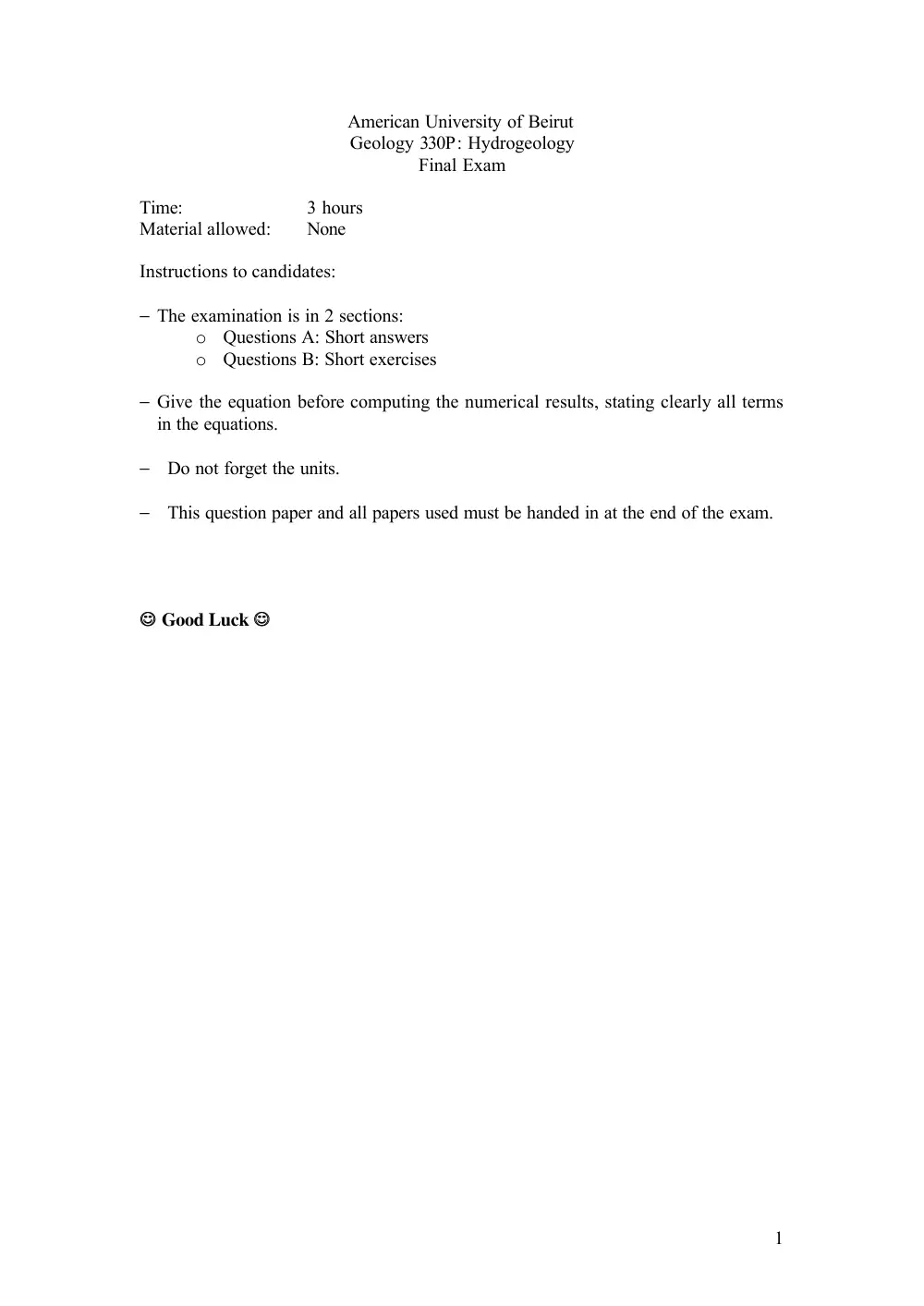
American University of Beirut
Geology 330P: Hydrogeology
Final Exam
Time:
3 hours
Material allowed:
None
Instructions to candidates:
− The examination is in 2 sections:
o Questions A: Short answers
o Questions B: Short exercises
− Give the equation before computing the numerical results, stating clearly all terms
in the equations.
− Do not forget the units.
− This question paper and all papers used must be handed in at the end of the exam.
☺
☺ Good Luck ☺
☺
2
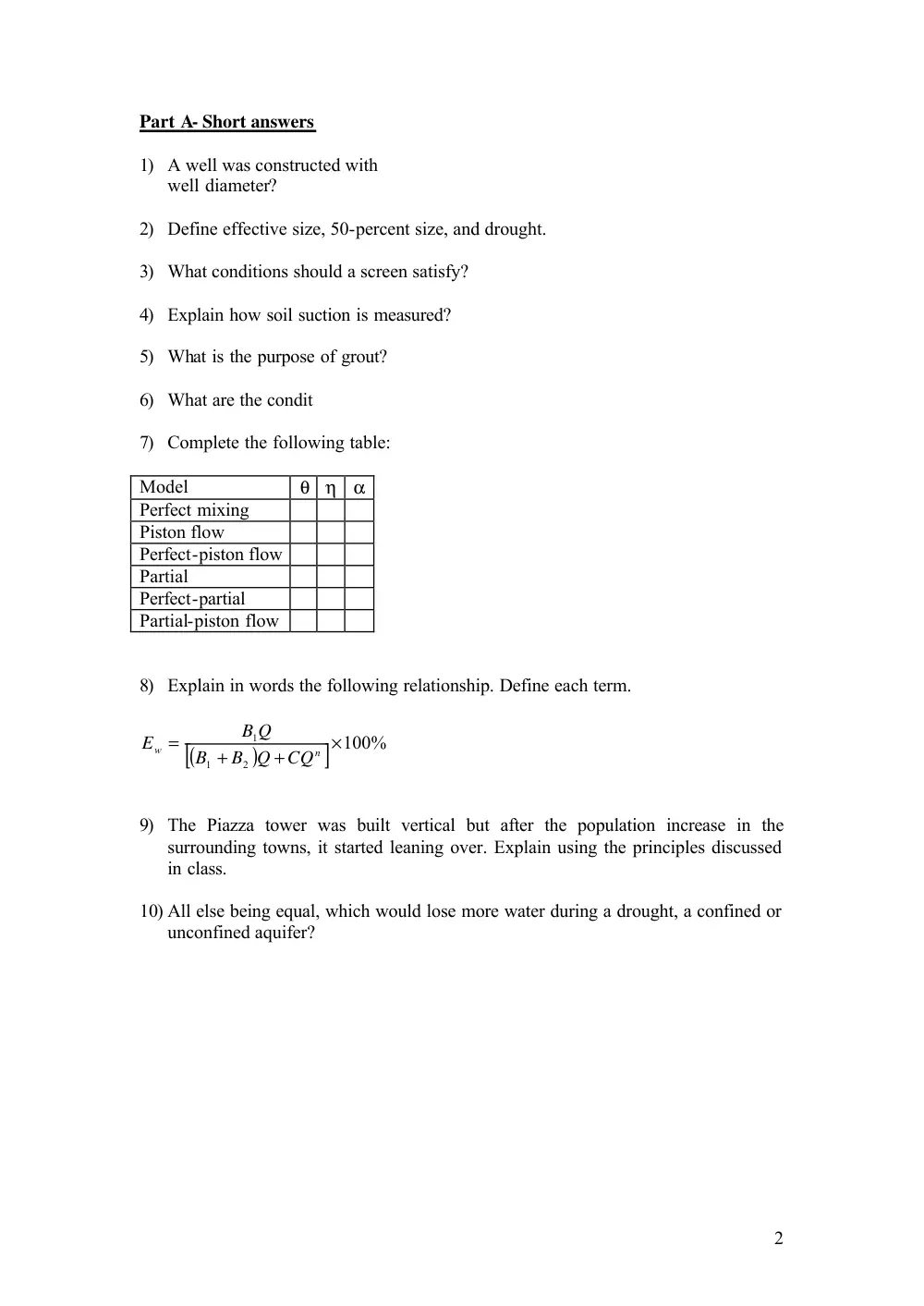
Part A- Short answers
1) A well was constructed with
well diameter?
2) Define effective size, 50-percent size, and drought.
3) What conditions should a screen satisfy?
4) Explain how soil suction is measured?
5) What is the purpose of grout?
6) What are the condit
7) Complete the following table:
Model
θ η α
Perfect mixing
Piston flow
Perfect-piston flow
Partial
Perfect-partial
Partial-piston flow
8) Explain in words the following relationship. Define each term.
9) The Piazza tower was built vertical but after the population increase in the
surrounding towns, it started leaning over. Explain using the principles discussed
in class.
10) All else being equal, which would lose more water during a drought, a confined or
unconfined aquifer?
(
)
[
]
%
100
2
1
1
×
+
+
=
n
w
CQ
B Q
B
B Q
E
3
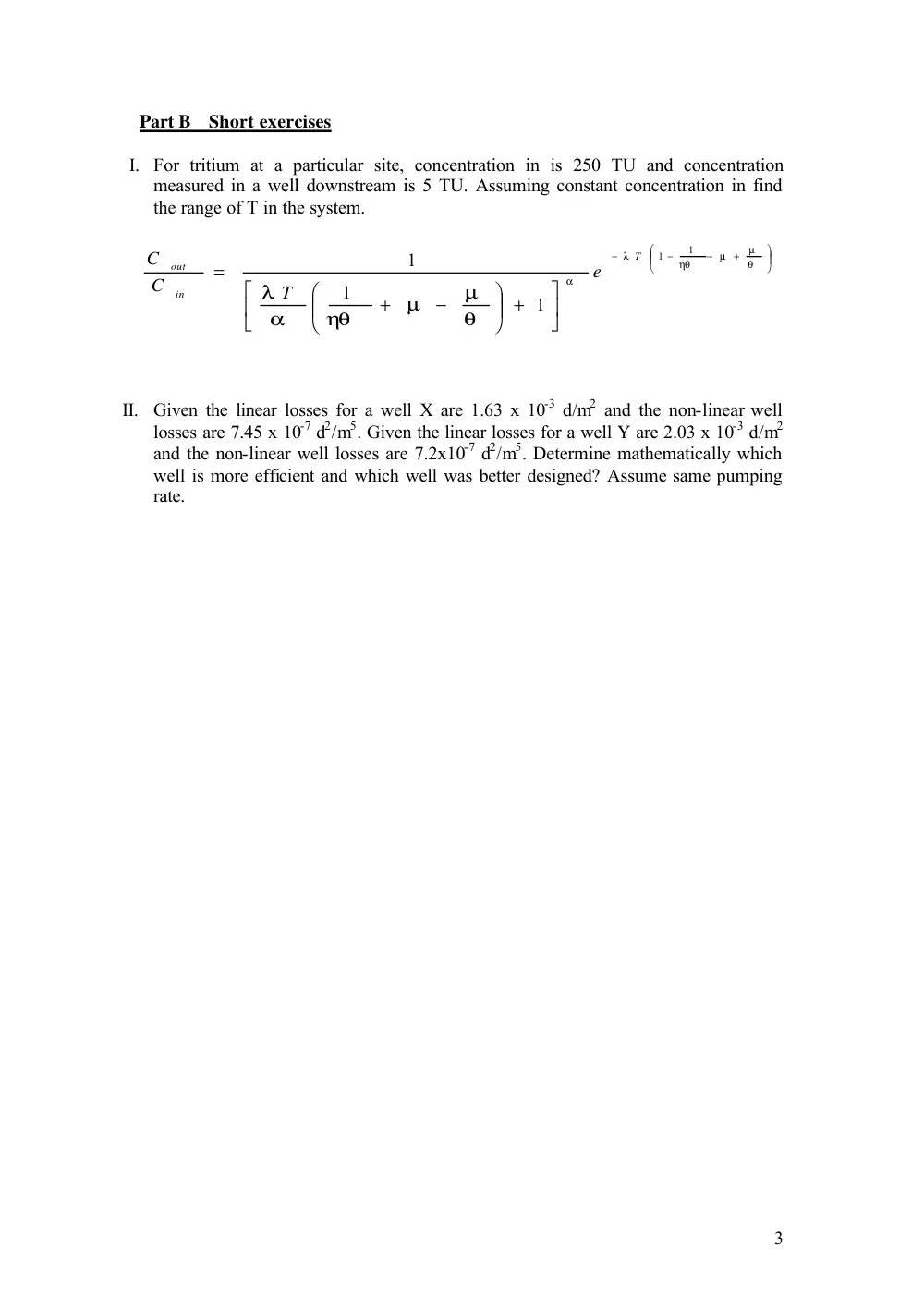
Part B Short exercises
I. For tritium at a particular site, concentration in is 250 TU and concentration
measured in a well downstream is 5 TU. Assuming constant concentration in find
the range of T in the system.
II. Given the linear losses for a well X are 1.63 x 10⁻³ d/m2 and the non-linear well
losses are 7.45 x 10⁻⁷ d2/m5. Given the linear losses for a well Y are 2.03 x 10⁻³ d/m2
and the non-linear well losses are 7.2x10⁻⁷ d2/m5. Determine mathematically which
well is more efficient and which well was better designed? Assume same pumping
rate.
+
−
−
−
+
−
+
=
θ
µ
µ
ηθ
λ
α
θ
µ
µ
ηθ
α
λ
1
1
1
1
1
T
in
out
e
T
C
C