
MATH 101 Exam 2, Fall 2011
American University of Beirut · Calculus and Analytical Geometry I · 5 pages · Dr. Zadour Khachadourian
More MATH 101 files
Show the text of this exam
MATH101 mid-term quiz 2
Saturday 3 December 2011
Name:
ID:
Section: Khachadourian
5
6
7
8
Bright
9
10
11
Question:
1
2
3
4
5
6
7
Total
Points:
20
14
10
14
15
15
12
100
Score:
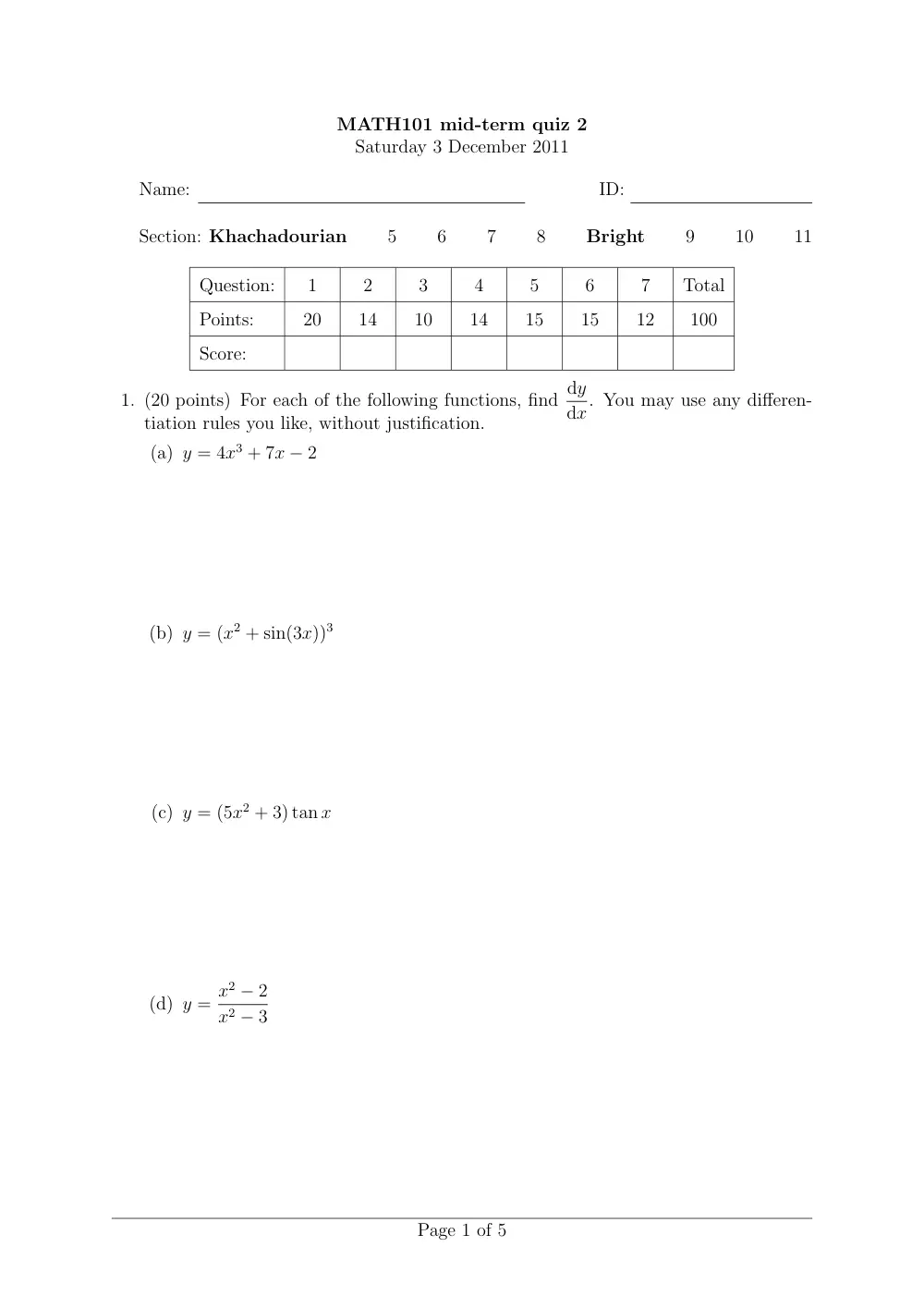
1. (20 points) For each of the following functions, find dy
dx. You may use any differen-
tiation rules you like, without justification.
(a) y = 4x3 + 7x − 2
(b) y = (x2 + sin(3x))3
(c) y = (5x2 + 3) tan x
(d) y = x2 − 2
x2 − 3
Page 1 of 5
MATH 101
Mid-term quiz 2
3 December, 2011
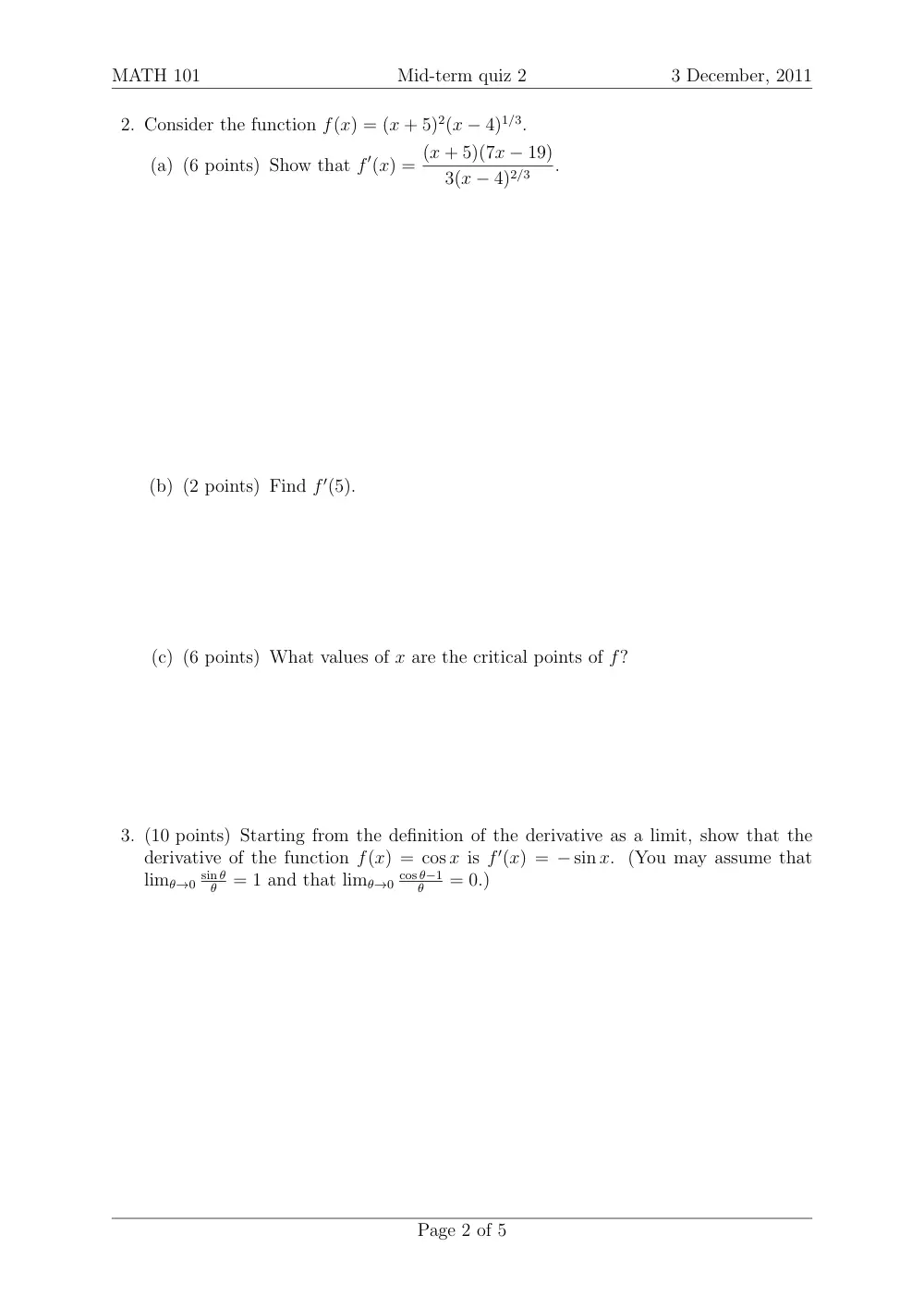
2. Consider the function f(x) = (x + 5)2(x − 4)1/3.
(a) (6 points) Show that f ′(x) = (x + 5)(7x − 19)
3(x − 4)2/3
.
(b) (2 points) Find f ′(5).
(c) (6 points) What values of x are the critical points of f?
3. (10 points) Starting from the definition of the derivative as a limit, show that the
derivative of the function f(x) = cos x is f ′(x) = − sin x. (You may assume that
limθ→0
sin θ
θ
= 1 and that limθ→0
cos θ−1
θ
= 0.)
Page 2 of 5
MATH 101
Mid-term quiz 2
3 December, 2011
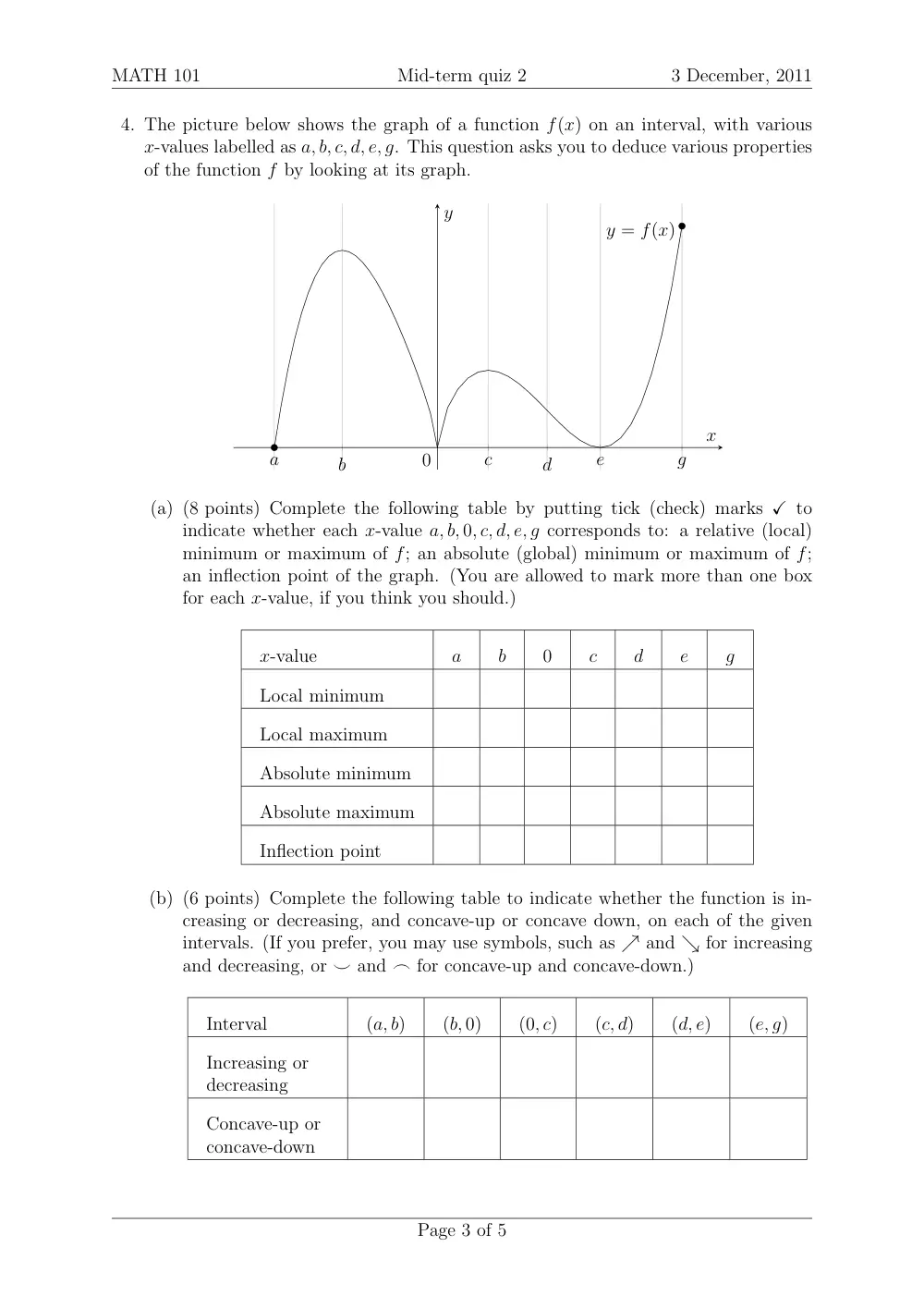
4. The picture below shows the graph of a function f(x) on an interval, with various
x-values labelled as a, b, c, d, e, g. This question asks you to deduce various properties
of the function f by looking at its graph.
a
b
c
d
e
g
y = f(x)
0
x
y
(a) (8 points) Complete the following table by putting tick (check) marks ✓ to
indicate whether each x-value a, b, 0, c, d, e, g corresponds to: a relative (local)
minimum or maximum of f; an absolute (global) minimum or maximum of f;
an inflection point of the graph. (You are allowed to mark more than one box
for each x-value, if you think you should.)
x-value
a
b
0
c
d
e
g
Local minimum
Local maximum
Absolute minimum
Absolute maximum
Inflection point
(b) (6 points) Complete the following table to indicate whether the function is in-
creasing or decreasing, and concave-up or concave down, on each of the given
intervals. (If you prefer, you may use symbols, such as ↗ and ↘ for increasing
and decreasing, or ⌣ and ⌢ for concave-up and concave-down.)
Interval
(a, b)
(b, 0)
(0, c)
(c, d)
(d, e)
(e, g)
Increasing or
decreasing
Concave-up or
concave-down
Page 3 of 5
MATH 101
Mid-term quiz 2
3 December, 2011
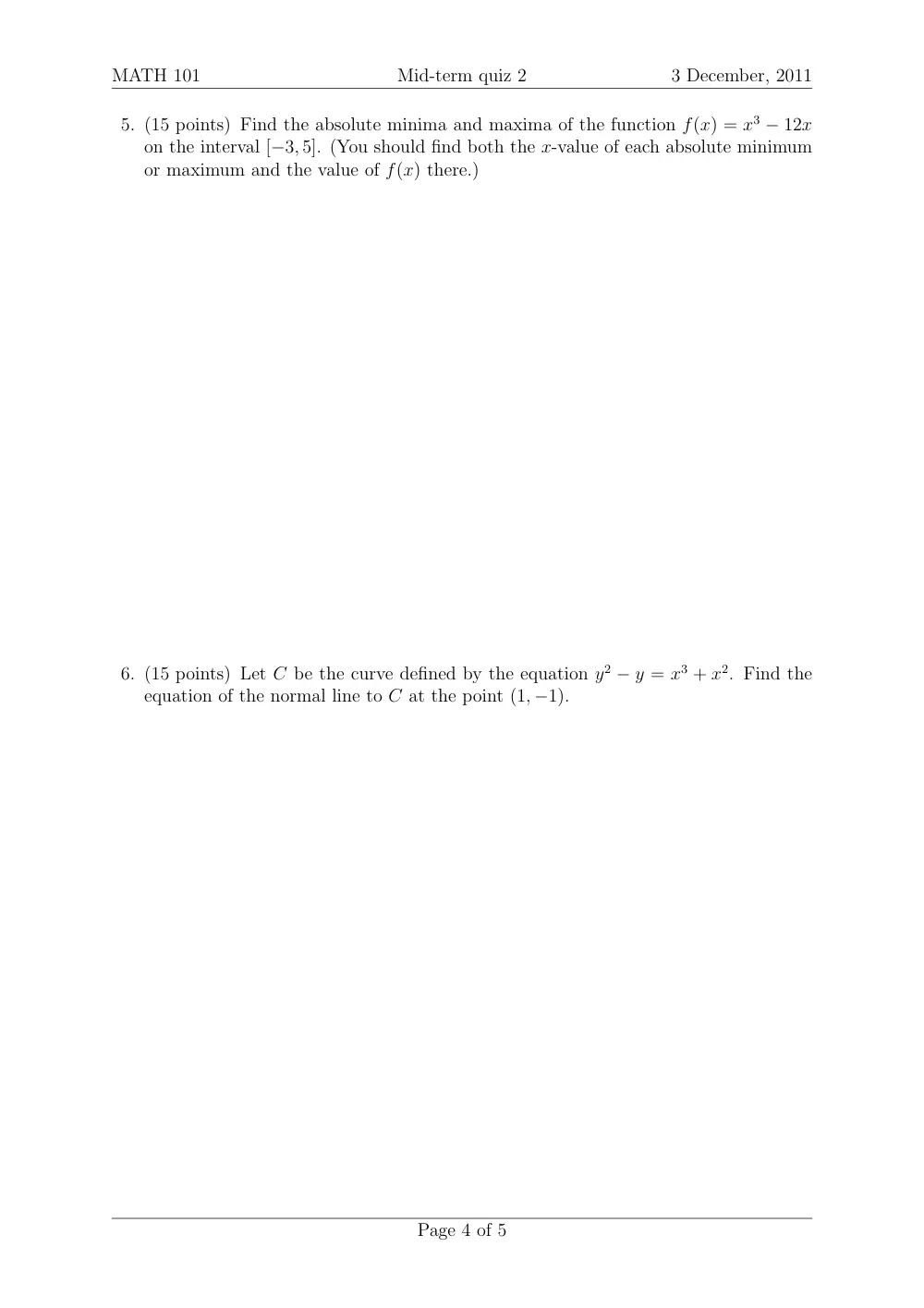
5. (15 points) Find the absolute minima and maxima of the function f(x) = x3 − 12x
on the interval [−3, 5]. (You should find both the x-value of each absolute minimum
or maximum and the value of f(x) there.)
6. (15 points) Let C be the curve defined by the equation y2 − y = x3 + x2. Find the
equation of the normal line to C at the point (1, −1).
Page 4 of 5
MATH 101
Mid-term quiz 2
3 December, 2011
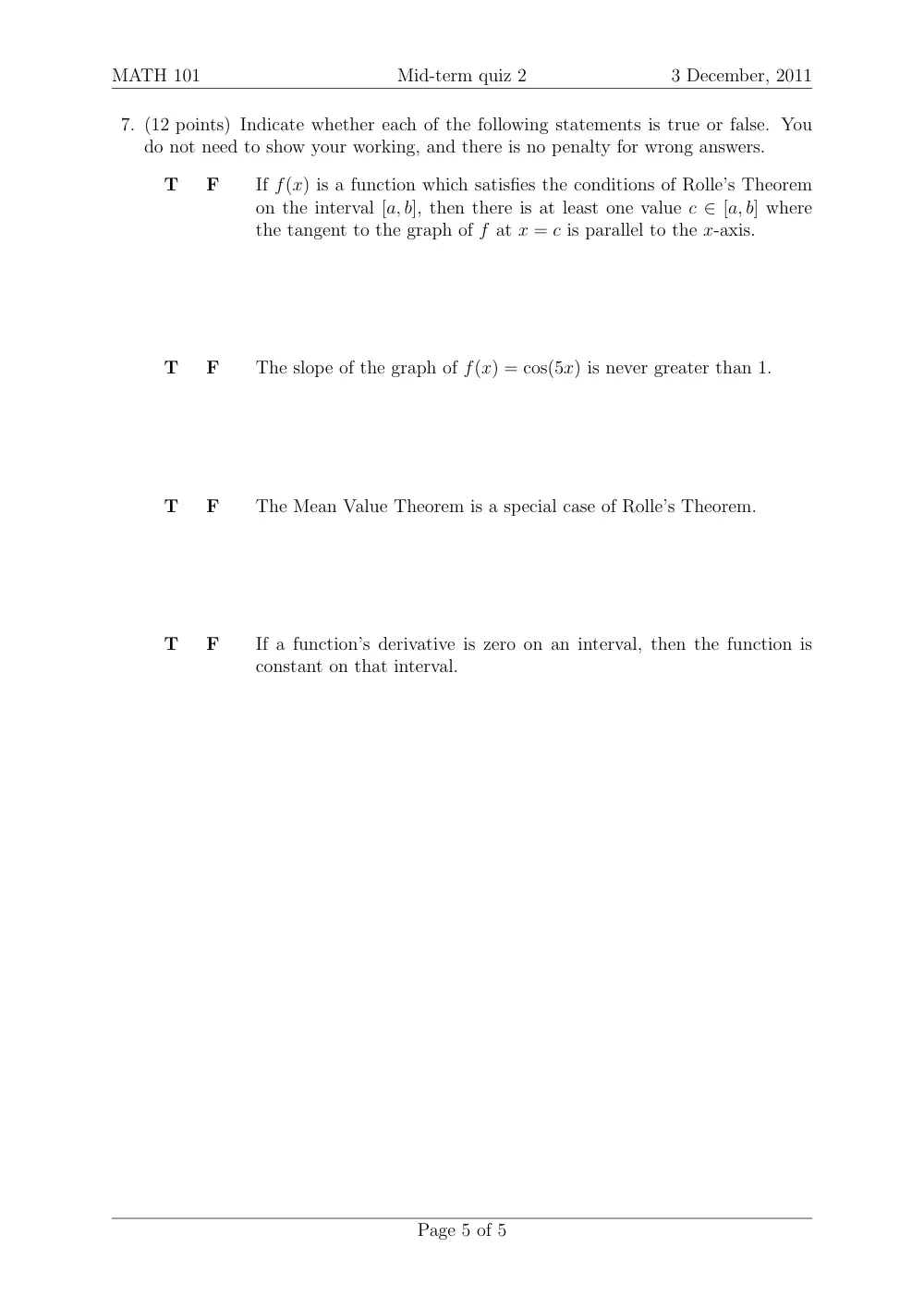
7. (12 points) Indicate whether each of the following statements is true or false. You
do not need to show your working, and there is no penalty for wrong answers.
T
F
If f(x) is a function which satisfies the conditions of Rolle’s Theorem
on the interval [a, b], then there is at least one value c ∈ [a, b] where
the tangent to the graph of f at x = c is parallel to the x-axis.
T
F
The slope of the graph of f(x) = cos(5x) is never greater than 1.
T
F
The Mean Value Theorem is a special case of Rolle’s Theorem.
T
F
If a function’s derivative is zero on an interval, then the function is
constant on that interval.
Page 5 of 5