
MATH 101 Midterm Quiz 1 with Solution, Fall 2013
American University of Beirut · Calculus and Analytical Geometry I · 6 pages · Dr. Martin James Bright · with solution
More MATH 101 files
Show the text of this exam
AMERICAN UNIVERSITY OF BEIRUT
MATH 101 — Calculus & Analytic Geometry I
Fall Semester 2013–14
Mid-term Exam 1
Saturday 5 October, 2013
Time: 1 hour
Name:
ID:
Circle your recitation section:
1
2
3
4
5
Fri 9am
Fri 10am
Fri 4pm
Fri 11am
Thurs 2pm
6
7
8
9
10
Thurs 11am
Thurs 12:30pm
Mon 8am
Mon 9am
Mon 2pm
The backs of the pages may be used as scratch paper.
Please do not open this paper until you are instructed to do so.
Question:
1
2
3
4
5
6
Total
Points:
6
15
10
6
9
14
60
Score:
MATH 101
Mid-term exam 1
5 October, 2013
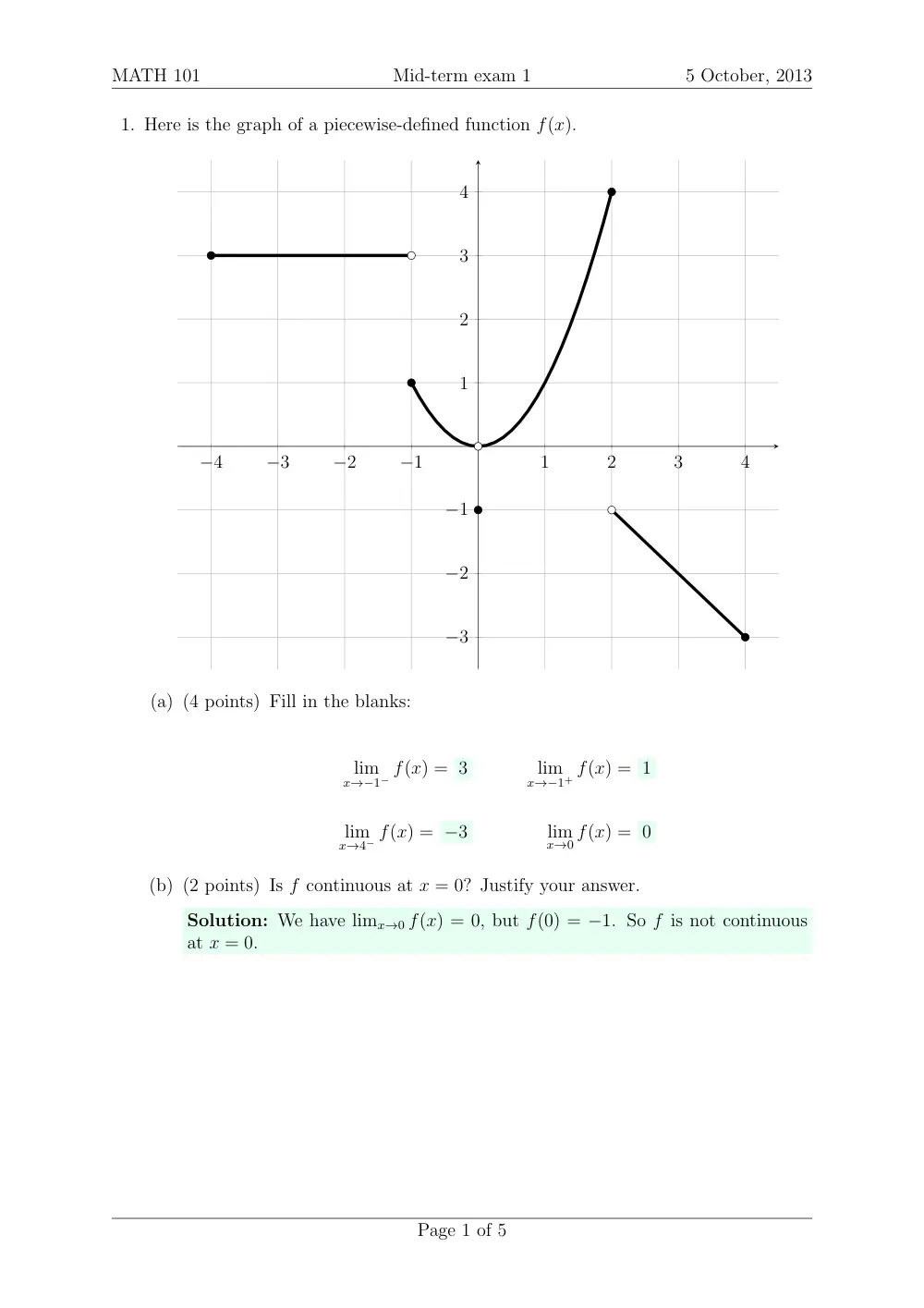
1. Here is the graph of a piecewise-defined function f(x).
−4
−3
−2
−1
1
2
3
4
−3
−2
−1
1
2
3
4
(a) (4 points) Fill in the blanks:
lim
x→−1− f(x) = 3
lim
x→−1+ f(x) = 1
lim
x→4− f(x) = −3
lim
x→0 f(x) = 0
(b) (2 points) Is f continuous at x = 0? Justify your answer.
Solution: We have limx→0 f(x) = 0, but f(0) = −1. So f is not continuous
at x = 0.
Page 1 of 5
MATH 101
Mid-term exam 1
5 October, 2013
2. (15 points) Calculate the following limits. Show your working.
(a) lim
x→0
cos x + 1
5x − 2
Solution:
lim
x→0
cos x + 1
5x − 2
= limx→0 cos x + limx→0 1
limx→0 5x − limx→0 2
= 1 + 1
0 − 2 = −1.
(b) lim
x→2
�
x2 − 3x + 2
x2 − 4
Solution:
lim
x→2
�
x2 − 3x + 2
x2 − 4
= lim
x→2
�
(x − 2)(x − 1)
(x − 2)(x + 2) = lim
x→2
�
x − 1
x + 2 = 1
2.
(c) lim
x→∞
2x + 1
x2 − 9
Solution:
lim
x→∞
2x + 1
x2 − 9 = lim
x→∞
2/x2 + 1/x
1 − 9/x2
= 0
1 = 0.
(d) lim
x→7
√x + 2 − 3
x − 7
Solution:
lim
x→7
√x + 2 − 3
x − 7
= lim
x→7
(√x + 2 − 3)(√x + 2 + 3)
(x − 7)(√x + 2 + 3)
= lim
x→7
x − 7
(x − 7)(√x + 2 + 3) = lim
x→7
1
√x + 2 + 3 = 1
6.
(e) lim
x→0
sin(3x)
x4 + x
Solution:
lim
x→0
sin(3x)
x4 + x = lim
x→0
sin(3x)
3x
3x
x4 + x = lim
x→0
sin(3x)
3x
lim
x→0
3
x3 + 1 = 1 × 3 = 3.
Page 2 of 5
MATH 101
Mid-term exam 1
5 October, 2013
3.
(a) (8 points) Complete the following table by putting a tick (check mark) ✓ or
a cross × in each empty box to indicate whether each function is: even; odd;
increasing; decreasing.
Function
even
odd
increasing
decreasing
4 sin x
×
✓
×
×
7
✓
×
×
×
x + ⌊x⌋
×
×
✓
×
|2x + 1|
×
×
×
×
(b) (2 points) If f is an increasing function and g is a decreasing function, does the
composition f ◦ g have to be increasing or decreasing? Justify your answer.
Solution: For any numbers x1 and x2 with x1 > x2, we have g(x1) < g(x2)
because g is decreasing, and then f(g(x1)) < f(g(x2)) because f is increasing.
So f ◦ g is decreasing.
4. (6 points) Use the Intermediate Value Theorem to show that the equation
cos x = x
has a solution between 0.7 and 0.8.
Solution: The equation can be re-arranged to f(x) = cos x − x = 0. Now
f(0.7) = cos(0.7) − 0.7 = 0.065 . . .
and
f(0.8) = cos(0.8) − 0.8 = −0.103 . . . .
Since f is a continuous function, and 0 lies between −0.103 and 0.065, the Inter-
mediate Value Theorem implies that there is some c ∈ [0.7, 0.8] satisfying f(c) = 0,
that is, cos c = c.
Page 3 of 5
MATH 101
Mid-term exam 1
5 October, 2013
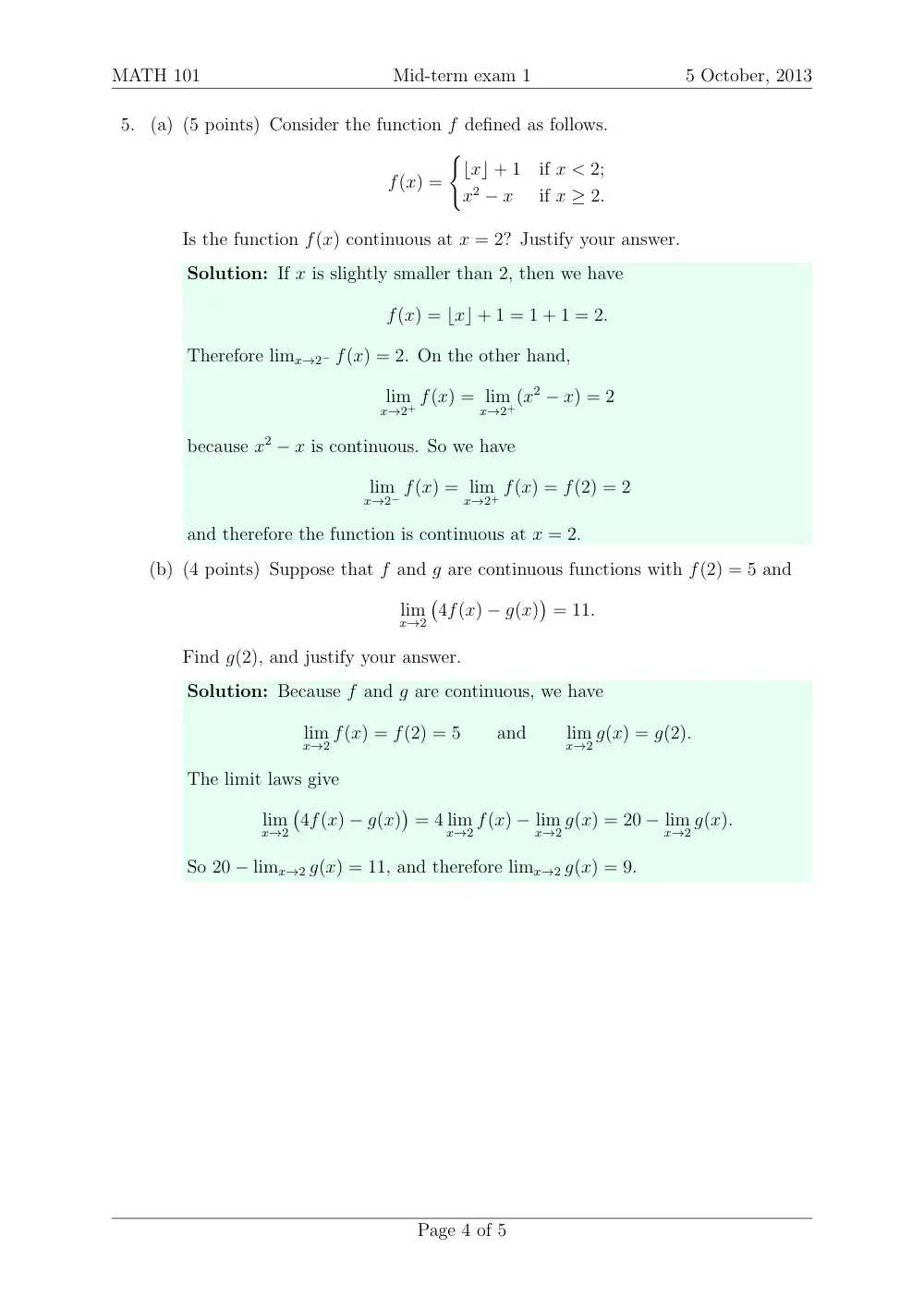
5.
(a) (5 points) Consider the function f defined as follows.
f(x) =
�
⌊x⌋ + 1
if x < 2;
x2 − x
if x ≥ 2.
Is the function f(x) continuous at x = 2? Justify your answer.
Solution: If x is slightly smaller than 2, then we have
f(x) = ⌊x⌋ + 1 = 1 + 1 = 2.
Therefore limx→2− f(x) = 2. On the other hand,
lim
x→2+ f(x) = lim
x→2+(x2 − x) = 2
because x2 − x is continuous. So we have
lim
x→2− f(x) = lim
x→2+ f(x) = f(2) = 2
and therefore the function is continuous at x = 2.
(b) (4 points) Suppose that f and g are continuous functions with f(2) = 5 and
lim
x→2
�
4f(x) − g(x)
�
= 11.
Find g(2), and justify your answer.
Solution: Because f and g are continuous, we have
lim
x→2 f(x) = f(2) = 5
and
lim
x→2 g(x) = g(2).
The limit laws give
lim
x→2
�
4f(x) − g(x)
�
= 4 lim
x→2 f(x) − lim
x→2 g(x) = 20 − lim
x→2 g(x).
So 20 − limx→2 g(x) = 11, and therefore limx→2 g(x) = 9.
Page 4 of 5
MATH 101
Mid-term exam 1
5 October, 2013
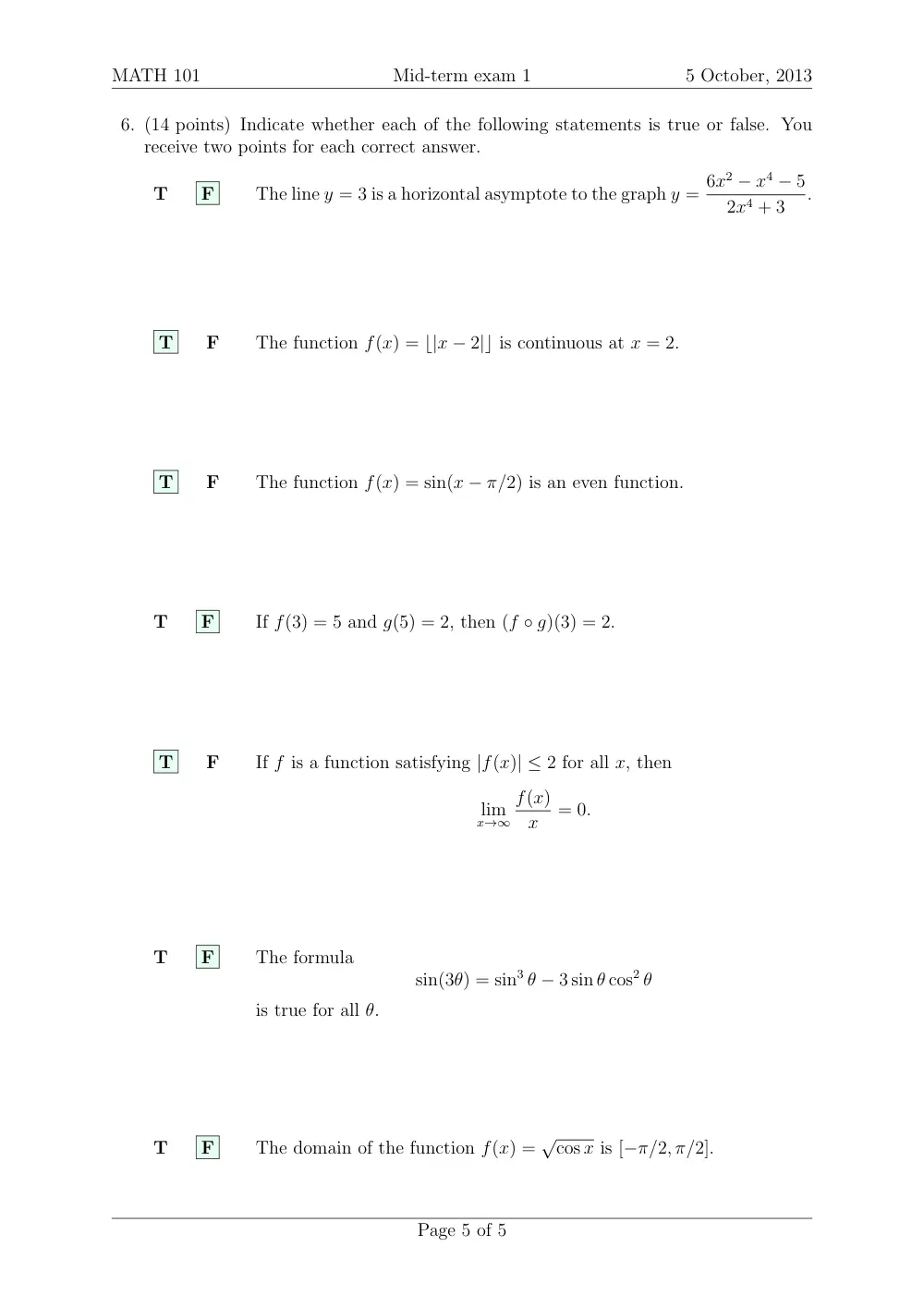
6. (14 points) Indicate whether each of the following statements is true or false. You
receive two points for each correct answer.
T
F
The line y = 3 is a horizontal asymptote to the graph y = 6x2 − x4 − 5
2x4 + 3
.
T
F
The function f(x) = ⌊|x − 2|⌋ is continuous at x = 2.
T
F
The function f(x) = sin(x − π/2) is an even function.
T
F
If f(3) = 5 and g(5) = 2, then (f ◦ g)(3) = 2.
T
F
If f is a function satisfying |f(x)| ≤ 2 for all x, then
lim
x→∞
f(x)
x
= 0.
T
F
The formula
sin(3θ) = sin3 θ − 3 sin θ cos2 θ
is true for all θ.
T
F
The domain of the function f(x) = √cos x is [−π/2, π/2].
Page 5 of 5