
MATH 201 Final, Fall 1997
American University of Beirut · Calculus and Analytical Geometry III · 9 pages · Prof. Hazar Abu Khuzam

More MATH 201 files
- Final · Spring 2019Final examView
- Problems Difficult Problem 5 Tlas 2017 Final · Spring 2019Final examView
- Final · Spring 2019Final examView
- Final · Fall 2018Final examView
- Final · Fall 2018Final examView
- Final Finals with Solution Collection · Spring 2017Final exam · with solutionView
- Final Finals with Solution Collection · Spring 2017Final exam · with solutionView
- Final · Spring 2017Final examView
Show the text of this final exam
ema
. AHIGAN UNIVER:
LIBRARY
OF REIROT
- EWAN BENTO.
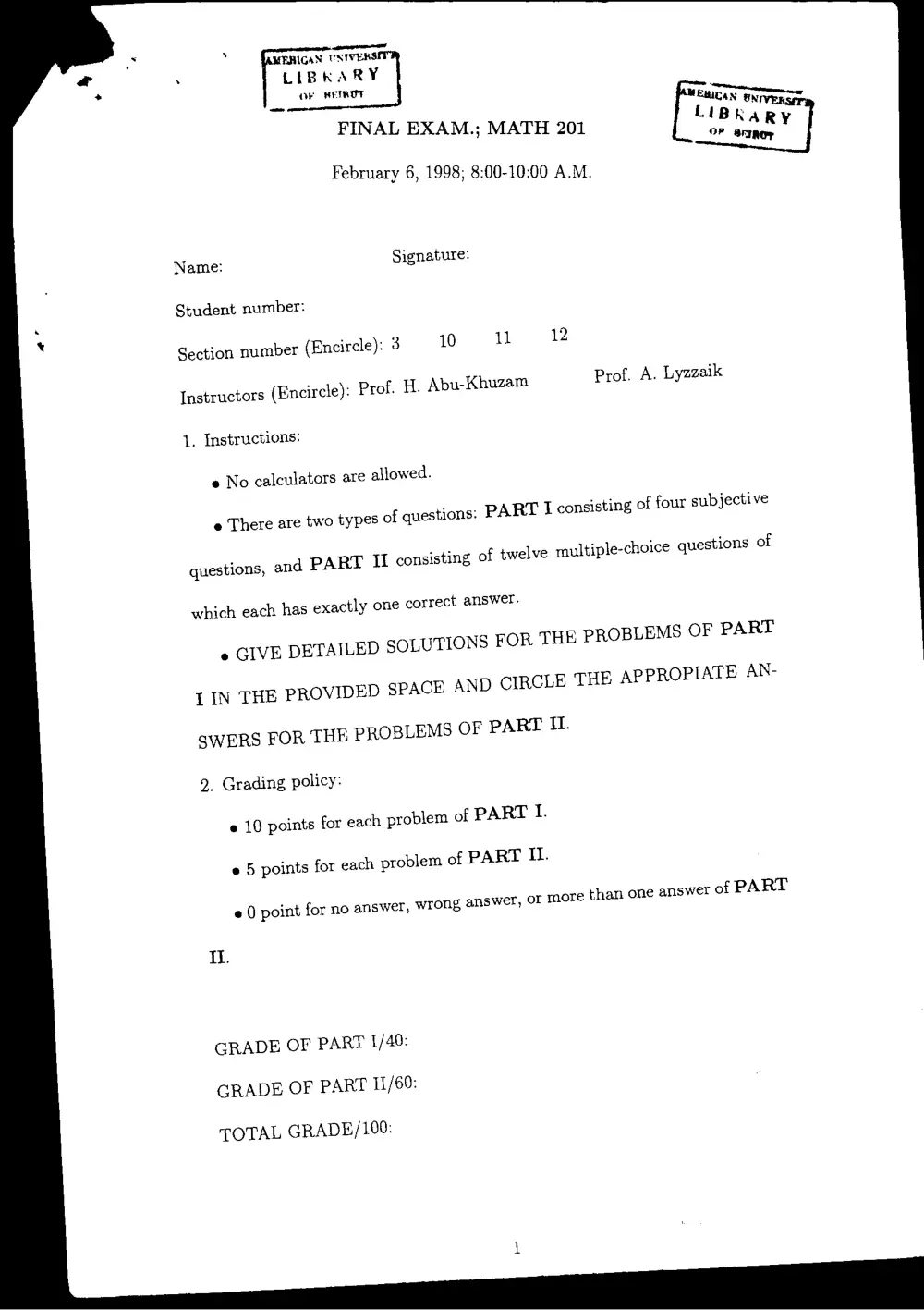
FINAL EXAM.; MATH 201 esaey
P sruRUT
February 6, 1998; 8:00-10:00 A.M.
Name: Signature:
Student number:
x
Section number (Encircle): 3 10 11 12
Instructors (Encircle): Prof, H. Abu-Khuzam Prof. A. Lyzzaik
1. Instructions:
e No calculators are allowed.
e There are two types of questions: PART I consisting of four subjective
twelve multiple-choice questions of
questions, and PART II consisting of
which each has exactly one correct answer.
BTAILED SOLUTIONS FOR THE P
D CIRCLE THE APPROPIATE AN-
e GIVE D ROBLEMS OF PART
LIN THE PROVIDED SPACE AN
SWERS FOR THE PROBLEMS OF PART II.
2. Grading policy:
e 10 points for each problem of PART IL.
e 5 points for each problem of PART IL.
e 0 point for no answer, wrong answer, or more than one answer of PART
I.
GRADE OF PART 1/40:
GRADE OF PART I1/60:
TOTAL GRADE/100:
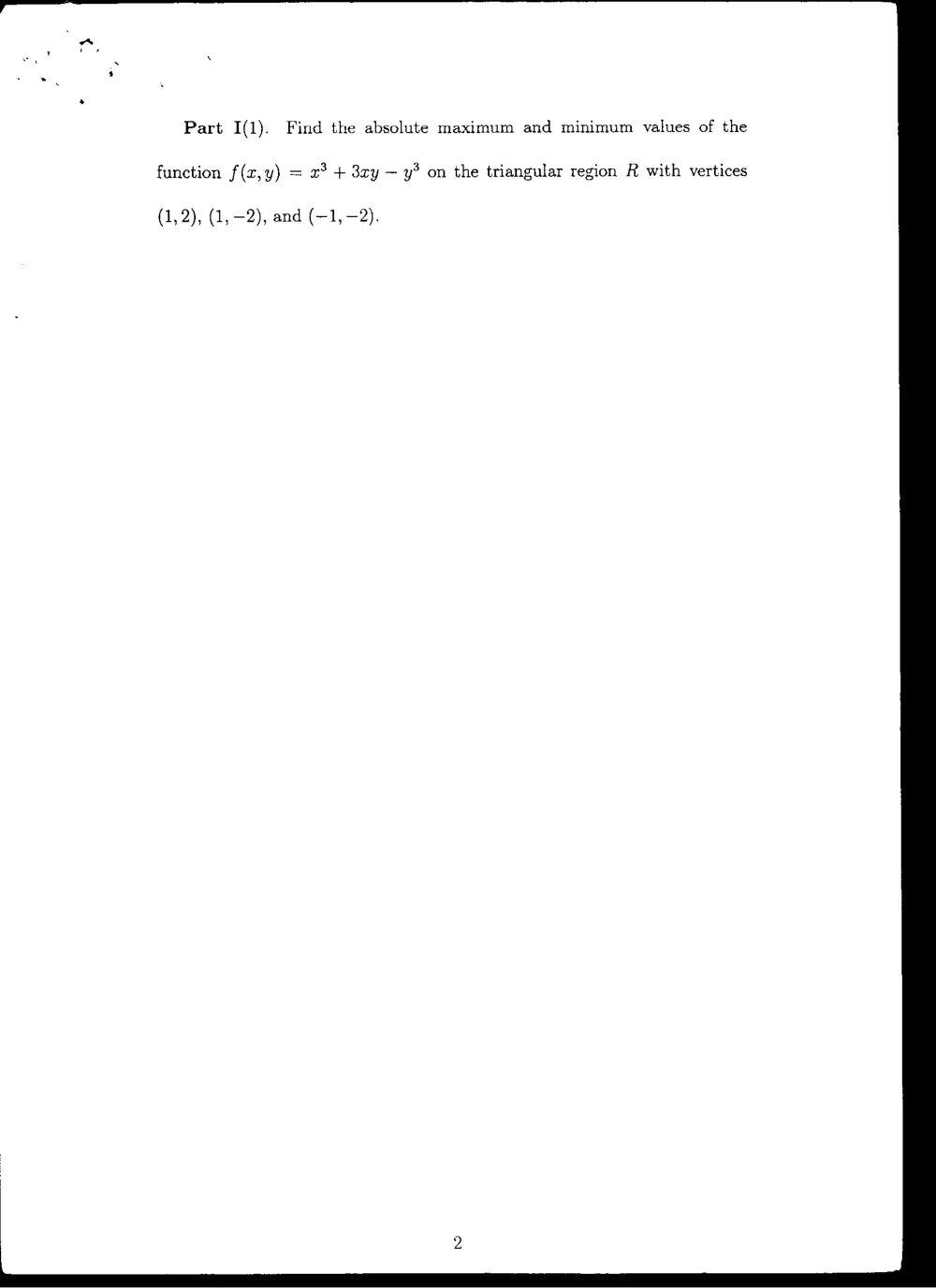
Part I(1). Find the absolute maximum and minimum values of the
function f(z,y) = 2° + 3zy — y® on the triangular region R with vertices
(1,2), (1, -2), and (—1,—2).
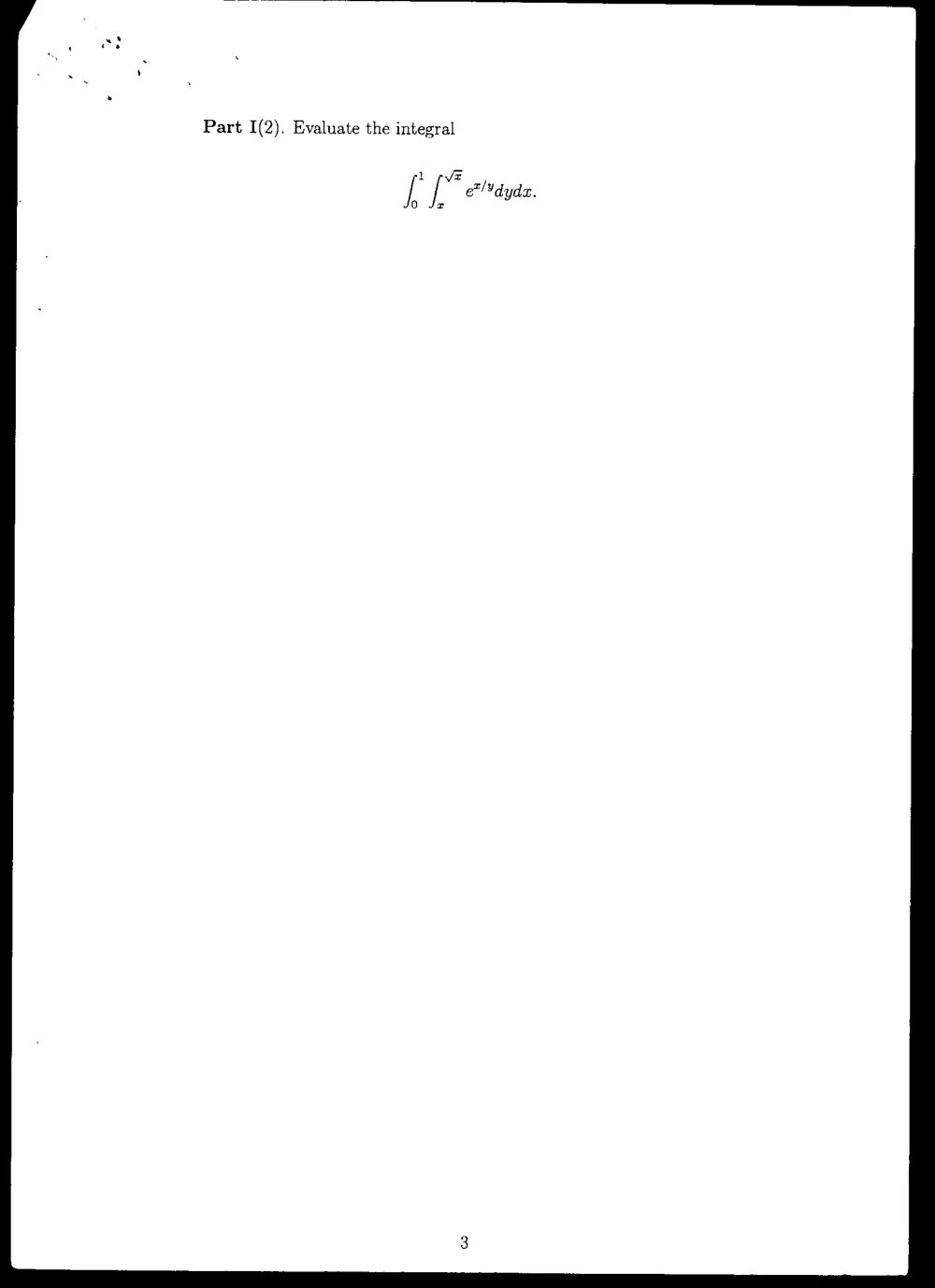
Part I(2). Evaluate the integral
L pve
| [ e/ Ydydz.
0 Ja
Part 1(3). Set up a triple integral (without evaluating it)in cylindrical
coordinates for the volume of the solid bounded by the zy—plane, the cylinder
r=1+sin@, and the planer+y+2z=2.
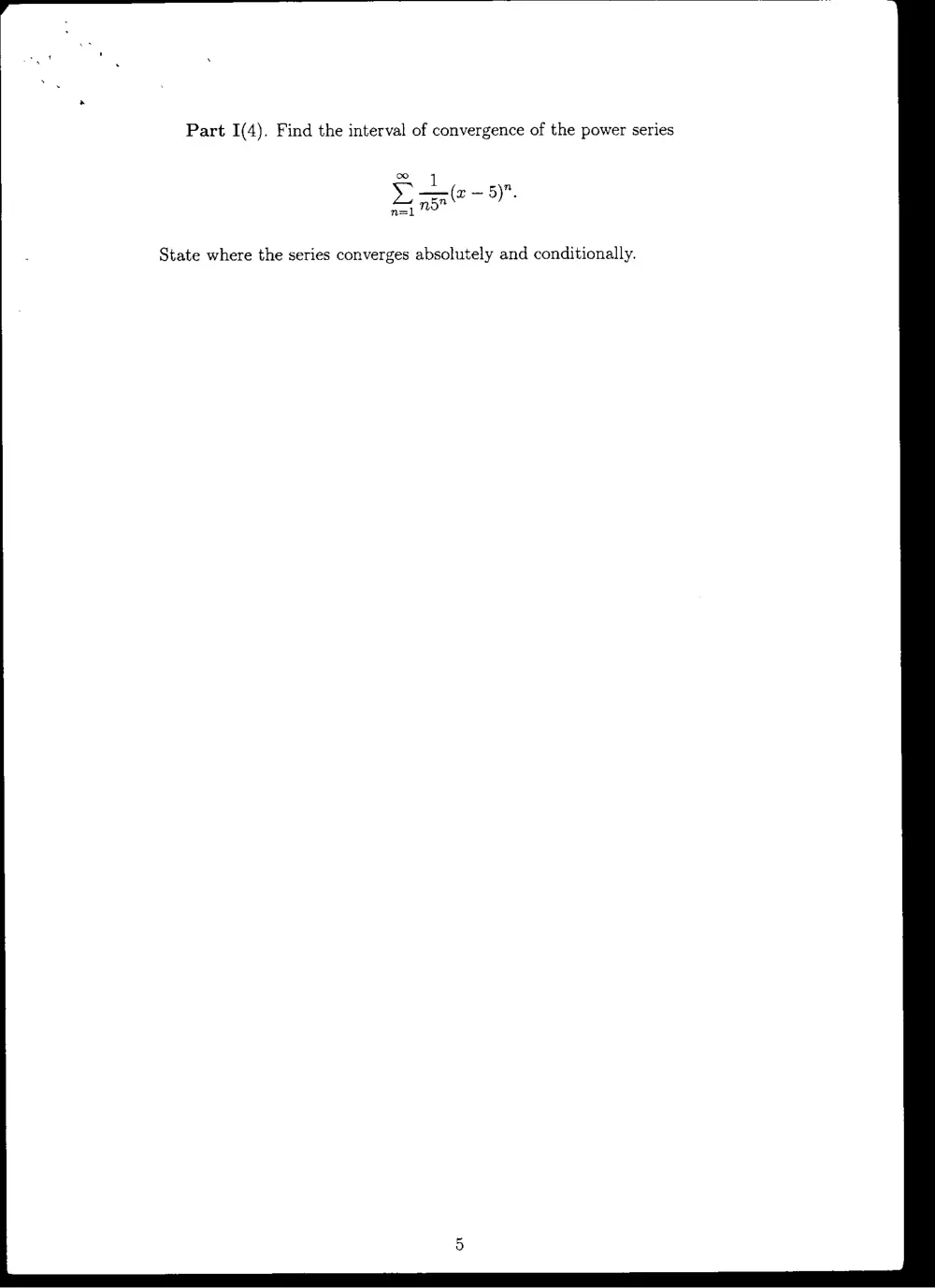
Part I(4). Find the interval of convergence of the power series
State where the series converges absolutely and conditionally.
Part IT
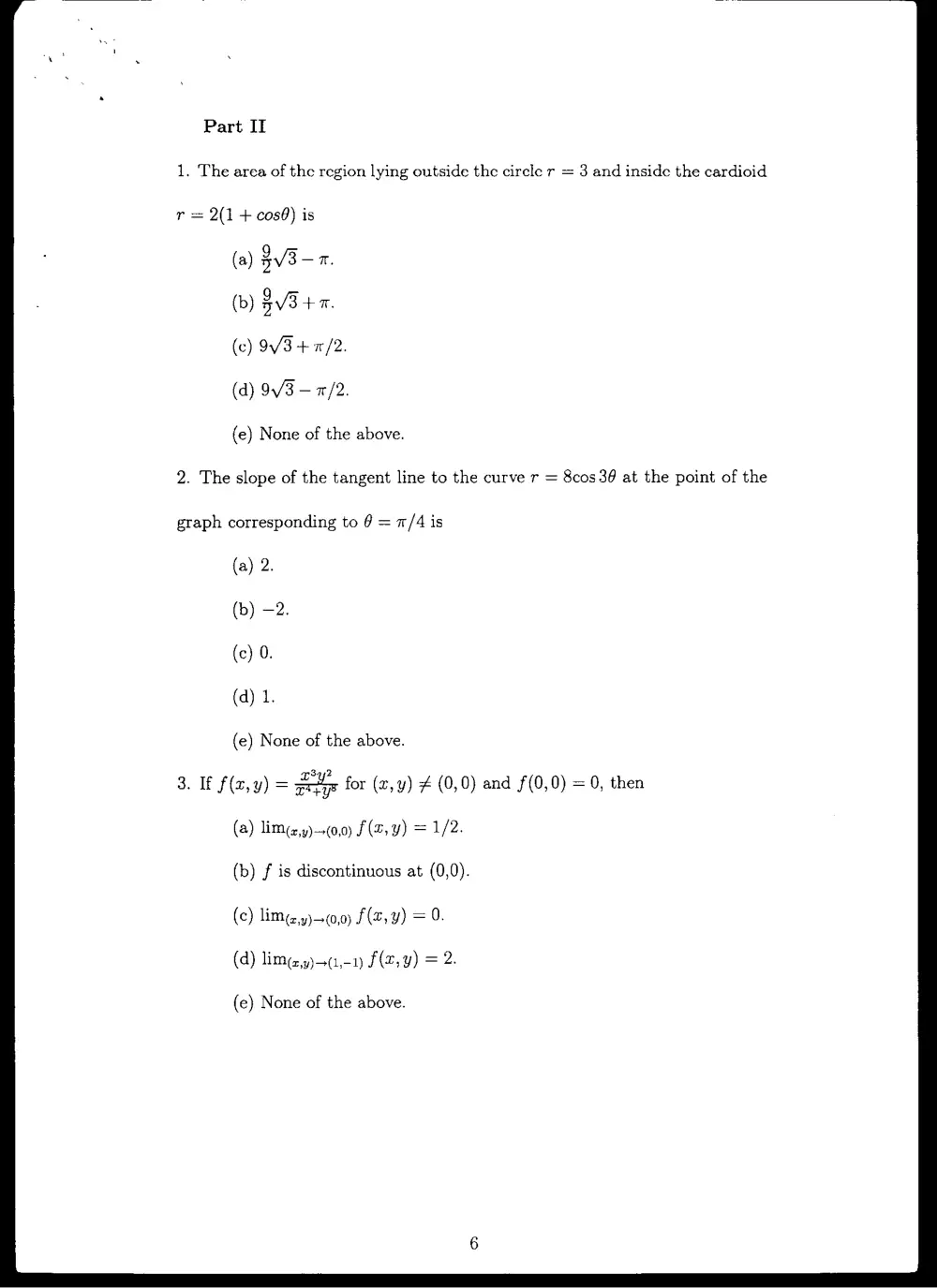
1. The area of the region lying outside the circle r = 3 and inside the cardioid
r = 2(1 + cos@) is
(a) $v3 —T.
(b) $V3 +0.
(c) 9V3 + 1/2.
(d) 9V3 — 1/2.
(e) None of the above.
2. The slope of the tangent line to the curve r = 8cos 36 at the point of the
graph corresponding to @ = 7/4 is
(a) 2.
(d) 1.
(e) None of the above.
3. If f(x,y) = is for (x,y) # (0,0) and f(0,0) = 0, then
(a) limeey)+(0,0) f(t, y) = 1/2.
(b) f is discontinuous at (0,0).
(c) lime) 0,0) f(2,y) = 0.
(4) limeey)c,-1) f(z, y) = 2.
(e) None of the above.
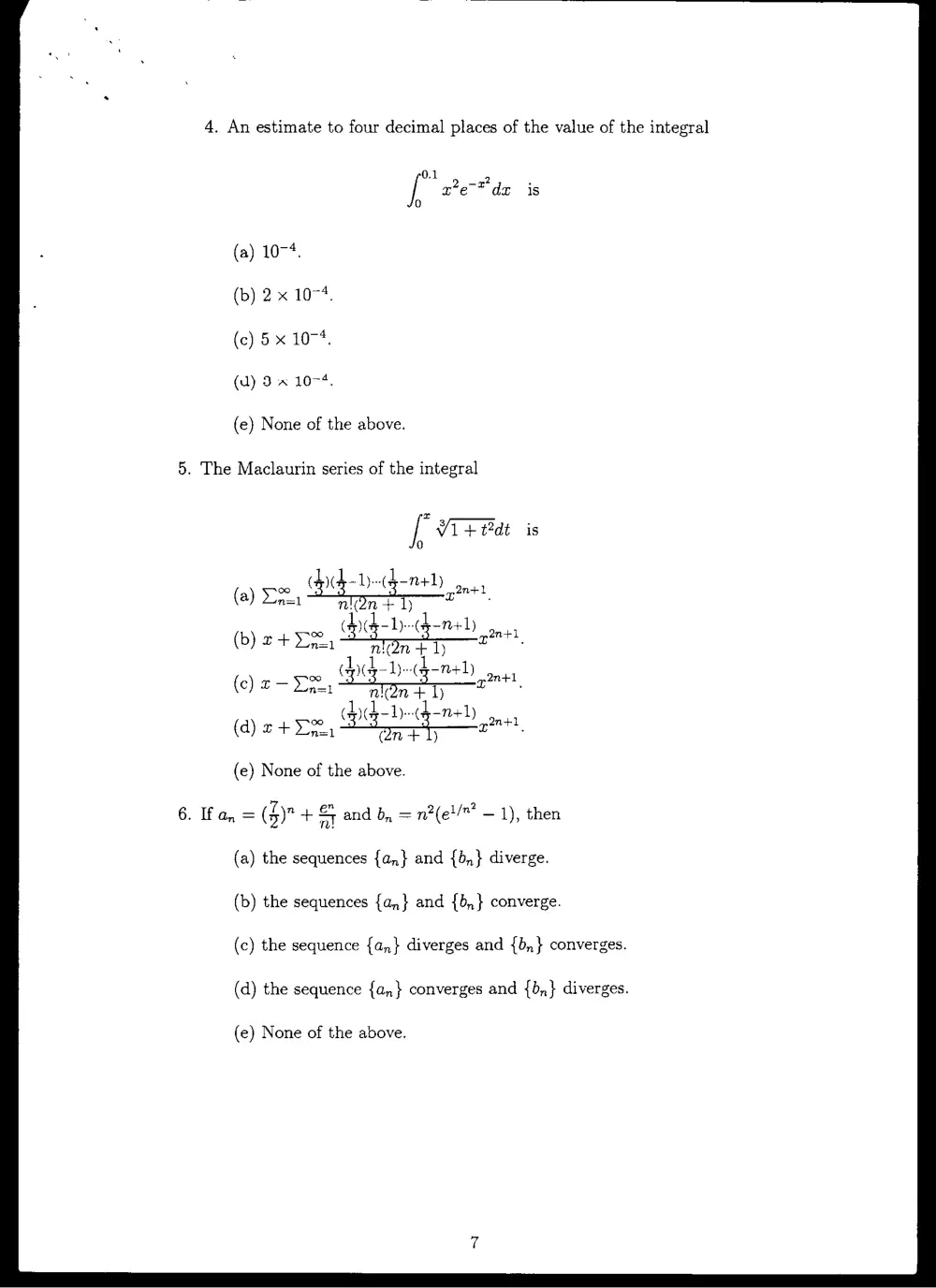
4. An estimate to four decimal places of the value of the integral
Ol. aa
I ae * dz is
0
(a) 10-4.
(b) 2 x 10⁻⁴.
(c) 5x 1074,
(a) 9-« 10-4.
(e) None of the above.
5. The Maclaurin series of the integral
[ Yi+tadt is
0
hy dh-b--(4-nt])
nin + 1)
wo GD Ge)
(b) m+ rel ni + 1)
wo hb dnb
(c)@-Dy ; mk nT) z
wo (Pg-Deg-nm+D a
(d)2 +d, ned gent,
genth
(a) Crea
perth
2n+1
(e) None of the above.
6. If a, = (S)" + al and b, = n2(e!/*" — 1), then
(a) the sequences {a,} and {b,} diverge.
(b) the sequences {a,} and {b,} converge.
(c) the sequence {a,} diverges and {b,} converges.
(d) the sequence {a,} converges and {b,} diverges.
(e) None of the above.
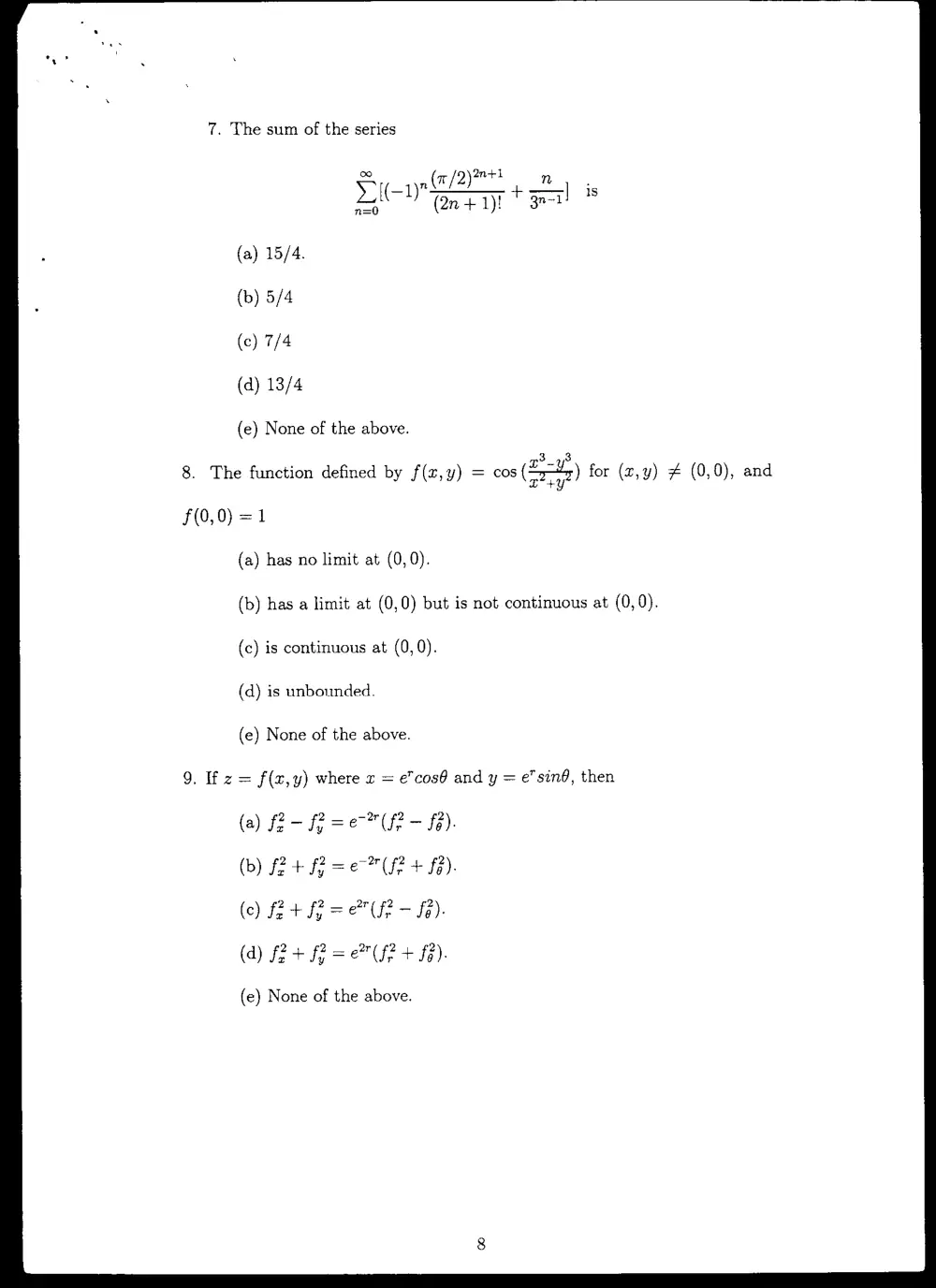
7. The sum of the series
GY) aa
LCD rei ta
] is
(a) 15/4.
(b) 5/4
(c) 7/4
(d) 13/4
(e) None of the above
3_,3
8. The function defined by f(x,y) = cos (2-45) for (x,y) # (0,0), and
x+y
f(0,0) =1
(a) has no limit at (0,0).
(b) has a limit at (0,0) but is not continuous at (0,0).
(c) is continuous at (0,0).
(d) is unbounded.
(e) None of the above.
9, If z = f(x,y) where x = e"cos@ and y = e"sin#, then
(a) f2- fp =e (FP — £2).
(b) fe + fp =e (fe + fe).
(c) fa + fp =e (Fr — fe):
(d) f2+ f= eR + f)-
(e) None of the above.
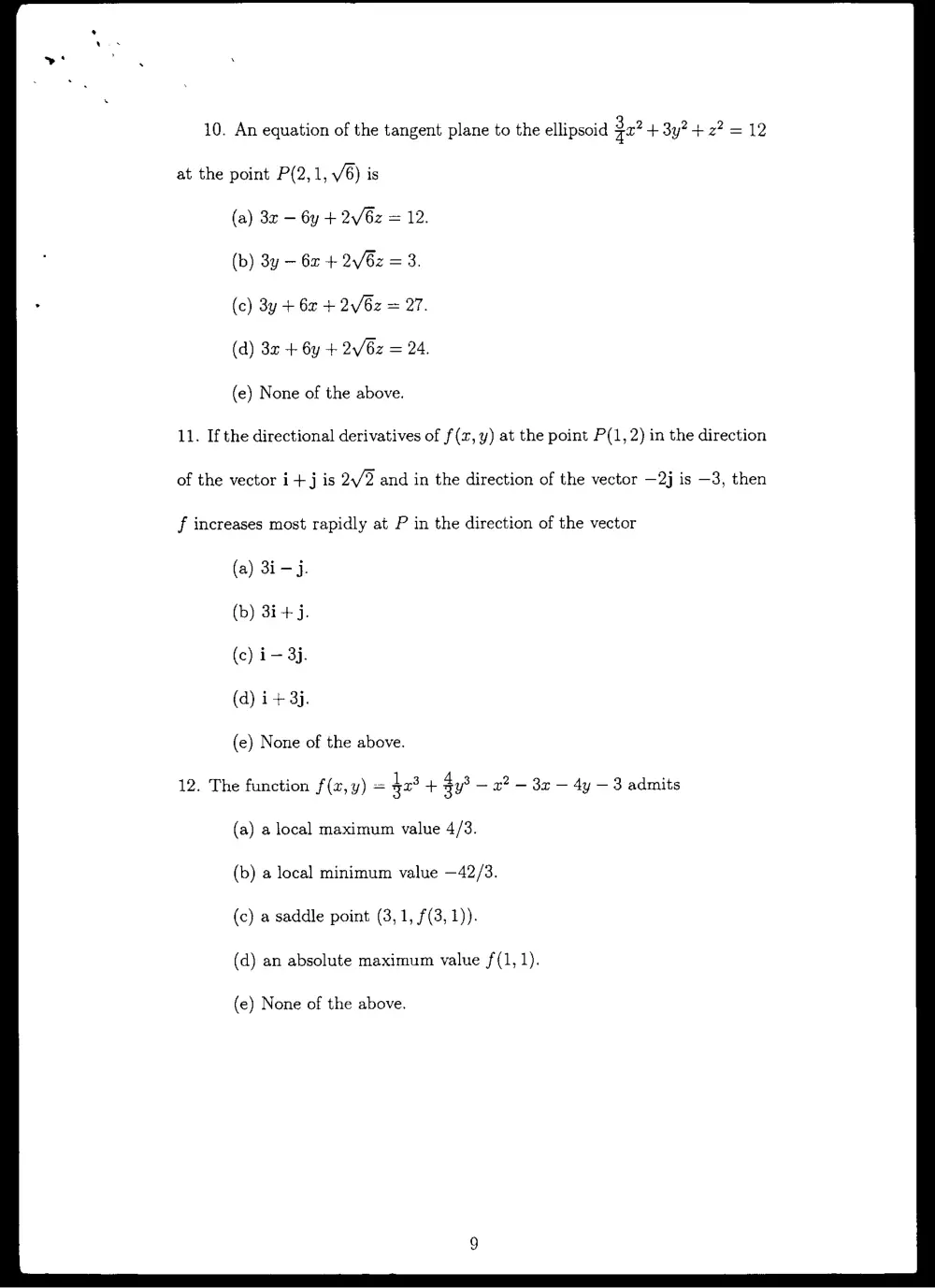
10. An equation of the tangent plane to the ellipsoid 32? + 3y? +z? = 12
at the point P(2,1, V6) is
(a) 32 — 6y + 2V6z = 12.
(b) 3y — 62 + 2V6z = 3.
(c) 3y + 6x + 26z = 27.
(d) 3a + 6y + 2V6z = 24.
(e) None of the above.
11. If the directional derivatives of f(x,y) at the point P(1, 2) in the direction
of the vector i+j is 2\/2 and in the direction of the vector —2j is —3, then
f increases most rapidly at P in the direction of the vector
(e) None of the above.
12. The function f(x,y) = 42° + $y’ — 2? — 32 — 4y — 3 admits
(a) a local maximum value 4/3.
(b) a local minimum value —42/3.
(c) a saddle point (3,1, f(3, 1)).
(d) an absolute maximum value f(1, 1).
(e) None of the above.