
MATH 201 Final, Fall 1999
American University of Beirut · Calculus and Analytical Geometry III · 5 pages · Prof. Hazar Abu Khuzam
More MATH 201 files
- Final · Spring 2019Final examView
- Problems Difficult Problem 5 Tlas 2017 Final · Spring 2019Final examView
- Final · Spring 2019Final examView
- Final · Fall 2018Final examView
- Final · Fall 2018Final examView
- Final Finals with Solution Collection · Spring 2017Final exam · with solutionView
- Final Finals with Solution Collection · Spring 2017Final exam · with solutionView
- Final · Spring 2017Final examView
Show the text of this final exam
January 27 , 2000 FINAL EXAMINATION VERSION I
MATHEMATICS 201
FALL 1999- 2000
Time : 2 Hours
Circle out your instructor’s name and your section number
Prof. H.Abu-Khuzam Section: 6 and 12
Prof. A. Lyzzaik Section: 5 and 7
NOTE: Make sure that you have 6 pages and twenty questions
/100
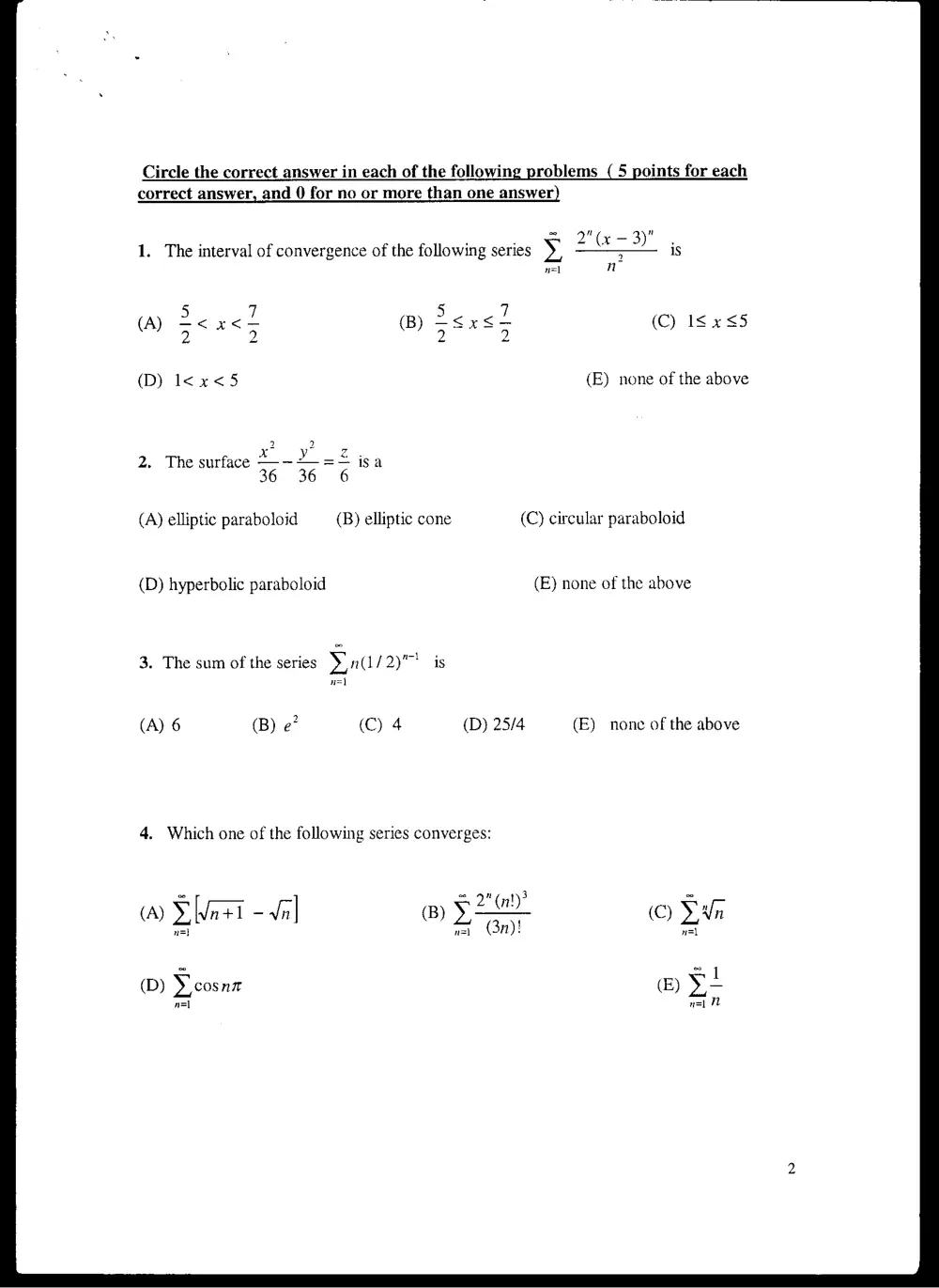
Circle the correct answer in each of the following problems (5 points for each
correct answer, and 0 for no or more than one answer)
My 3)"
1. The interval of convergence of the following series »y 23) is
n=l n
2
5 7 5 7
A) =< x<- B) —sxs<- C) ls x s5
(A) 5 *S 5 (B) 7 SESS (C) Is x
(D) l<x<5 (E) none of the above
2. The surface x _y Le is a
36 «6
(A) elliptic paraboloid (B) elliptic cone (C) circular paraboloid
(D) hyperbolic paraboloid (E) none of the above
3. The sum of the series }n(1/2)"" is
n=l
(A) 6 (B) e? (C) 4 (D) 25/4 (E) none of the above
4. Which one of the following series converges:
co eo n 3 co
(A) S lvaal - Vil (B) ¥2 (nt) © ¥Wn
n=} ml (3n)! n=)
(D) ¥ cosa (E) y+
n=l
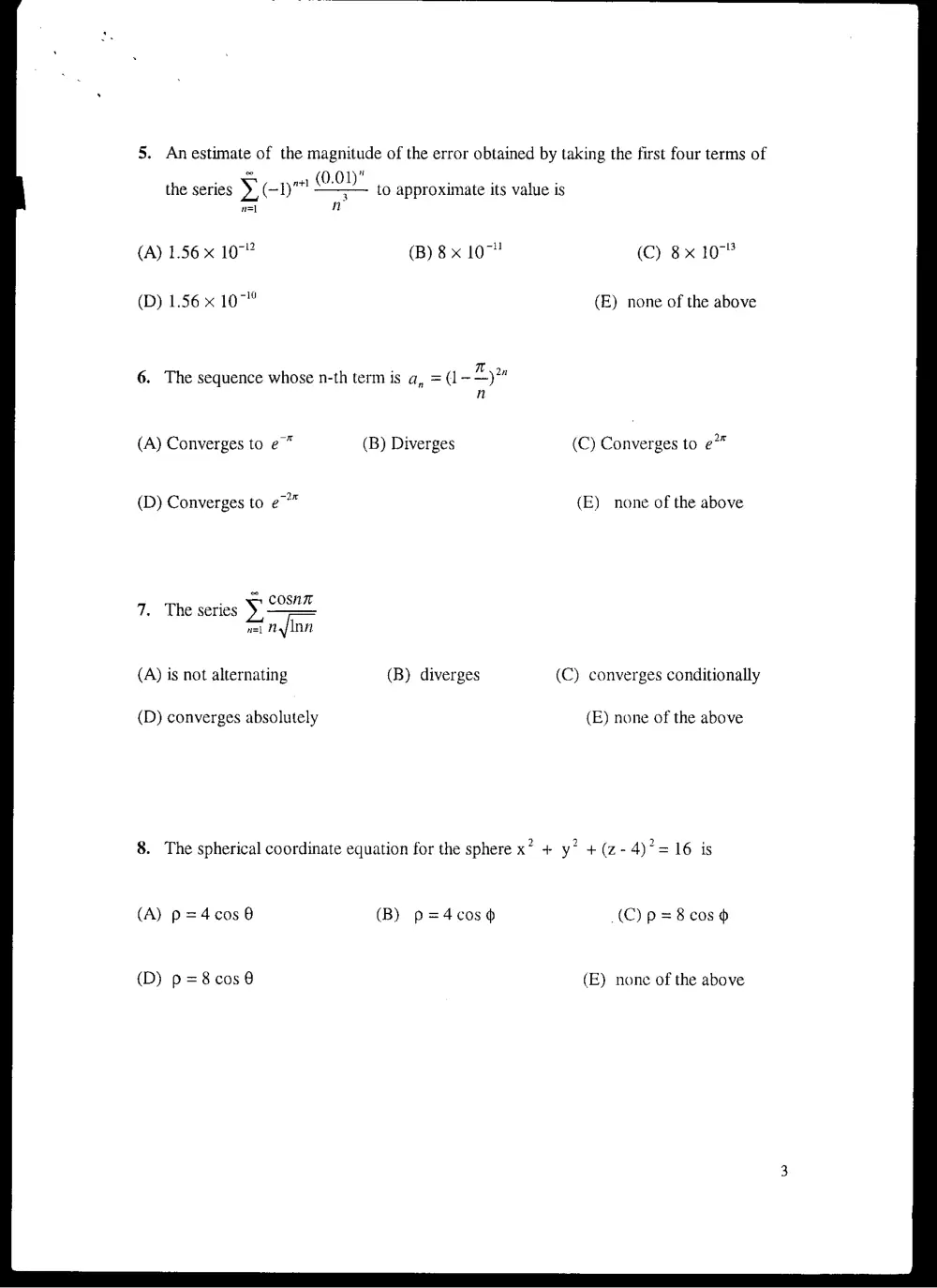
5. Anestimate of the magnitude of the error obtained by taking the first four terms of
(0.01)"
3
the series »y (-1)""
n=] nf
to approximate its value is
(A) 1.56 x 10°? (B) 8x 1077 (C) 8x 10⁸
(D) 1.56 x 10⁷° (E) none of the above
6. The sequence whose n-th term is a, = (1- 2) on
nA
(A) Converges to e” (B) Diverges (C) Converges to e*
(D) Converges to er (E) none of the above
.. ~ COSNT
7. The series
nmi Naf lon
(A) is not alternating (B) diverges (C) converges conditionally
(D) converges absolutely (E) none of the above
8. The spherical coordinate equation for the sphere x? + y? + (z-4)?=16 is
(A) p=4cos 6 (B) p=4coso (C)p=8cos >
(D) p=8cos@ (E) none of the above
1
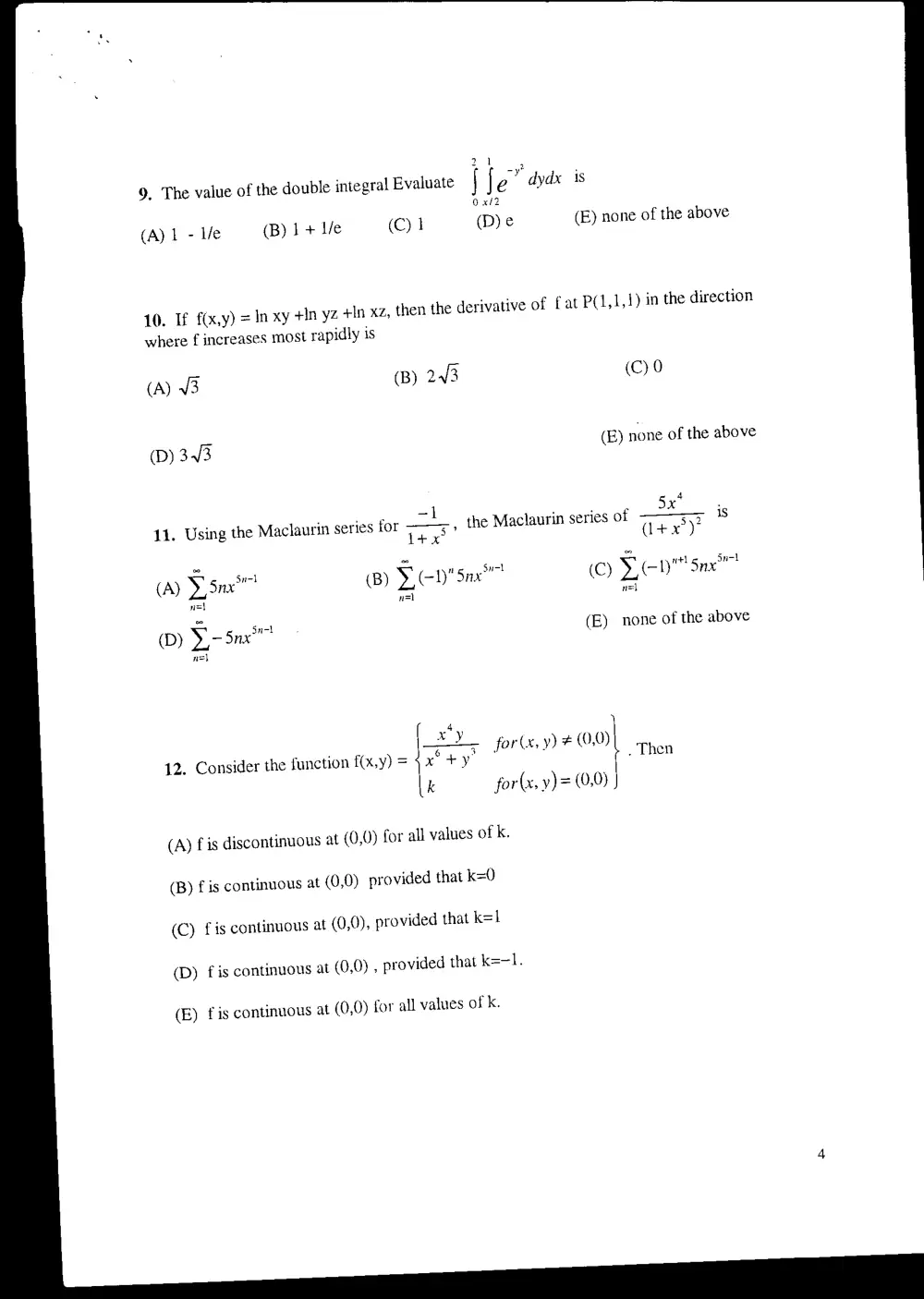
9, The value of the double integral Evaluate j } eo” dydx is
0 x/2
(A) 1 - Le (B) 1+ Le (C) 1 (Dye (E) none of the above
10. If f(x,y) = In xy +In yz +In xz, then the derivative of fat P(1,1,!) in the direction
where f increases Most rapidly is
(A) ¥3 (B) 2V3 (C)0
(E) none of the above
(D) 33
4
11. Using the Maclaurin series for u =» the Maclaurin series of 5x =< is
I+x (+x)°
(A) Sn" (By) YCD"Snx”™ Yep Snax
n=l n=l
n=l
(D) >y -5nx""
n=}
(E) none of the above
44,
XY for(x,y) # 0)
12. Consider the function f(xy) = 4x ty
k for(x. y) = (0,0)
. Then
(A) fis discontinuous at (0,0) for all values of k.
(B) f is continuous at (0,0) provided that k=0
(C) f is continuous at (0,0), provided that k=1
(D) f is continuous at (0,0) , provided that k=-l.
(E) fis continuous at (0,0) for all values ofk.
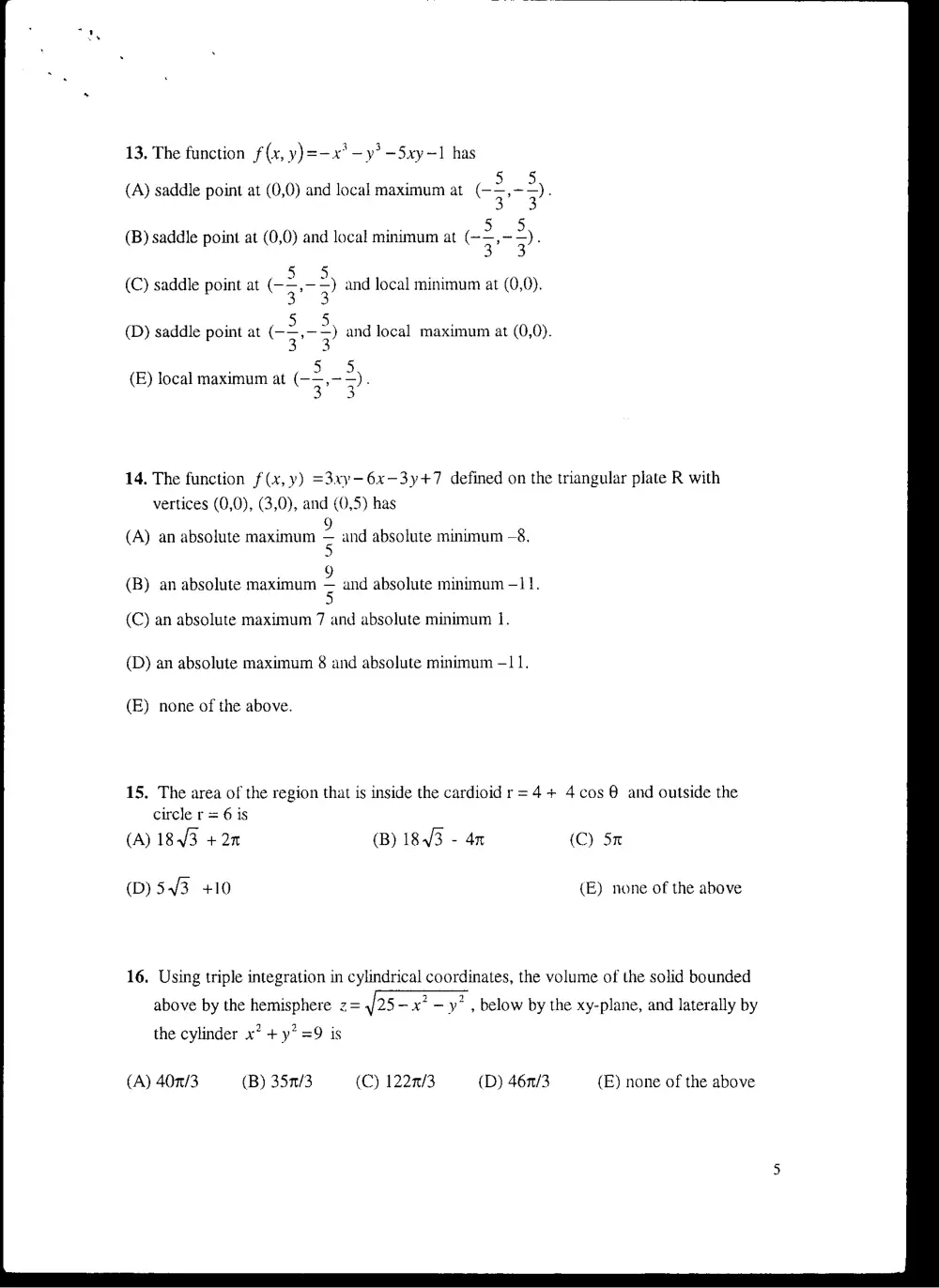
13. The function f(x, y)=-x'-y? —5xy~—1 has
(A) saddle point at (0,0) and local maximum at -3,-3 .
(B) saddle point at (0,0) and local minimum at 3 2) .
5 5 a
(C) saddle point at a 3 and local minimum at (0,0).
(D) saddle point at C3-D and local maximum at (0,0).
. oe)
(E) local maximum at Co =).
3
14. The function f(x,y) =3xy-6x—3y+7 defined on the triangular plate R with
vertices (0,0), (3,0), and (0,5) has
9 a
(A) an absolute maximum 3 and absolute minimum -8.
9
(B) an absolute maximum = and absolute minimum -11.
(C) an absolute maximum 7 and absolute minimum 1.
(D) an absolute maximum 8 and absolute minimum -11.
(E) none of the above.
15. The area of the region that is inside the cardioid r= 4+ 4 cos 6 and outside the
circle r = 6 is
(A) 1843 +22 (B) 183 - 4x (C) 5x
(D) 5 V3 +10 {E) none of the above
16. Using triple integration in cylindrical coordinates, the volume of the solid bounded
above by the hemisphere z= /25-—.x? — y” , below by the xy-plane, and laterally by
the cylinder x? + y? =9 is
(A) 402/3 (B) 35/3 (C) 122n/3 (D) 46n/3 (E) none of the above