
MATH 201 Final, Fall 2003
American University of Beirut · Calculus and Analytical Geometry III · 14 pages · Prof. Kamal Makdisi


Showing the first 10 of 14 pages. Download the PDF to see all of it.
More MATH 201 files
- Final · Spring 2019Final examView
- Problems Difficult Problem 5 Tlas 2017 Final · Spring 2019Final examView
- Final · Spring 2019Final examView
- Final · Fall 2018Final examView
- Final · Fall 2018Final examView
- Final Finals with Solution Collection · Spring 2017Final exam · with solutionView
- Final Finals with Solution Collection · Spring 2017Final exam · with solutionView
- Final · Spring 2017Final examView
Show the text of this final exam
UIRED, “a PARTIAL CREDI
Finok® fall L008 - o 5 Gedy (c>
Gt Bo) y
S$... ANSWERS, NO JUSTIFICATIO
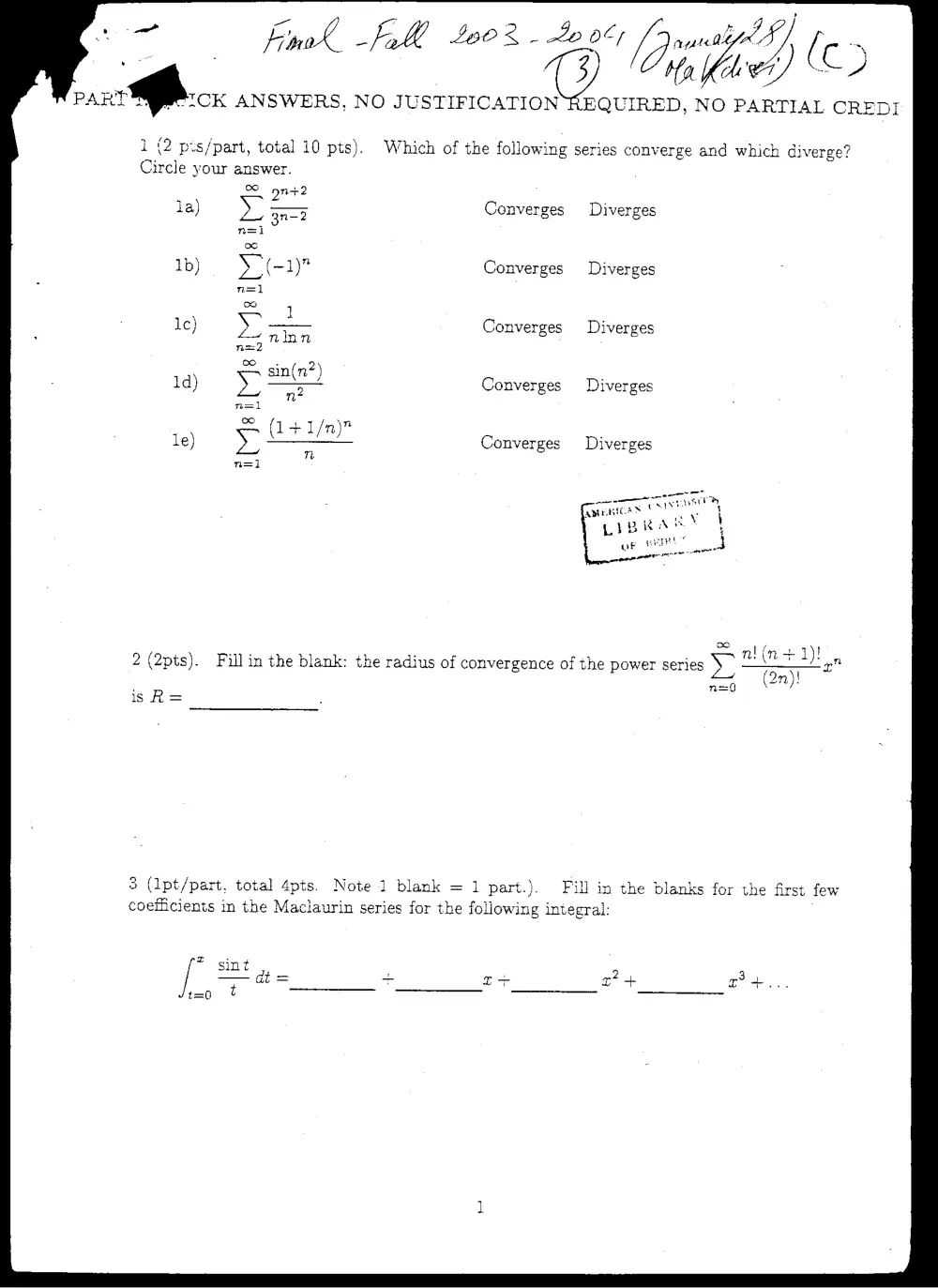
1 (2 pis/part, total 10 pts). Which of the following series converge and which diverge?
Circle your answer.
ont?
la) ) Converges Diverges
1b) Converges Diverges
1c) Converges Diverges
Converges Diverges
Converges Diverges
aT
CAS :
fees "
lin +l
2 (2pts). Fill in the blank: the radius of convergence of the power series 3 aot
27):
n
n=O
is R=
3 (1pt/part, total 4pts. Note 1 blank = 1 part.). Fill in the blanks for the Arst few
coeficients in the Maclaurin series for the following integral:
4 (2pts each for parts a-d, 4pts each for parts e-f, total l€pts). The following picture
shows level curves for a function f(z, y), and the value of the gradient Vf at some points.
—!DAT
DATA
VS(h,)2 52447
=, °
i V5 (Pel= 32527
VS (Pe)=- a+4
4a) Draw a vector on the figure at P, pointing in the direction of maximum increase
of f.
g
’, Circle the correct answer for 4b, 4c, 4d:
of : was . . .
4b) Sn is positive zero negative aoes not exist.
IL i Py .
of | . . toe : _
4c) Ba | 1S positive zero negative does not exist.
wc lP,
4d) lim f(x,y) is positive zero negative does not exist.
(x,y) (0,0) :
4e) Fill in the blank: The equation of the tangent line to the level curve passing
through P,(7, 3) is
e\ 17: : . . . < 3 . 1
4f) Fill in the blank: We start from the point 5(5, 0), and move a distance of ds = 706
units in the direction of the vector 7 =7+ 2). Then the change in the value of f(z, y) is
approximately
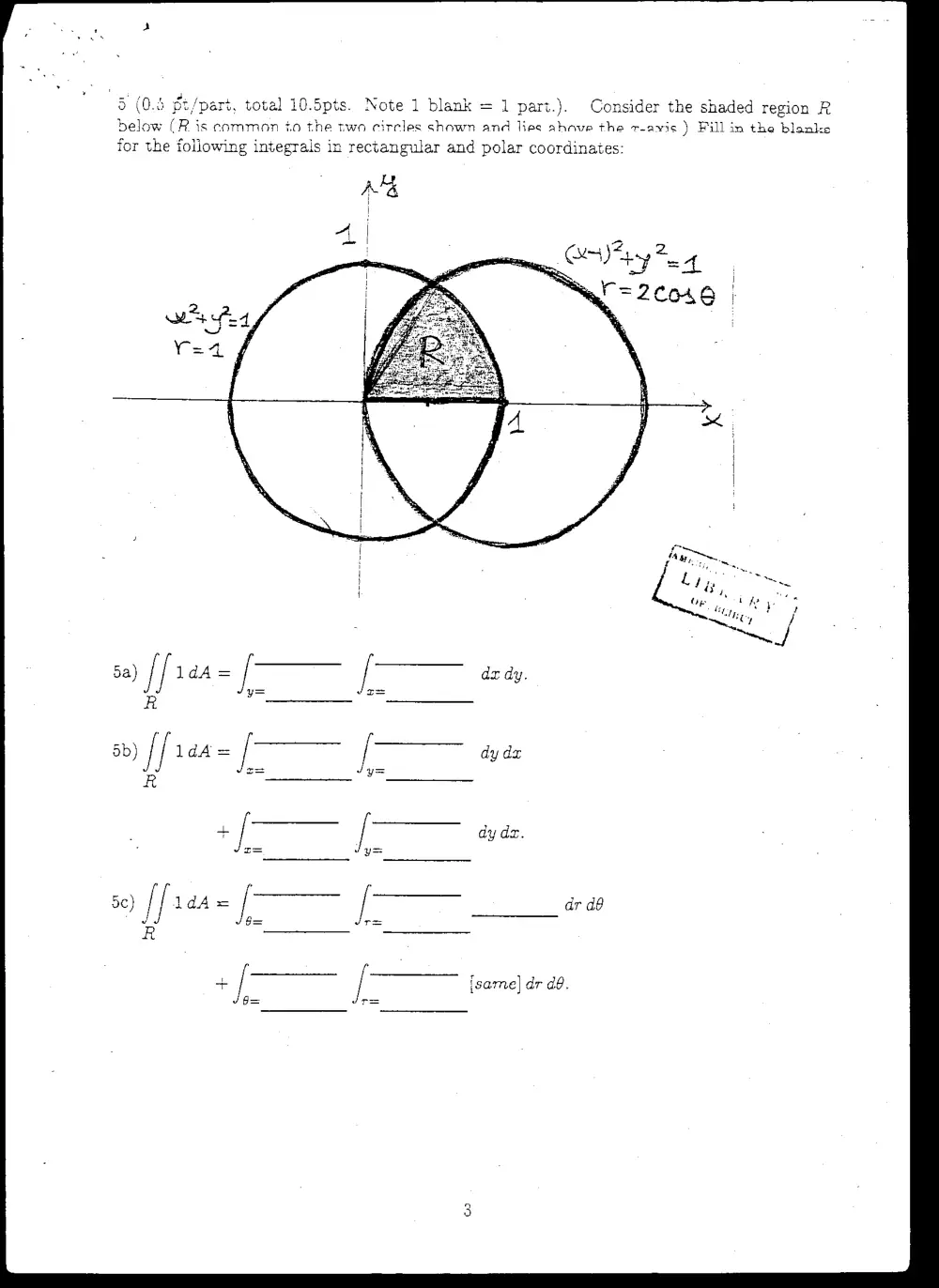
“(0.5 St/part, total 10.5pts. Note 1 blank = 1 part.). Consider the shaded region R
elow (Ris common to the two circles shown and lies ahave the r-avis ) Fill in the blanke
for the following integrals in rectangular and polar coordinates:
A'S
a!
same] dr dé.
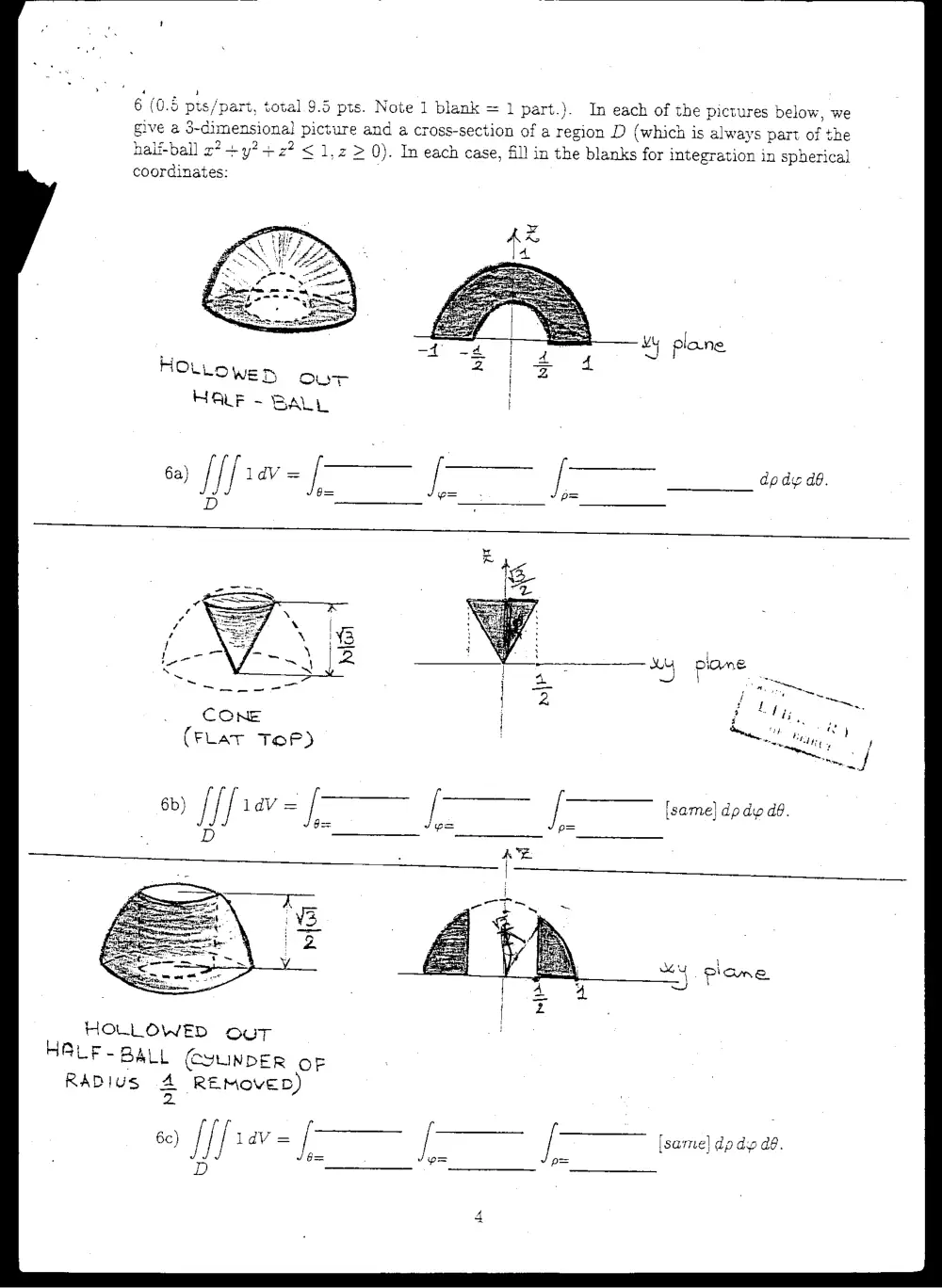
6 (0.5 pts/part, total 9.5 pts. Note 1 blank = 1 part.). In each of the pictures below, we
give a o-cimensional picoure and a cross-section of a region D (which is always part of the
hali-ball 2? +y?+2z? <1,z> 0). Ineach case, fill in the blanks for integration in spherical
coordinates:
u
My plane
dp dy dé.
LY DIONE
< pn
i L his. ee
ne are ) ,
~~ /
6b) If/ 1dV =| | | [same] dp dy dé.
= ee p=
D
HOLLOWED ouT
HALF - BALL (SUNDER oF
RADIUS A REMovED)
z
«i [for
[same] dp dy dé.
sp
oP
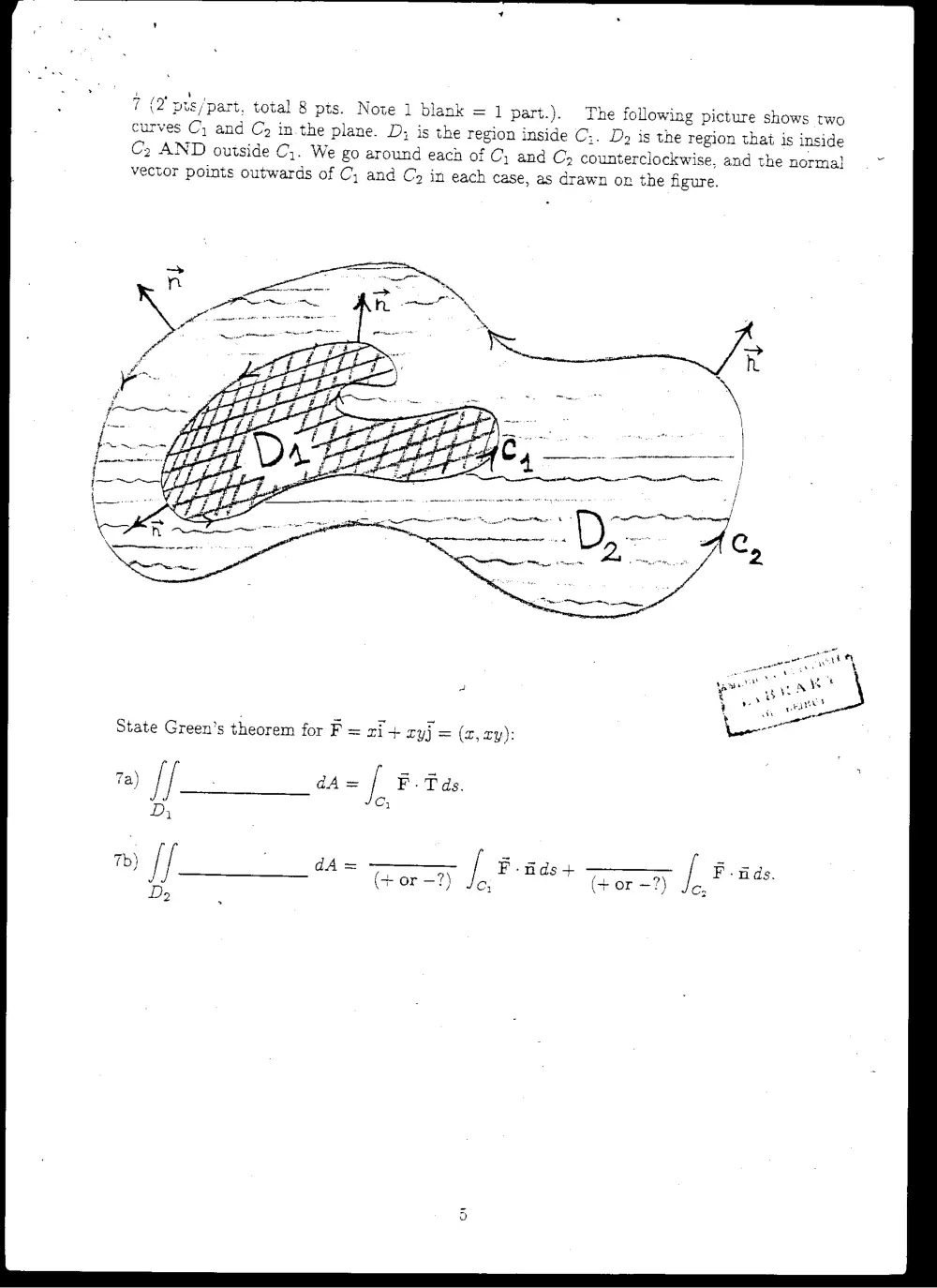
7 {2 pus/part, total 8 pts. Note 1] blank = 1 part.). The following picture shows two
curves C; and C2 in the plane. D; is the region inside C;. Dz is the region that is inside
Cy AND outside Cy. We go around each of C; and C> counterclockwise, and the norma}
vector points outwards of C, and C> in each case, as drawn or the figure.
,
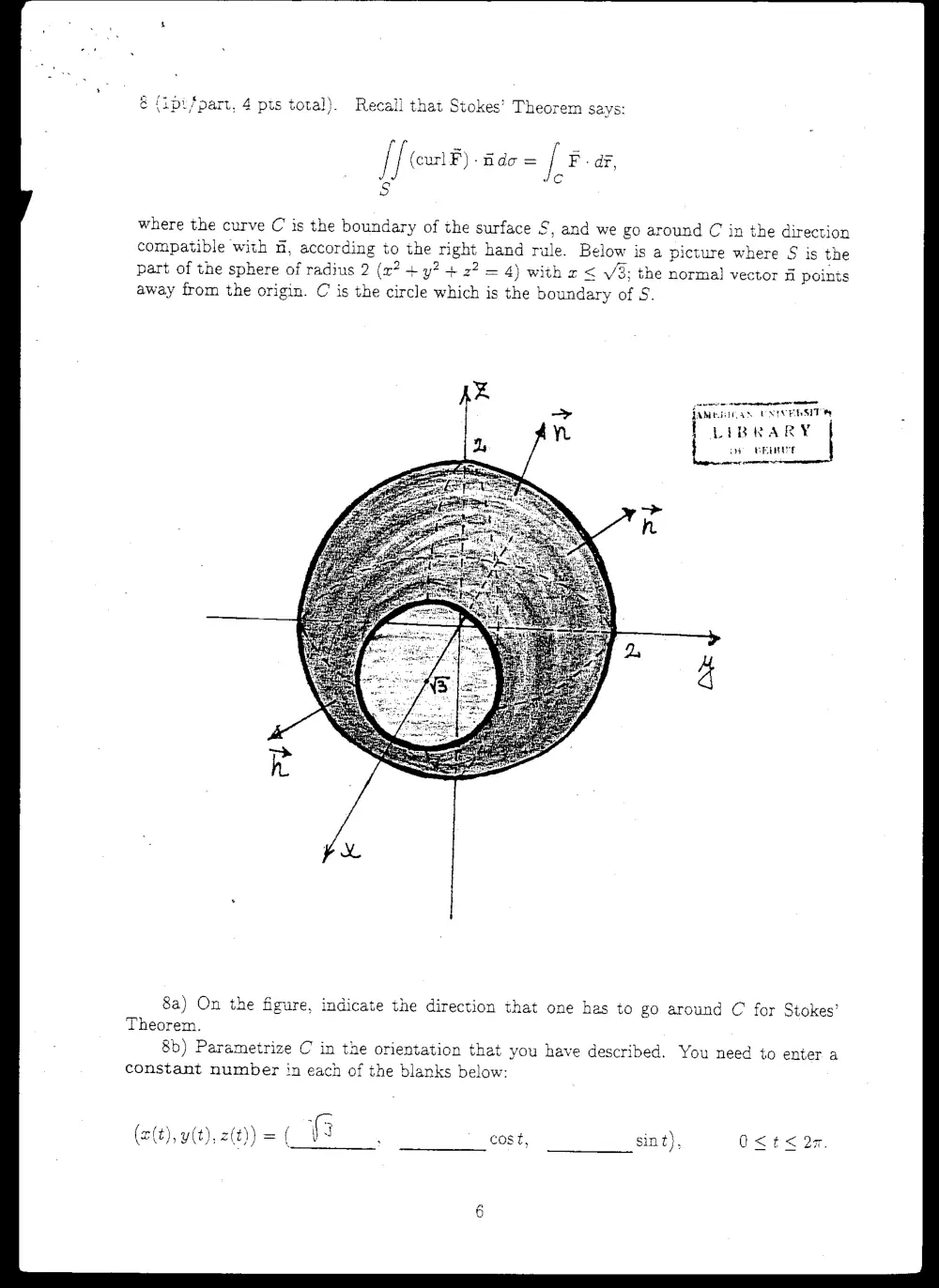
& (ipt/part, 4 pts total). i t Stokes’ Theorem says:
= | Far,
VCO
where the curve C is the boundary of the surface § S, and we go around C in the direction
compatible with fi, according to the ens hand rule. Below is a picture where S is the
part of the sphere of radius 2 (x? + y? = 4) with 2 < V3; the normal vector points
away from the origin. C is the circle which is the boundary of 3.
pace neem em
JAMESGAN UNTCEESIT
LIBRARY
Da BREE
8a) On the figure, indicate the direction that one has to go around C for Stokes’
Theorem.
8b) Parametrize C in the orientation that you have described. You need to enter a
constant number in each of the blanks below:
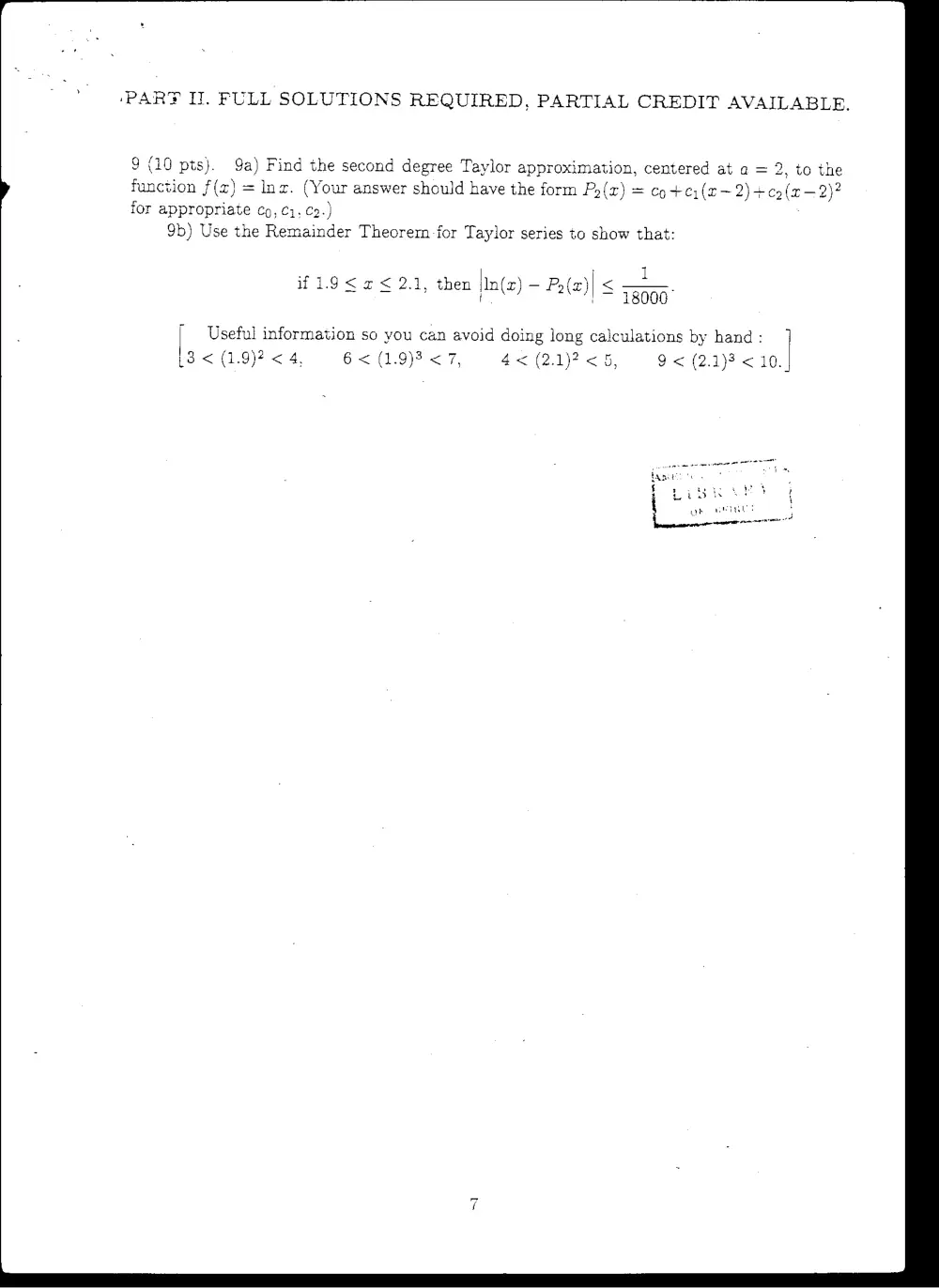
‘PART Il. FULL SOLUTIONS REQUIRED, PARTIAL CREDIT AVAILABLE.
9 (19 pts). Qa) Find the second degree Taylor approximation, centered at a = 2, to the
function f(z) = Inz. (Your answer should have the form P2(x) = co +¢1(x@~2)+cp(x—2)?
for appropriate cg, C1, C2.)
9b) Use the Remainder Theorem -for Taylor series to show that:
| Useful information so you can avoid doing long calculations by hand :
18 < (1.9)? < 4, 6 < (1.9)3 <7, 4< (2.1)? <5, 9 < (2.1)3 < 10.
~l
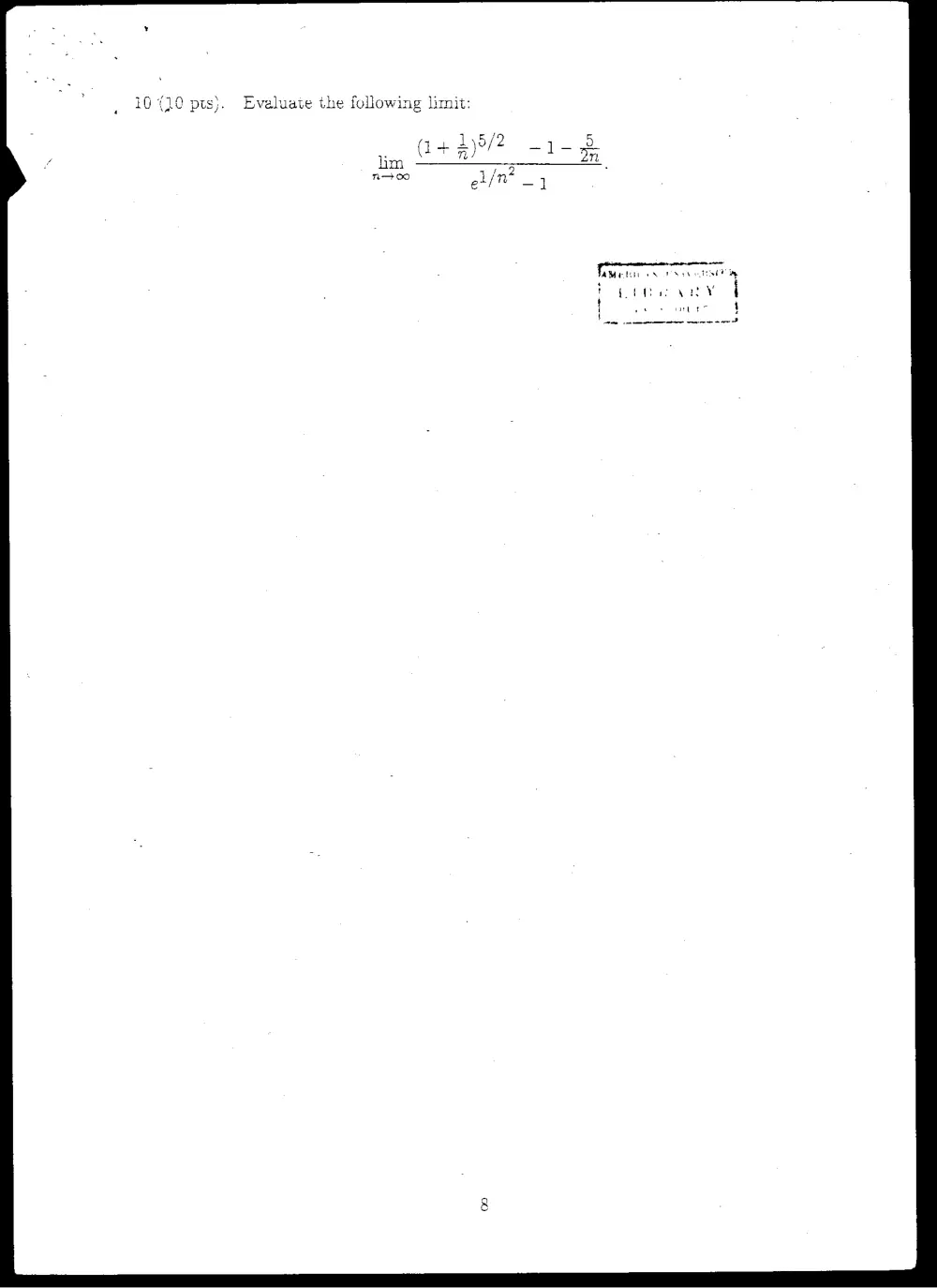
10 (10 pts). Evaluate the following limit:
AMeb eS PN The 7
tiharany |
eee)
ce ce et
Url =3i44j, 7 = 314 2j, ofl = -f4j.
/| ° : flew , J» Poa) rd
>
B
i
B
lo)
ct
Bb
@
ot
R
iH
&
o
Il
”
+
v and y = y(s,t) = st? ~ 4. Find the value of
9
\ 2 \
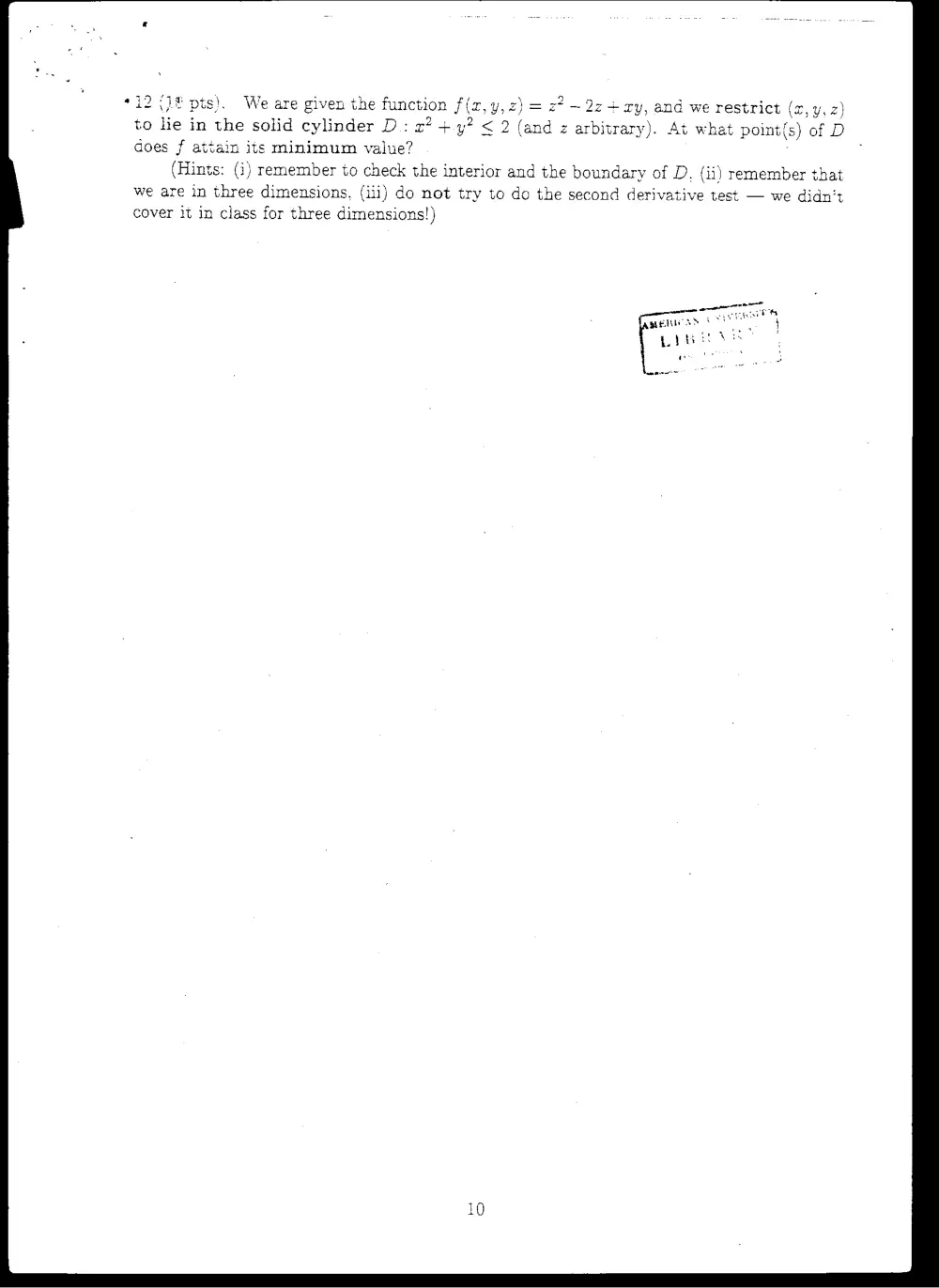
“12 ()# pts!. We are given the function f(z,y,z) = 2° -2z+-zy, and we restrict (2,y,2)
to lie in the solid cylinder D: 27+? < 2 (and z arbitrary). At what point(s) of D
does f attain its minimum value? :
(Hints: (i) remember to check the interior and the boundary of D, (ii) remember that
we are in three dimensions, (iii) do not try to do the second derivative test — we didn’t
cover it in class for three dimensions!)