
MATH 201 Final, Fall 2004
American University of Beirut · Calculus and Analytical Geometry III · 9 pages · Mr. Hassan Yamani



More MATH 201 files
- Final · Spring 2019Final examView
- Final · Spring 2019Final examView
- Problems Difficult Problem 5 Tlas 2017 Final · Spring 2019Final examView
- Final · Fall 2018Final examView
- Final · Fall 2018Final examView
- Final Finals with Solution Collection · Spring 2017Final exam · with solutionView
- Final Finals with Solution Collection · Spring 2017Final exam · with solutionView
- Final · Spring 2017Final examView
Show the text of this final exam
FINAL EXAMINATION \.
MATH 201
January 29, 2005; 3:00-5:00 P.M.
Name: Signature:
Student number:
Section number (Encircle): 17 18 19 20
Instructors (Encircle): Dr. H. Yamani Mrs. M. Jurdak Prof. A. Lyzzaik
Instructions:
e No calculators are allowed.
e There are two types of questions:
PART I consists of four work-out problems. Give a detailed solution for
each of these problems.
PART II consists of twelve multiple-choice questions each with exactly
one correct answer. Circle the appropriate answer for each of these prob-
lems.
Grading policy:
e 10 points for each problem of PART I.
5 points for each problem of PART II.
e 0 point for no, wrong, or more than one answer of PART II.
GRADE OF PART 1/40:
GRADE OF PART II/60:
TOTAL GRADE/100:
aed rer |
LERRARY }
\
|
on WIRE
Part I(1). Use the change of variables u = z—y andv = 2+ y to
evaluate the integral
[Le — y)? cos*(x + y) dx dy
over the square region A bounded by the lines c ~ y = 1, r- y = —1,
ety=lety=3.
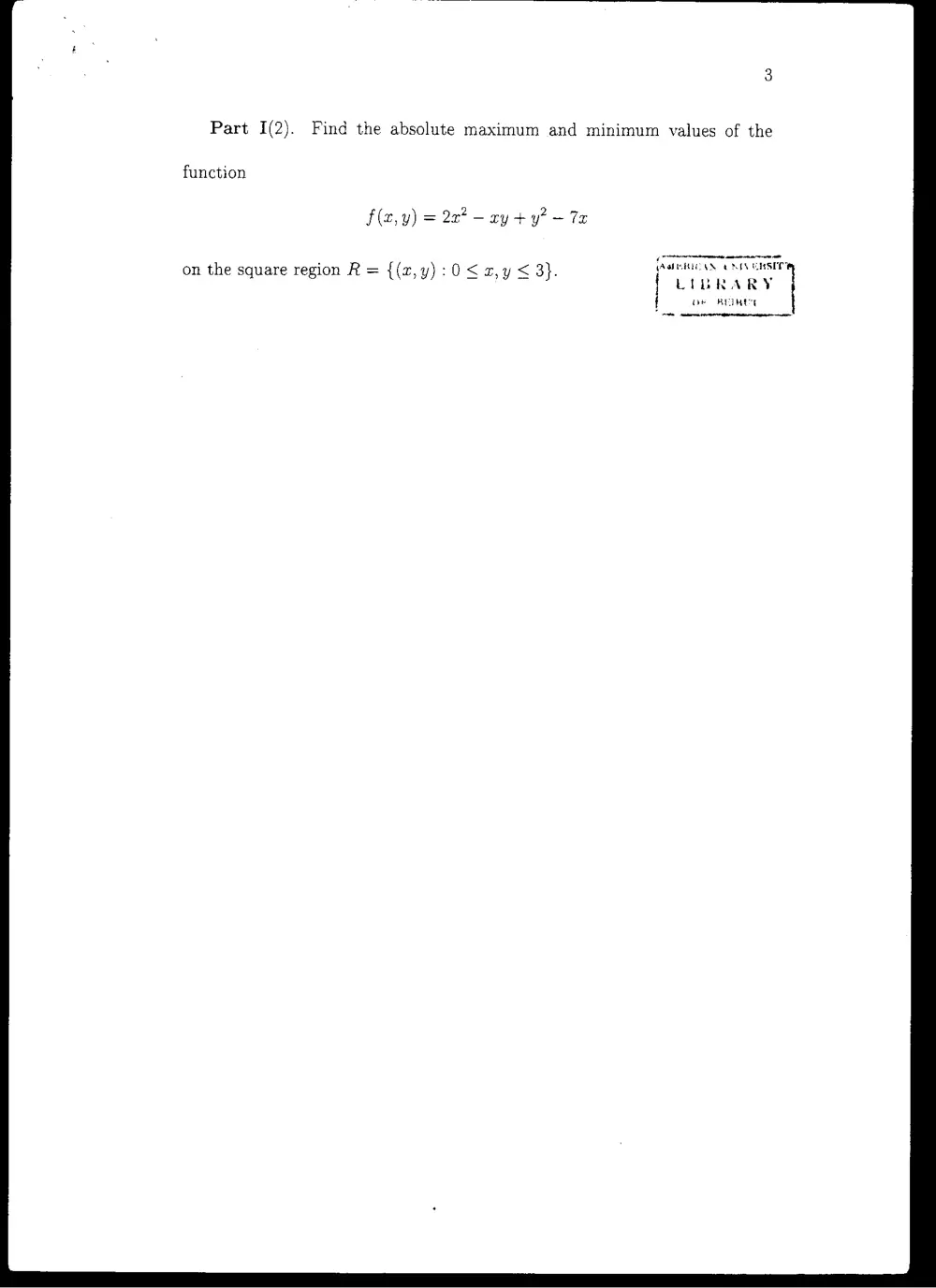
Part 1(2). Find the absolute maximum and minimum values of the
function
f(z,y) = 22? -ayty’ - 7x
on the square region R = {(z,y):0<2,y < 3}. Pe sey |
| oF RETIRE
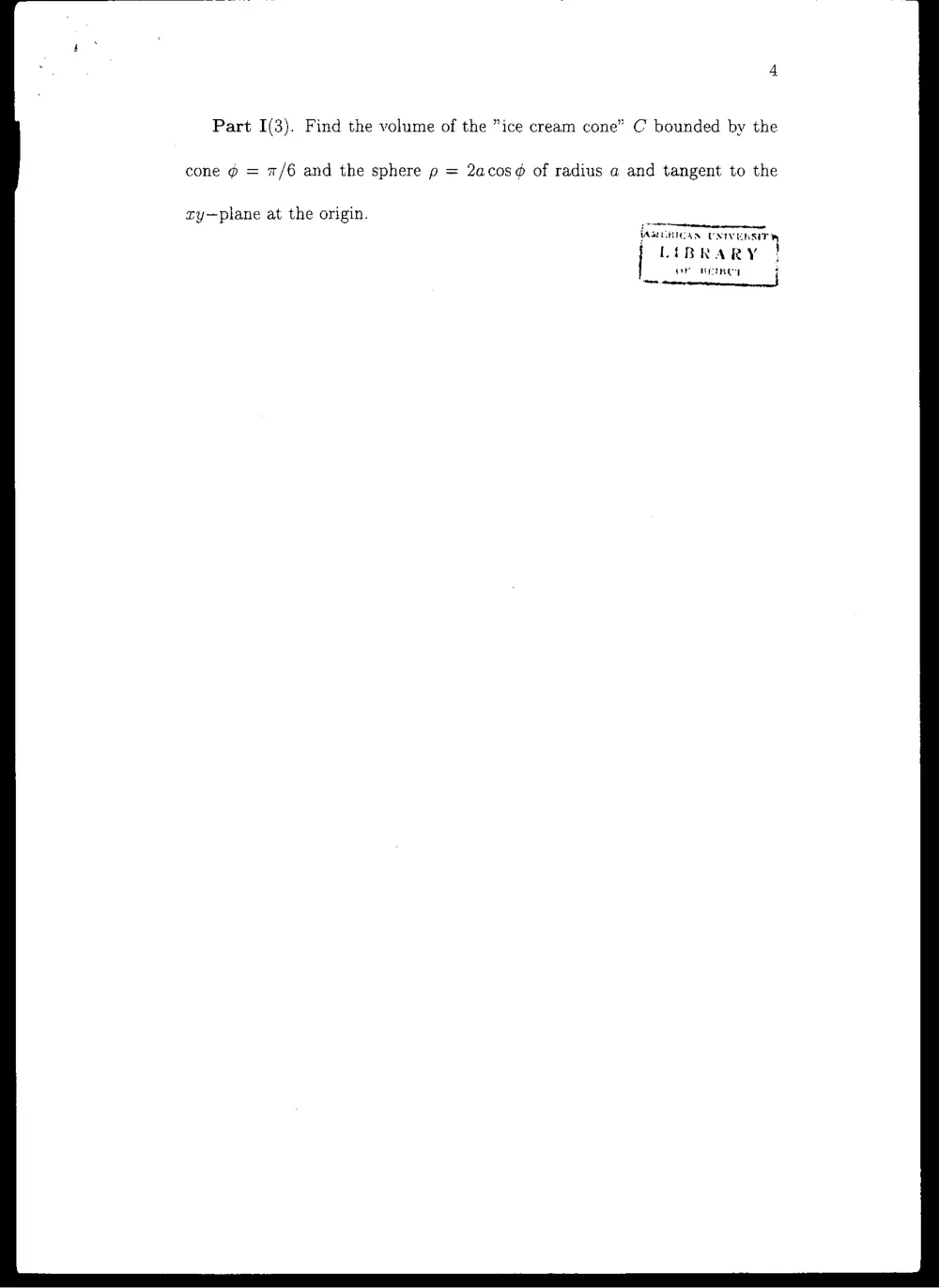
Part 1(3). Find the volume of the ice cream cone” C bounded by the
cone @ = 7/6 and the sphere p = 2acos@ of radius a and tangent to the
xry—plane at the origin.
eee
JAMEKICAN UNIVEKSIT
LIBRARY !
OF BEIROT i
Part 1(4). Use Lagrange multipliers to find the point on the plane 2x +
3y + 4z = 12 at which the function f(z, y,z) = 42? + y? + 52” has its least
value.
PAMRICAN UE SIVENSITe®
LIBKARY
OF BEIRUT
Tee memento tipennitsieren
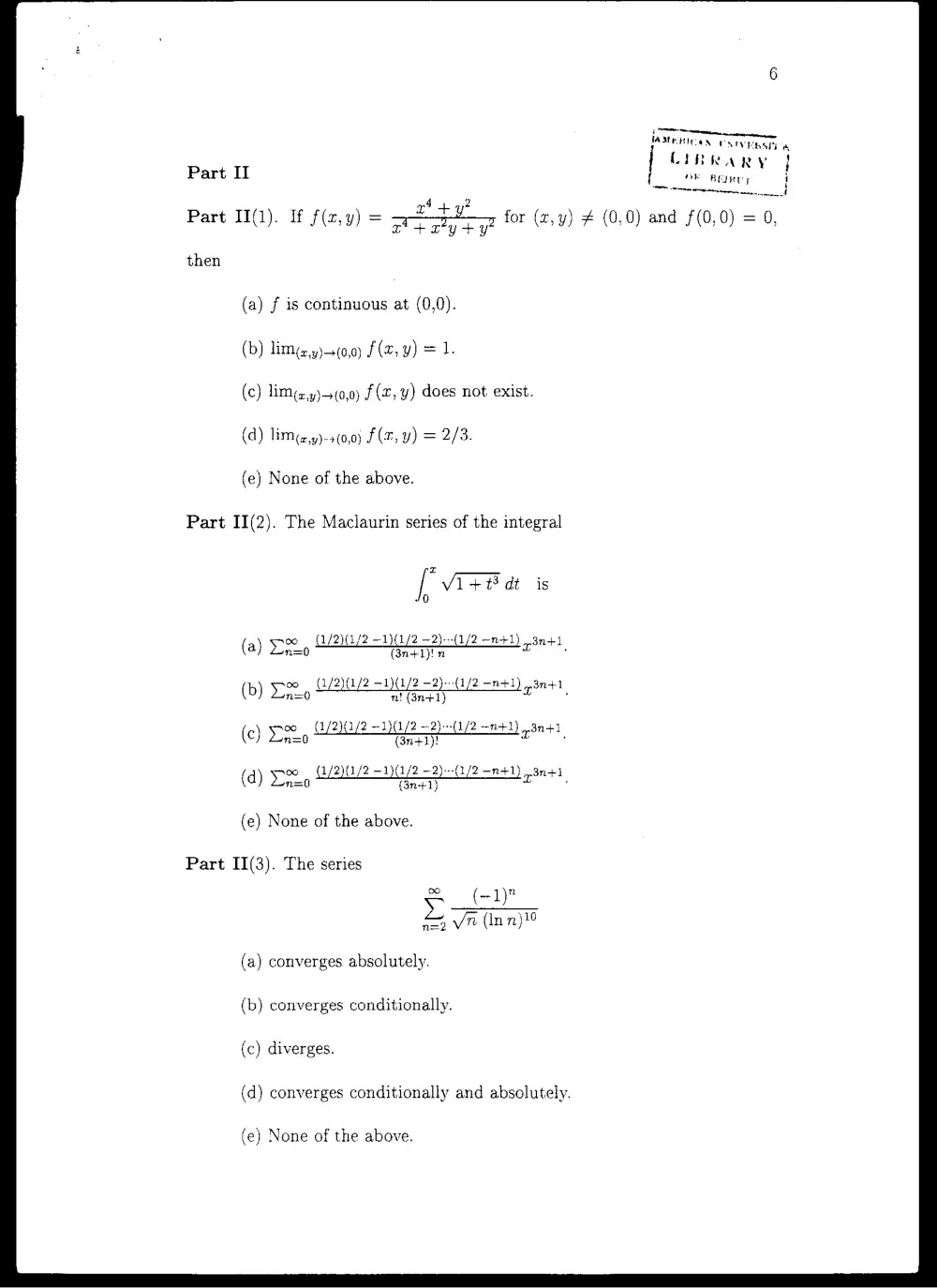
Part II
Part II(1). If f(z, y) =v" | for (z, y)
then
e+ aetyty
(a) f is continuous at (0,0).
(b) lime.) (0,0) f(@,y) = 1.
(c) lime y)-+(0,0) f(a, y) does not exist.
(d) limee,y)-»(0,0) f(@, ) = 2/3.
{e) None of the above.
Part II(2). The Maclaurin series of the integral
xo
| V1+8 dt is
0
(1/2)(1/2 -1)(1/2 —2)---(1/2 —n-+1)
(a) Dio (3n+1)!n me nth
(b) E2 (2/2) /2 = 1) (0/2 ~2)--(1/2 =n+1) 7 3n+1
n=0 n! (8n+1)
(€) Co OR ee,
(d) oo = (1/2)(1/2 -1)(1/2 —2).--(1/2 =n) 3nd
n=0 (3n+1)
(e) None of the above.
Part II(3). The series
-1)"
loa}
tan Inn)?
fan Ve
(a) converges absolutely.
(b) converges conditionally.
(c) diverges.
(d) converges conditionally and absolutely.
(e) None of the above.
—
i nnn
AMeHIC aN ¢ MIVEDSTS a
LIBRARY
OF Berry
# (0,0) and f(0,0) = 0,
5
i
{ Se eet etree ne
AMERICAN UNIVERS TOR
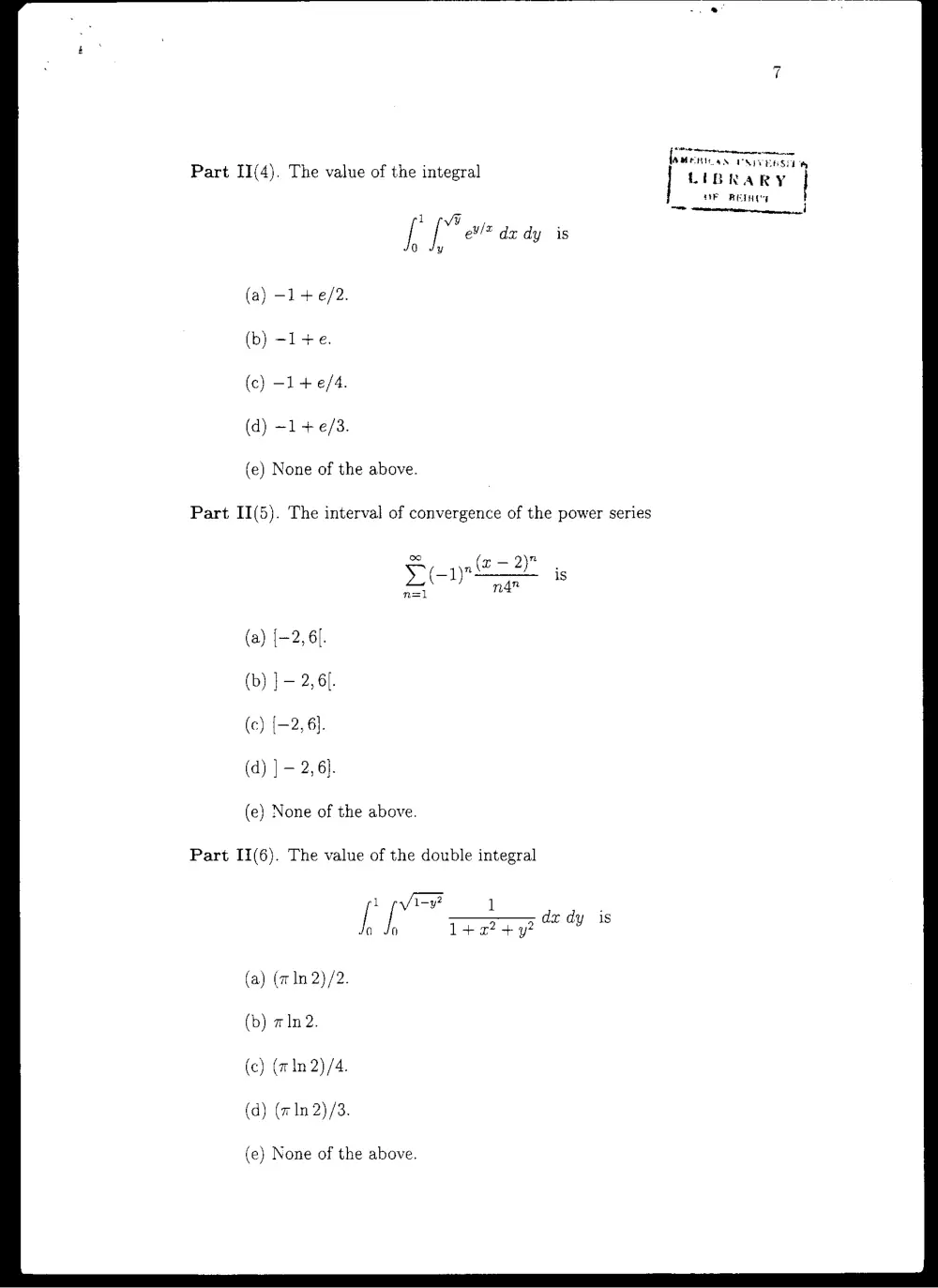
Part II(4). The value of the integral
Lope
[ | * evle dx dy is
0 Jy
LIBRARY
QF REIRG YD
Tt cere enced
(a) -1 + e/2.
(b) -I+e.
(c) -l+e/4.
(d) ~1+e/3.
(e) None of the above.
Part II(5). The interval of convergence of the power series
St(-1 (2 = = is
(a) [-2, 6].
(b) | — 2,6].
(c) [-2, 6].
(d) } — 2,6].
(e) None of the above.
Part II(6). The value of the double integral
CI” ap ee
(a) (wn 2)/2.
(b) mIn2.
(c) (win 2)/4.
(d) (n In 2)/3.
(e) None of the above.
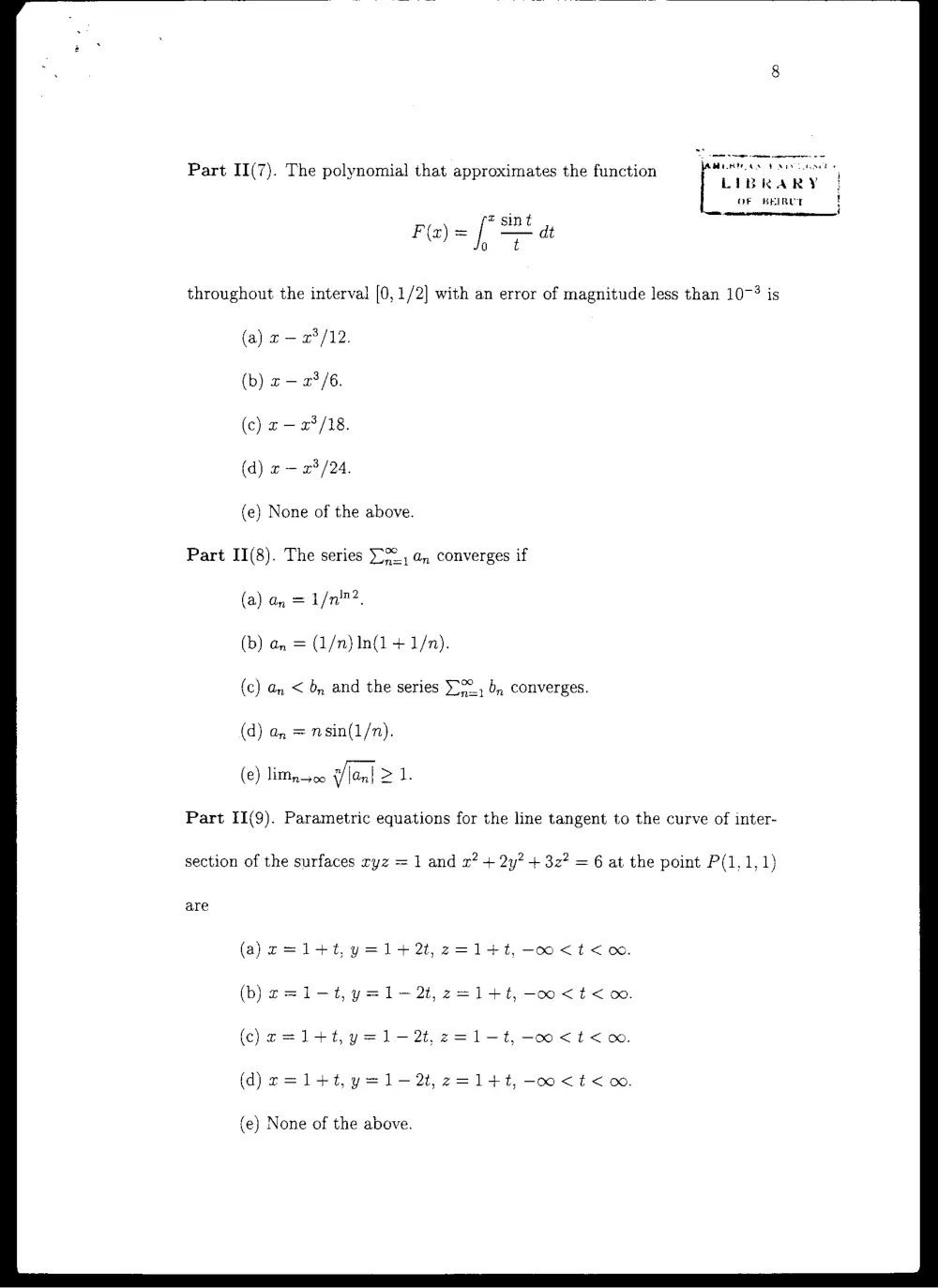
Part II(7). The polynomial that approximates the function Memtnes tsi poets
LIBRARY |
Of BEIRUT }
= sint ,
ia) = [Sa ——
o ¢
throughout the interval [0, 1/2] with an error of magnitude less than 107° is
(a) 2 — 23/12.
(b) « -— 23/6.
(c) «— «3/18.
(d) 2 — 23/24,
{e) None of the above.
Part II(8). The series 0°: , a, converges if
(a) ay, = 1/niP?.
(b) an = (1/n)In(1 + 1/n).
{c) Qn < bp and the series °°, 6, converges.
n=1
(d) @n = nsin(1/n).
(e) limp soo flan! >i.
Part II(9). Parametric equations for the line tangent to the curve of inter-
section of the surfaces ryz = 1 and x? + 2y? + 3z? = 6 at the point P(1,1,1)
are
(a)xc=lit, y=14+2t,z=14+t,-w<t<c.
(b)e=1—-t,y=1—2t,z=1+t, -w<t<oo.
(c)m=1lt+t,y=1-2t,2=1-t,-w<t<oo.
(d)v=1l4+t,y=1-2t,z=14+t, -wo<t<o.
{e) None of the above.
9
JAMIA © SSE
LIBRARY
OF BEIRET ‘
3
nm
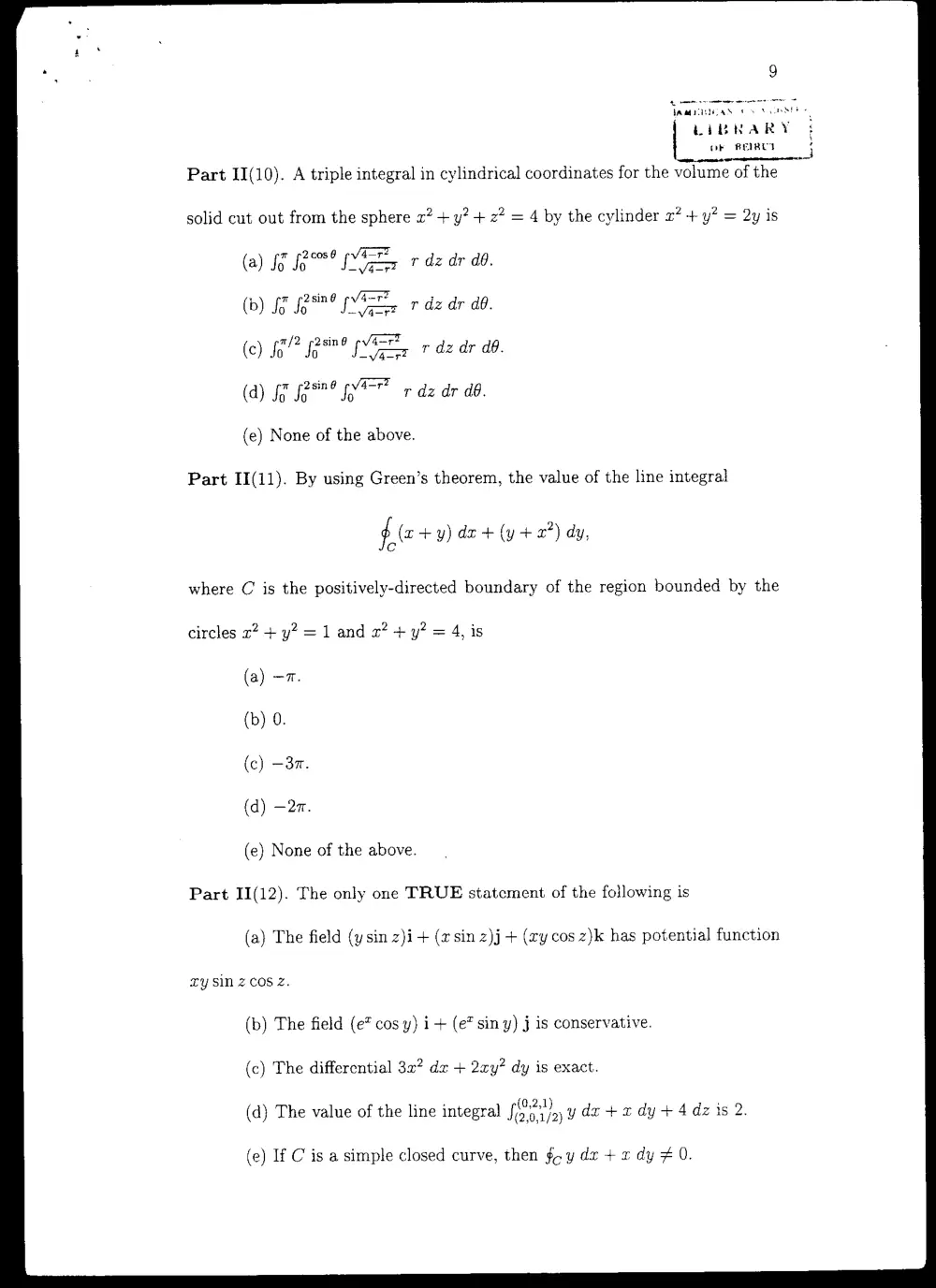
Part II(10). A triple integral in cylindrical coordinates for the volume of the
solid cut out from the sphere 1? + y? + 2? = 4 by the cylinder z? + y* = 2y is
(a) fo goose pes r dz dr dé.
(b) Jo Jon? fy ~; 7 dzdr dd.
(c) far? seein ve r dz dr dé.
d) ft fo5"8 [Mr dz dr dO.
0 Jo 0
e) None of the above.
(e)
Part II(11). By using Green’s theorem, the value of the line integral
fer) dz + (y+ 27) dy,
where C is the positively-directed boundary of the region bounded by the
circles c? + y?=1 and 2? +y? = 4, is
(a) —7.
(e) None of the above.
Part II(12). The only one TRUE statcment of the following is
(a) The field (ysin z)i+ (xsin z)j + (zy cos z)k has potential function
ry sin z COs Z.
(b) The field (e* cos y) i + (e* sin y) j is conservative.
(c) The differential 32° dx + 2zy? dy is exact.
(d) The value of the line integral Seer ydr+a2dy+4 dz is 2.
(e) If C is a simple closed curve, then fo y dz + x dy # 0.