
MATH 201 Final, Fall 2004
American University of Beirut · Calculus and Analytical Geometry III · 5 pages
More MATH 201 files
- Final · Spring 2019Final examView
- Final · Spring 2019Final examView
- Problems Difficult Problem 5 Tlas 2017 Final · Spring 2019Final examView
- Final · Fall 2018Final examView
- Final · Fall 2018Final examView
- Final Finals with Solution Collection · Spring 2017Final exam · with solutionView
- Final Finals with Solution Collection · Spring 2017Final exam · with solutionView
- Final · Spring 2017Final examView
Show the text of this final exam
&
“- ignature: Student Number:
+
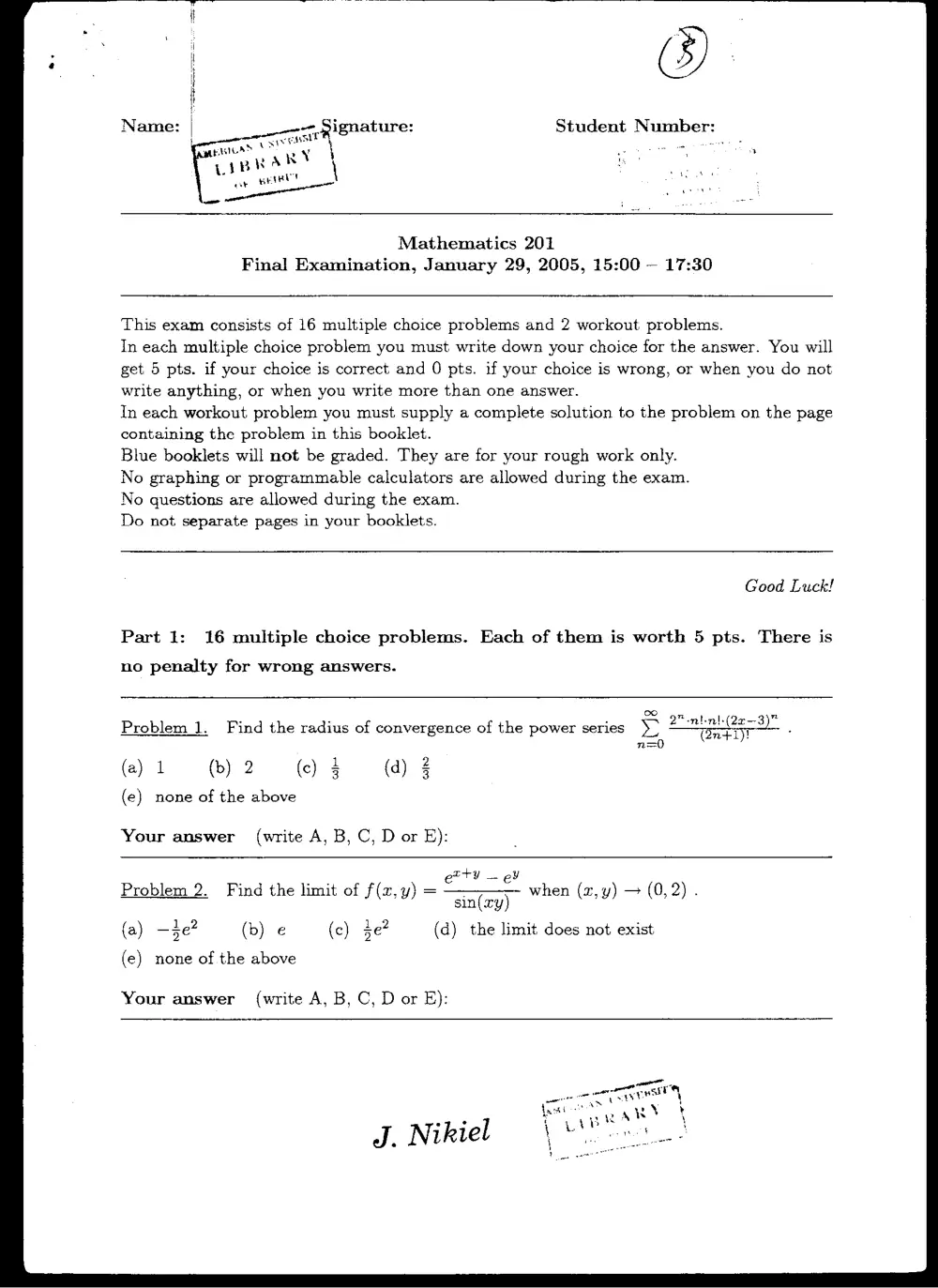
Mathematics 201
Final Examination, January 29, 2005, 15:00 — 17:30
This exam consists of 16 multiple choice problems and 2 workout problems.
In each multiple choice problem you must write down your choice for the answer. You will
get 5 pts. if your choice is correct and 0 pts. if your choice is wrong, or when you do not
write anything, or when you write more than one answer.
In each workout problem you must supply a complete solution to the problem on the page
containing the problem in this booklet.
Blue booklets will not be graded. They are for your rough work only.
No graphing or programmable calculators are allowed during the exam.
No questions are allowed during the exam.
Do not separate pages in your booklets.
Good Luck!
Part 1: 16 multiple choice problems. Each of them is worth 5 pts. There is
no penalty for wrong answers.
2° -nt-n|-(22—3)”
fe.)
Problem J. Find the radius of convergence of the power series }~ att
n=0
(2) 1 () 2 (@3 @)
(e) none of the above
wl
Your answer (write A, B, C, D or E):
T+Y _ oY
Problem 2. Find the limit of f(x,y) = “= when (2, y) — (0,2) .
sin(xy)
{a) —}e? (b) e (c) $e? (d) the limit does not exist
(e) none of the above
Your answer (write A, B, C, D or E):
omit
nT
oe man yavt \
{asi AX No
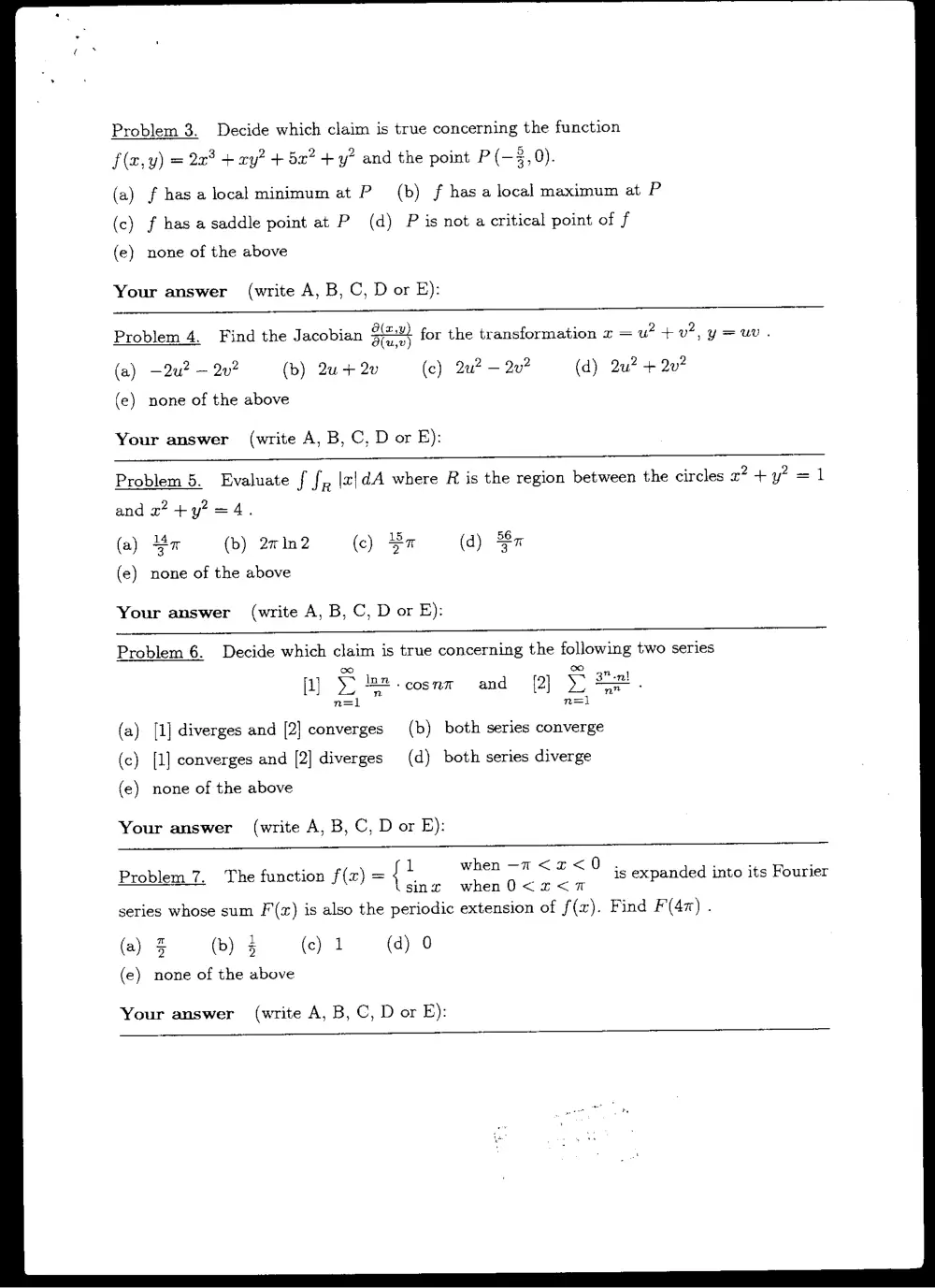
Problem 3. Decide which claim is true concerning the function
f(a,y) = 223 + cy? + 5a? +y° and the point P(-3,0).
a) f hasa local minimum at P (b) f has a local maximum at P
(
(c) f has a saddle point at P (d) P is not a critical point of f
(
e) none of the above
Your answer (write A, B, C, D or E):
Problem 4. Find the Jacobian sen for the transformation ¢ = u? + v?, y= uw .
(a) —2u? — 2v? (b) 2u+2v (c) 2u® — 2v? (d) 2u? + 2v?
(e) none of the above
Your answer (write A, B, C, D or E):
Problem 5. Evaluate f {,, |z|dA where R is the region between the circles z? + y? = 1
and g?+y* =4.
(a) Un (b) 27 ln2 (c) Ba
(e) none of the above
Your answer (write A, B, C, D or E):
Problem 6. Decide which claim is true concerning the following two series
Co
[l] 32 B® -cosna and [2]
n=l
n=l
(a) [1] diverges and [2] converges (b) both series converge
(c) [1] converges and [2] diverges (d) both series diverge
(e) none of the above
Your answer (write A, B, C, D or E):
1 when -7 <2 <0
snz whenO<242<7
series whose sum F(z) is also the periodic extension of f(r). Find F(4z) .
(a2) §} (vb) se) 1 (A)
(e) none of the above
Problem 7. The function f(x) = {
is expanded into its Fourier
Your answer (write A, B, C, D or E):
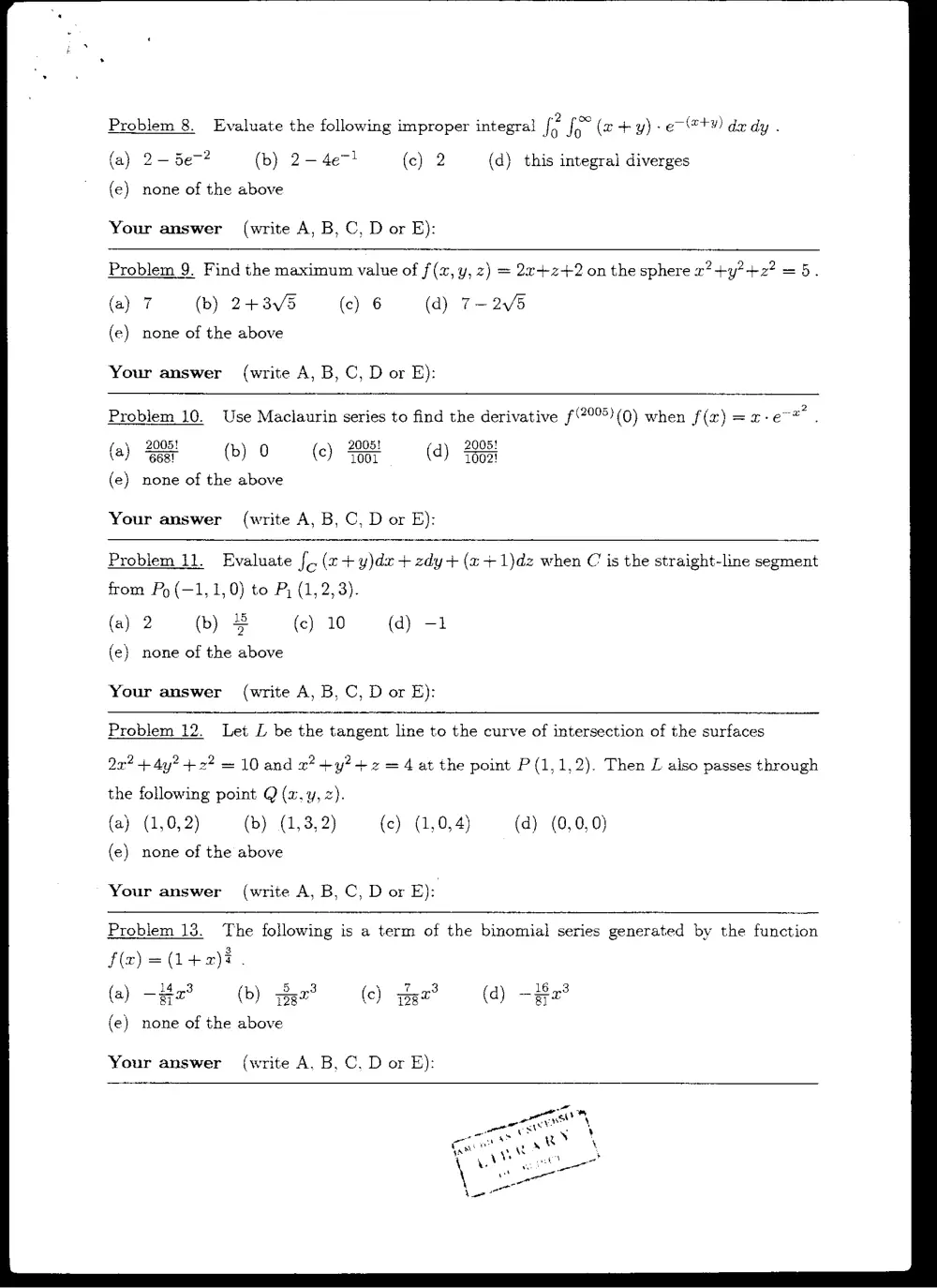
Probiem 8. Evaluate the following improper integral fe So (2 +y)-e@+9) da dy .
(a) 2-5e7? (b) 2-4e7} (c) 2 (d) this integral diverges
(e) none of the above
Your answer (write A, B, C, D or E):
Problem 9. Find the maximum value of f(z, y, z) = 2v+z+2 on the sphere x? +y?+z? =5.
(a) 7 (b) 2+3V5 (c) 6 (d) 7-2V5
(e) none of the above
Your answer (write A, B, C, D or E):
Problem 10. Use Maclaurin series to find the derivative f(?°°) (0) when f(z) =z- ee
() BE) 0) Ea) BB
(e) none of the above
Your answer (write A, B, C, D or E):
Problem 11. Evaluate f. (r+y)dx + zdy+(x%+1)dz when C is the straight-line segment
from Po (—1,1,0) to P, (1, 2,3).
(a) 2 (b) 2 (c) 10 (d) -1
(e) none of the above
Your answer (write A, B, C, D or E):
Problem 12. Let L be the tangent line to the curve of intersection of the surfaces
Qa? 4+ Ay? +22 = 10 and x? +y?+2=4 at the point P(1,1,2). Then L also passes through
the following point Q (x,y, 2).
{a} (1,0,2) (b) (1,3,2) — (e) (1,0,4) (d) (0,0, 0)
(e) none of the above
Your answer (write A, B, C, D or E):
Problem 13. The following is a term of the binomial series generated by the function
(2) —H#o® —(b) Ber? (6) ig? (a) 89
(e) none of the above
Your answer (write A. B, C. D or E):
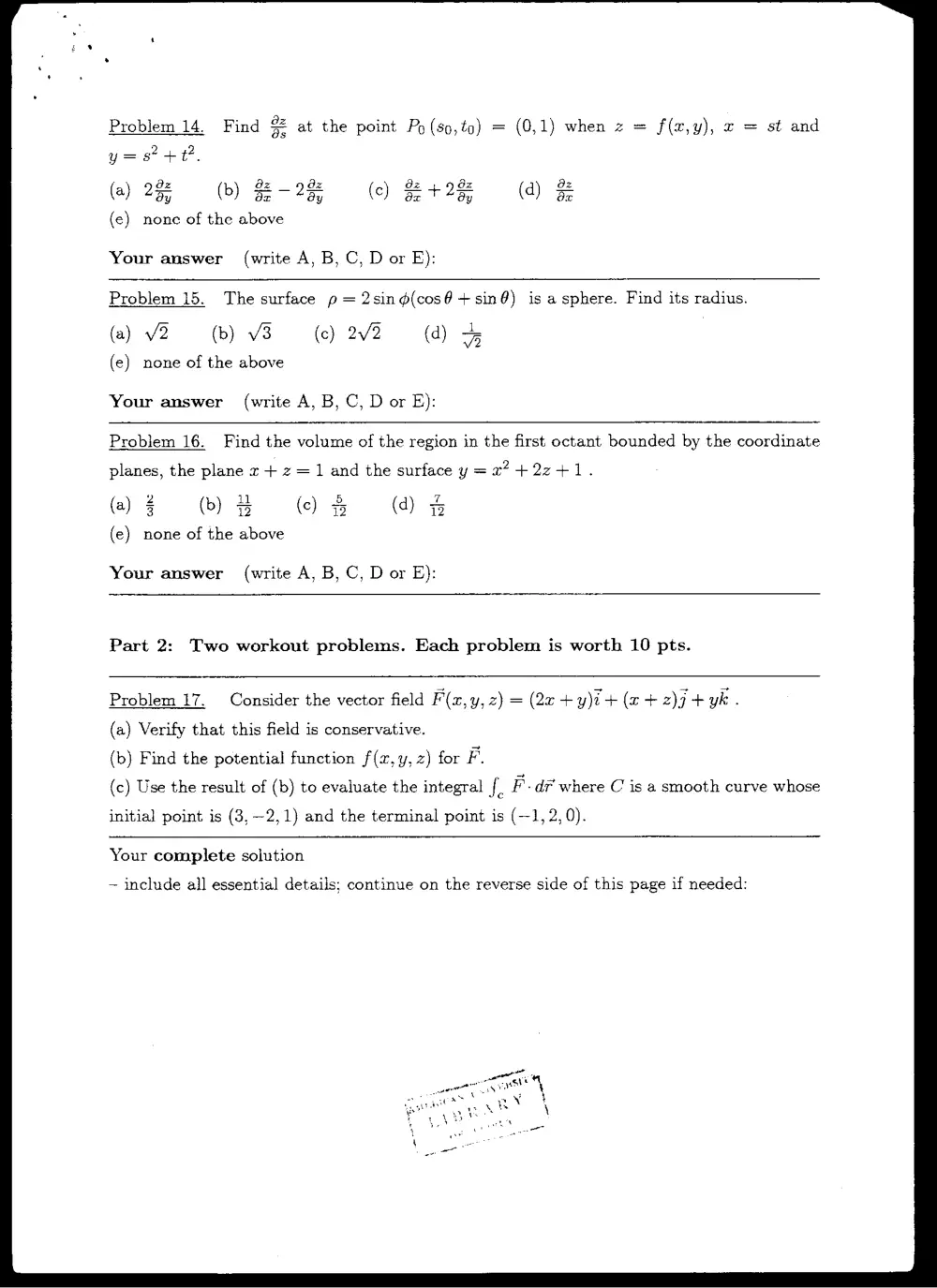
Problem 14. Find oe at the point Po (so,to) = (0,1) when z = f(x,y), 2 =
y= 8s? + t.
(a) 292 = (b) #2 - 282 (c) $2 + 2%
(e) none of the above
Your answer (write A, B, C, D or E):
Problem 15. The surface p = 2sin¢(cos@+sin@) is a sphere. Find its radius.
(a) V2 (b) VB (ce) 2V2—(d)
(e) none of the above
Your answer (write A, B, C, D or E):
Problem 16. Find the volume of the region in the first octant bounded by the coordinate
planes, the plane x +z=1and the surface y=ar+2z4+1.
@™ 3 Op O8 @ME
(e) none of the above
Your answer (write A, B, C, D or E):
Part 2: Two workout problems. Each problem is worth 10 pts.
Problem 17. Consider the vector field F(2x,y, 2) = (Qu +y)i+(x2+2)j + yk .
(a) Verify that this field is conservative.
(b) Find the potential function f(x,y, z) for F.
(c) Use the result of (b) to evaluate the integral F. df where C is a smooth curve whose
initial point is (3,--2,1) and the terminal point is (—1, 2,0).
Your complete solution
— include all essential details; continue on the reverse side of this page if needed:
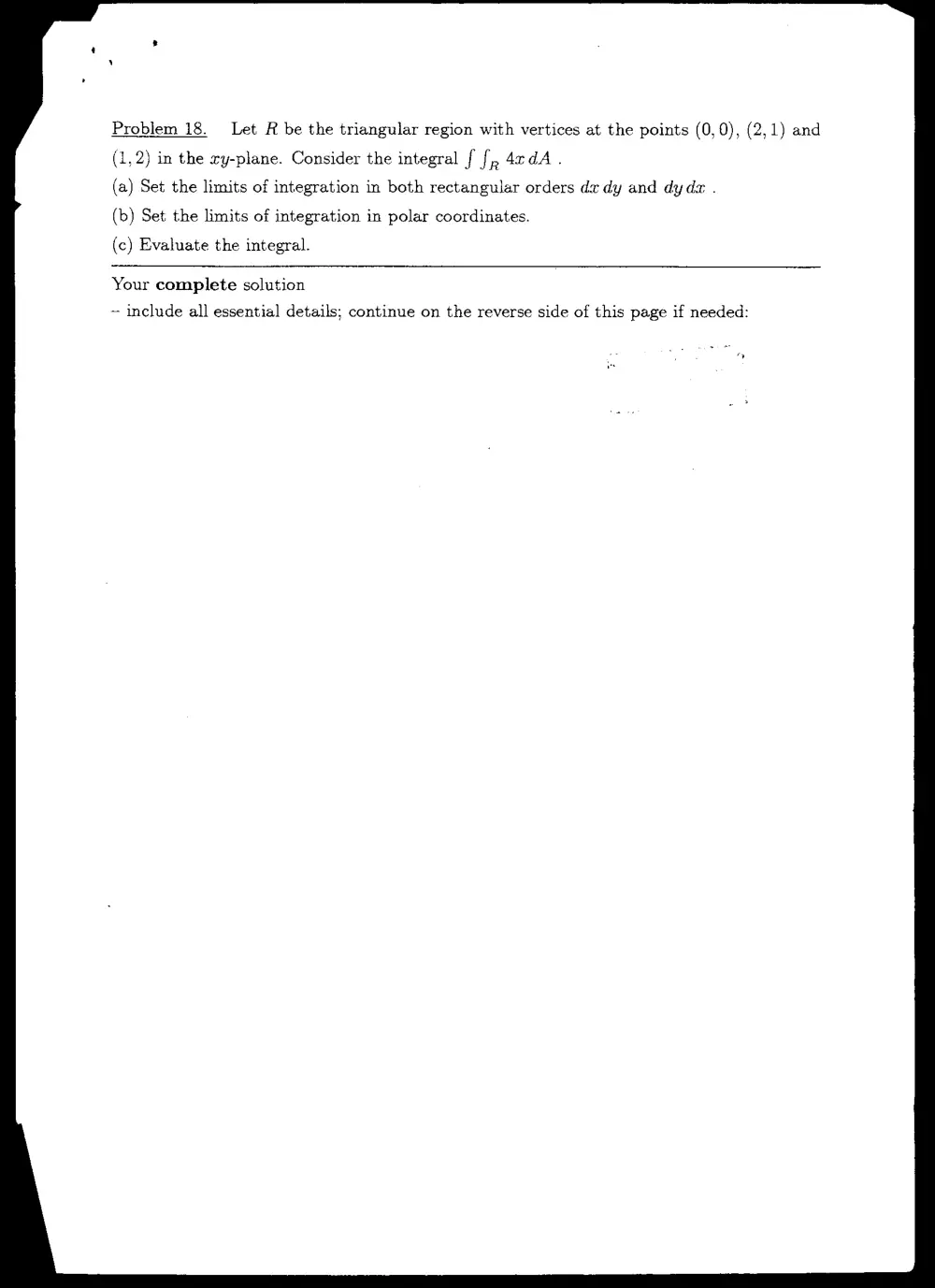
Problem 18. Let R be the triangular region with vertices at the points (0,0), (2,1) and
(1,2) in the zy-plane. Consider the integral f [, 4cdA .
) Set the limits of integration in both rectangular orders dx dy and dydz .
(a
(b) Set the limits of integration in polar coordinates.
(
c) Evaluate the integral.
Your complete solution
~ include all essential] details; continue on the reverse side of this page if needed: