
MATH 201 Final, Fall 2007
American University of Beirut · Calculus and Analytical Geometry III · 11 pages

Showing the first 10 of 11 pages. Download the PDF to see all of it.
More MATH 201 files
- Final · Spring 2019Final examView
- Problems Difficult Problem 5 Tlas 2017 Final · Spring 2019Final examView
- Final · Spring 2019Final examView
- Final · Fall 2018Final examView
- Final · Fall 2018Final examView
- Final Finals with Solution Collection · Spring 2017Final exam · with solutionView
- Final Finals with Solution Collection · Spring 2017Final exam · with solutionView
- Final · Spring 2017Final examView
Show the text of this final exam
FINAL EXAMINATION
MATH 201
January 24, 2008, 11:30-1:30pm
Name:
Student number:
Section number (Encircle):
21
22
23
Instructions:
• No calculators are allowed.
• There are two types of questions:
Part I consists of ten multiple choice questions out of 5
points each with exactly one correct answer.
Part II consists of five work-out problems out of 10
points each. Give a detailed solution for each of these
problems.
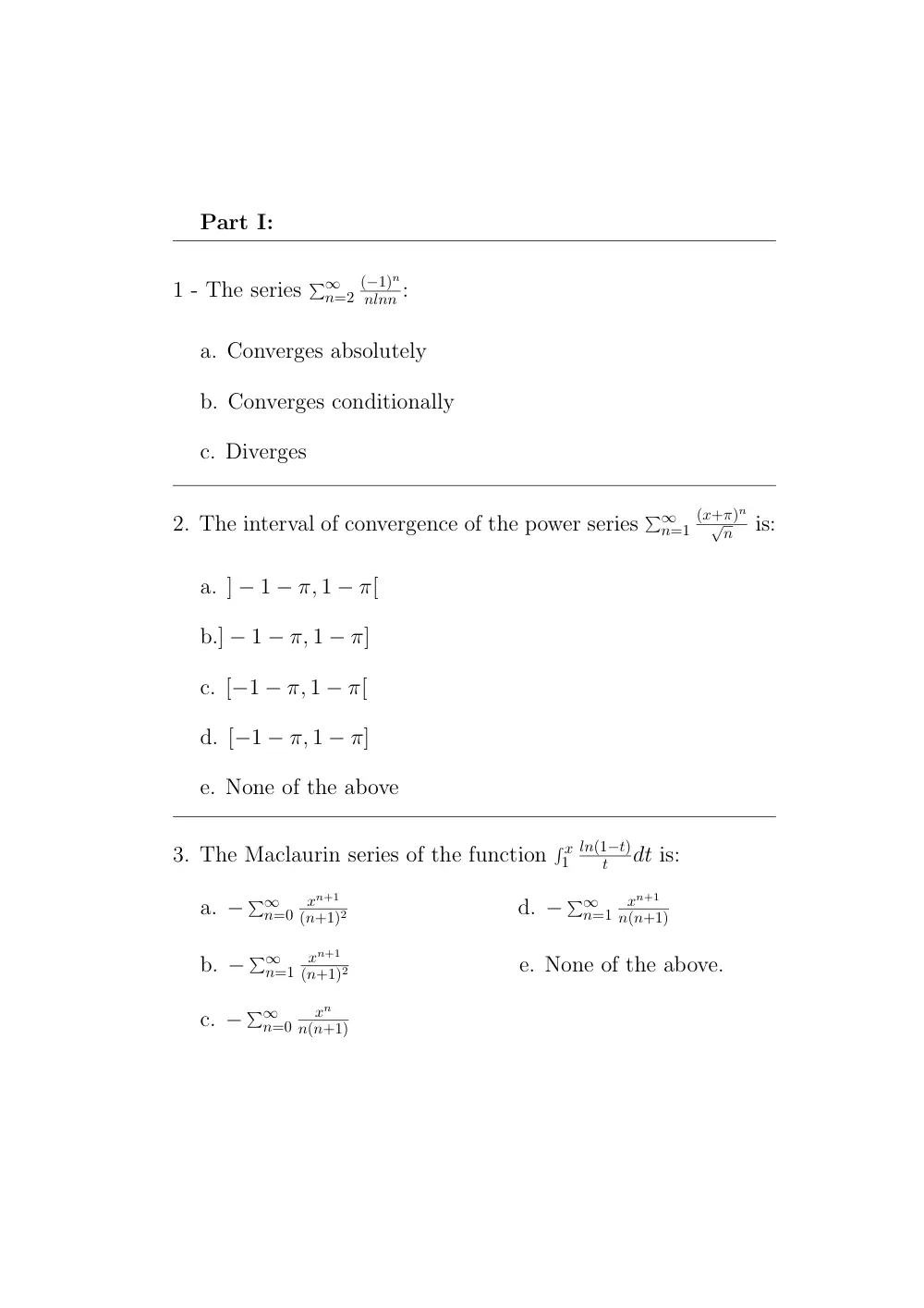
Part I:
1 - The series
�∞
n=2
(−1)n
nlnn :
a. Converges absolutely
b. Converges conditionally
c. Diverges
2. The interval of convergence of the power series
�∞
n=1
(x+π)n
√n
is:
a. ] − 1 − π, 1 − π[
b.] − 1 − π, 1 − π]
c. [−1 − π, 1 − π[
d. [−1 − π, 1 − π]
e. None of the above
3. The Maclaurin series of the function
� x
1
ln(1−t)
t
dt is:
a. −
�∞
n=0
xn+1
(n+1)2
d. −
�∞
n=1
xn+1
n(n+1)
b. −
�∞
n=1
xn+1
(n+1)2
e. None of the above.
c. −
�∞
n=0
xn
n(n+1)
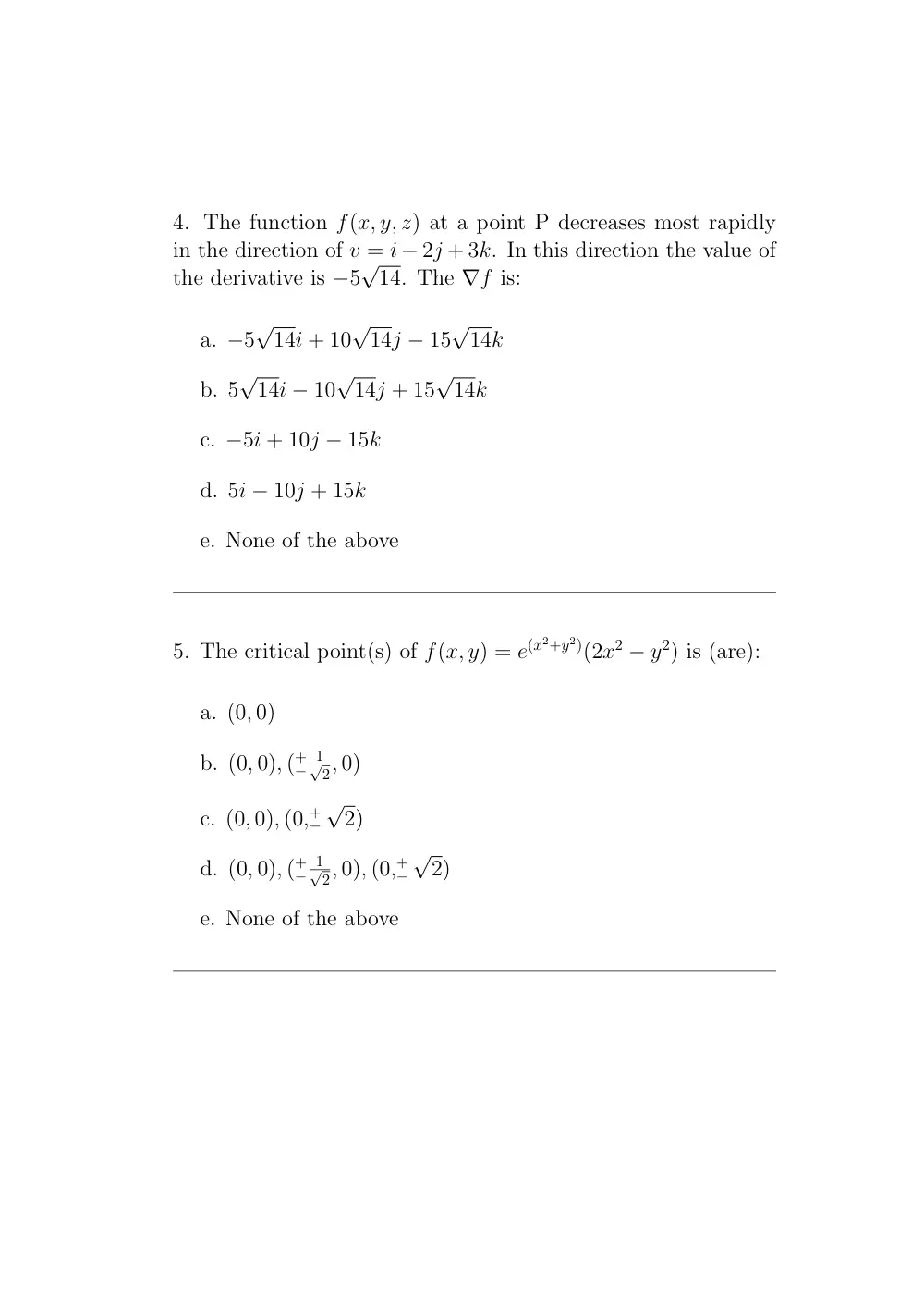
4. The function f(x, y, z) at a point P decreases most rapidly
in the direction of v = i − 2j + 3k. In this direction the value of
the derivative is −5
√
14. The ∇f is:
a. −5
√
14i + 10
√
14j − 15
√
14k
b. 5
√
14i − 10
√
14j + 15
√
14k
c. −5i + 10j − 15k
d. 5i − 10j + 15k
e. None of the above
5. The critical point(s) of f(x, y) = e(x2+y2)(2x2 − y2) is (are):
a. (0, 0)
b. (0, 0), (+
−
1
√
2, 0)
c. (0, 0), (0,+
−
√
2)
d. (0, 0), (+
−
1
√
2, 0), (0,+
−
√
2)
e. None of the above
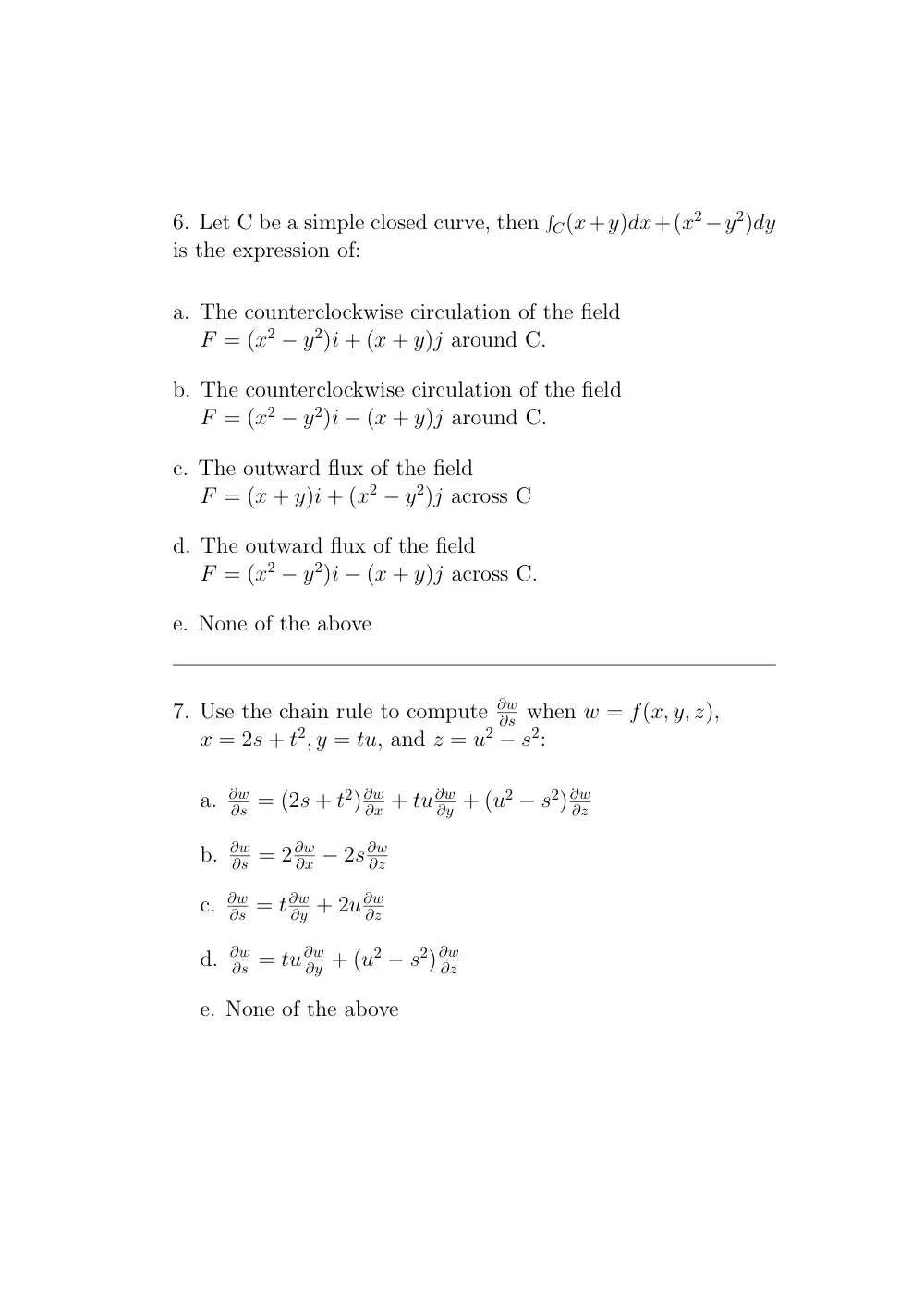
6. Let C be a simple closed curve, then
�
C(x+y)dx+(x2−y2)dy
is the expression of:
a. The counterclockwise circulation of the field
F = (x2 − y2)i + (x + y)j around C.
b. The counterclockwise circulation of the field
F = (x2 − y2)i − (x + y)j around C.
c. The outward flux of the field
F = (x + y)i + (x2 − y2)j across C
d. The outward flux of the field
F = (x2 − y2)i − (x + y)j across C.
e. None of the above
7. Use the chain rule to compute ∂w
∂s when w = f(x, y, z),
x = 2s + t2, y = tu, and z = u2 − s2:
a. ∂w
∂s = (2s + t2)∂w
∂x + tu∂w
∂y + (u2 − s2)∂w
∂z
b. ∂w
∂s = 2∂w
∂x − 2s∂w
∂z
c. ∂w
∂s = t∂w
∂y + 2u∂w
∂z
d. ∂w
∂s = tu∂w
∂y + (u2 − s2)∂w
∂z
e. None of the above
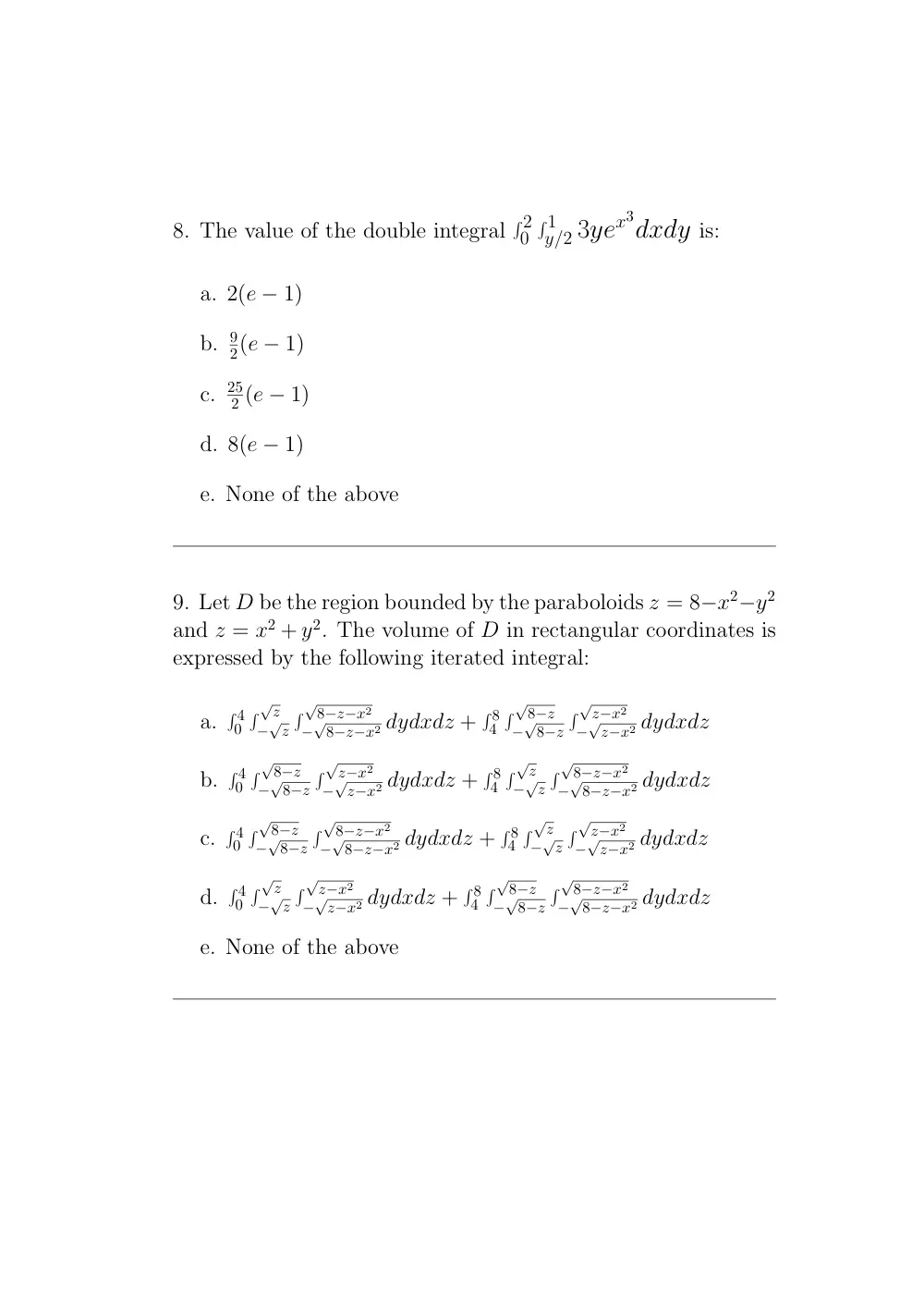
8. The value of the double integral
� 2
0
� 1
y/2 3yex3dxdy is:
a. 2(e − 1)
b. 9
2(e − 1)
c. 25
2 (e − 1)
d. 8(e − 1)
e. None of the above
9. Let D be the region bounded by the paraboloids z = 8−x2−y2
and z = x2 + y2. The volume of D in rectangular coordinates is
expressed by the following iterated integral:
a.
� 4
0
� √z
−√z
� √
8−z−x2
−
√
8−z−x2 dydxdz +
� 8
4
� √8−z
−√8−z
� √
z−x2
−
√
z−x2 dydxdz
b.
� 4
0
� √8−z
−√8−z
� √
z−x2
−
√
z−x2 dydxdz +
� 8
4
� √z
−√z
� √
8−z−x2
−
√
8−z−x2 dydxdz
c.
� 4
0
� √8−z
−√8−z
� √
8−z−x2
−
√
8−z−x2 dydxdz +
� 8
4
� √z
−√z
� √
z−x2
−
√
z−x2 dydxdz
d.
� 4
0
� √z
−√z
� √
z−x2
−
√
z−x2 dydxdz +
� 8
4
� √8−z
−√8−z
� √
8−z−x2
−
√
8−z−x2 dydxdz
e. None of the above
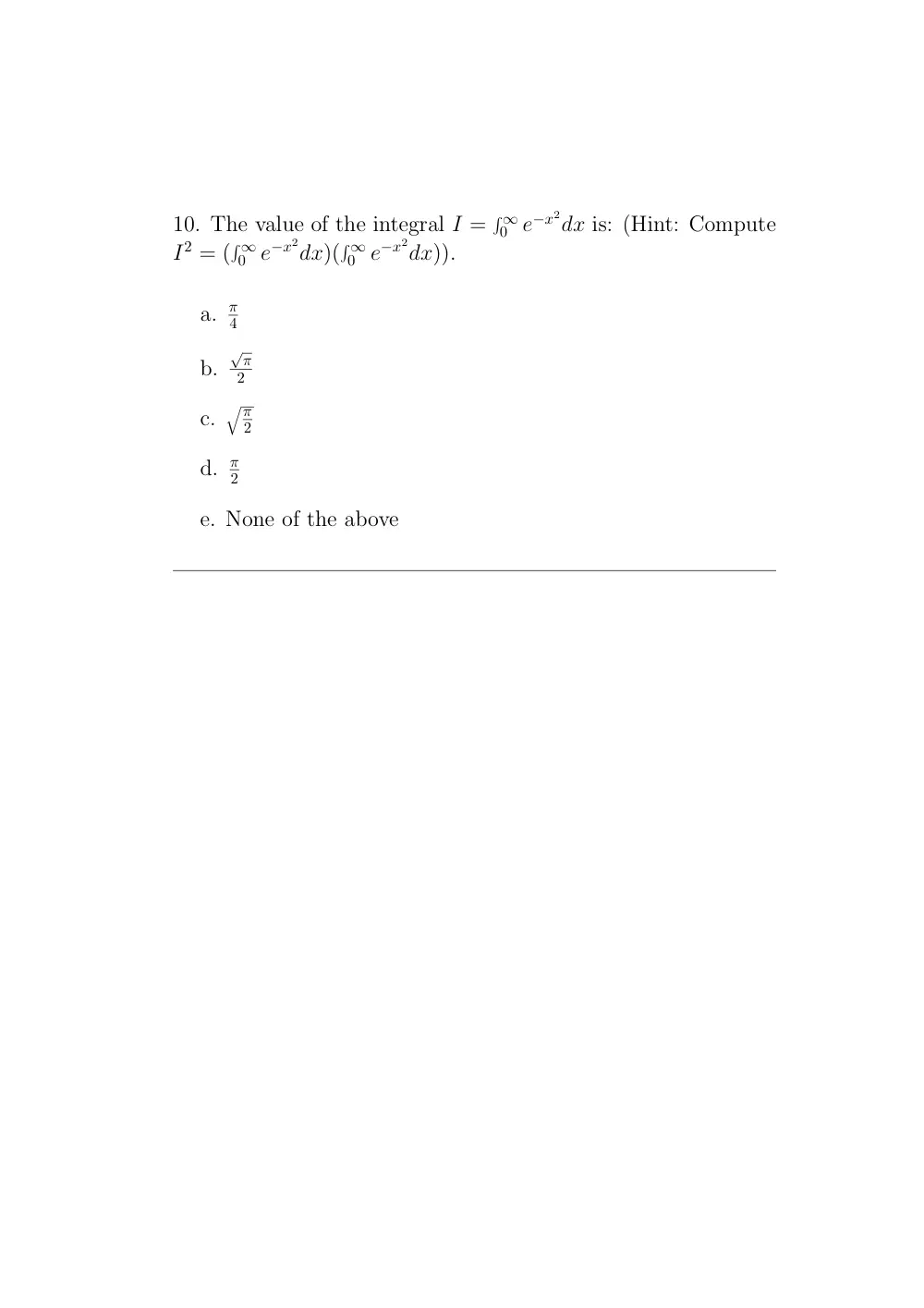
10. The value of the integral I =
� ∞
0 e−x2dx is: (Hint: Compute
I2 = (
� ∞
0 e−x2dx)(
� ∞
0 e−x2dx)).
a. π
4
b.
√π
2
c.
�π
2
d. π
2
e. None of the above
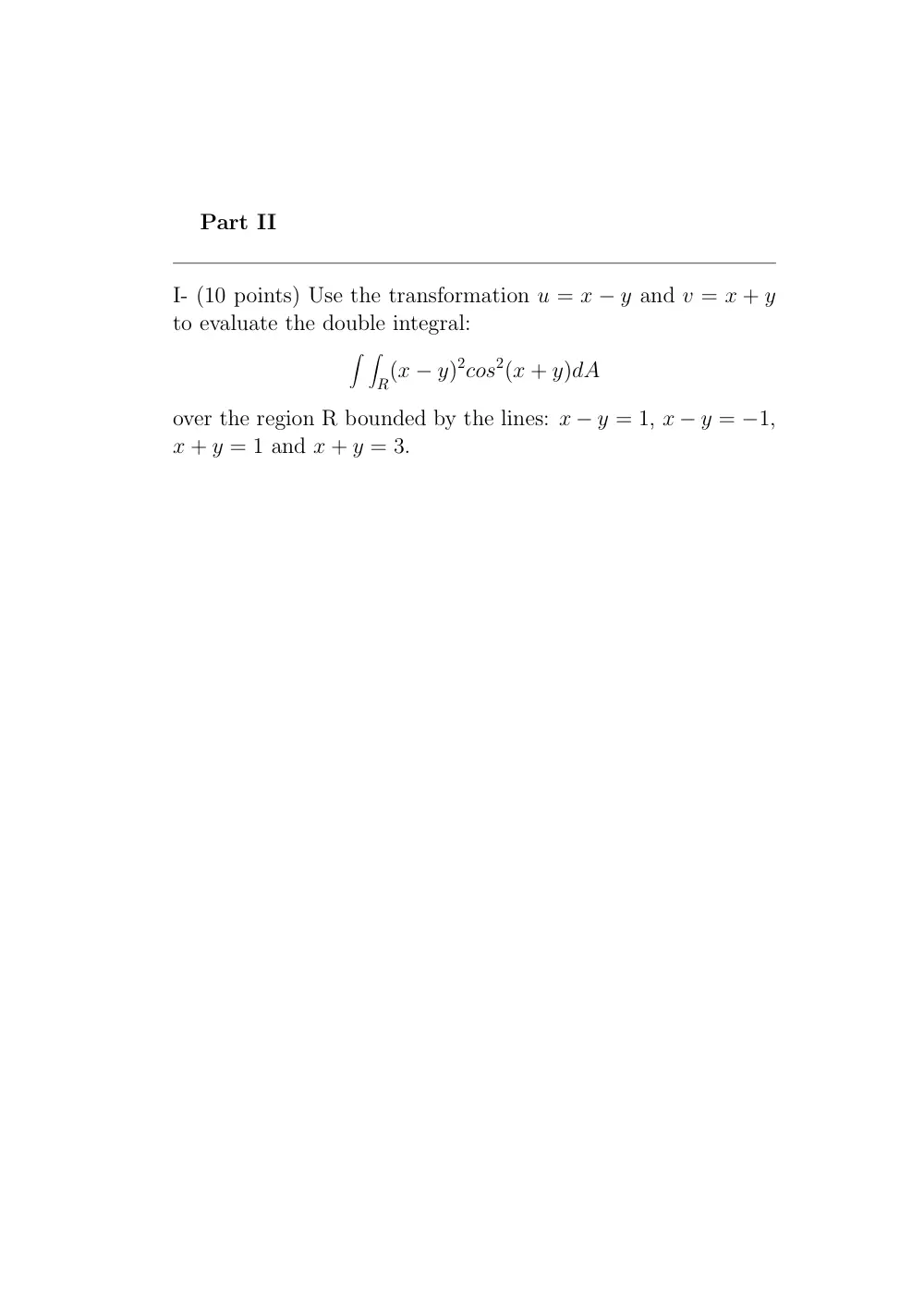
Part II
I- (10 points) Use the transformation u = x − y and v = x + y
to evaluate the double integral:
� �
R(x − y)2cos2(x + y)dA
over the region R bounded by the lines: x − y = 1, x − y = −1,
x + y = 1 and x + y = 3.
II- (10 points) Use the method of Lagrange Multipliers to
find the dimensions of the rectangle of greatest area that can be
inscribed in the ellipse x2
16 + y2
9 = 1.
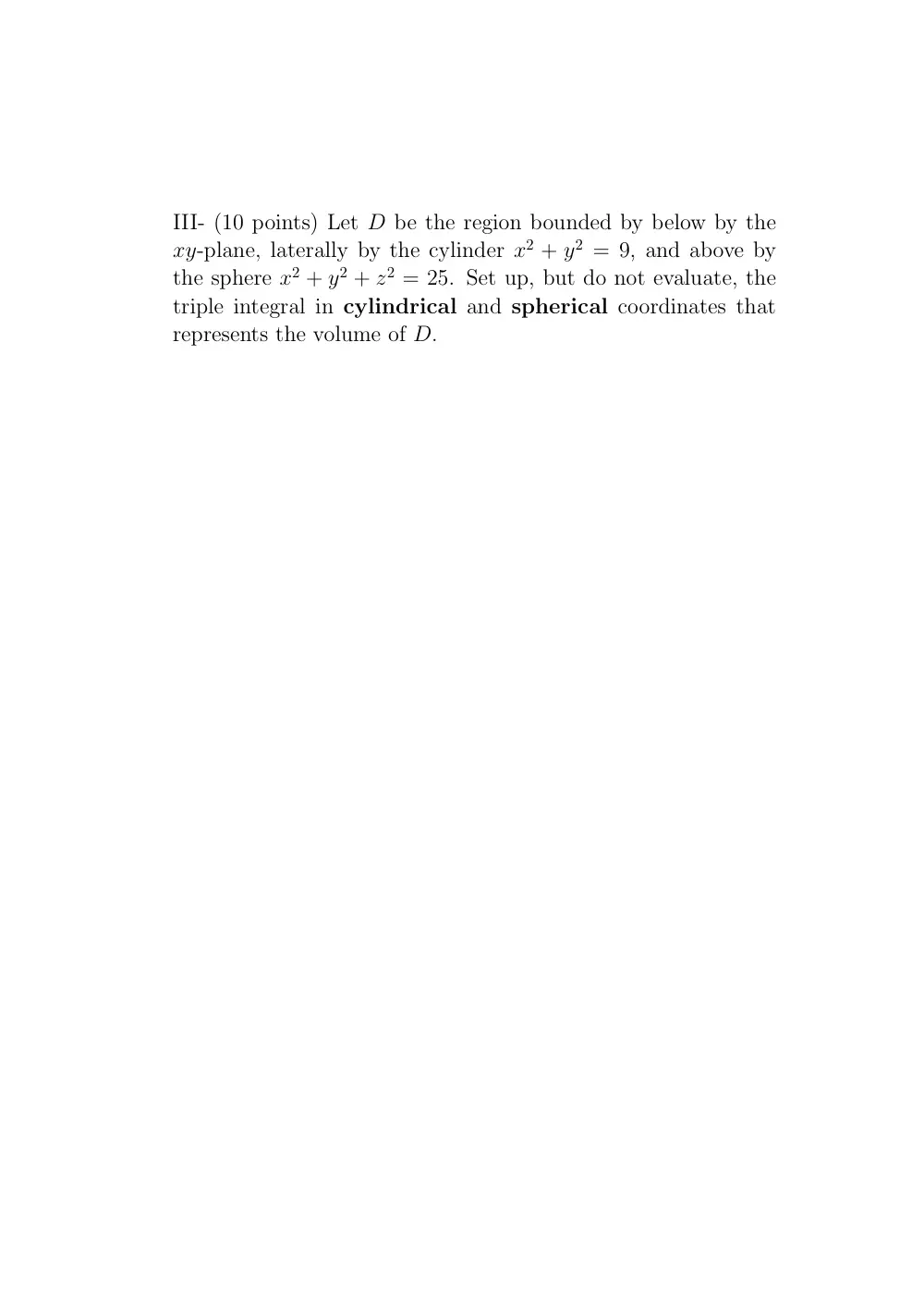
III- (10 points) Let D be the region bounded by below by the
xy-plane, laterally by the cylinder x2 + y2 = 9, and above by
the sphere x2 + y2 + z2 = 25. Set up, but do not evaluate, the
triple integral in cylindrical and spherical coordinates that
represents the volume of D.
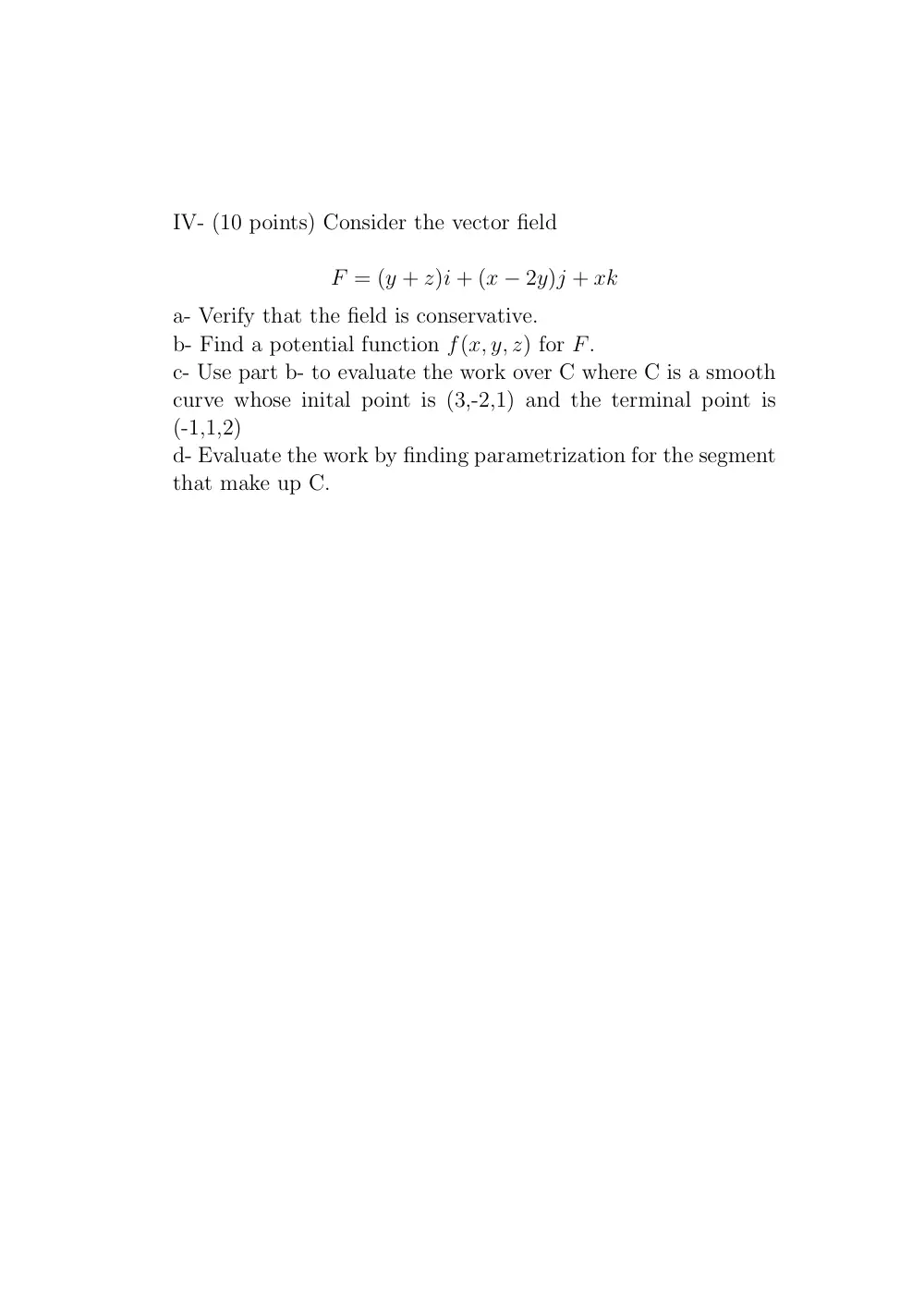
IV- (10 points) Consider the vector field
F = (y + z)i + (x − 2y)j + xk
a- Verify that the field is conservative.
b- Find a potential function f(x, y, z) for F.
c- Use part b- to evaluate the work over C where C is a smooth
curve whose inital point is (3,-2,1) and the terminal point is
(-1,1,2)
d- Evaluate the work by finding parametrization for the segment
that make up C.
V- (10 points) Let C be the closed curve in the plane starting
from (0, 0) which first goes to (1, 1) along the parabola y =
x2 and then returns to (0, 0) along the line y = x. Compute
�
C ydx + eydy twice:
a) directly
b) using Green’s theorem