
MATH 201 Final, Fall 2008
American University of Beirut · Calculus and Analytical Geometry III · 3 pages · Dr. Mohammad Kobeissi

More MATH 201 files
- Final · Spring 2019Final examView
- Final · Spring 2019Final examView
- Problems Difficult Problem 5 Tlas 2017 Final · Spring 2019Final examView
- Final · Fall 2018Final examView
- Final · Fall 2018Final examView
- Final Finals with Solution Collection · Spring 2017Final exam · with solutionView
- Final Finals with Solution Collection · Spring 2017Final exam · with solutionView
- Final · Spring 2017Final examView
Show the text of this final exam
American University of Beirut
MATH 201
Calculus and Analytic Geometry III
Fall 2008-2009
Final Exam - solution
Exercise 1 a. If f(u, v, w) is a differentiable function and if u = x−y, v = y−z, and w = z−x,
show that ∂f
∂x + ∂f
∂y + ∂f
∂z = 0
∂f
∂x = ∂f
∂u. ∂u
∂x + ∂f
∂v . ∂v
∂x + ∂f
∂w.∂w
∂x = ∂f
∂u − ∂f
∂w;
∂f
∂y = −∂f
∂u + ∂f
∂v , and ∂f
∂z = −∂f
∂v + ∂f
∂w, and hence
∂f
∂x + ∂f
∂y + ∂f
∂z = 0
b. Use the method of Lagrange multipliers to find the maximum and minimum values of
f(x, y) = 3x − y + 6 on the circle x2 + y2 = 4
∇f = λ∇g ⇔
3 = 2λx
−1 = 2λy
x2 + y2 = 4 (g(x, y) = 0)
⇔
3
2λ = x
− 1
2λ = y
x2 + y2 = 4
x2 + y2 = 4 ⇒
9
4λ2 +
1
4λ2 = 4 ⇒ λ2 = 10
16 ⇒ λ = ±
√
10
4
for λ =
√
10
4 ; x =
6
√
10, and y = −
2
√
10, and f(x, y) = 2
√
10 + 6 (maximum value of f)
for λ = −
√
10
4 ; x = −
6
√
10, and y = +
2
√
10, and f(x, y) = −2
√
10 + 6 (minimum value of f)
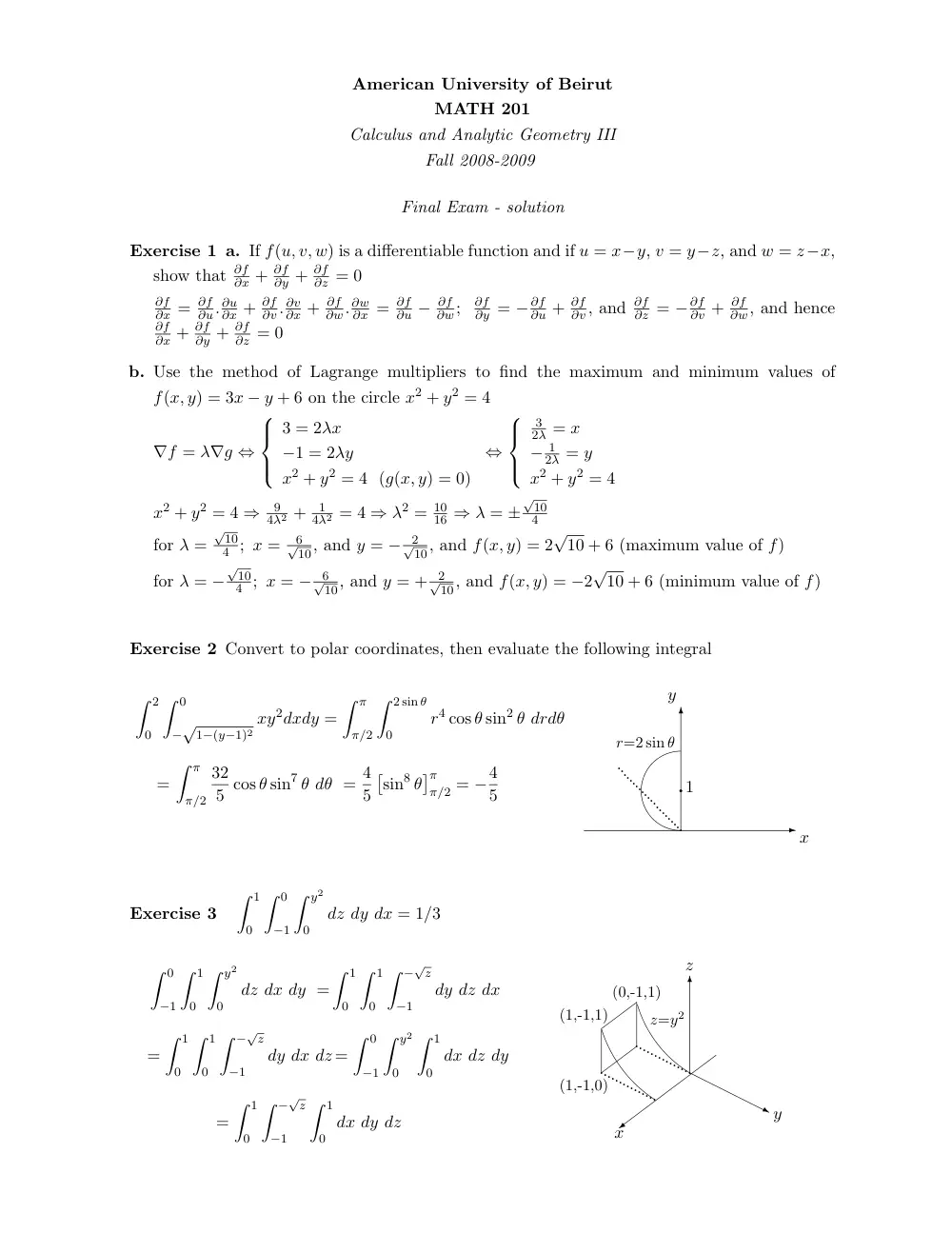
Exercise 2 Convert to polar coordinates, then evaluate the following integral
6
- x
y
1
r=2 sin θ
......................
� 2
0
� 0
−√
1−(y−1)2 xy2dxdy =
� π
π/2
� 2 sin θ
0
r4 cos θ sin2 θ drdθ
=
� π
π/2
32
5 cos θ sin7 θ dθ = 4
5
�
sin8 θ
�π
π/2 = −4
5
Exercise 3
� 1
0
� 0
−1
� y2
0
dz dy dx = 1/3
=
j
x
6
z=y2
y
z
(0,-1,1)
...............
...............
(1,-1,1)
(1,-1,0)
� 0
−1
� 1
0
� y2
0
dz dx dy =
� 1
0
� 1
0
� −√z
−1
dy dz dx
=
� 1
0
� 1
0
� −√z
−1
dy dx dz =
� 0
−1
� y2
0
� 1
0
dx dz dy
=
� 1
0
� −√z
−1
� 1
0
dx dy dz
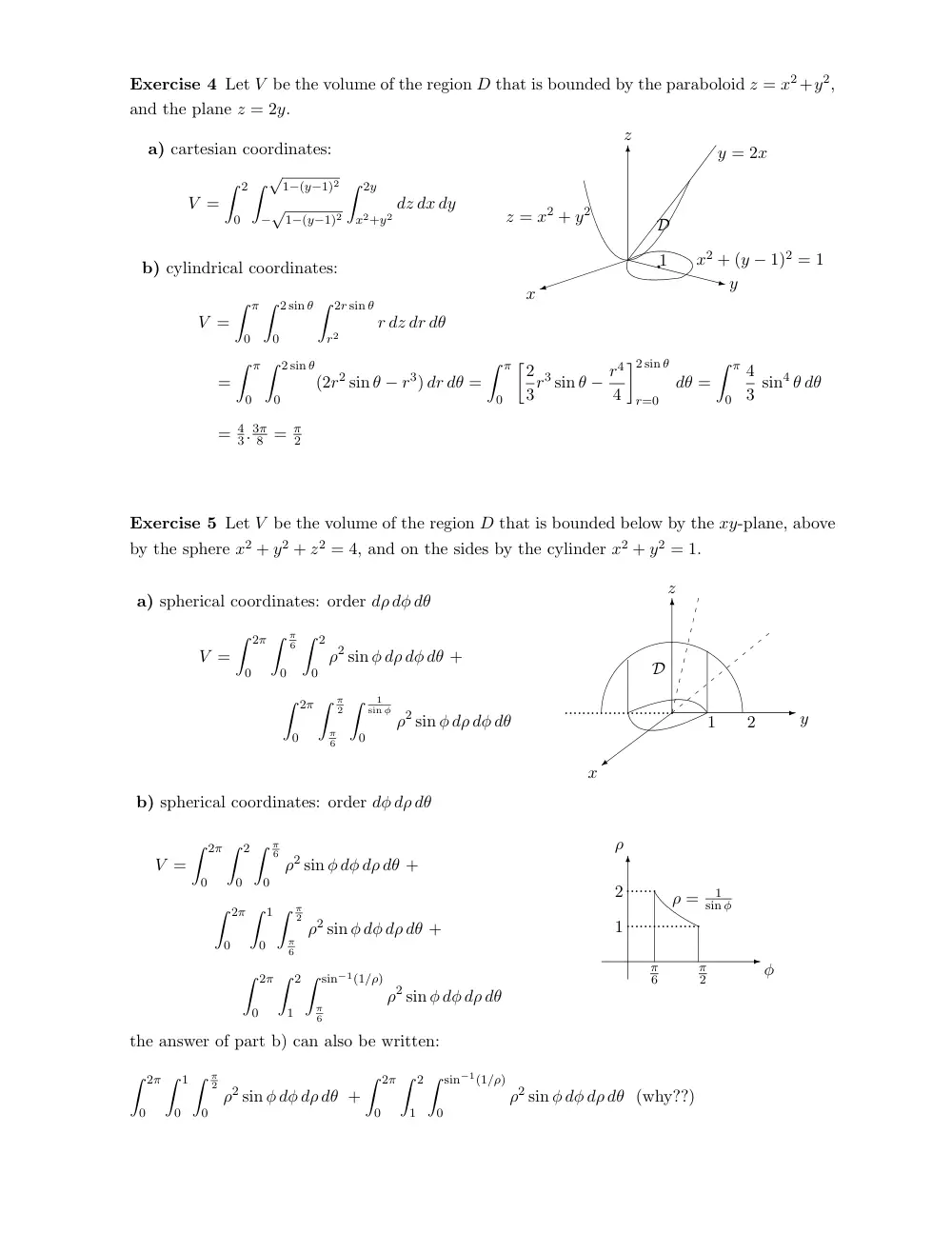
Exercise 4 Let V be the volume of the region D that is bounded by the paraboloid z = x2+y2,
and the plane z = 2y.
6
z
z
x )
y
D
x2 + (y − 1)2 = 1
1
z = x2 + y2
y = 2x
a) cartesian coordinates:
V =
� 2
0
� √
1−(y−1)2
−√
1−(y−1)2
� 2y
x2+y2 dz dx dy
b) cylindrical coordinates:
V =
� π
0
� 2 sin θ
0
� 2r sin θ
r2
r dz dr dθ
=
� π
0
� 2 sin θ
0
(2r2 sin θ − r3) dr dθ =
� π
0
�2
3r3 sin θ − r4
4
�2 sin θ
r=0
dθ =
� π
0
4
3 sin4 θ dθ
= 4
3.3π
8 = π
2
Exercise 5 Let V be the volume of the region D that is bounded below by the xy-plane, above
by the sphere x2 + y2 + z2 = 4, and on the sides by the cylinder x2 + y2 = 1.
6
-
=
.........................
x
y
z
1
2
D
a) spherical coordinates: order dρ dφ dθ
V =
� 2π
0
�
π
6
0
� 2
0
ρ2 sin φ dρ dφ dθ +
� 2π
0
�
π
2
π
6
�
1
sin φ
0
ρ2 sin φ dρ dφ dθ
6
- φ
ρ
π
6
π
2
.................
.......
1
2
ρ =
1
sin φ
b) spherical coordinates: order dφ dρ dθ
V =
� 2π
0
� 2
0
�
π
6
0
ρ2 sin φ dφ dρ dθ +
� 2π
0
� 1
0
�
π
2
π
6
ρ2 sin φ dφ dρ dθ +
� 2π
0
� 2
1
� sin−1(1/ρ)
π
6
ρ2 sin φ dφ dρ dθ
the answer of part b) can also be written:
� 2π
0
� 1
0
�
π
2
0
ρ2 sin φ dφ dρ dθ +
� 2π
0
� 2
1
� sin−1(1/ρ)
0
ρ2 sin φ dφ dρ dθ (why??)
Exercise 6 a. Find the work done by the force F = xi + y2j + (y − z)k along the straight line
from (0, 0, 0) to (1, 1, 1).
r(t) = ti + tj + tk , 0 ≤ t ≤ 1; dr
dt = i + j + k, F(t) = ti + t2k, and F � dr
dt = t + t2, hence
W =
� 1
0
(t + t2)dt = 5/6
b. Evaluate
� (1,π/2,e)
(0,0,1)
(ln z + ex sin y)dx + ex cos ydy + (x/z − z)dz
f(x, y, z) = x ln z + ex sin y − z2
2 + C is a potential function (check it!), hence
� (1,π/2,e)
(0,0,1)
(ln z + ex sin y)dx + ex cos ydy + (x/z − z)dz =
�
x ln z + ex sin y − z2
2
�(1,π/2,e)
(0,0,1)
=
3
2 + e − e2
2
c. Find the outward flux of the field F = (y − 2x)i + (x + y)j across the curve C in the first
quadrant, bounded by the lines y = 0, y = x and x + y = 1.
6
- x
x + y = 1
y
C1
y = x
C2
C3
R
-
i) direct calculation: Flux =
�
C
Mdy − Ndx
C1 : r1(t) = ti , 0 ≤ t ≤ 1; Mdy − Ndx = −tdt
and
�
C1
Mdy − Ndx =
� 1
0
−tdt = −1/2
C2 : r2(t) = (1 − t)i + tj , 0 ≤ t ≤ 1/2;
Mdy − Ndx = (1 − 3t)dt
and
�
C2
Mdy − Ndx =
� 1/2
0
(1 − 3t)dt = −1/8
C3 : r3(t) = (1
2 − t)i + (1
2 − t)j , 0 ≤ t ≤ 1/2; Mdy − Ndx = (3
2 − 3t)dt, and
�
C3
Mdy − Ndx =
� 1/2
0
(3
2 − 3t)dt = 3/8
Flux(F) =
�
C
Mdy − Ndx = −1/2 − 1/8 + 3/8 = −1/4
ii) Green’s theorem: Flux =
� �
R
divFdA
divF = ∂M
∂x + ∂N
∂y = −2 + 1 = −1
� �
R
divFdA =
� 1/2
0
� 1−y
y
− dxdy =
� 1/2
0
(2y − 1)dy = −1/4