
MATH 201 Final, Fall 2008
American University of Beirut · Calculus and Analytical Geometry III · 2 pages · Prof. Wissam Raji

More MATH 201 files
- Final · Spring 2019Final examView
- Final · Spring 2019Final examView
- Problems Difficult Problem 5 Tlas 2017 Final · Spring 2019Final examView
- Final · Fall 2018Final examView
- Final · Fall 2018Final examView
- Final Finals with Solution Collection · Spring 2017Final exam · with solutionView
- Final Finals with Solution Collection · Spring 2017Final exam · with solutionView
- Final · Spring 2017Final examView
Show the text of this final exam
Final Exam-Math 201
• Write your name and your I.D. on the booklet
• The duration of the test is two hours
• Calculators are allowed
1. (5 points) Determine whether �∞
n=1
(tan−1n)2
n2+1
converge or diverge. Please provide all the
details.
2. (10 points) a) Show that for | x |< 1, we have
ln1 + x
1 − x = 2
�
x + x3
3 + x5
5 + ...
�
.
(Hint: Determine the expansion of ln(1 + x) and ln(1 − x) first to determine the expansion
of ln 1+x
1−x).
b) How many terms of the Mclaurin series for ln(1 + x) should you add to be sure of
calculating ln1.1 with an error of magnitude less than 10−8.
3. (10 points) Find the maximum and the minimum values of the function f(x, y) = 3x + 4y
on the circle x2 + y2 = 1 by using the method of Lagrange multipliers.
4. (10 points) Your company manufactures right circular cylindrical molasses storage tanks
that are 25 feet high with a radius of 5 feet. How sensitive are the tanks’ volumes to small
variations in height and radius. After finding the formula for the change in volume, calculate
the change in volume if the radius changes from 5 to 5.1 and the height changes from 25 to
24.3.(Hint: The volume of the tank is given by V = πr2h).
5. (5 points) Find all the local extreme values of the function f(x, y) = xy−x2−y2−2x−2y+4.
1
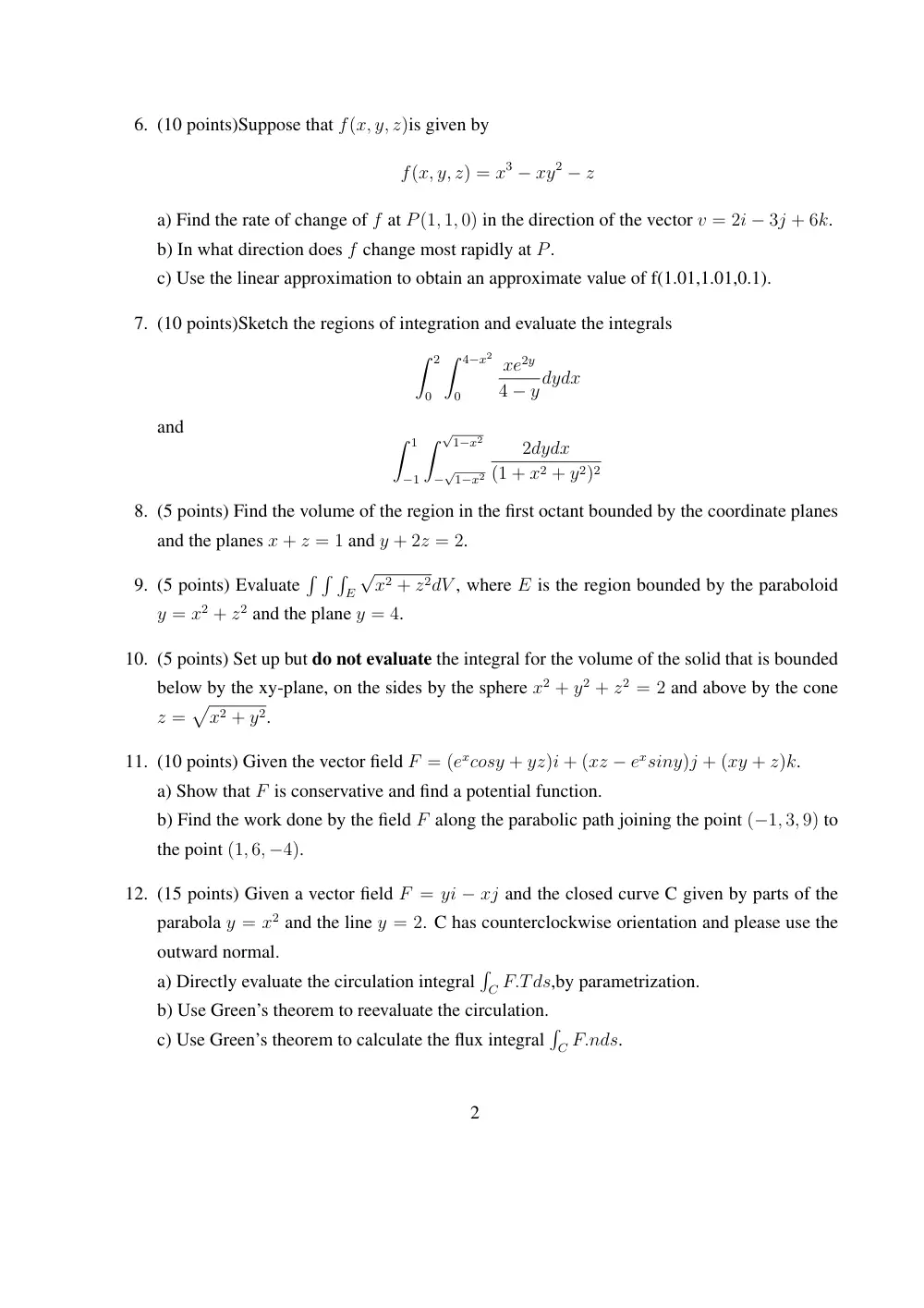
6. (10 points)Suppose that f(x, y, z)is given by
f(x, y, z) = x3 − xy2 − z
a) Find the rate of change of f at P(1, 1, 0) in the direction of the vector v = 2i − 3j + 6k.
b) In what direction does f change most rapidly at P.
c) Use the linear approximation to obtain an approximate value of f(1.01,1.01,0.1).
7. (10 points)Sketch the regions of integration and evaluate the integrals
� 2
0
� 4−x2
0
xe2y
4 − ydydx
and
� 1
−1
� √
1−x2
−
√
1−x2
2dydx
(1 + x2 + y2)2
8. (5 points) Find the volume of the region in the first octant bounded by the coordinate planes
and the planes x + z = 1 and y + 2z = 2.
9. (5 points) Evaluate
� � �
E
√
x2 + z2dV , where E is the region bounded by the paraboloid
y = x2 + z2 and the plane y = 4.
10. (5 points) Set up but do not evaluate the integral for the volume of the solid that is bounded
below by the xy-plane, on the sides by the sphere x2 + y2 + z2 = 2 and above by the cone
z =
�
x2 + y2.
11. (10 points) Given the vector field F = (excosy + yz)i + (xz − exsiny)j + (xy + z)k.
a) Show that F is conservative and find a potential function.
b) Find the work done by the field F along the parabolic path joining the point (−1, 3, 9) to
the point (1, 6, −4).
12. (15 points) Given a vector field F = yi − xj and the closed curve C given by parts of the
parabola y = x2 and the line y = 2. C has counterclockwise orientation and please use the
outward normal.
a) Directly evaluate the circulation integral
�
C F.Tds,by parametrization.
b) Use Green’s theorem to reevaluate the circulation.
c) Use Green’s theorem to calculate the flux integral
�
C F.nds.
2