
MATH 201 Final, Fall 2008
American University of Beirut · Calculus and Analytical Geometry III · 12 pages




Showing the first 10 of 12 pages. Download the PDF to see all of it.
More MATH 201 files
- Final · Spring 2019Final examView
- Final · Spring 2019Final examView
- Problems Difficult Problem 5 Tlas 2017 Final · Spring 2019Final examView
- Final · Fall 2018Final examView
- Final · Fall 2018Final examView
- Final Finals with Solution Collection · Spring 2017Final exam · with solutionView
- Final Finals with Solution Collection · Spring 2017Final exam · with solutionView
- Final · Spring 2017Final examView
Show the text of this final exam
1
FINAL EXAMINATION
MATH 201
January 24, 2008; 11:30 A.M.-1:30 P.M.
Name:
Signature:
Circle Your Section Number:
17.
18
19
20
24
25
Instructions:
• There are two types of questions:
PART I consists of six work-out problems. Give detailed solutions.
PART II consists of eight multiple-choice questions each with exactly
one correct answer. Circle the appropriate answer.
Grading policy:
• 10 points for each problem of PART I.
• 5 points for each problem of PART II.
• 0 point for no, wrong, or more than one answer of PART II.
GRADE OF PART I
/60
GRADE OF PART II
/40
TOTAL GRADE
/100
2
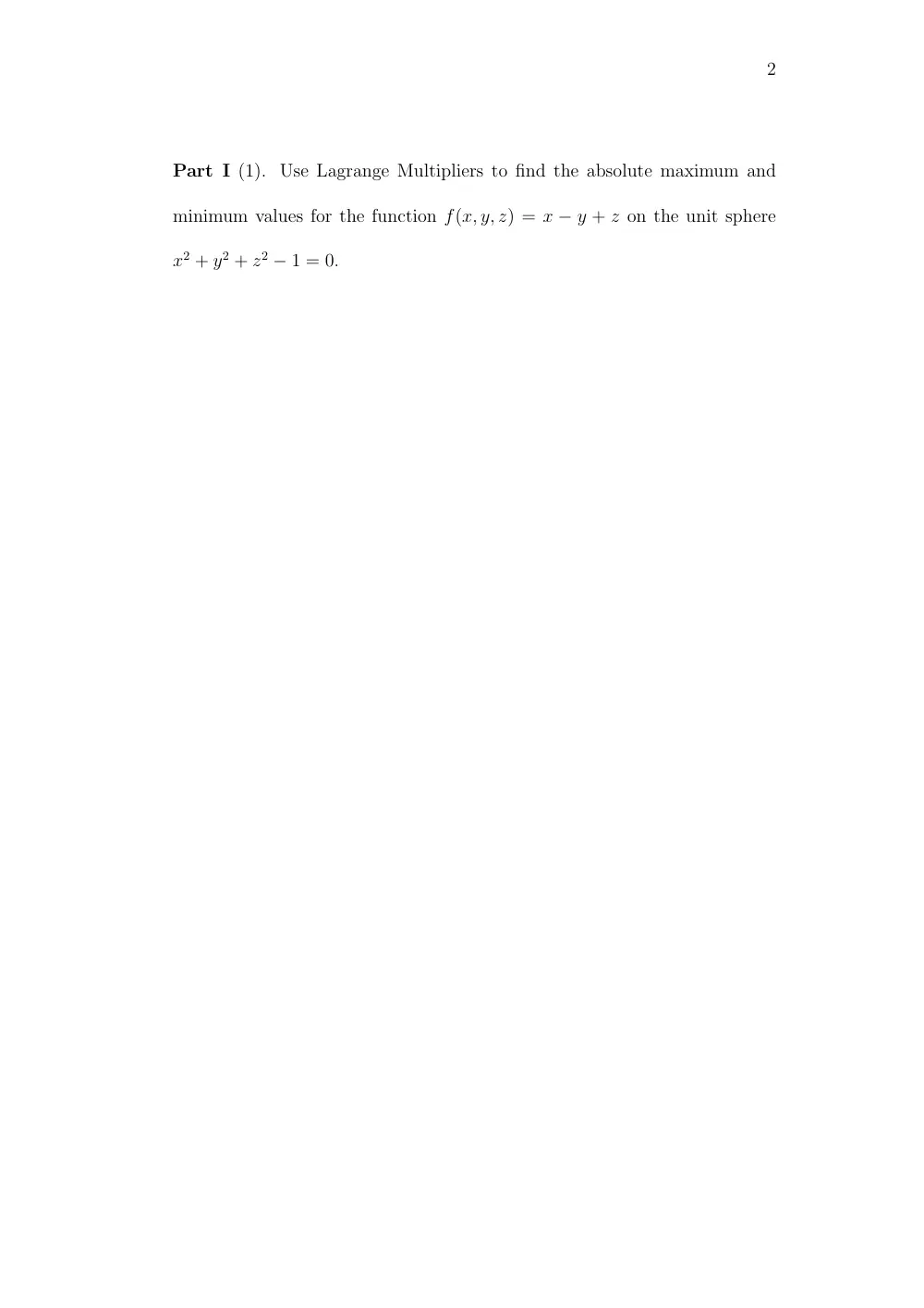
Part I (1). Use Lagrange Multipliers to find the absolute maximum and
minimum values for the function f(x, y, z) = x − y + z on the unit sphere
x2 + y2 + z2 − 1 = 0.
3
Part I (2).
Use cylindrical coordinates to find the volume of the solid
bounded above by the surface z = e
√x2 + y2
, below by the xy−plane, and
laterally by the cylinder x2 + y2 = 1.
4
Part I (3). Find the absolute maximum and minimum values of the function
f(x, y) = x2 +3y −3xy over the triangular region R bounded by the x−axis,
the y−axis, and the line x + y = 6.
5
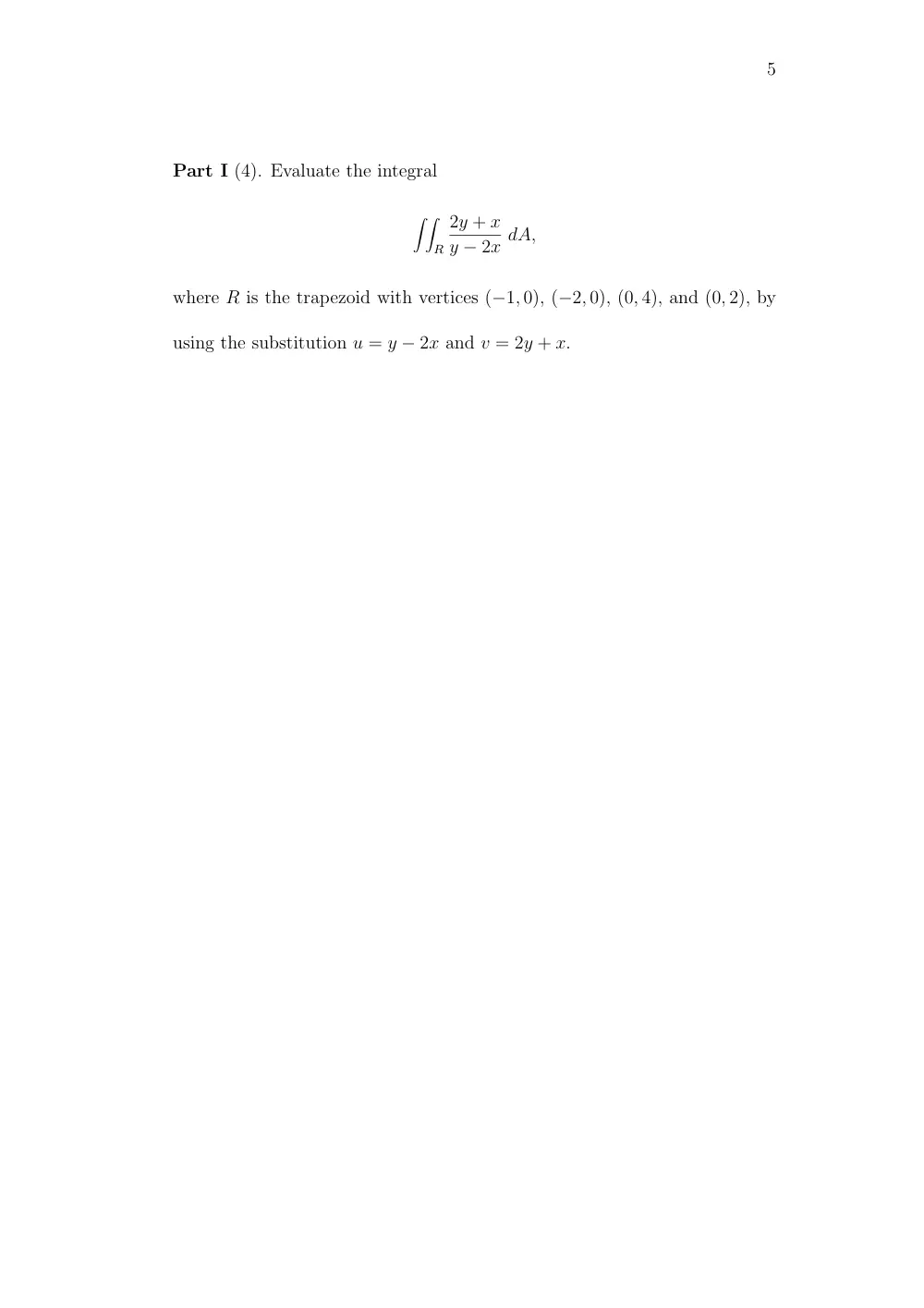
Part I (4). Evaluate the integral
� �
R
2y + x
y − 2x dA,
where R is the trapezoid with vertices (−1, 0), (−2, 0), (0, 4), and (0, 2), by
using the substitution u = y − 2x and v = 2y + x.
6
7
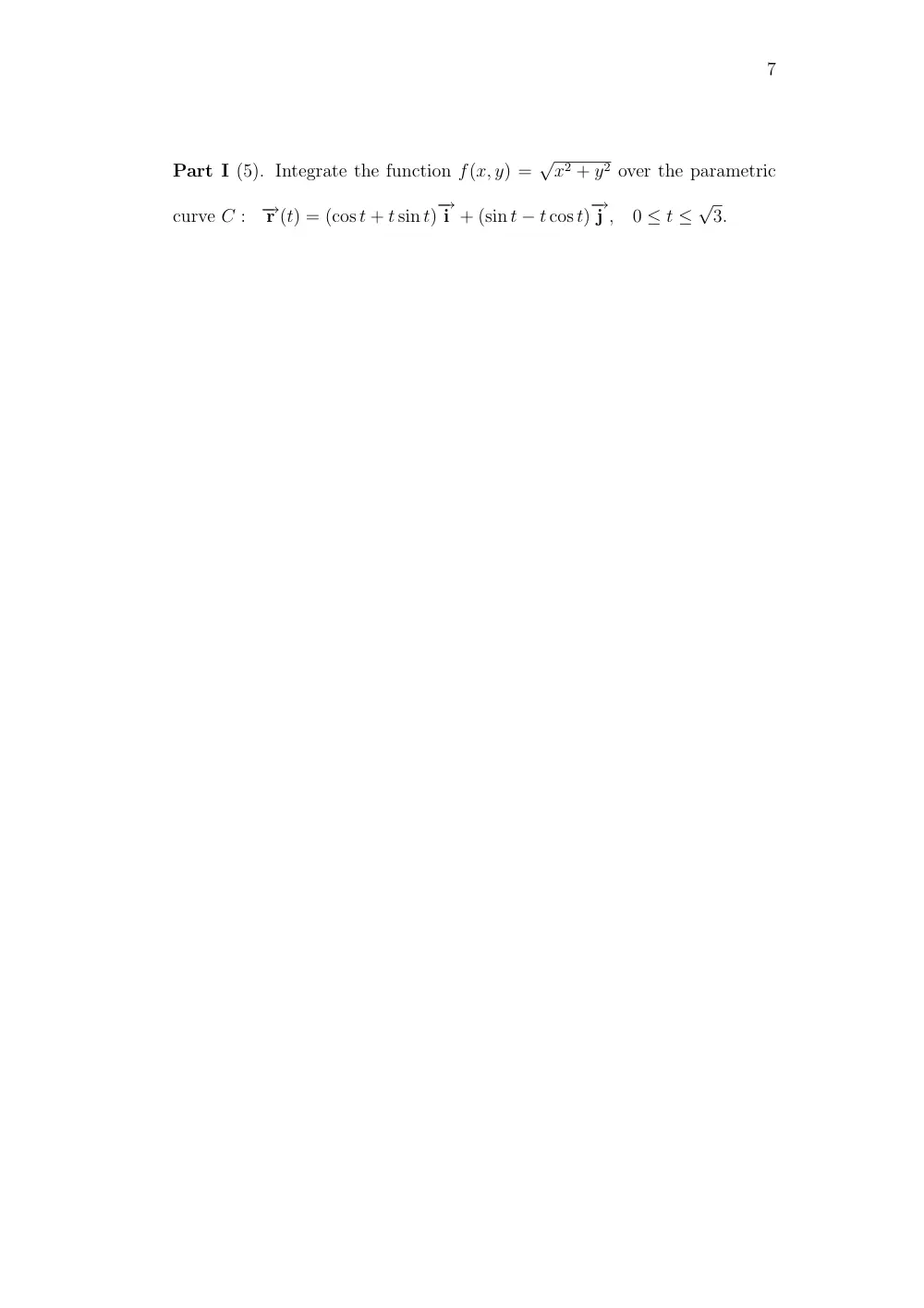
Part I (5). Integrate the function f(x, y) = √x2 + y2 over the parametric
curve C :
−→r (t) = (cos t + t sin t)−→i + (sin t − t cos t)−→j ,
0 ≤ t ≤
√
3.
8
Part I (6). Sketch the region of integration of the integral
� 4
0
� 2
√y x3 cos(xy) dx dy,
and evaluate the integral by reversing its order of integration.
9
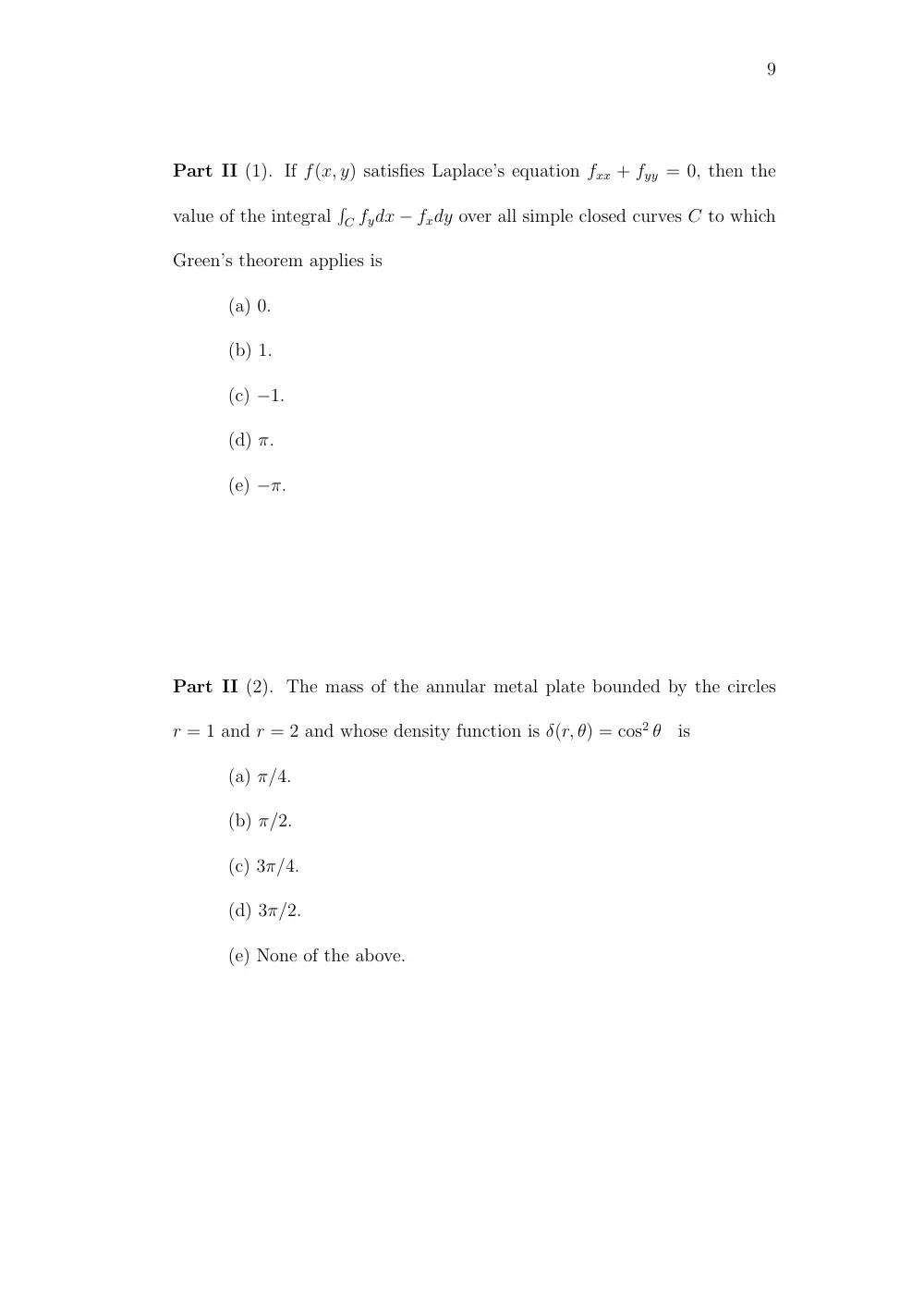
Part II (1). If f(x, y) satisfies Laplace’s equation fxx + fyy = 0, then the
value of the integral
�
C fydx − fxdy over all simple closed curves C to which
Green’s theorem applies is
(a) 0.
(b) 1.
(c) −1.
(d) π.
(e) −π.
Part II (2). The mass of the annular metal plate bounded by the circles
r = 1 and r = 2 and whose density function is δ(r, θ) = cos2 θ
is
(a) π/4.
(b) π/2.
(c) 3π/4.
(d) 3π/2.
(e) None of the above.
10
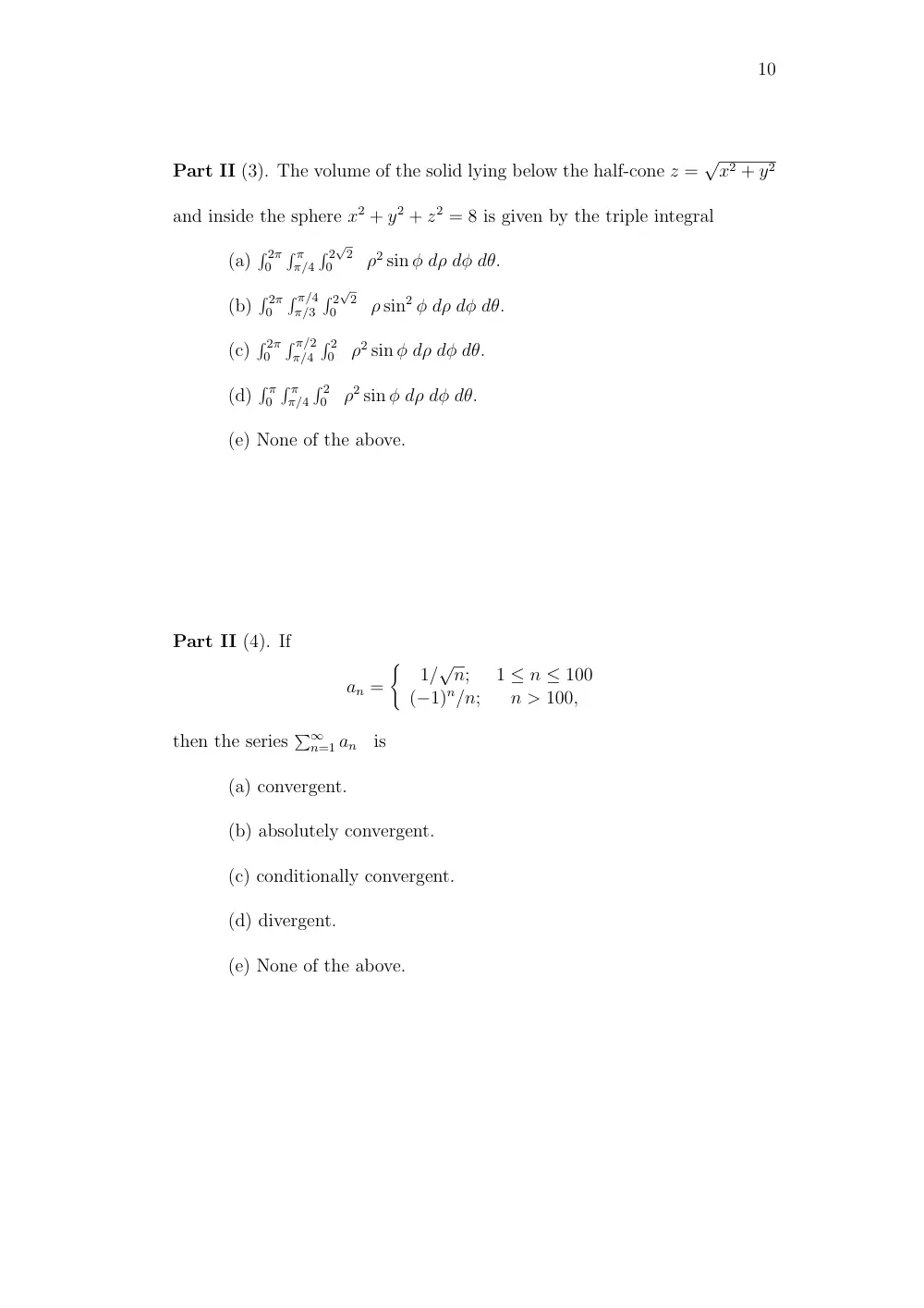
Part II (3). The volume of the solid lying below the half-cone z = √x2 + y2
and inside the sphere x2 + y2 + z2 = 8 is given by the triple integral
(a)
� 2π
0
� π
π/4
� 2
√
0 2
ρ2 sin φ dρ dφ dθ.
(b)
� 2π
0
� π/4
π/3
� 2
√
0 2
ρ sin2 φ dρ dφ dθ.
(c)
� 2π
0
� π/2
π/4
� 2
0
ρ2 sin φ dρ dφ dθ.
(d)
� π
0
� π
π/4
� 2
0
ρ2 sin φ dρ dφ dθ.
(e) None of the above.
Part II (4). If
an =
�
1/√n;
1 ≤ n ≤ 100
(−1)n/n;
n > 100,
then the series �∞
n=1 an
is
(a) convergent.
(b) absolutely convergent.
(c) conditionally convergent.
(d) divergent.
(e) None of the above.
11
Part II (5). The power series
∞
�
k=2
(−1)k (2x − 1)k
k6k
has interval of absolute convergence
(a) −5/2 < x ≤ 7/2.
(b) −5/2 < x < 7/2.
(c) −5/2 ≤ x < 7/2.
(d) −5/2 ≤ x ≤ 7/2.
(e) None of the above.
Part II (6). The directional derivative of the function
f(x, y, z) = x2 + 4y2 − 9z2
at the point P(3, 0, −4) in the direction from P to the origin is
(a) 52.
(b) −52.
(c) 54.
(d) −54.
(e) None of the above.
12
Part II (7) The function f(x, y) = x2 − 4xy + y3 + 4y
(a) has local minimum at (4, 2) and local maximum at (4/3, 2/3).
(b) has local minimum at (4, 2) and saddle point at (4/3, 2/3).
(c) has local maximum at (4, 2) and saddle point at (4/3, 2/3).
(d) has saddle point at (4, 2) and local minimum at (4/3, 2/3).
(e) None of the above.
Part II (8) An equation of the tangent plane to the surface 2x2−y+5z2 = 0
at the point (1, 7, 1) is
(a) 3x − y + z = −3.
(b) x + y + 2z = 10.
(c) 10x − y + 4z = 7.
(d) 4x − y + 10z = 7.
(e) None of the above.