
MATH 201 Final, Fall 2009
American University of Beirut · Calculus and Analytical Geometry III · 13 pages · Prof. Nazih Nahlus


Showing the first 10 of 13 pages. Download the PDF to see all of it.
More MATH 201 files
- Final · Spring 2019Final examView
- Final · Spring 2019Final examView
- Problems Difficult Problem 5 Tlas 2017 Final · Spring 2019Final examView
- Final · Fall 2018Final examView
- Final · Fall 2018Final examView
- Final Finals with Solution Collection · Spring 2017Final exam · with solutionView
- Final Finals with Solution Collection · Spring 2017Final exam · with solutionView
- Final · Spring 2017Final examView
Show the text of this final exam
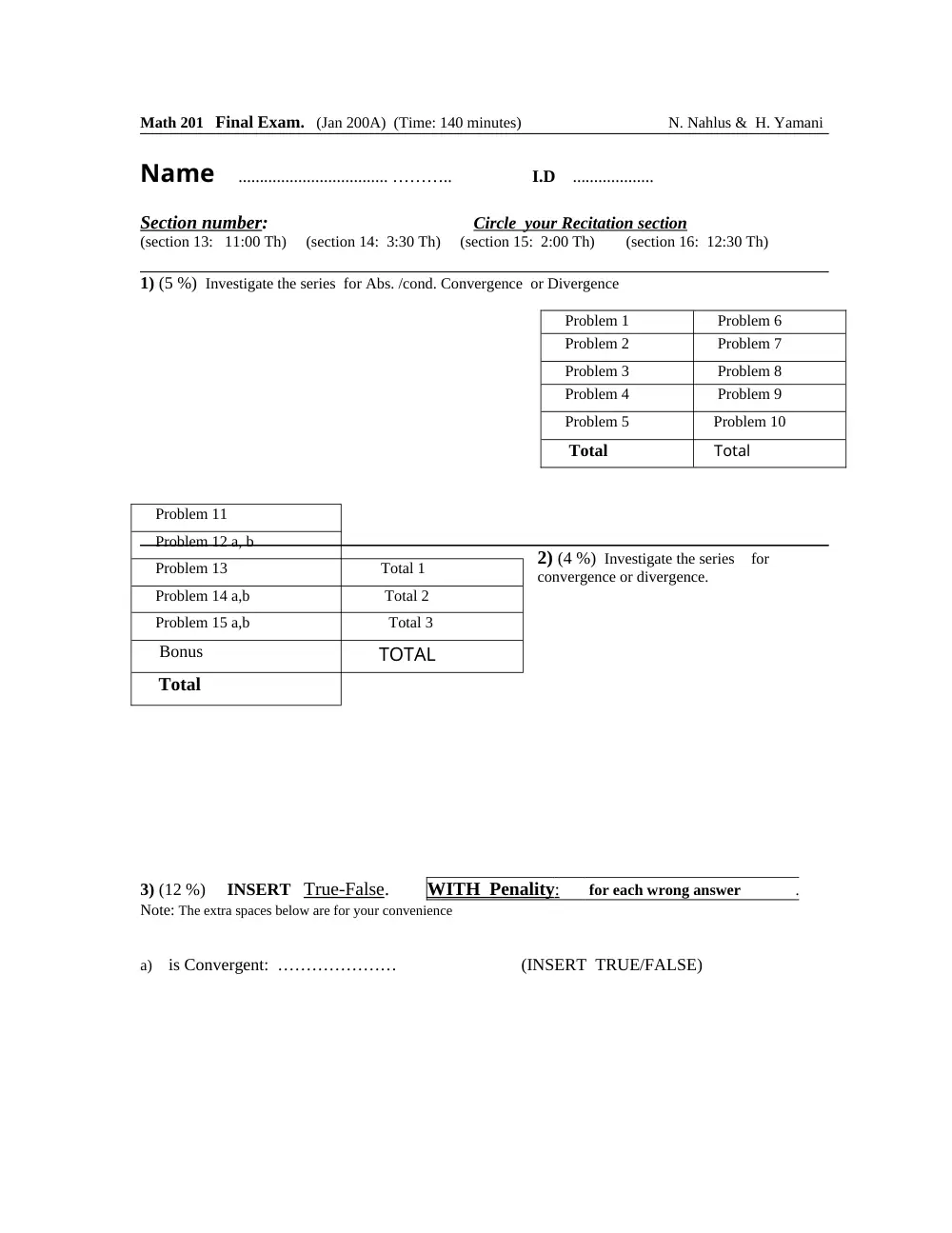
Math 201 Final Exam. (Jan 200A) (Time: 140 minutes) N. Nahlus & H. Yamani
Name ................................... ………..
I.D ...................
Section number: Circle your Recitation section
(section 13: 11:00 Th) (section 14: 3:30 Th) (section 15: 2:00 Th) (section 16: 12:30 Th)
1) (5 %) Investigate the series for Abs. /cond. Convergence or Divergence
Problem 1
Problem 6
Problem 2
Problem 7
Problem 3
Problem 8
Problem 4
Problem 9
Problem 5
Problem 10
Total
Total
2) (4 %) Investigate the series for
convergence or divergence.
3) (12 %) INSERT True-False. WITH Penality
: for each wrong answer .
Note: The extra spaces below are for your convenience
a) is Convergent: ………………… (INSERT TRUE/FALSE)
Problem 11
Problem 12 a, b
Problem 13
Total 1
Problem 14 a,b
Total 2
Problem 15 a,b
Total 3
Bonus
TOTAL
Total
b) a) is Convergent: ………………… (INSERT TRUE/FALSE)
c) (for all n) implies is Divergent: ………… (INSERT TRUE/FALSE)
d) is Divergent: ………… (INSERT TRUE/FALSE)
4)
(6%) Find the domain of convergence of
|
|
|
|
|
|
|
|
|
|
|
|
|
|
|
|
|
|
|
|
|
|
|
|
|
|
|
|
|
5. (5 %) (i) Find
.
(ii) Deduce the value of .
Hint: From tabular integration,
|
|
|
|
|
|
|
|
|
|
|
|
|
|
|
|
|
|
|
|
|
|
|
|
|
|
|
|
|
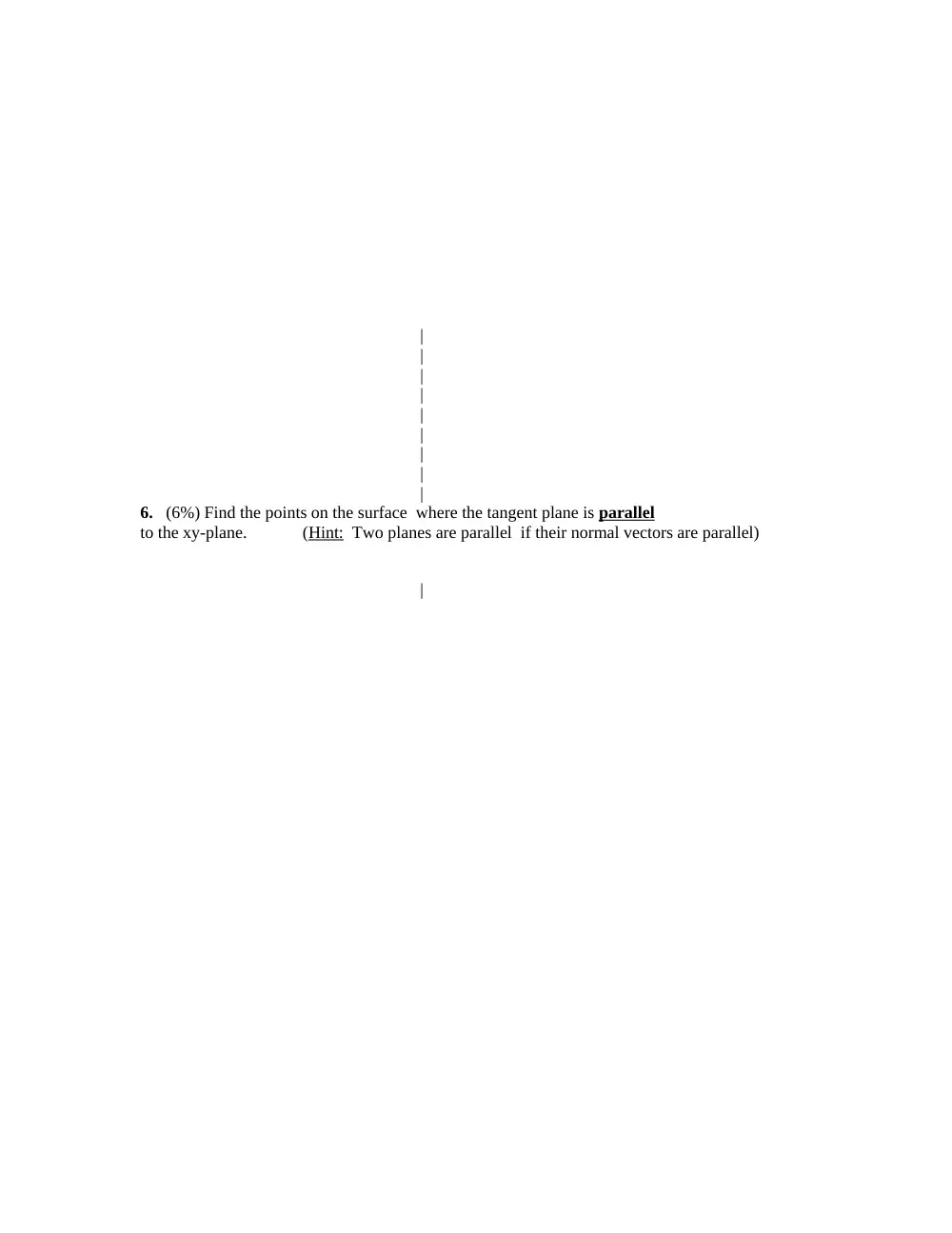
6. (6%) Find the points on the surface where the tangent plane is parallel
to the xy-plane. (Hint: Two planes are parallel if their normal vectors are parallel)
|
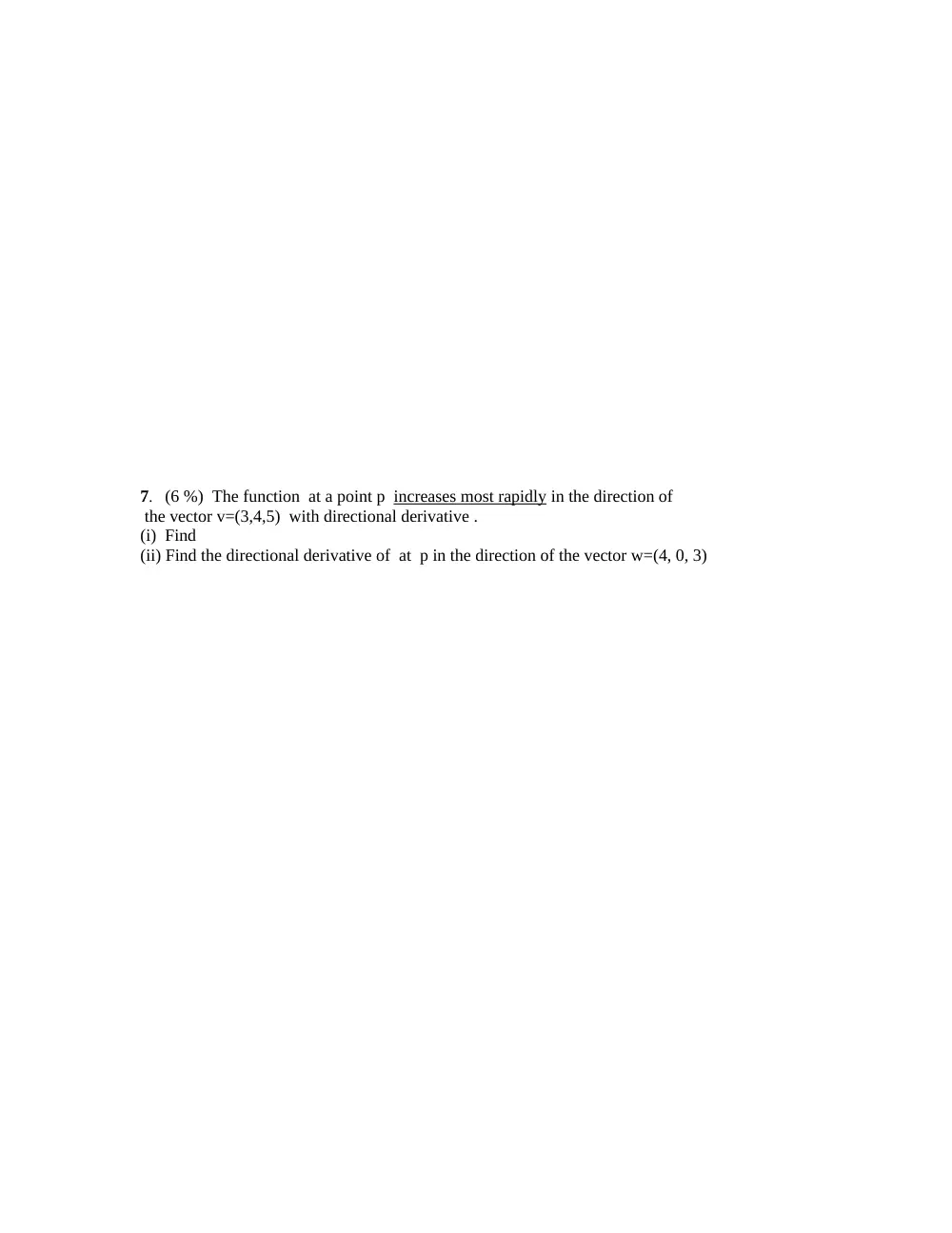
7. (6 %) The function at a point p increases most rapidly in the direction of
the vector v=(3,4,5) with directional derivative .
(i) Find
(ii) Find the directional derivative of at p in the direction of the vector w=(4, 0, 3)
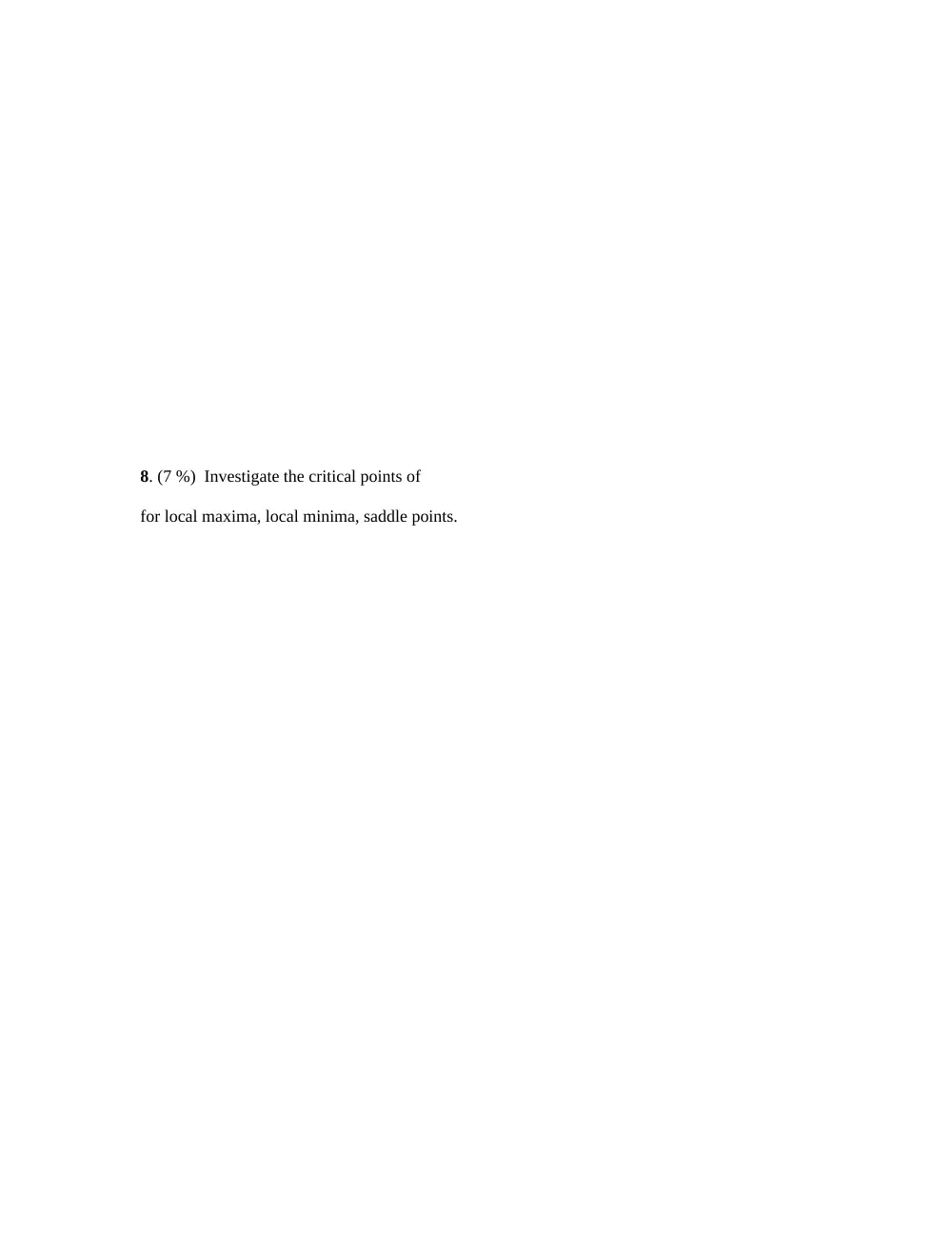
8. (7 %) Investigate the critical points of
for local maxima, local minima, saddle points.
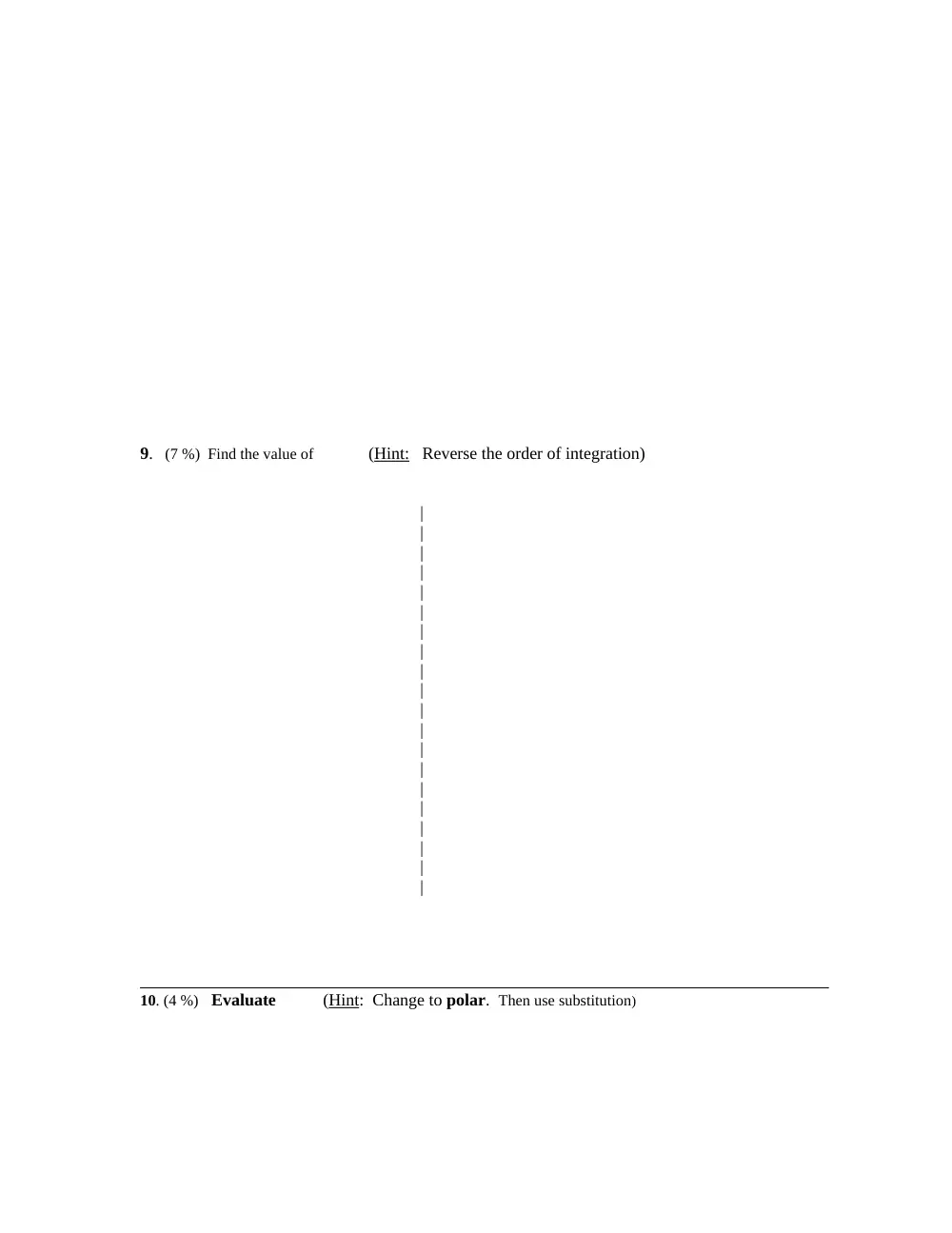
9. (7 %) Find the value of (Hint: Reverse the order of integration)
|
|
|
|
|
|
|
|
|
|
|
|
|
|
|
|
|
|
|
|
10. (4 %) Evaluate (Hint: Change to polar. Then use substitution)
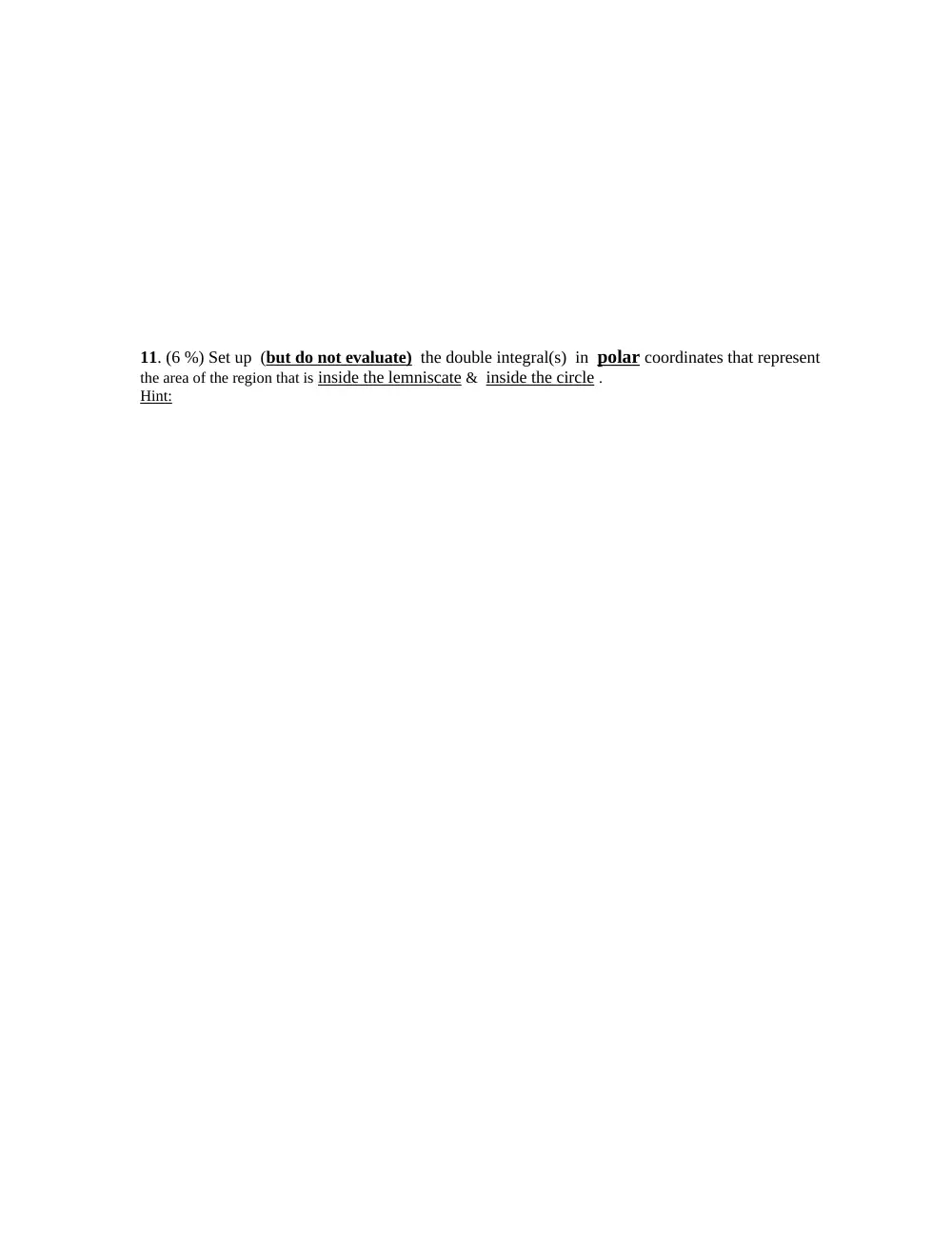
11. (6 %) Set up (but do not evaluate) the double integral(s) in polar coordinates that represent
the area of the region that is inside the lemniscate & inside the circle .
Hint:
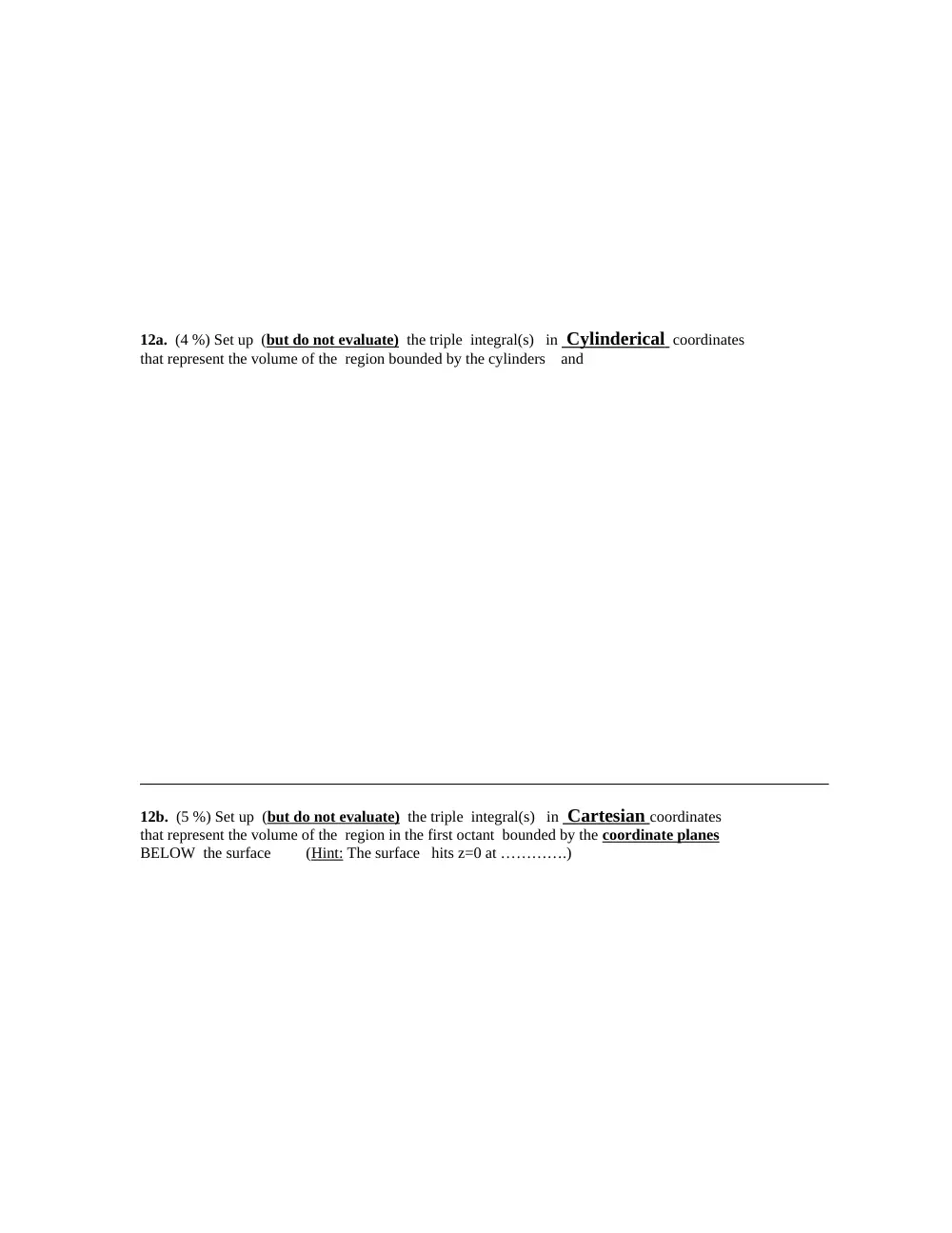
12a. (4 %) Set up (but do not evaluate) the triple integral(s) in Cylinderical
coordinates
that represent the volume of the region bounded by the cylinders and
12b. (5 %) Set up (but do not evaluate) the triple integral(s) in Cartesian coordinates
that represent the volume of the region in the first octant bounded by the coordinate planes
BELOW the surface (Hint: The surface hits z=0 at ………….)
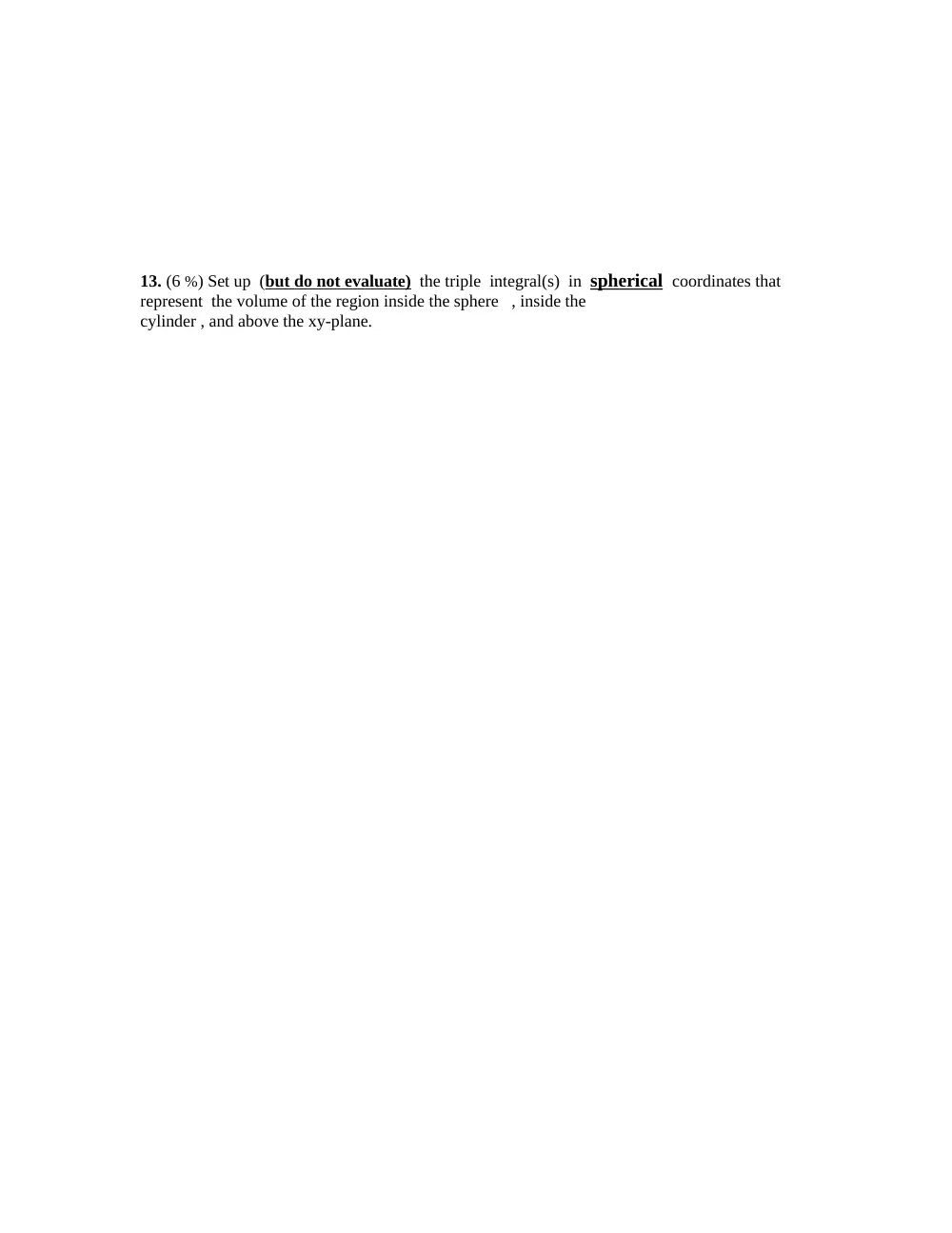
13. (6 %) Set up (but do not evaluate) the triple integral(s) in spherical coordinates that
represent the volume of the region inside the sphere , inside the
cylinder , and above the xy-plane.
Note: All curves below are assumed to be (smooth, counter clockwise & traced once)
14a. (5 %) Use Green’s Theorem to find
where C is the circle:
14b. (4 %) Find where C is a complicated curve (not passing through the origin) from A(1,1) to
B(3,2).
(Hint: By inspection, By inspection, find your potential function f(x,y))
15a. (3 %) Use Green’s Theorem (in a clever way) to find where C is the circle
.
15b. (5 %) Use Green’s theorem (with holes) to find
where C is any complicated simple closed curve around the origin.
Hint: Assume without proof that except at the origin
Bonus 4 % Use Gauss Theorem (or the divergence Theorem)
to find the outward flux of the vector field
(i)
across the sphere
(ii)
across the sphere
Reminder: JUST use Gauss Theorem. (Do not, Do not, calculate )