
MATH 201 Final, Fall 2009
American University of Beirut · Calculus and Analytical Geometry III · 4 pages · Dr. Mohammad Kobeissi


More MATH 201 files
- Final · Spring 2019Final examView
- Final · Spring 2019Final examView
- Problems Difficult Problem 5 Tlas 2017 Final · Spring 2019Final examView
- Final · Fall 2018Final examView
- Final · Fall 2018Final examView
- Final Finals with Solution Collection · Spring 2017Final exam · with solutionView
- Final Finals with Solution Collection · Spring 2017Final exam · with solutionView
- Final · Spring 2017Final examView
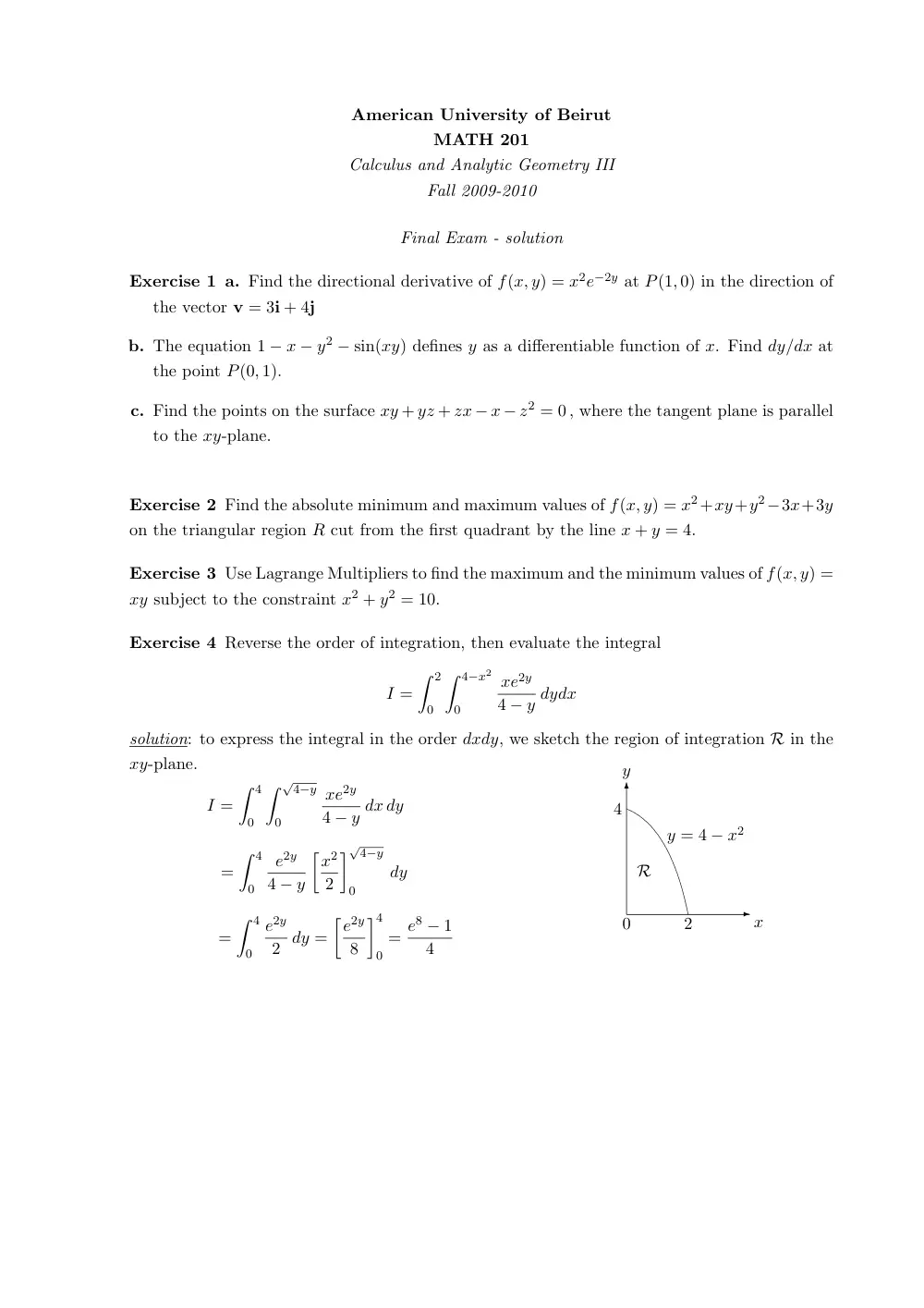
Show the text of this final exam
American University of Beirut
MATH 201
Calculus and Analytic Geometry III
Fall 2009-2010
Final Exam - solution
Exercise 1 a. Find the directional derivative of f(x, y) = x2e−2y at P(1, 0) in the direction of
the vector v = 3i + 4j
b. The equation 1 − x − y2 − sin(xy) defines y as a differentiable function of x. Find dy/dx at
the point P(0, 1).
c. Find the points on the surface xy + yz + zx − x − z2 = 0 , where the tangent plane is parallel
to the xy-plane.
Exercise 2 Find the absolute minimum and maximum values of f(x, y) = x2+xy+y2−3x+3y
on the triangular region R cut from the first quadrant by the line x + y = 4.
Exercise 3 Use Lagrange Multipliers to find the maximum and the minimum values of f(x, y) =
xy subject to the constraint x2 + y2 = 10.
Exercise 4 Reverse the order of integration, then evaluate the integral
I =
∫ 2
0
∫ 4−x2
0
xe2y
4 − y dydx
solution: to express the integral in the order dxdy, we sketch the region of integration R in the
xy-plane.
6
-
y
y = 4 − x2
R
2
0
4
x
I =
∫ 4
0
∫ √4−y
0
xe2y
4 − y dx dy
=
∫ 4
0
e2y
4 − y
[x2
2
]√4−y
0
dy
=
∫ 4
0
e2y
2 dy =
[e2y
8
]4
0
= e8 − 1
4
Exercise 5 Let V be the volume of the region D that is bounded below by the xy-plane, above
by the paraboloid z = 9 − x2 − y2, and lying outside the cylinder x2 + y2 = 1.
solution:
6
-
�
x
y
z
1
D
3
a) V =
∫ 2π
0
∫ 3
1
∫ 9−r2
0
r dzdrdθ
= 2π
∫ 3
1
r(9 − r2) dr
= 2π
[
9
2 r2 − r4
4
]3
1 = 32π
b) to express the integral in the order drdzdθ, we sketch the region of integration R in the
rz-plane.
6
- r
z
z = 9 − r2
1
R
3
V =
∫ 2π
0
∫ 8
0
∫ √9−z
1
r dr dz dθ
.....
8
Exercise 6 Let V be the volume of the region that is bounded form below by the sphere
x2 + y2 + (z − 1)2 = 1 and from above by the cone z =
√
x2 + y2. Express V as an iterated
triple integral in spherical coordinates, then evaluate the resulting integral (sketch the region of
integration).
solution: The equation of the sphere x2 +y2 +(z −1)2 = 1 in spherical coordinates is ρ = 2 cos ϕ
6
-
�
x
y
z
x2 + y2 + (z − 1)2 = 1
z =
√
x2 + y2
1
D
V =
∫ 2π
0
∫ π/2
π/4
∫ 2 cos ϕ
0
ρ2 sin ϕ dρ dϕ dθ
=
∫ 2π
0
∫ π/2
π/4
8
3 cos3 ϕ sin ϕ dϕ dθ
=
∫ 2π
0
2
3
[
− cos4 ϕ
]π/2
π/4 dθ =
∫ 2π
0
1
6 dθ = π
3
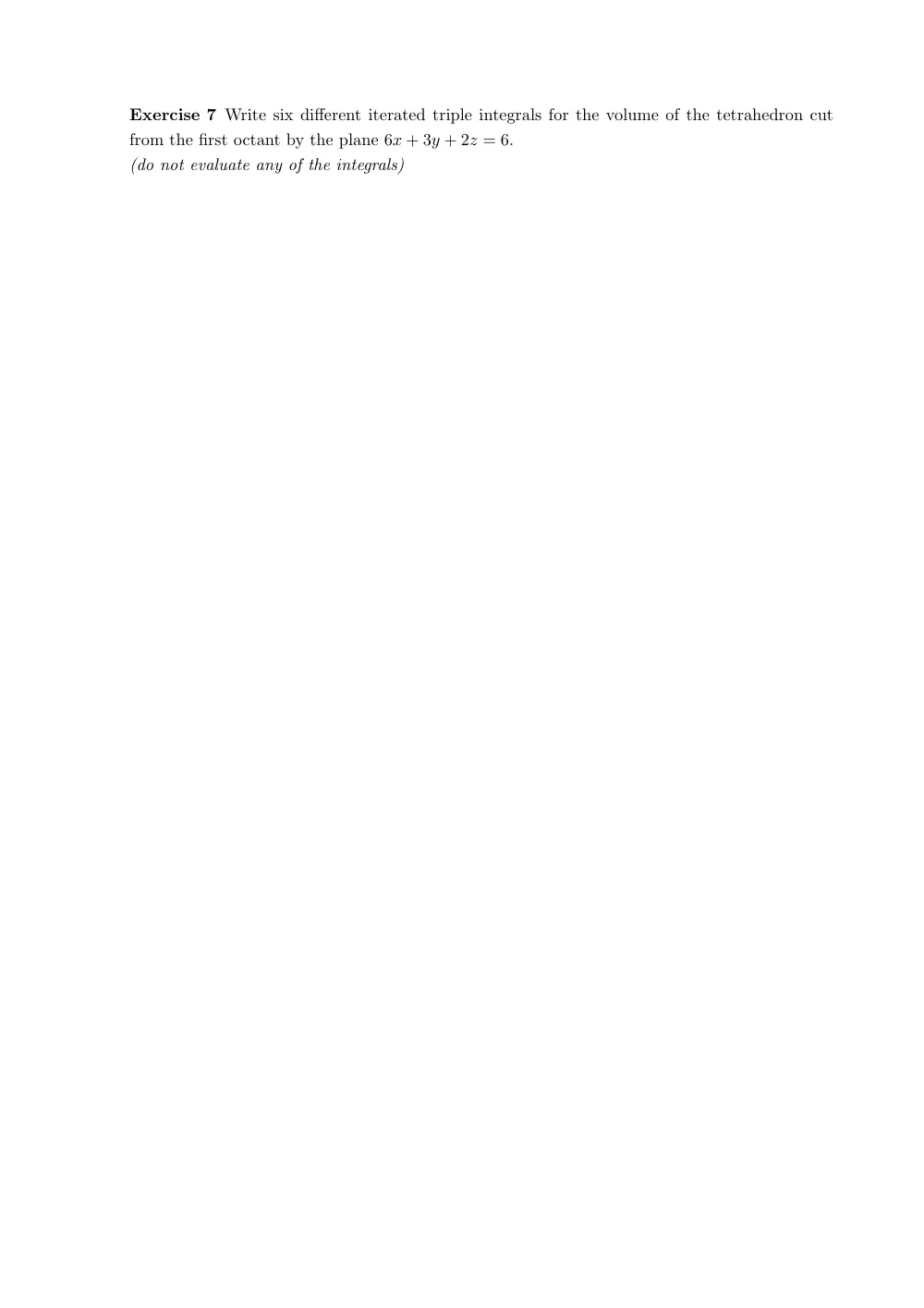
Exercise 7 Write six different iterated triple integrals for the volume of the tetrahedron cut
from the first octant by the plane 6x + 3y + 2z = 6.
(do not evaluate any of the integrals)
Exercise 8 a. Find the line integral of f(x, y) = (x+y2)/
√
1 + x2 along the curve C : y = x2/2
from (1, 1/2) to (0, 0).
solution: - r(t) = (1 − t)i + (1−t)2
2
j , 0 ≤ t ≤ 1;
- v(t) = dr
dt = −i − (1 − t)j, and |v(t)| =
√
1 + (1 − t)2 ;
- f(t) =
(1−t)+ (1−t)4
4
√
1+(1−t)2 , hence
∫
C
f(s)ds =
∫ 1
0
f(t).|v(t)|dt =
∫ 1
0
[
(1 − t) + (1 − t)4
4
]
dt = 11/20
b. Show that the differential form 2 cos ydx + ( 1
y − 2x sin y)dy + (1/z)dz is exact, then evaluate
∫ (1,π/2,2)
(0,2,1)
2 cos ydx +
(1
y − 2x sin y
)
dy + (1/z)dz
solution: f(x, y, z) = 2x cos y + ln(yz) + C is a potential function (check it!), hence
∫ (1,π/2,2)
(0,2,1)
2 cos ydx +
(1
y − 2x sin y
)
dy + (1/z)dz = [2x cos y + ln(yz) + C](1,π/2,2)
(0,2,1)
= ln(π/2)
c. Find the counterclockwise circulation of the field F = 2xy3i + 4x2y2j across the curve C in
the first quadrant, bounded by the lines y = 0, x = 1 and the curve y = x3.
i) direct calculation: cicculation =
�
C
Mdx + Ndy
C1 : r1(t) = ti , 0 ≤ t ≤ 1; Mdx + Ndy = 0, and
∫
C1
dx + Ndy = 0
C2 : r2(t) = i + tj , 0 ≤ t ≤ 1; Mdx + Ndy = 4t2dt, and
∫
C2
Mdx + Ndy =
∫ 1
0
4t2dt = 4/3
C3 : r3(t) = (1 − t)i + (1 − t)3j , 0 ≤ t ≤ 1; Mdx + Ndy = −14(1 − t)10dt, and
∫
C3
Mdx + Ndy =
∫ 1
0
−14(1 − t)10dt = −14/11
circulation(F) =
�
C
Mdx + Ndy = 0 + 4/3 − 14/11 = 2/33
ii) Green’s theorem: circulation(F) =
∫ ∫
R
(curlF) · k dA
(curlF) · k = ∂N
∂x − ∂M
∂y = 8xy2 − 6xy2 = 2xy2
∫ ∫
R
(curlF) · k dA =
∫ 1
0
∫ x3
0
2xy2 dy dx =
∫ 1
0
2x
[y3
3
]x3
0
dx = 2/3
∫ 1
0
x10dx = 2/33