
MATH 201 Final, Fall 2010
American University of Beirut · Calculus and Analytical Geometry III · 2 pages · Dr. Mohammad Kobeissi
More MATH 201 files
- Problems Difficult Problem 5 Tlas 2017 Final · Spring 2019Final examView
- Final · Spring 2019Final examView
- Final · Spring 2019Final examView
- Final · Fall 2018Final examView
- Final · Fall 2018Final examView
- Final Finals with Solution Collection · Spring 2017Final exam · with solutionView
- Final Finals with Solution Collection · Spring 2017Final exam · with solutionView
- Final · Spring 2017Final examView
Show the text of this final exam
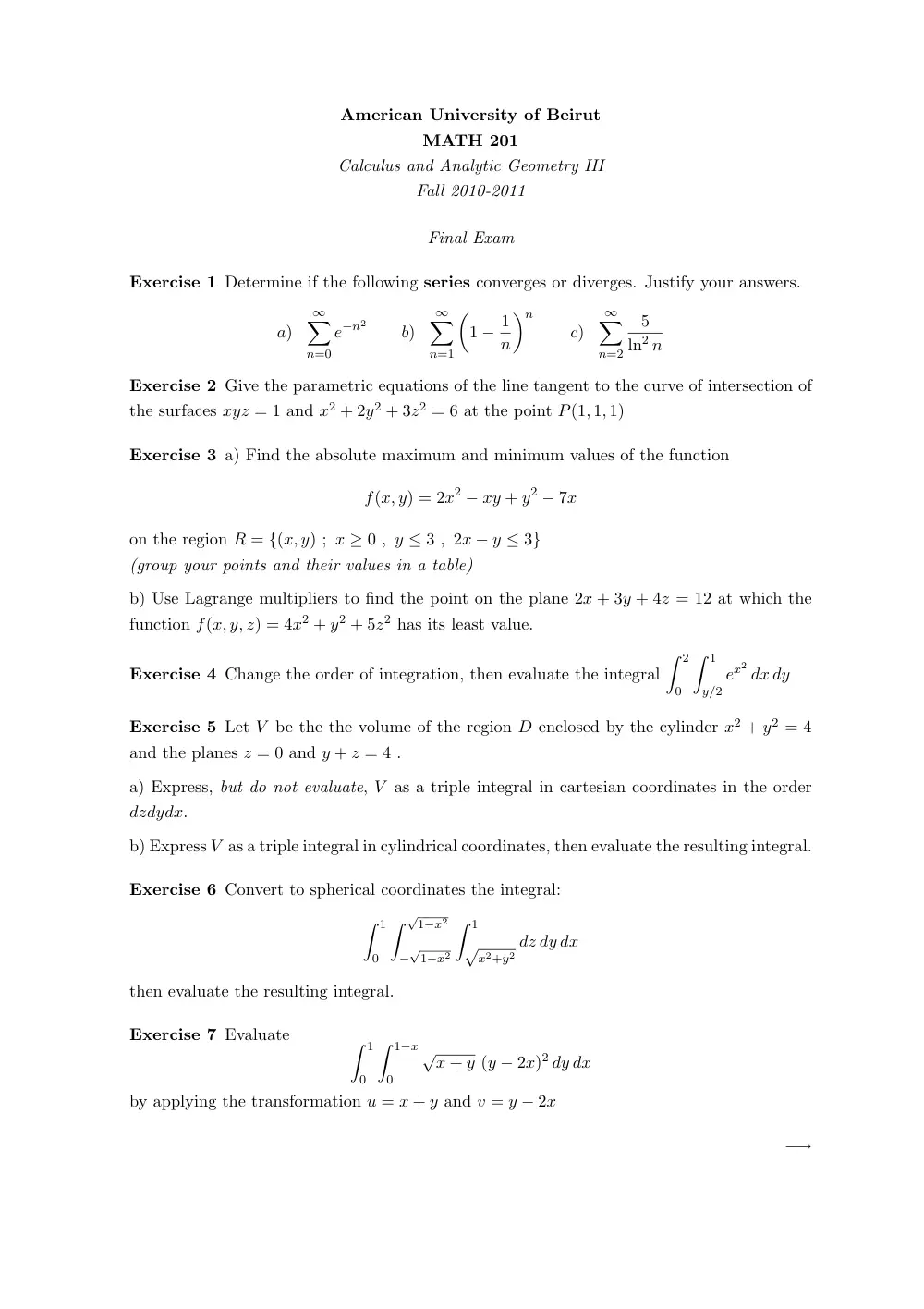
American University of Beirut
MATH 201
Calculus and Analytic Geometry III
Fall 2010-2011
Final Exam
Exercise 1 Determine if the following series converges or diverges. Justify your answers.
a)
∞
�
n=0
e−n2
b)
∞
�
n=1
�
1 − 1
n
�n
c)
∞
�
n=2
5
ln2 n
Exercise 2 Give the parametric equations of the line tangent to the curve of intersection of
the surfaces xyz = 1 and x2 + 2y2 + 3z2 = 6 at the point P(1, 1, 1)
Exercise 3 a) Find the absolute maximum and minimum values of the function
f(x, y) = 2x2 − xy + y2 − 7x
on the region R = {(x, y) ; x ≥ 0 , y ≤ 3 , 2x − y ≤ 3}
(group your points and their values in a table)
b) Use Lagrange multipliers to find the point on the plane 2x + 3y + 4z = 12 at which the
function f(x, y, z) = 4x2 + y2 + 5z2 has its least value.
Exercise 4 Change the order of integration, then evaluate the integral
� 2
0
� 1
y/2
ex2 dx dy
Exercise 5 Let V be the the volume of the region D enclosed by the cylinder x2 + y2 = 4
and the planes z = 0 and y + z = 4 .
a) Express, but do not evaluate, V as a triple integral in cartesian coordinates in the order
dzdydx.
b) Express V as a triple integral in cylindrical coordinates, then evaluate the resulting integral.
Exercise 6 Convert to spherical coordinates the integral:
� 1
0
� √
1−x2
−
√
1−x2
� 1
√
x2+y2 dz dy dx
then evaluate the resulting integral.
Exercise 7 Evaluate
� 1
0
� 1−x
0
√x + y (y − 2x)2 dy dx
by applying the transformation u = x + y and v = y − 2x
−→
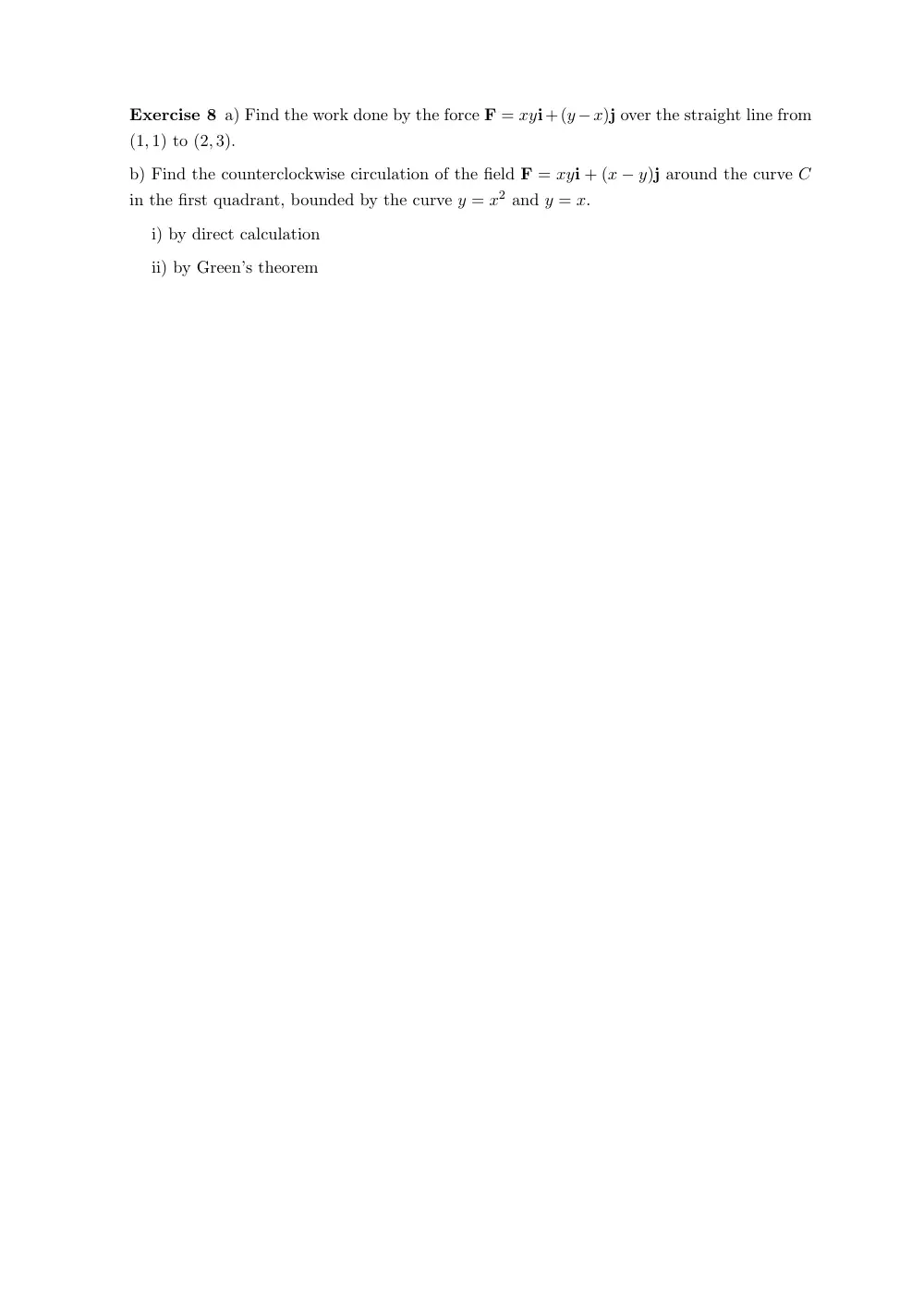
Exercise 8 a) Find the work done by the force F = xyi+(y −x)j over the straight line from
(1, 1) to (2, 3).
b) Find the counterclockwise circulation of the field F = xyi + (x − y)j around the curve C
in the first quadrant, bounded by the curve y = x2 and y = x.
i) by direct calculation
ii) by Green’s theorem