
MATH 201 Final, Fall 2010
American University of Beirut · Calculus and Analytical Geometry III · 2 pages · Dr. Michel Egeileh

More MATH 201 files
- Problems Difficult Problem 5 Tlas 2017 Final · Spring 2019Final examView
- Final · Spring 2019Final examView
- Final · Spring 2019Final examView
- Final · Fall 2018Final examView
- Final · Fall 2018Final examView
- Final Finals with Solution Collection · Spring 2017Final exam · with solutionView
- Final Finals with Solution Collection · Spring 2017Final exam · with solutionView
- Final · Spring 2017Final examView
Show the text of this final exam
/
he
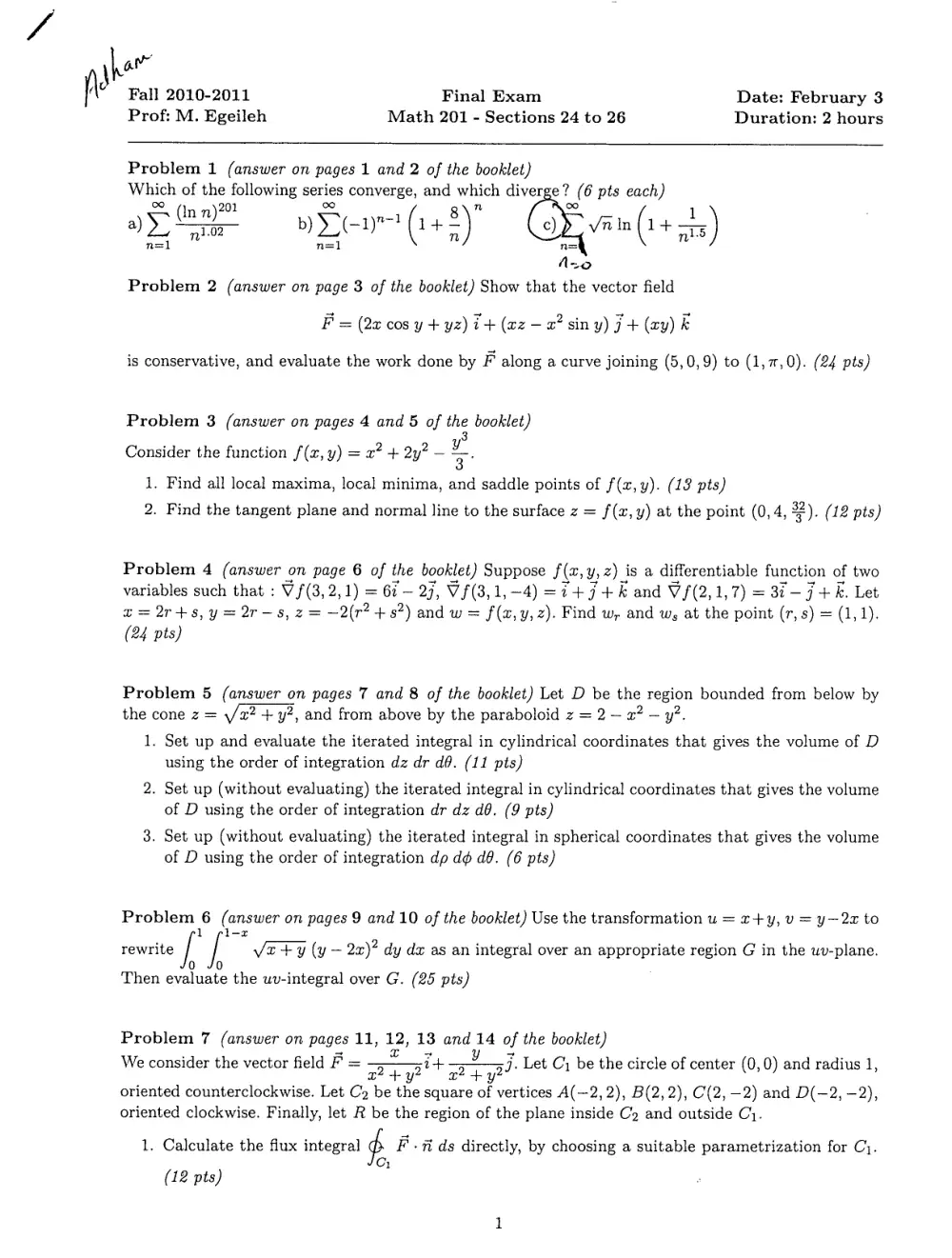
Fall 2010-2011 Final Exam Date: February 3
Prof: M. Egeileh Math 201 - Sections 24 to 26 Duration: 2 hours
Problem 1 (answer on pages 1 and 2 of the booklet)
Which of the following series converge, and which diver;
nn 201 oo n
yer wdc (142)
n=1
e? (6 pts each)
lo]
Problem 2 (answer on page 3 of the booklet) Show that the vector field
F = (22 cos y + yz) i+ (xz — x? sin y) J+ (xy) k
is conservative, and evaluate the work done by F along a curve joining (5,0,9) to (1, 7,0). (24 pts)
Problem 3 (answer on pages 4 and 5 of the booklet)
3
Consider the function f(z, y) = x? + 2y* — 7
1. Find all local maxima, local minima, and saddle points of f(z, y). (13 pts)
2. Find the tangent plane and normal line to the surface z = f(x,y) at the point (0,4, 32), (12 pts)
Problem 4 (answer on page 6 of the booklet) Suppose f(x,y, 2) is a differentiable function of two
variables such that : Vf (3, 2,1) = 61 — 27, Vf(3,1,-4) =i +j+k and Vf(2,1,7) = 3i-j+k. Let
g= +s, y = 2r—s, z= —2r? +s?) and w= f(z,y,z). Find w, and wg at the point (r,s) = (1,1).
(24 pts)
Problem 5 (answer on pages 7 and 8 of the booklet) Let D be the region bounded from below by
the cone z = \/x? + y?, and from above by the paraboloid z = 2 — 2? — y?.
1. Set up and evaluate the iterated integral in cylindrical coordinates that gives the volume of D
using the order of integration dz dr d@. (11 pts)
2. Set up (without evaluating) the iterated integral in cylindrical coordinates that gives the volume
of D using the order of integration dr dz d@. (9 pts)
3. Set up (without evaluating) the iterated integral in spherical coordinates that gives the volume
of D using the order of integration dp dd dé. (6 pts)
Problem 6 (answer on pages 9 and 10 of the booklet) Use the transformation u = 2+y, v = y—2z to
l-zx
rewrite i Vz ¥y (y — 2x)? dy dz as an integral over an appropriate region G in the uv-plane.
o Jo
Then evaluate the wv-integral over G. (25 pts)
Problem 7 (answer on pages 11, 12, 13 and 14 of the booklet)
We consider the vector field F = 3 = sit 3 5): Let C be the circle of center (0,0) and radius 1,
x+y zr+y
oriented counterclockwise. Let C2 be the square of vertices A(—2, 2), B(2,2), C(2, —2) and D(—2, -2),
oriented clockwise. Finally, let R be the region of the plane inside C2 and outside C.
1. Calculate the flux integral Fads directly, by choosing a suitable parametrization for C.
C1
(12 pts)
2. Calculate the flux integral $, F.itds directly, by choosing a suitable parametrization for each
of the four sides of C2 ([AB], BCI, [CD] and [D4A]). (8 pts)
3. If G is a vector field in the plane, we define the flux of G inwards the region R by
a(G)=h G-itds+) G-ids
C1 Co
Use Green’s theorem to show that for any vector field G in the plane,
-- ff div(G) dA(a,y)
(Hint : call Do the square region enclosed by C2, and call D the disk enclosed by C...) (6 pts)
4. Use the results of questions 1. and 3. to recalculate F aids. (8 pts)
Co
Problem 8 (answer on pages 15, 16 and last of the booklet)
we that 2 an
om
for all x ER. (6 pts)
0.1
ZS pproximate [ e~®” dx with an error of magnitude less than 1075. (6 pts)
© Show that co
1
ent? da = =
fem eens
i nx? 2 ore —n(x?+y?)
(Hint : if I = e dx, then I -/ e dz dy). (6 pts)
o Jo
100 2 rT
+ E be the error resulting from the approximation [ e"* dr~ 3 Show that
0
750001
EI <
(6 pis)