
MATH 201 Final, Fall 2012
American University of Beirut · Calculus and Analytical Geometry III · 12 pages · Prof. Nazih Nahlus

Showing the first 10 of 12 pages. Download the PDF to see all of it.
More MATH 201 files
- Final · Spring 2019Final examView
- Problems Difficult Problem 5 Tlas 2017 Final · Spring 2019Final examView
- Final · Spring 2019Final examView
- Final · Fall 2018Final examView
- Final · Fall 2018Final examView
- Final Finals with Solution Collection · Spring 2017Final exam · with solutionView
- Final Finals with Solution Collection · Spring 2017Final exam · with solutionView
- Final · Spring 2017Final examView
Show the text of this final exam
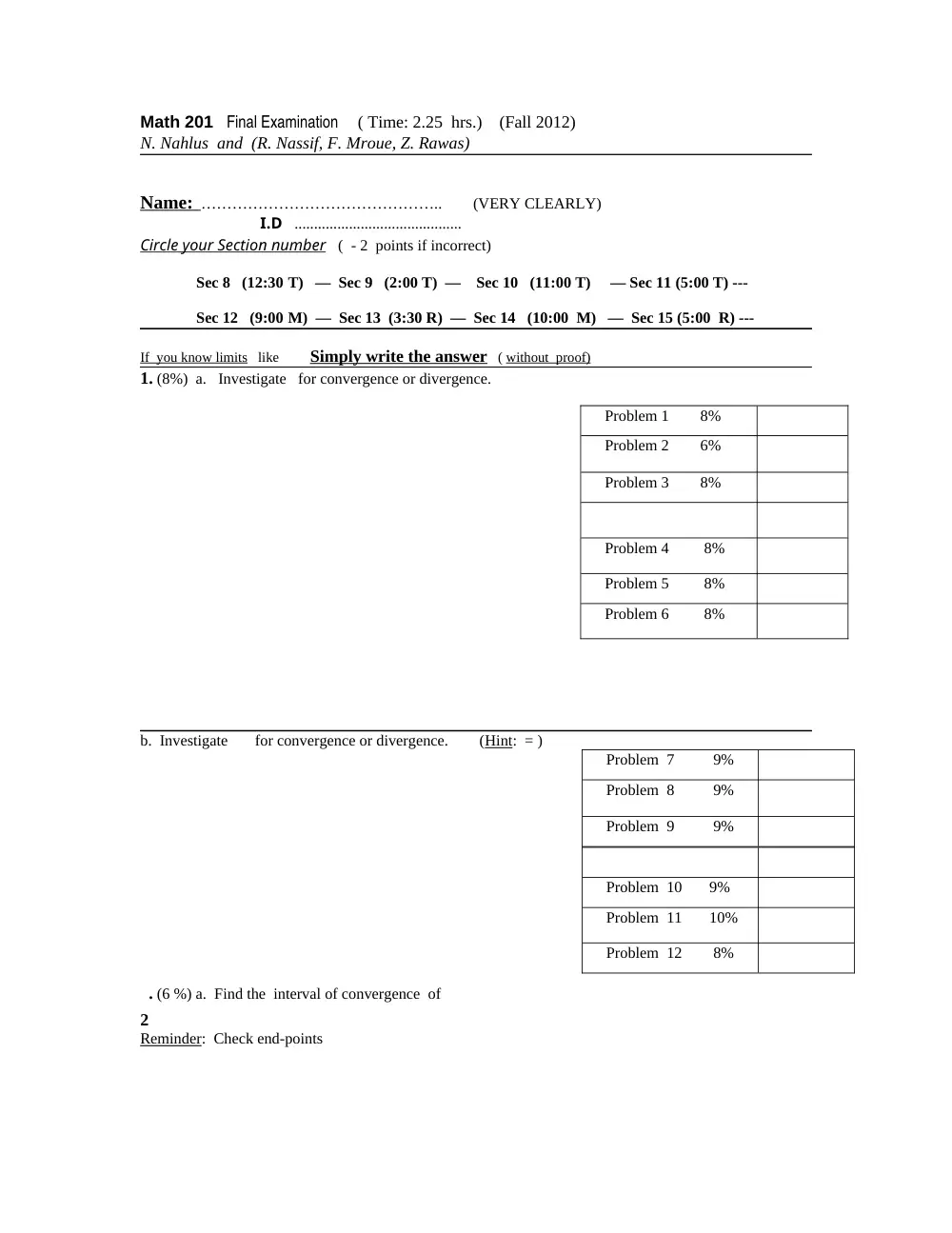
Math 201 Final Examination ( Time: 2.25 hrs.) (Fall 2012)
N. Nahlus and (R. Nassif, F. Mroue, Z. Rawas)
Name:
……………………………………….. (VERY CLEARLY)
I.D ...........................................
Circle your Section number ( - 2 points if incorrect)
Sec 8 (12:30 T) — Sec 9 (2:00 T) — Sec 10 (11:00 T) — Sec 11 (5:00 T) ---
Sec 12 (9:00 M) — Sec 13 (3:30 R) — Sec 14 (10:00 M) — Sec 15 (5:00 R) ---
If you know limits like
Simply write the answer ( without proof)
1. (8%) a. Investigate for convergence or divergence.
b. Investigate for convergence or divergence. (Hint: = )
2
. (6 %) a. Find the interval of convergence of
Reminder: Check end-points
Problem 1 8%
Problem 2 6%
Problem 3 8%
Problem 4 8%
Problem 5 8%
Problem 6 8%
Problem 7 9%
Problem 8 9%
Problem 9 9%
Problem 10 9%
Problem 11 10%
Problem 12 8%
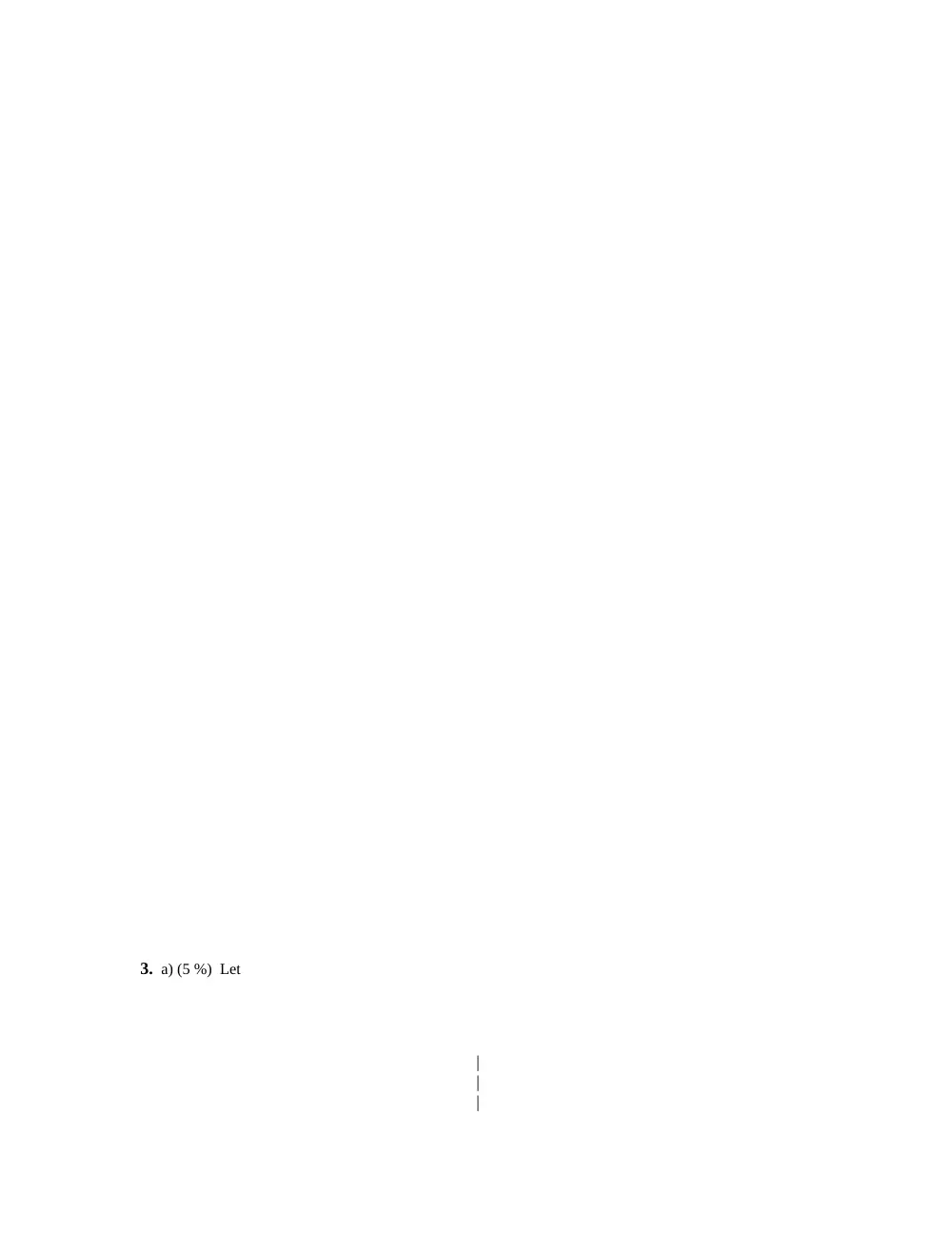
3. a) (5 %) Let
|
|
|
|
|
|
|
|
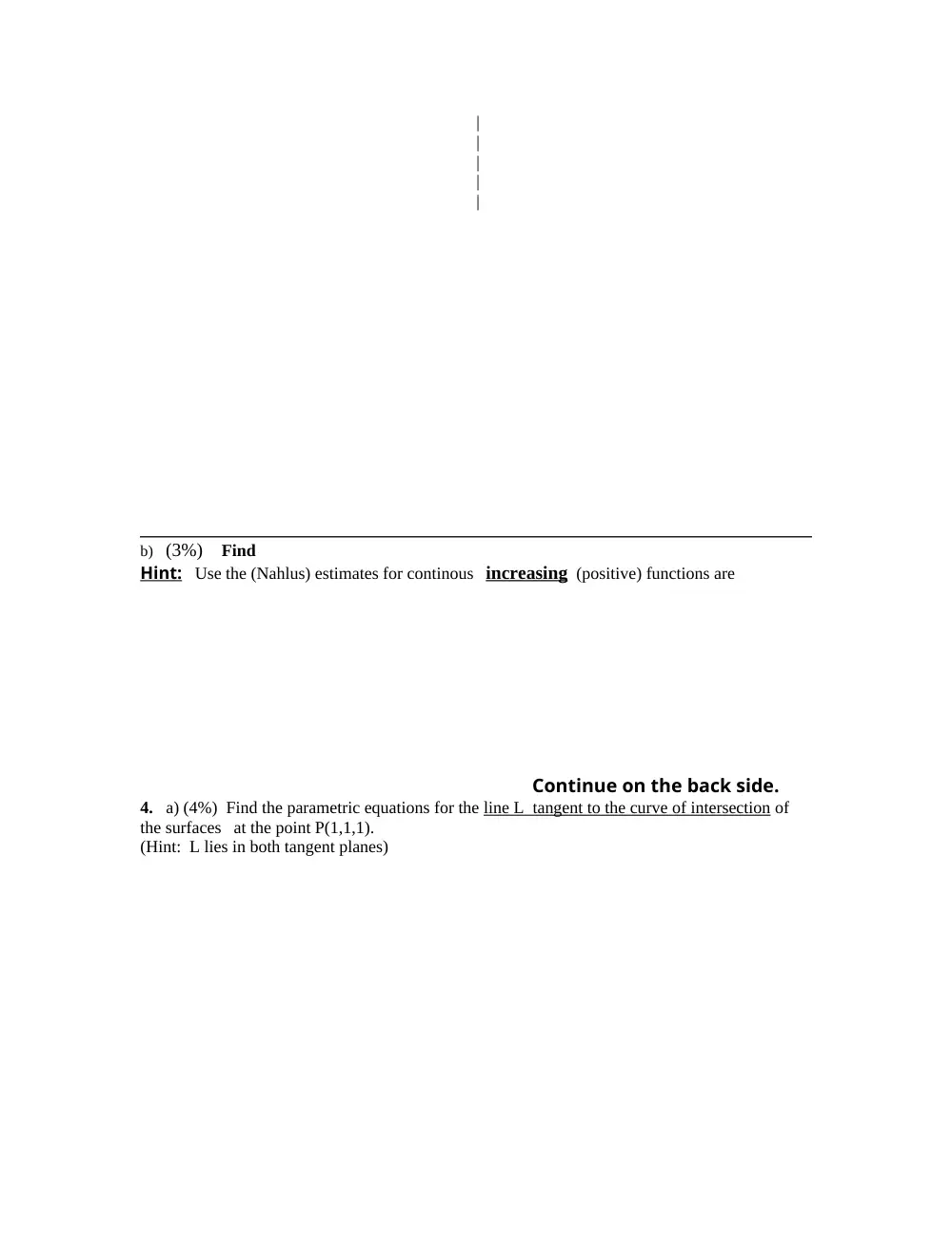
b) (3%) Find
Hint: Use the (Nahlus) estimates for continous increasing (positive) functions are
Continue on the back side.
4. a) (4%) Find the parametric equations for the line L tangent to the curve of intersection of
the surfaces at the point P(1,1,1).
(Hint: L lies in both tangent planes)
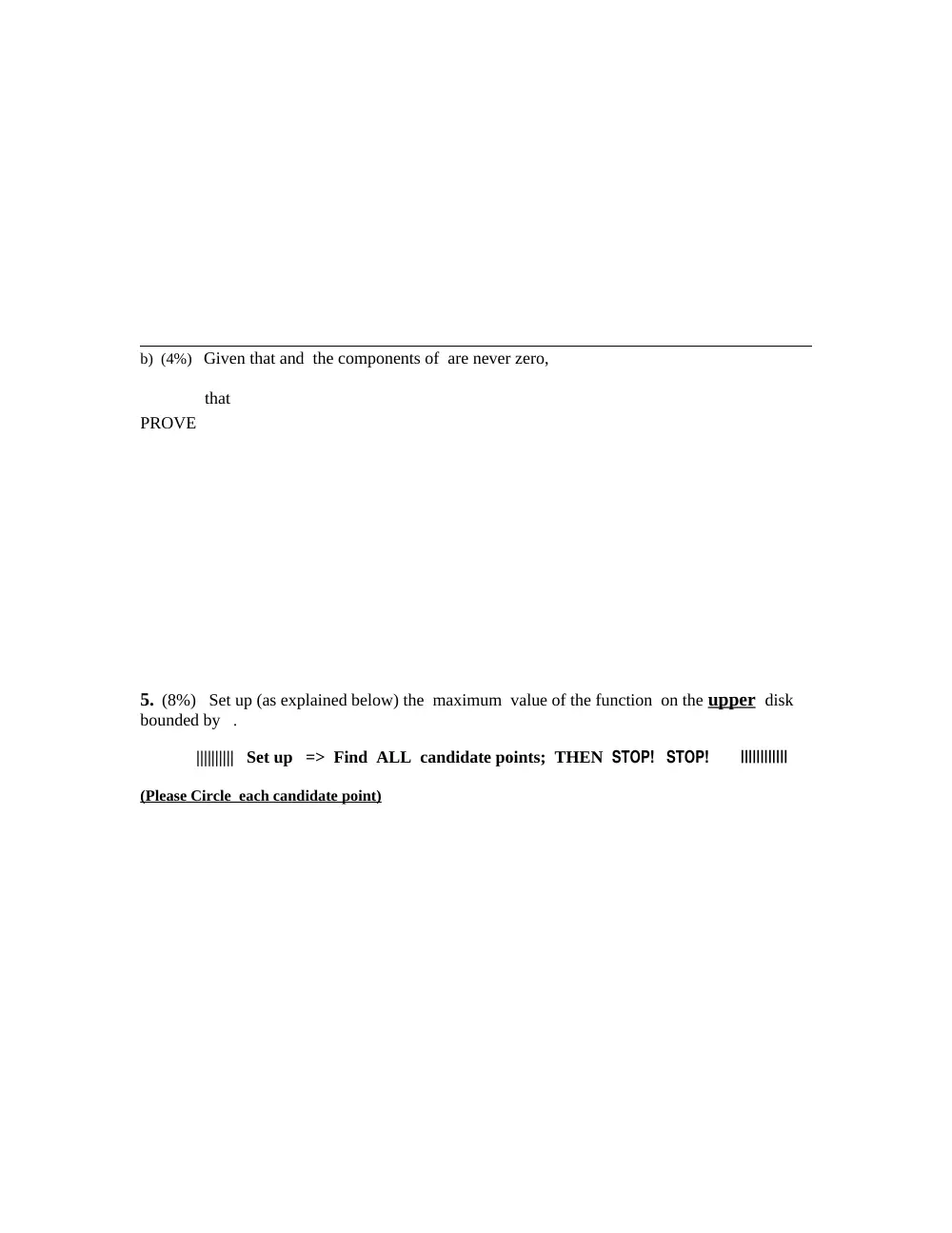
b) (4%) Given that and the components of are never zero,
PROVE
that
5. (8%) Set up (as explained below) the maximum value of the function on the upper disk
bounded by .
|||||||||| Set up => Find ALL candidate points; THEN STOP! STOP! ||||||||||||
(Please Circle each candidate point)
6. a) (4%) Investigate the critical point (0, 2) of the function
for local maxima, local minima, saddle points.
b) (5%) Let +100)
.Assume WITHOUT proof that (0,0) = 7 and (0,0) =8
From definitions, show that
f
is differentiable at (0,
0).
7. a) (5%) Find the value of
b )(4%) Evaluate by changing to polar coordinates.
8. a) (5%) Set up the integrals to find the area of the region that is inside the big loop of the
Limacon & outside the circle .
8b) (4%) Set up the integrals in cylindrical coordinates to find the volume in the 1st octant
BELOW the paraboloid
(Draw very carefully!
(Note The needed intersection is at z=1 (not z=0) with the same circle.)
9. a(5%) Let V be the same region in problem 8b in the 1st octant
below the paraboloid .
Set up the integrals to find the volume of V in spherical coordinates
in the order d d d .
9b) (4%) Set up the integral(s) to find the volume of V (above) in the order d d d.
( If you can not solve for cos , put ? & loose only 1 pt.)
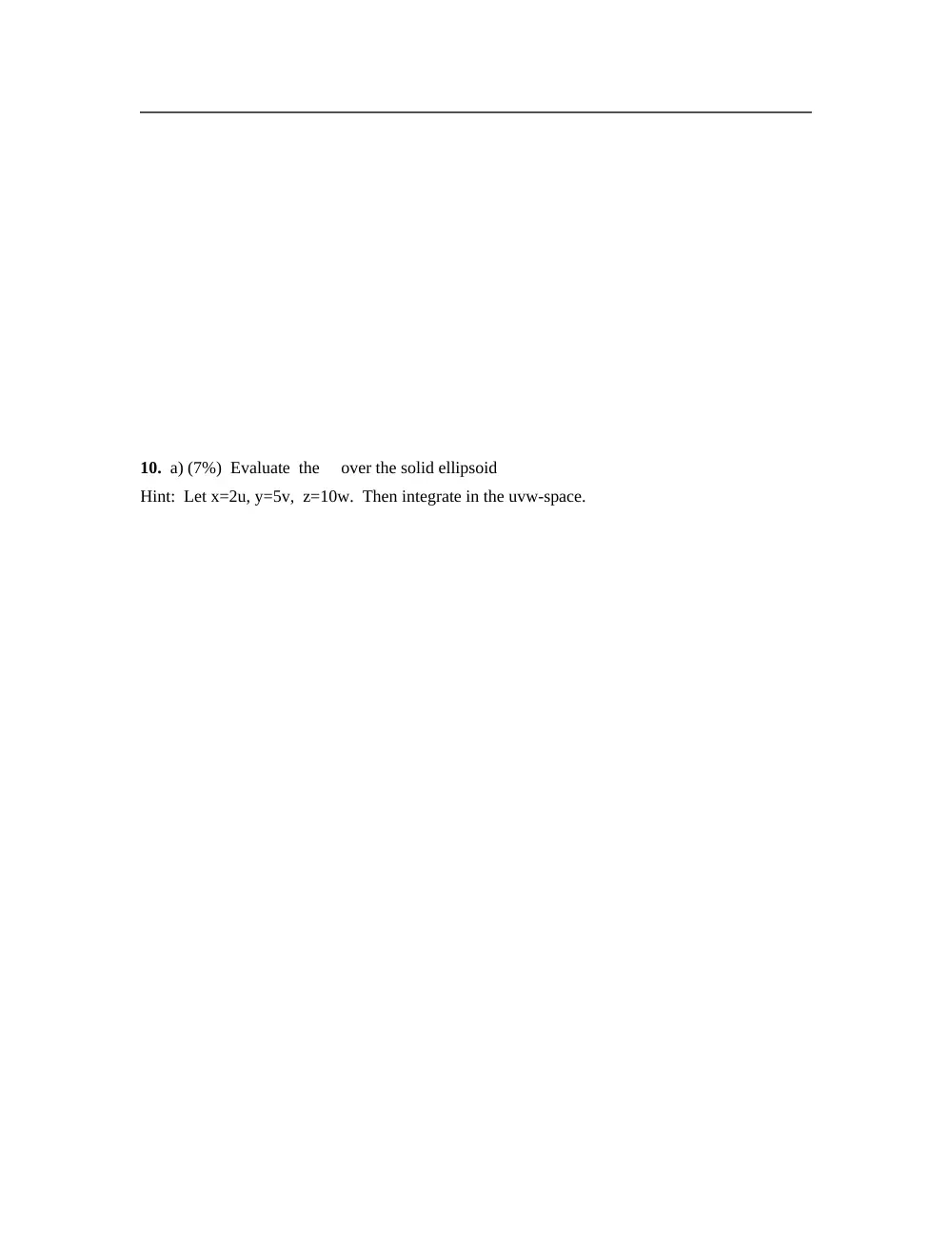
10. a) (7%) Evaluate the over the solid ellipsoid
Hint: Let x=2u, y=5v, z=10w. Then integrate in the uvw-space.
b) (2%) Set up the integrals to find (only) of the centroid of a plane region R
in the 1st quadrant bounded by .
Note: All curves C below (in problems 10—12) are assumed to be smooth (except for finitely
many points) counter clockwise, and traced once.
11. (a)(4%) Use Green’s Theorem to find the circulation of the vector field and C is the
circle: .
b. (4%) Evaluate for any wild path C
lying in the right-half plane (x>0) from A(1,1) to B(2,6)
by finding a potential function f(x,y) by inspection. Hint: Try
c. (2%) Solve part b above without finding a potential function f(x,y)?
12. a) (4%) Use Green’s theorem (with holes) to find
for any simple closed curve C . (To get full credit, check all details)
|
|
|
|
|
|
|
|
|
|
|
|
|
|
|
|
b. (2%) Use part (a) to compute
(Hint: Make a substitution to use part (a)
-------------------------------------------------------------------------------------------------
c. (2%) Set up the Line
integral to find the area of the “bumped” Cardiod.