
MATH 201 Final, Fall 2014
American University of Beirut · Calculus and Analytical Geometry III · 13 pages · Mr. Hassan Yamani

Showing the first 10 of 13 pages. Download the PDF to see all of it.
More MATH 201 files
- Problems Difficult Problem 5 Tlas 2017 Final · Spring 2019Final examView
- Final · Spring 2019Final examView
- Final · Spring 2019Final examView
- Final · Fall 2018Final examView
- Final · Fall 2018Final examView
- Final Finals with Solution Collection · Spring 2017Final exam · with solutionView
- Final Finals with Solution Collection · Spring 2017Final exam · with solutionView
- Final · Spring 2017Final examView
Show the text of this final exam
v
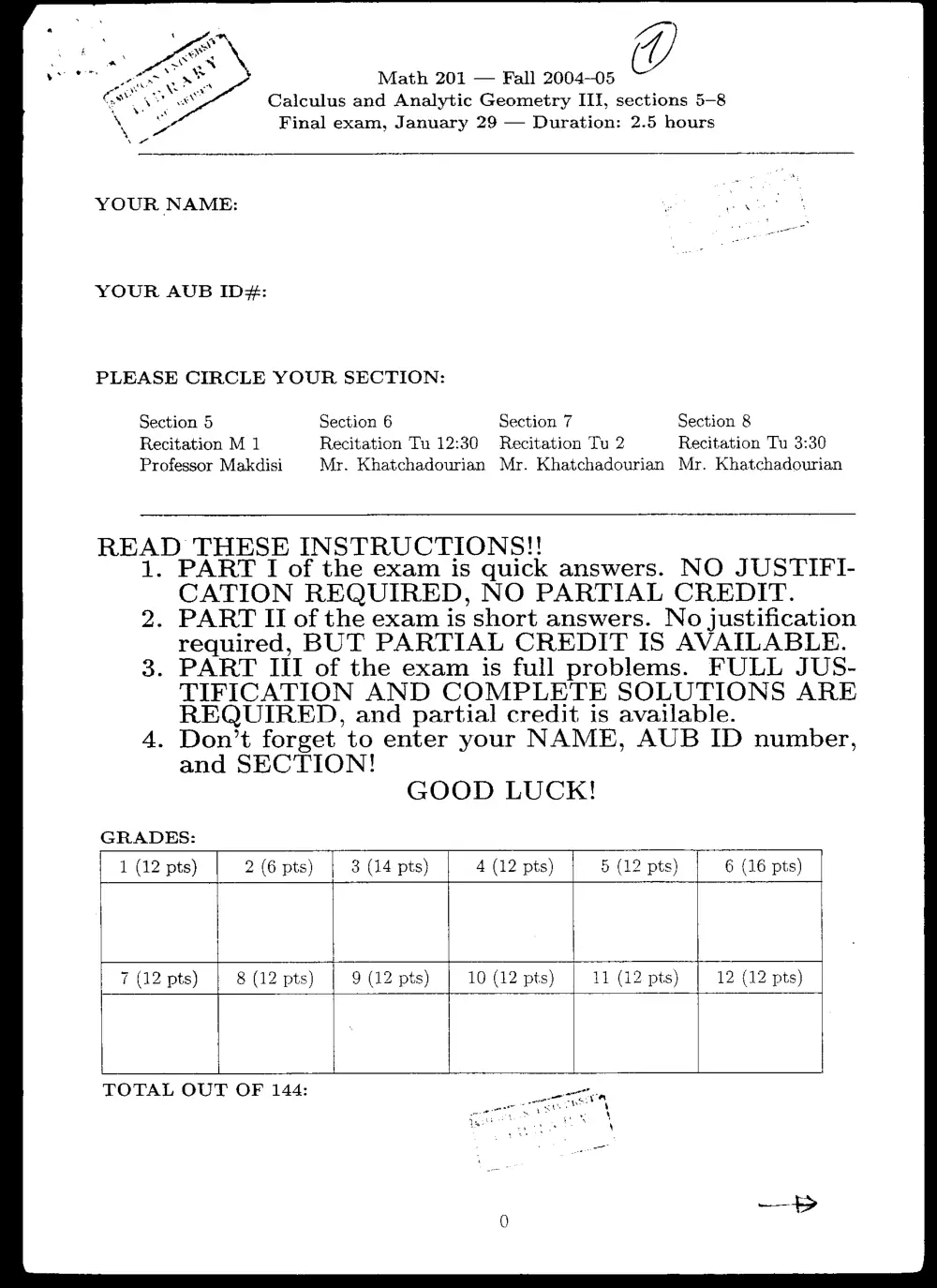
Math 201 — Fall 2004-05
Calculus and Analytic Geometry III, sections 5-8
Final exam, January 29 — Duration: 2.5 hours
YOUR NAME:
YOUR AUB ID#:
PLEASE CIRCLE YOUR SECTION:
Section 5 Section 6 Section 7 Section 8
Recitation M 1 Recitation Tu 12:30 Recitation Tu 2 Recitation Tu 3:30
Professor Makdisi Mr. Khatchadourian Mr. Khatchadourian Mr. Khatchadourian
READ THESE INSTRUCTIONS!
1. PART I of the exam is quick answers. NO JUSTIFI-
CATION REQUIRED, NO PARTIAL CREDIT.
. PART II of the exam is short answers. No justification
required, BUT PARTIAL CREDIT IS AVAILABLE.
. PART III of the exam is full problems. FULL JUS-
TIFICATION AND COMPLETE SOLUTIONS ARE
REQUIRED, and partial credit is available.
. Don’t forget to enter your NAME, AUB ID number,
and SECTION!
GOOD LUCK!
GRADES:
1 (12 pts) 3 (14 pts) 4 (12 pts)
TOTAL OUT OF 144:
a
,
‘ ,
* A
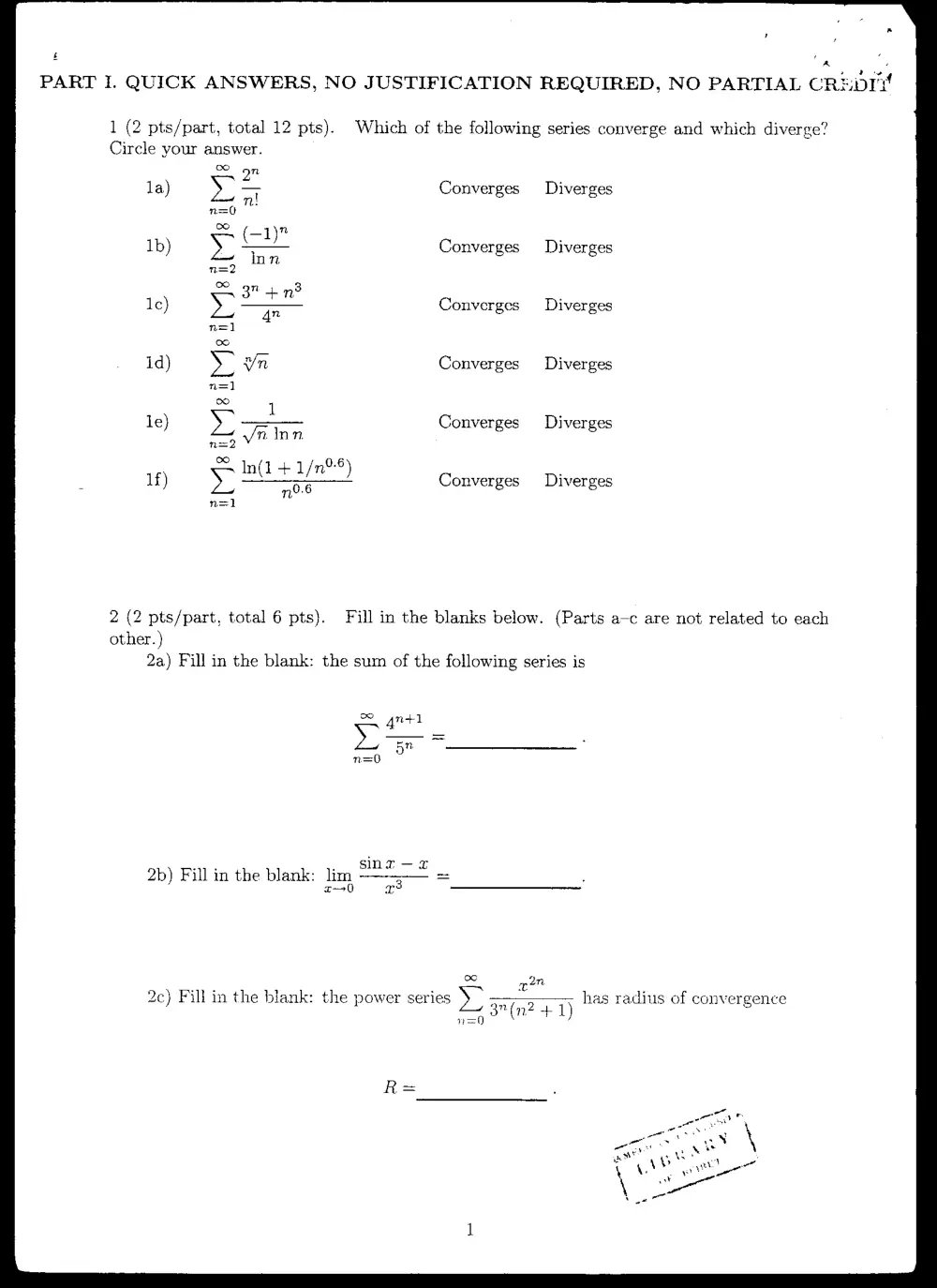
PART I. QUICK ANSWERS, NO JUSTIFICATION REQUIRED, NO PARTIAL CREDI
1 (2 pts/part, total 12 pts). Which of the following series converge and which diverge?
Circle your answer.
la) Converges Diverges
1b) Converges Diverges
1c) Converges Diverges
Converges Diverges
Converges Diverges
Converges Diverges
2 {2 pts/part, total 6 pts). Fill in the blanks below. (Parts a-c are not related to each
other.)
2a) Fill in the blank: the sum of the following series is
Aner
fo)
’ 5 =
n=0
2b) Fill in the blank: lim —-=—* =
z—0 x
een
has radius of convergence
2c) Fill in the blank: the power series > ¥en? + 1)
n? 4
n=0
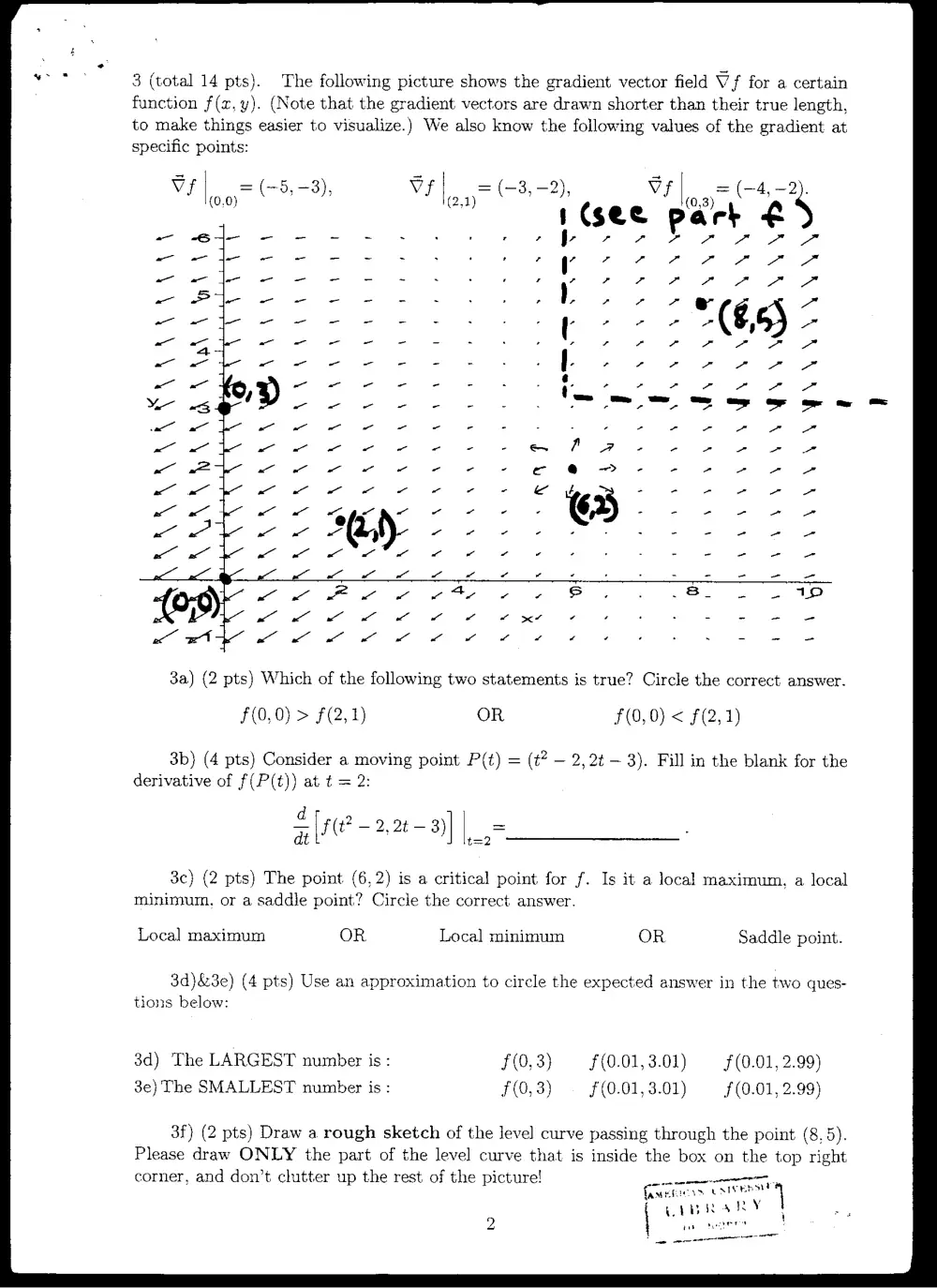
3 (total 14 pts). The following picture shows the gradient vector field Vf for a certain
function f(x,y). (Note that the gradient vectors are drawn shorter than their true length,
to make things easier to visualize.) We also know the following values of the gradient at
specific points:
Vf} =(-5,-3),
Vf
(0,0)
il
7
&
|
oN
rraf vv vv VV VAN Vea NVA
rrafpvavvvvvQvv\Sy\\\b
Du Ph VV VV VV AVANANANNAA\MS
cr
ian
e
»
52
64—-
\
L
‘
v
pet
VAVVA
‘
,VYVVNNANN @
nN
new == =P a= =
yo y
lee
BWivey
t
>
Cog
rvavvvvvy by vvv@vvy
ANNMNA DANA A Aa A A
KANNNANANANAVAANN
RS
KVNANANANANA HVT LV
\
ee a
VNNNA
NN AUN NNN
x
\
s 4s
0
VANANRANANANNAVAVV NVA
NAAN AA NNN VV AVE
Bev vvvvvvevries
CARA vce
\
4
\
y
.
3a) (2 pts) Which of the following two statements is true? Circle the correct answer.
(0,0) > (2,1) OR £(0,0) < (2,1)
3b) (4 pts) Consider a moving point P(t) = (t? — 2,2¢ — 3). Fill in the blank for the
derivative of f(P(t)) at t = 2:
a
di
fe - 2, 2t—3)] | =
t=2
3c) (2 pts) The point (6,2) is a critical point for f. Is it a local maximum, a local
minimum, or a saddle point? Circle the correct answer.
Local maximum OR Local minimum OR Saddle point.
3d)&3e) (4 pts) Use an approximation to circle the expected answer in the two ques-
tions below:
3d) The LARGEST number is : f (0,3) f (0.01, 3.01) 7 (0.01, 2.99)
3e) The SMALLEST number is : f(0,3) #(0.01,3.01) ——f (0.01, 2.99)
3f) (2 pts) Draw a rough sketch of the level curve passing through the point (8, 5).
Please draw ONLY the part of the level curve that is inside the box on the top right
corner, and don’t clutter up the rest of the picture!
,
£
PART Il. SHORT ANSWERS, no justification needed, PARTIAL CREDIT AVAILABLE.”
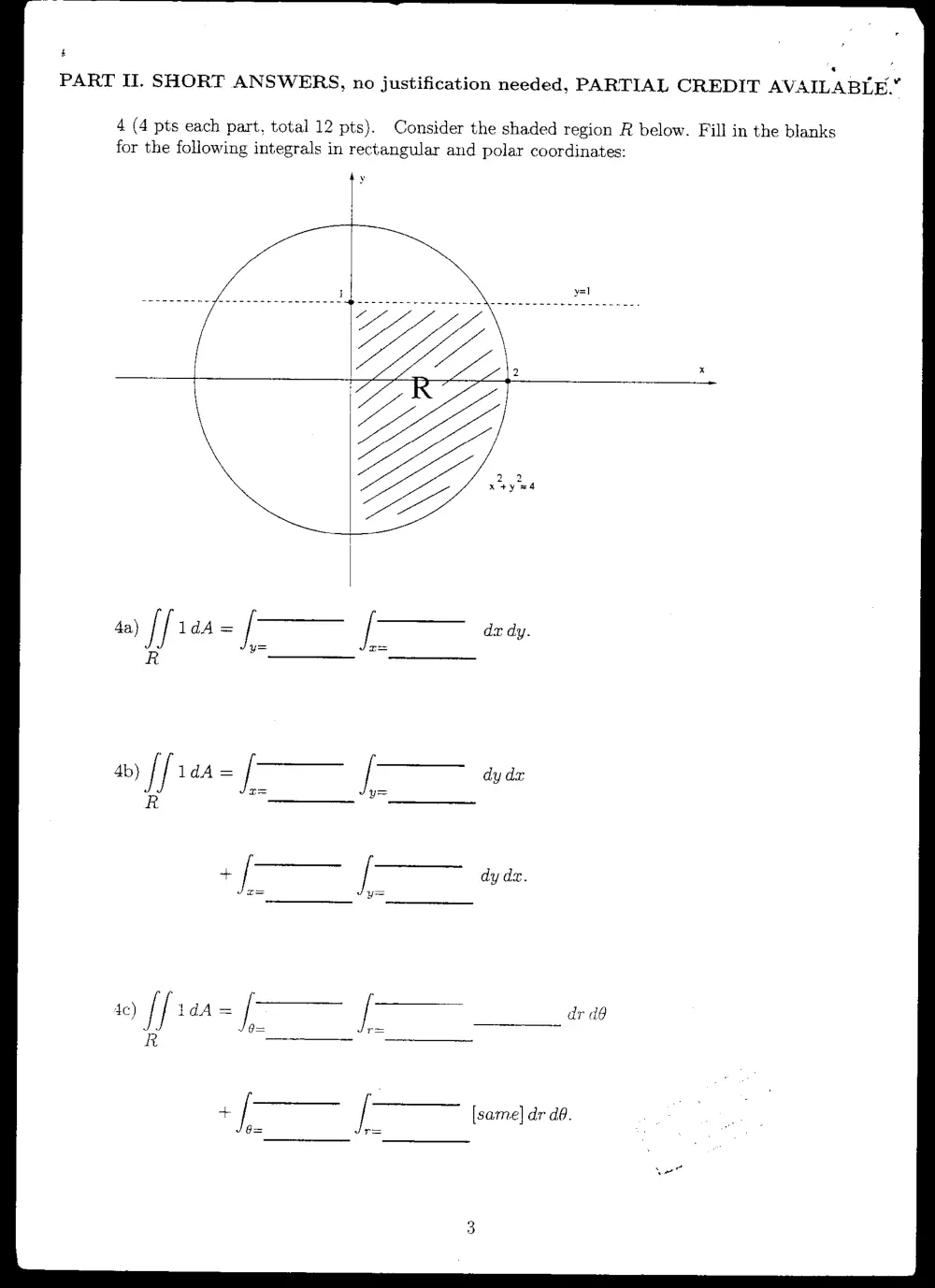
4 (4 pts each part, total 12 pts). Consider the shaded region R below. Fill in the blanks
for the following integrals in rectangular and polar coordinates:
hy
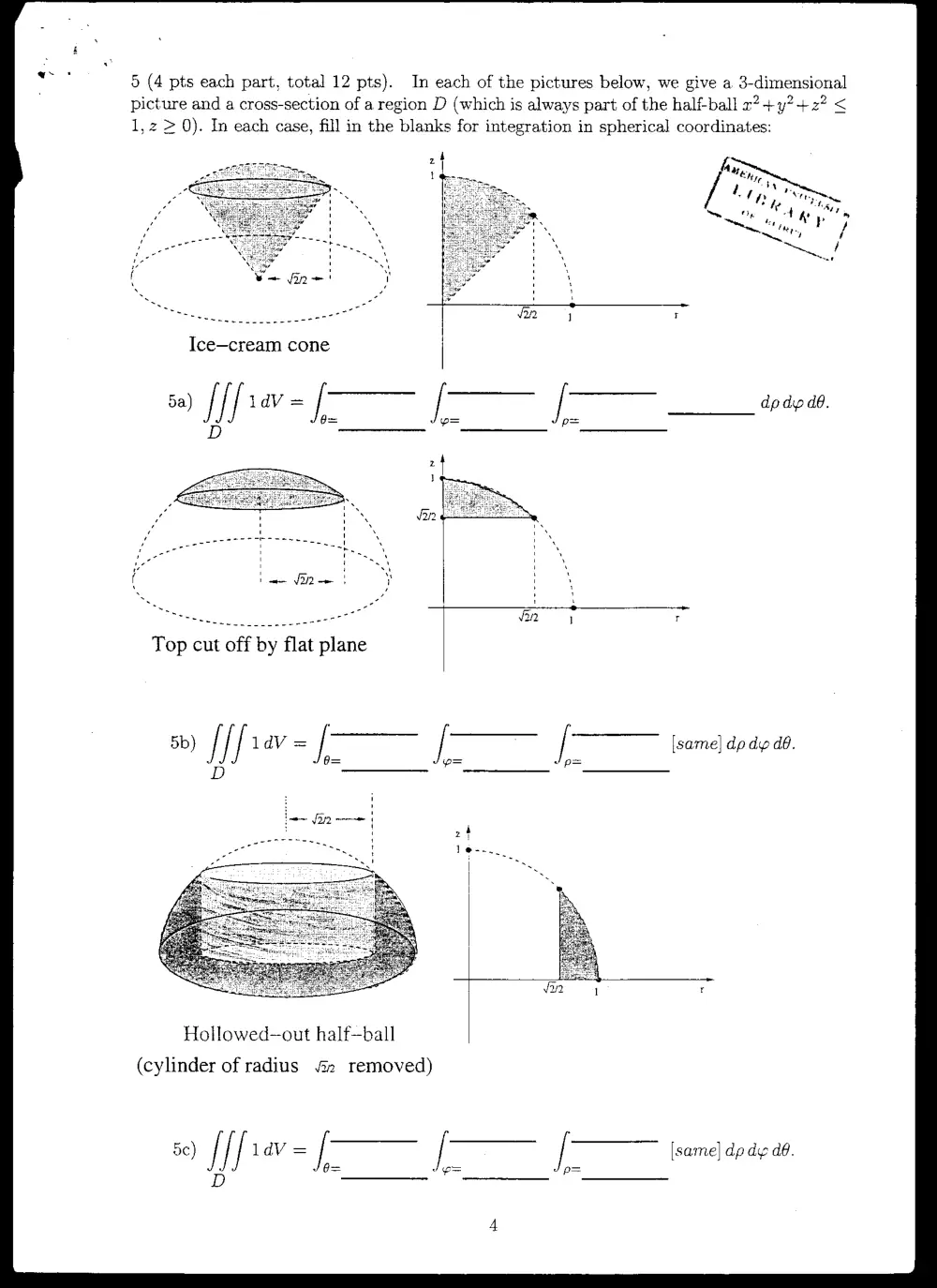
5 (4 pts each part, total 12 pts). In each of the pictures below, we give a 3-dimensional
picture and a cross-section of a region D (which is always part of the half-ball 2?+y?+2? <
1,2 > 0). In each case, fill in the blanks for integration in spherical coordinates:
z
1d
Ice-cream cone
5a) [fra fo
[same] dp dy dé.
Hollowed—out half—ball
(cylinder of radius 2 removed)
5c) [fpr = EC [same] dp dy dé.
D
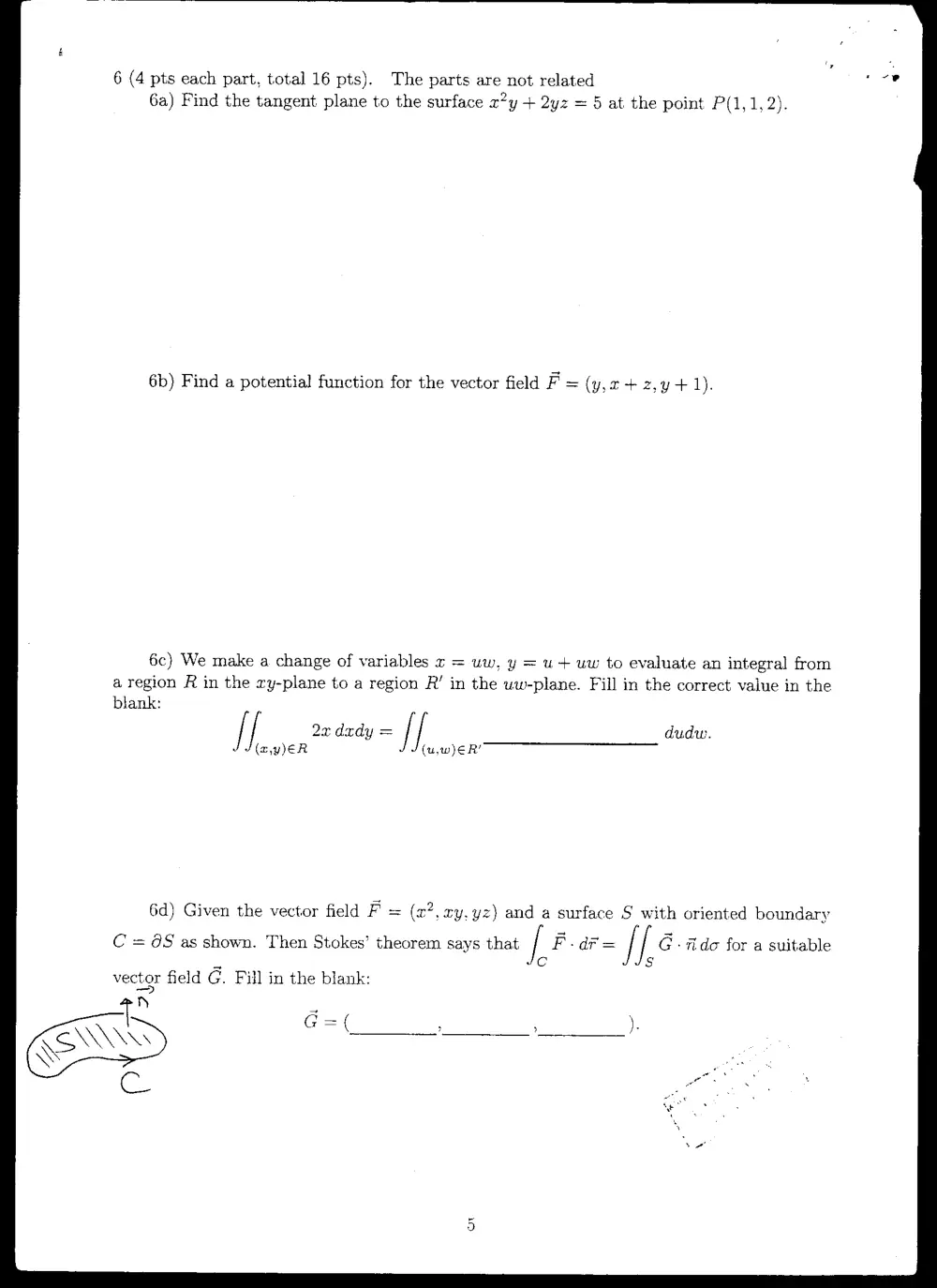
6 (4 pts each part, total 16 pts). The parts are not related
6a) Find the tangent plane to the surface x°y + 2yz = 5 at the point P(1,1,2).
6b) Find a potential function for the vector field F = (y,2+2,y+ 1).
6c) We make a change of variables x = uw, y = u + uw to evaluate an integral from
a region A in the ry-plane to a region R’ in the uw-plane. Fill in the correct value in the
blank:
// 2a dxdy = II dudw.
(2,y)ER (u,w)eR’
6d) Given the vector field F = (2?.xy,yz) and a surface S with oriented boundary
C = 0S as shown. Then Stokes’ theorem says that | F.dr= / i] G- fide for a suitable
C s
vector field G. Fill in the blank:
Nn
G=(
FEY
C
we PART III. FULL SOLUTIONS REQUIRED, PARTIAL CREDIT AVAILABLE.
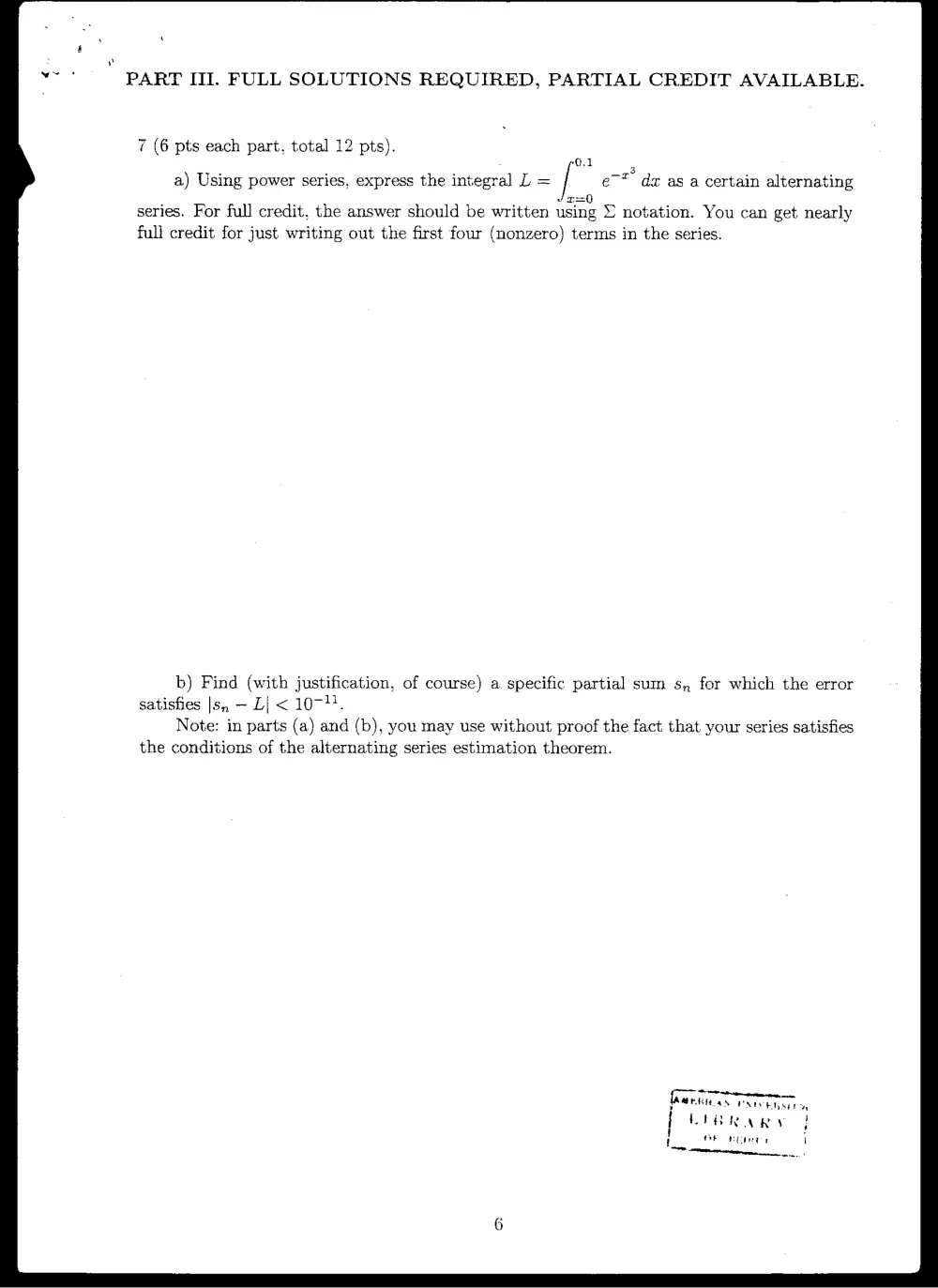
7 (6 pts each part, total 12 pts).
rO.1
3
a) Using power series, express the integral L = / e* dz as a certain alternating
r=0
series. For full credit, the answer should be written using © notation. You can get nearly
full credit for just writing out the first four (nonzero) terms in the series.
b) Find (with justification, of course) a specific partial sum s, for which the error
satisfies |s, — L| < 107}.
Note: in parts (a) and (b), you may use without proof the fact that your series satisfies
the conditions of the alternating series estimation theorem.
aaa
fain AN UNEVEN Sar a
| HIBRARY |
! Oe epee i
a
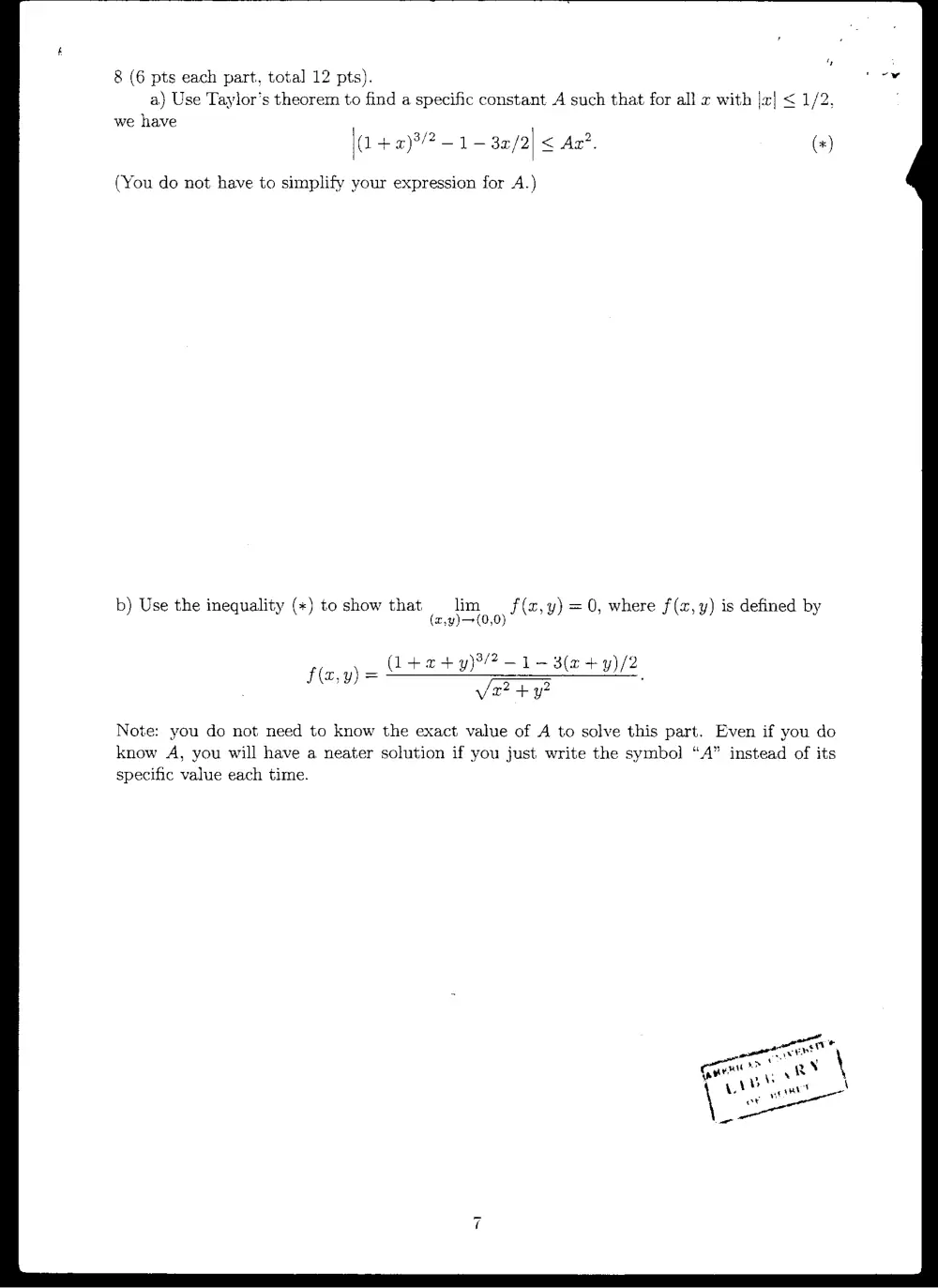
8 (6 pts each part, tota] 12 pts). Ley
a) Use Taylor’s theorem to find a specific constant A such that for all x with |a| < 1/2,
we have
(1+a)3/? —1- 32/2] < Az. (x)
(You do not have to simplify your expression for A.)
b) Use the inequality (*) to show that ( tm 0) f(x,y) = 0, where f(x,y) is defined by
zy) (0,
(l+24+y)9/? —1-3(2 + y)/2
Var +y? ,
Note: you do not need to know the exact value of A to solve this part. Even if you do
know A, you will have a neater solution if you just write the symbol “A” instead of its
specific value each time.
f(x,y) =
an *
nn ee x
Gueren R
7
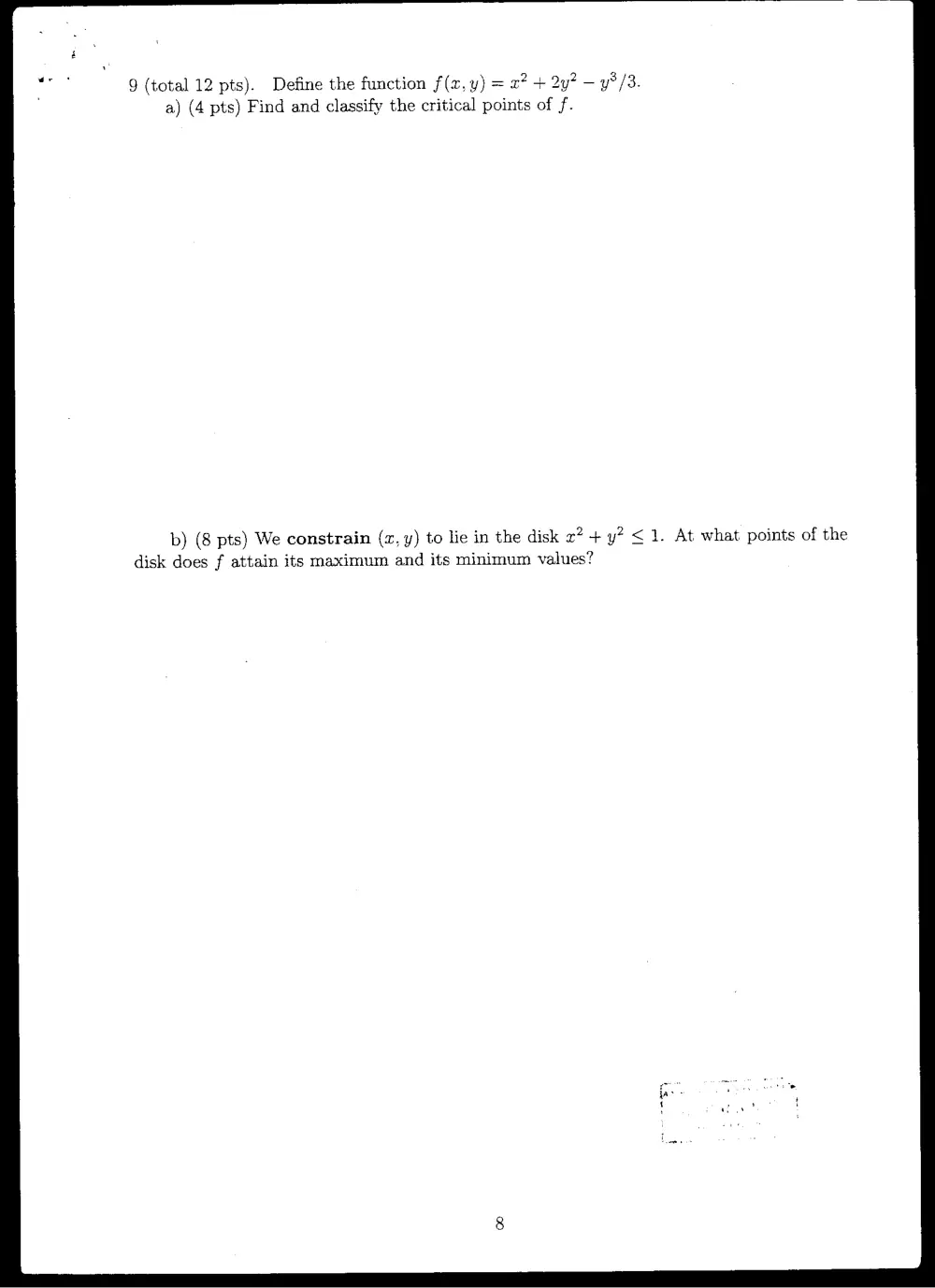
9 (total 12 pts). Define the function f(x,y) = 2? + 2y? — y*/3.
a) (4 pts) Find and classify the critical points of f.
b) (8 pts) We constrain (x,y) to lie in the disk xc? +y? <1. At what points of the
disk does f attain its maximum and its minimum values?
,
10 (6 pts each part, total 12 pts). Let C be the closed curve in the plane starting froin
(0,0), which first goes to (1,1) along the parabola y = x, and then returns to (0,0) along
the line y = x. Compute | ydxz + e¥ dy twice: (a) directly, (b) using Green’s theorem.
C
Sohution for (a):
Solution for (b):