
MATH 201 Final, Spring 2015
American University of Beirut · Calculus and Analytical Geometry III · 10 pages · Prof. Tamer Tlas



More MATH 201 files
- Final · Spring 2019Final examView
- Final · Spring 2019Final examView
- Problems Difficult Problem 5 Tlas 2017 Final · Spring 2019Final examView
- Final · Fall 2018Final examView
- Final · Fall 2018Final examView
- Final Finals with Solution Collection · Spring 2017Final exam · with solutionView
- Final Finals with Solution Collection · Spring 2017Final exam · with solutionView
- Final · Spring 2017Final examView
Show the text of this final exam
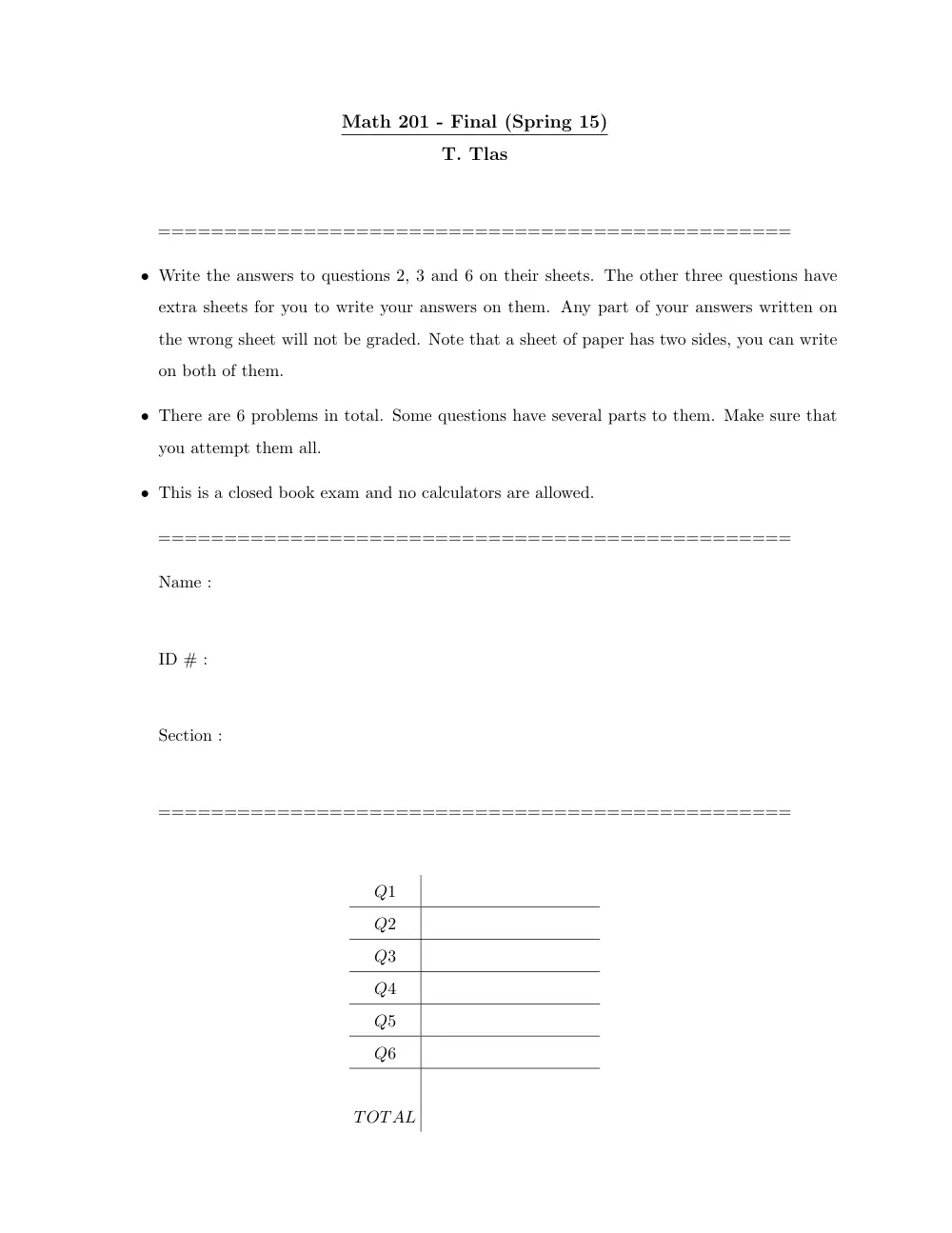
Math 201 - Final (Spring 15)
T. Tlas
================================================
• Write the answers to questions 2, 3 and 6 on their sheets. The other three questions have
extra sheets for you to write your answers on them. Any part of your answers written on
the wrong sheet will not be graded. Note that a sheet of paper has two sides, you can write
on both of them.
• There are 6 problems in total. Some questions have several parts to them. Make sure that
you attempt them all.
• This is a closed book exam and no calculators are allowed.
================================================
Name :
ID # :
Section :
================================================
Q1
Q2
Q3
Q4
Q5
Q6
TOTAL
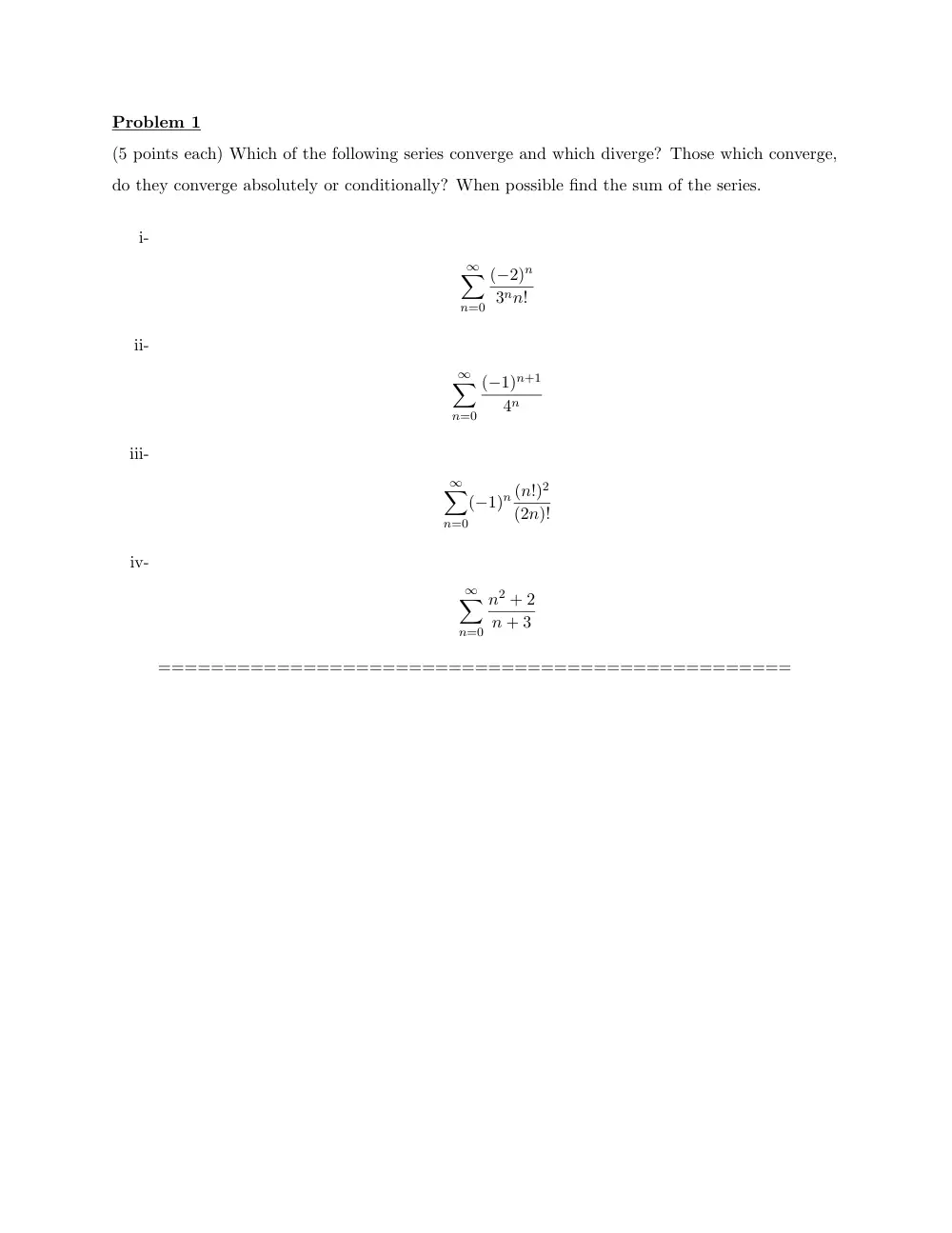
Problem 1
(5 points each) Which of the following series converge and which diverge? Those which converge,
do they converge absolutely or conditionally? When possible find the sum of the series.
i-
∞
�
n=0
(−2)n
3nn!
ii-
∞
�
n=0
(−1)n+1
4n
iii-
∞
�
n=0
(−1)n (n!)2
(2n)!
iv-
∞
�
n=0
n2 + 2
n + 3
================================================
ADDITIONAL SHEET FOR PROBLEM 1 ANSWER
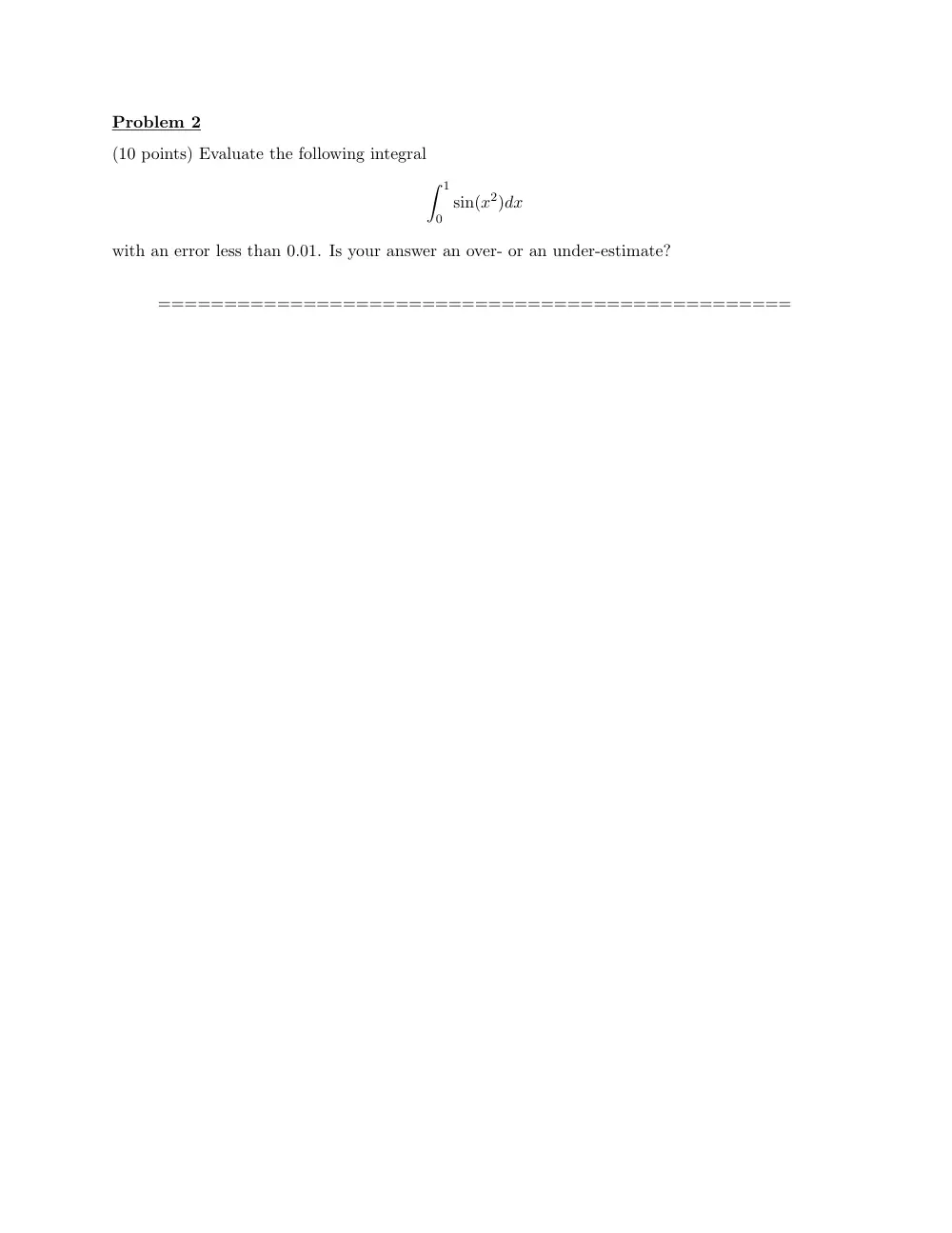
Problem 2
(10 points) Evaluate the following integral
� 1
0
sin(x2)dx
with an error less than 0.01. Is your answer an over- or an under-estimate?
================================================
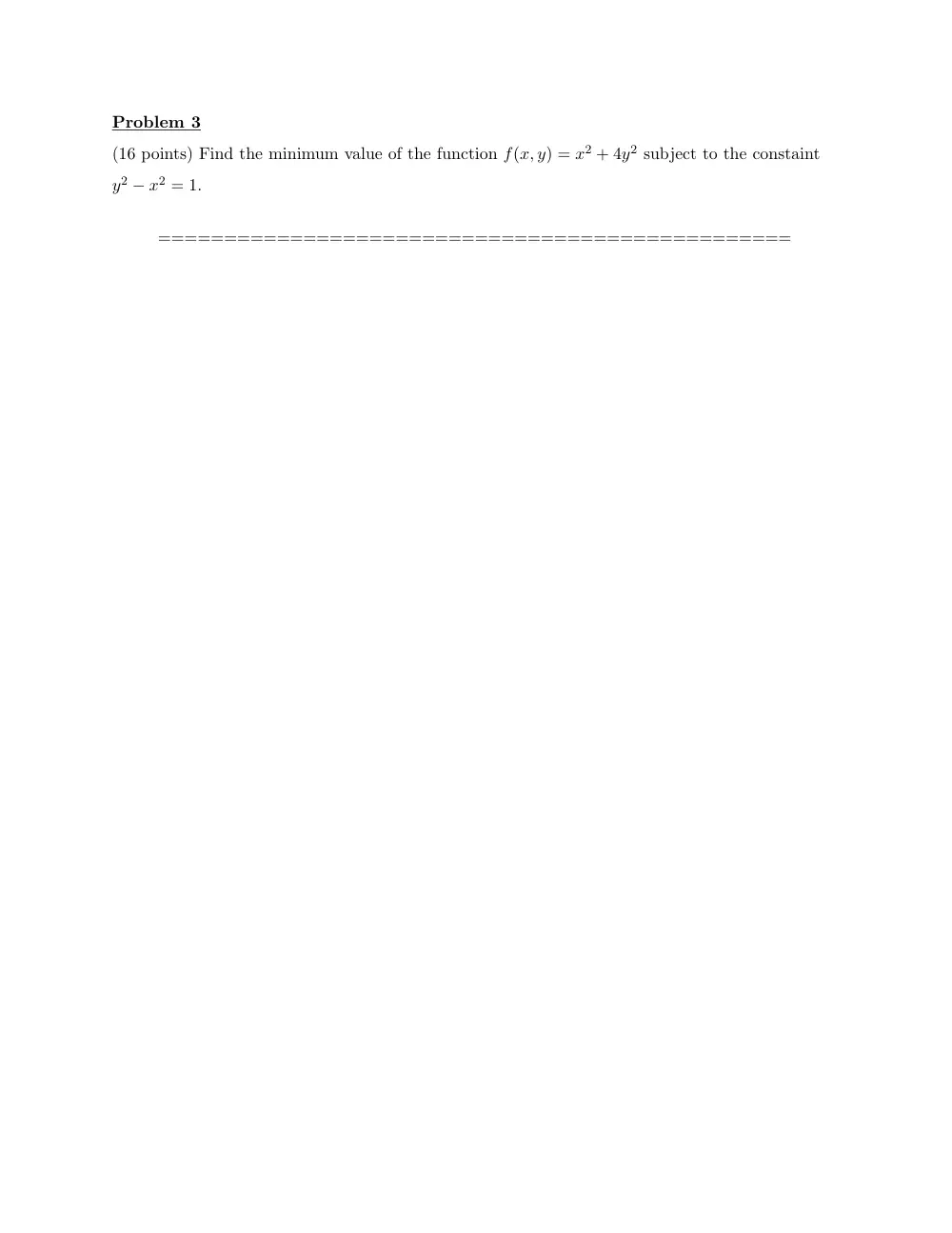
Problem 3
(16 points) Find the minimum value of the function f(x, y) = x2 + 4y2 subject to the constaint
y2 − x2 = 1.
================================================
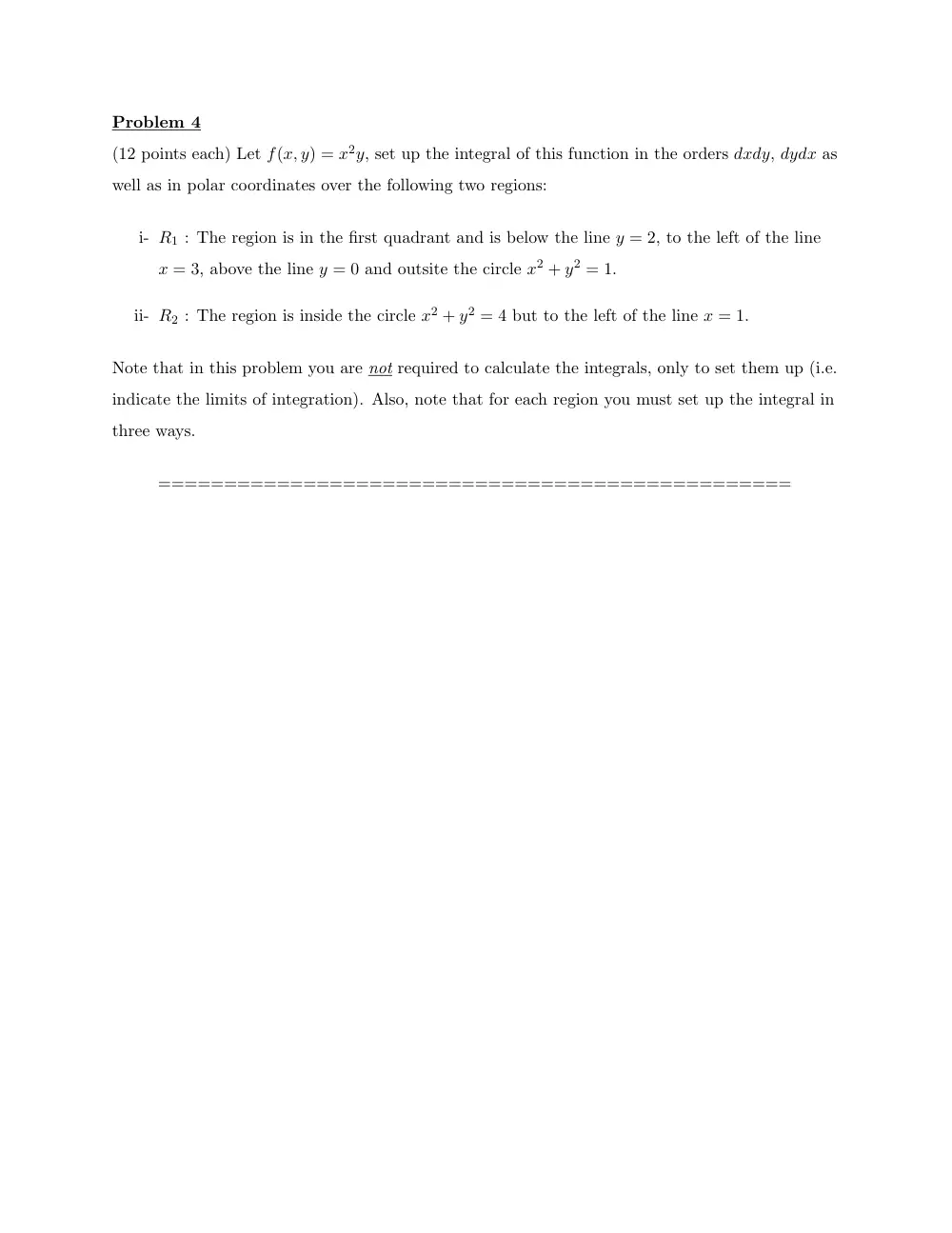
Problem 4
(12 points each) Let f(x, y) = x2y, set up the integral of this function in the orders dxdy, dydx as
well as in polar coordinates over the following two regions:
i- R1 : The region is in the first quadrant and is below the line y = 2, to the left of the line
x = 3, above the line y = 0 and outsite the circle x2 + y2 = 1.
ii- R2 : The region is inside the circle x2 + y2 = 4 but to the left of the line x = 1.
Note that in this problem you are not required to calculate the integrals, only to set them up (i.e.
indicate the limits of integration). Also, note that for each region you must set up the integral in
three ways.
================================================
ADDITIONAL SHEET FOR PROBLEM 4 ANSWER
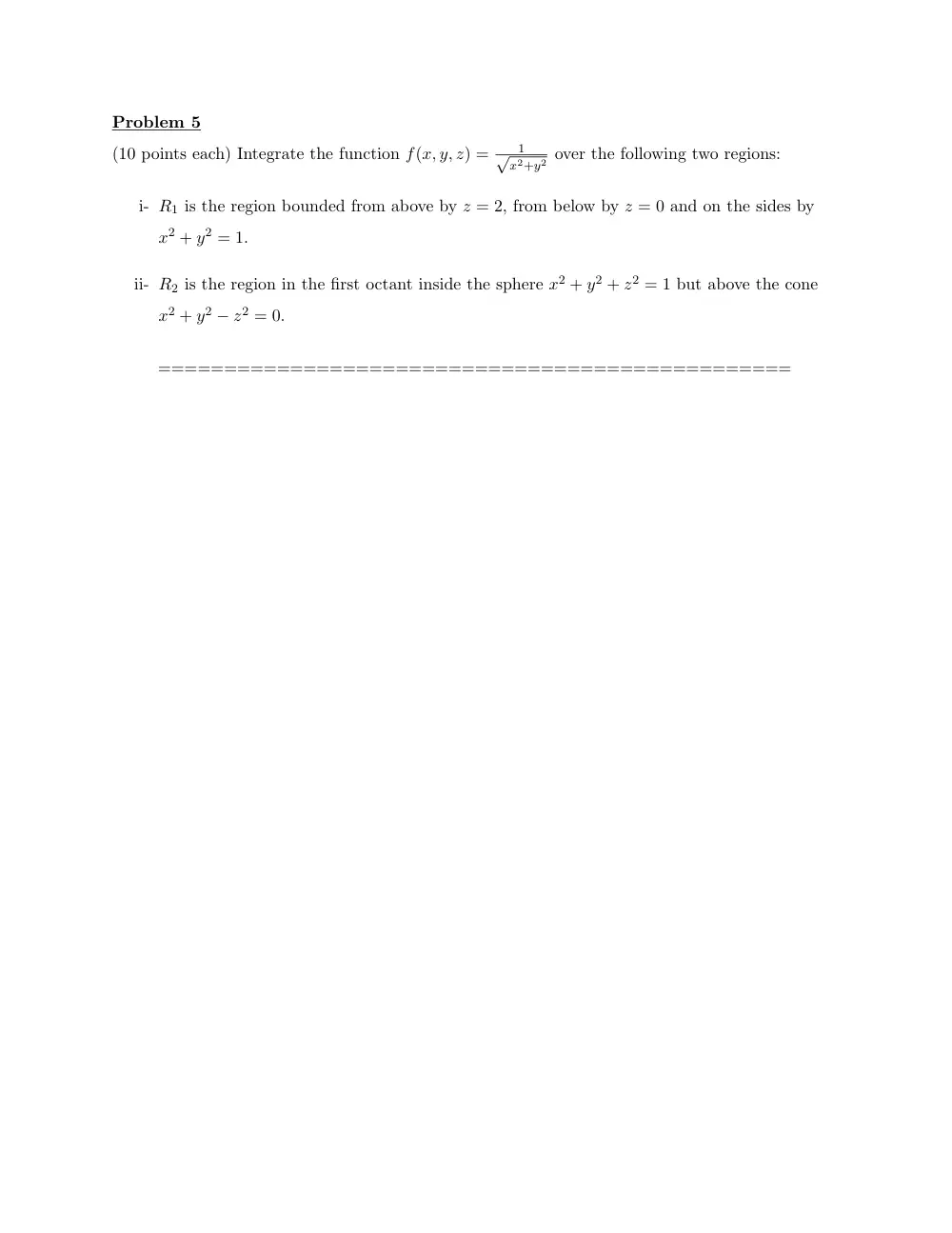
Problem 5
(10 points each) Integrate the function f(x, y, z) =
1
√
x2+y2 over the following two regions:
i- R1 is the region bounded from above by z = 2, from below by z = 0 and on the sides by
x2 + y2 = 1.
ii- R2 is the region in the first octant inside the sphere x2 + y2 + z2 = 1 but above the cone
x2 + y2 − z2 = 0.
================================================
ADDITIONAL SHEET FOR PROBLEM 5 ANSWER
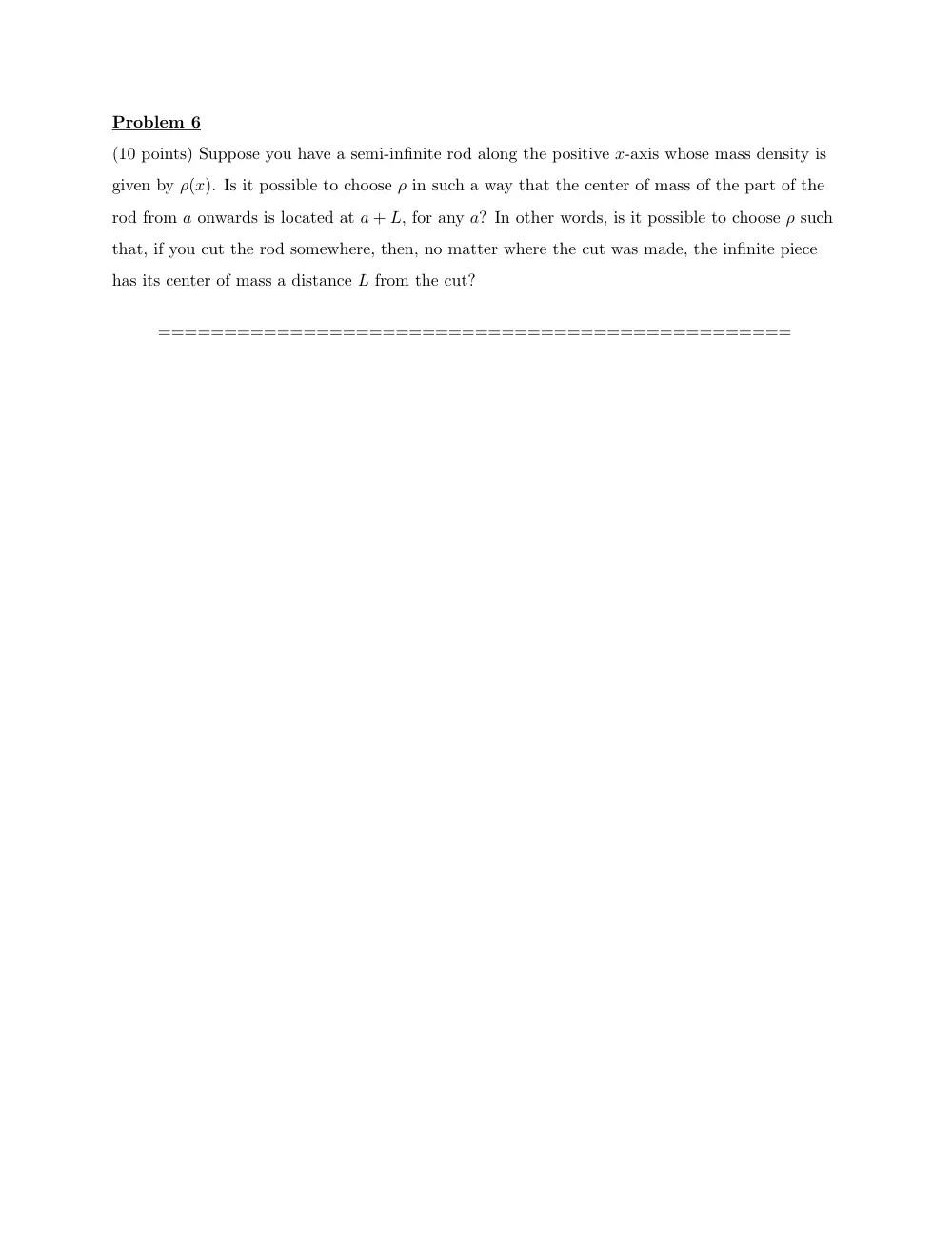
Problem 6
(10 points) Suppose you have a semi-infinite rod along the positive x-axis whose mass density is
given by ρ(x). Is it possible to choose ρ in such a way that the center of mass of the part of the
rod from a onwards is located at a + L, for any a? In other words, is it possible to choose ρ such
that, if you cut the rod somewhere, then, no matter where the cut was made, the infinite piece
has its center of mass a distance L from the cut?
================================================