
MATH 201 Problems For Final, Fall 2011
American University of Beirut · Calculus and Analytical Geometry III · 2 pages · Dr. Mohammad Kobeissi
More MATH 201 files
- Final · Spring 2019Final examView
- Final · Spring 2019Final examView
- Problems Difficult Problem 5 Tlas 2017 Final · Spring 2019Final examView
- Final · Fall 2018Final examView
- Final · Fall 2018Final examView
- Final Finals with Solution Collection · Spring 2017Final exam · with solutionView
- Final Finals with Solution Collection · Spring 2017Final exam · with solutionView
- Final · Spring 2017Final examView
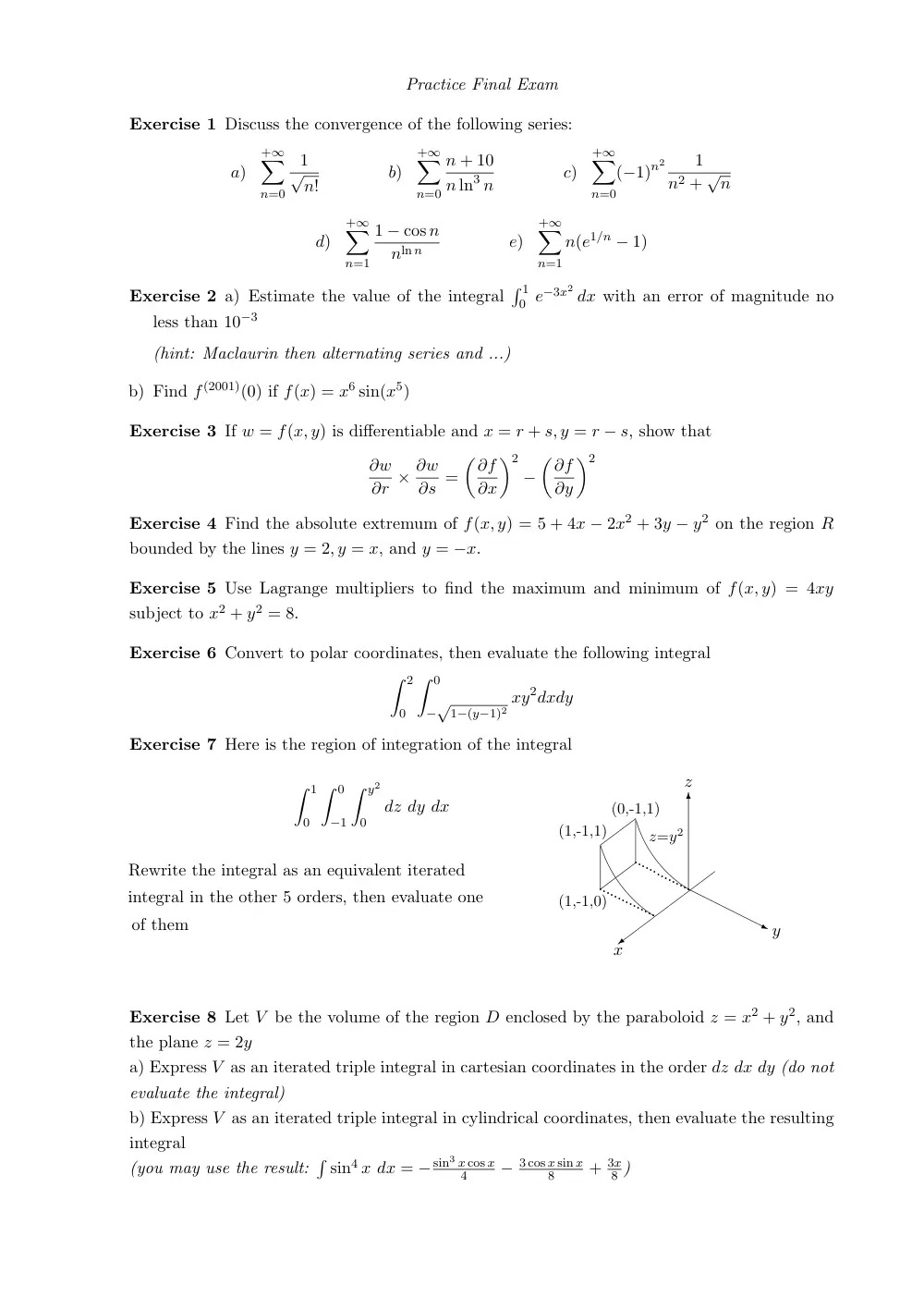
Show the text of this final exam
Practice Final Exam
Exercise 1 Discuss the convergence of the following series:
a)
+∞
�
n=0
1
√
n!
b)
+∞
�
n=0
n + 10
n ln3 n
c)
+∞
�
n=0
(−1)n2
1
n2 + √n
d)
+∞
�
n=1
1 − cos n
nln n
e)
+∞
�
n=1
n(e1/n − 1)
Exercise 2 a) Estimate the value of the integral
� 1
0 e−3x2 dx with an error of magnitude no
less than 10−3
(hint: Maclaurin then alternating series and ...)
b) Find f(2001)(0) if f(x) = x6 sin(x5)
Exercise 3 If w = f(x, y) is differentiable and x = r + s, y = r − s, show that
∂w
∂r × ∂w
∂s =
�∂f
∂x
�2
−
�∂f
∂y
�2
Exercise 4 Find the absolute extremum of f(x, y) = 5 + 4x − 2x2 + 3y − y2 on the region R
bounded by the lines y = 2, y = x, and y = −x.
Exercise 5 Use Lagrange multipliers to find the maximum and minimum of f(x, y) = 4xy
subject to x2 + y2 = 8.
Exercise 6 Convert to polar coordinates, then evaluate the following integral
� 2
0
� 0
−√
1−(y−1)2 xy2dxdy
Exercise 7 Here is the region of integration of the integral
=
j
x
6
z=y2
y
z
(0,-1,1)
...............
...............
(1,-1,1)
(1,-1,0)
� 1
0
� 0
−1
� y2
0
dz dy dx
Rewrite the integral as an equivalent iterated
integral in the other 5 orders, then evaluate one
of them
Exercise 8 Let V be the volume of the region D enclosed by the paraboloid z = x2 + y2, and
the plane z = 2y
a) Express V as an iterated triple integral in cartesian coordinates in the order dz dx dy (do not
evaluate the integral)
b) Express V as an iterated triple integral in cylindrical coordinates, then evaluate the resulting
integral
(you may use the result:
�
sin4 x dx = −sin3 x cos x
4
− 3 cos x sin x
8
+ 3x
8 )
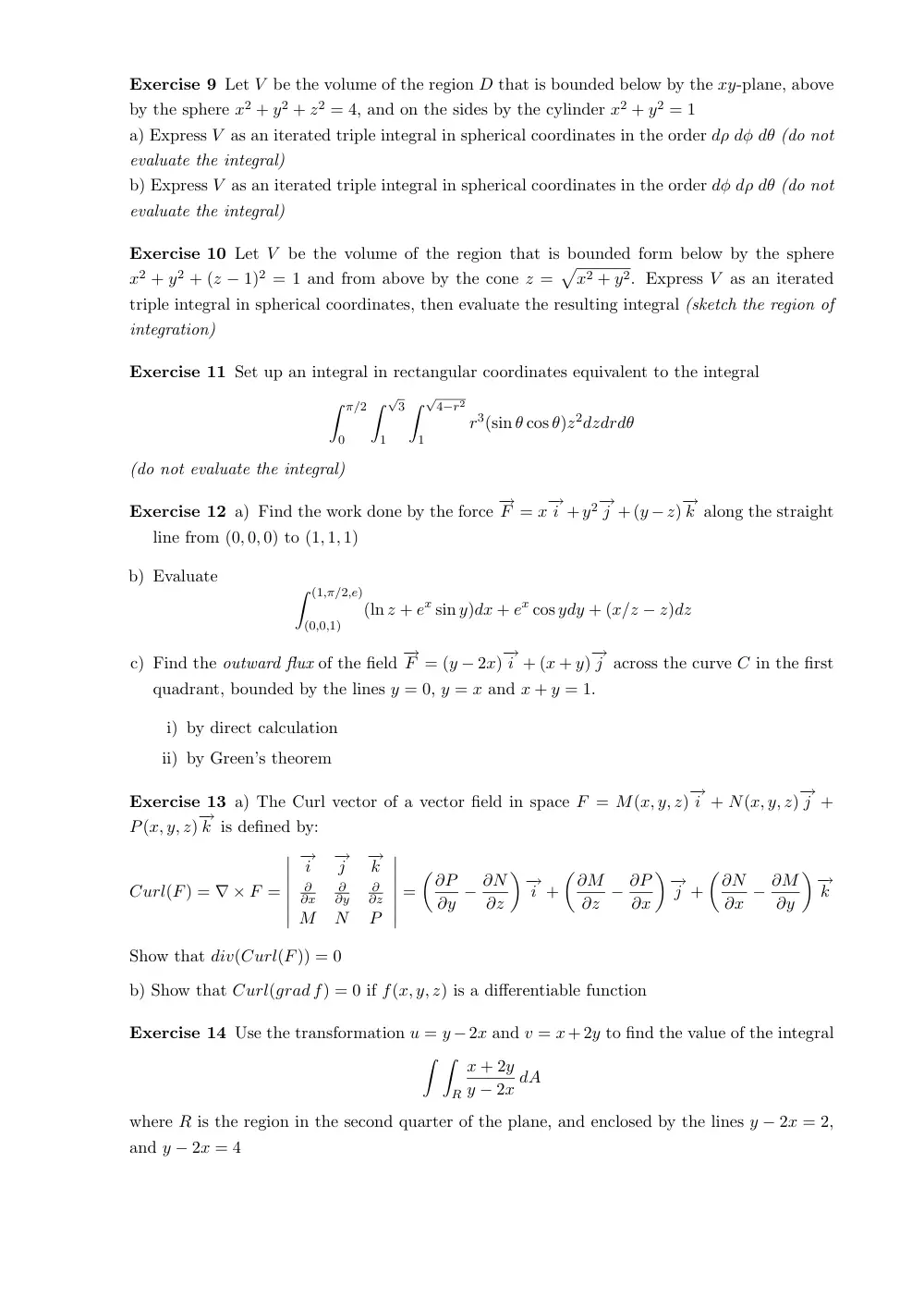
Exercise 9 Let V be the volume of the region D that is bounded below by the xy-plane, above
by the sphere x2 + y2 + z2 = 4, and on the sides by the cylinder x2 + y2 = 1
a) Express V as an iterated triple integral in spherical coordinates in the order dρ dφ dθ (do not
evaluate the integral)
b) Express V as an iterated triple integral in spherical coordinates in the order dφ dρ dθ (do not
evaluate the integral)
Exercise 10 Let V be the volume of the region that is bounded form below by the sphere
x2 + y2 + (z − 1)2 = 1 and from above by the cone z =
�
x2 + y2. Express V as an iterated
triple integral in spherical coordinates, then evaluate the resulting integral (sketch the region of
integration)
Exercise 11 Set up an integral in rectangular coordinates equivalent to the integral
� π/2
0
� √
3
1
� √
4−r2
1
r3(sin θ cos θ)z2dzdrdθ
(do not evaluate the integral)
Exercise 12 a) Find the work done by the force −→
F = x−→i +y2−→j +(y −z)−→k along the straight
line from (0, 0, 0) to (1, 1, 1)
b) Evaluate
� (1,π/2,e)
(0,0,1)
(ln z + ex sin y)dx + ex cos ydy + (x/z − z)dz
c) Find the outward flux of the field −→
F = (y − 2x)−→i + (x + y)−→j across the curve C in the first
quadrant, bounded by the lines y = 0, y = x and x + y = 1.
i) by direct calculation
ii) by Green’s theorem
Exercise 13 a) The Curl vector of a vector field in space F = M(x, y, z)−→i + N(x, y, z)−→j +
P(x, y, z)−→k is defined by:
Curl(F) = ∇ × F =
�������
−→i
−→j
−→k
∂
∂x
∂
∂y
∂
∂z
M
N
P
�������
=
�∂P
∂y − ∂N
∂z
� −→i +
�∂M
∂z − ∂P
∂x
� −→j +
�∂N
∂x − ∂M
∂y
� −→k
Show that div(Curl(F)) = 0
b) Show that Curl(grad f) = 0 if f(x, y, z) is a differentiable function
Exercise 14 Use the transformation u = y −2x and v = x+2y to find the value of the integral
� �
R
x + 2y
y − 2x dA
where R is the region in the second quarter of the plane, and enclosed by the lines y − 2x = 2,
and y − 2x = 4