
MATH 201 Useful File, Fall 2009
American University of Beirut · Calculus and Analytical Geometry III · 3 pages · Prof. Wissam Raji

More MATH 201 files
- Useful File Guide for Taylor Series - Problems · Spring 2019FileView
- Other Solution for Math 201 Exercises · Spring 2018File · with solutionView
- Useful File Good to Know for Math 201 · Fall 2018FileView
- Other Solution for Math 201 Exercises · Spring 2018File · with solutionView
- Useful File Practice Quiz 2 · Spring 2017FileView
- Useful File Practice Quiz 2 · Spring 2017FileView
- Useful File Integral · Spring 2016FileView
- Useful File Integral · Spring 2016FileView
Show the text of this file
MATH201 Prerequisites
-------------------------------
Course textbook: Finney, Weir, and Giordano, Thomas' Calculus, 11th edition.
--------------------------------
Below are some main points you should be familiar with. If you feel you need to practice more
about a few topics you should check the textbook. If you feel that you need to learn most of these
topics you should take MATH102! These topics are covered in the following sections of the
textbook: 1.6, 7.1, 7.2, 7.3, 7.4, 7.7, 7.8, 12.1–12.5, 8.1–8.5.
---------------------------------------------
Inverse Functions and Logarithms
-
One-to-one and Inverse Functions
-
Logarithmic functions
y = logax � x = ay, log10x = log x, logex = ln x
(0,∞) logax (-∞,∞)
ax
Assume a > 0, a ≠ 1, so that the function y = ax is one-to-one; x also is nonnegative.
Observe:
alog
a
x = x and logaax = x (a > 0, a ≠ 1, x > 0)
e ln x = x and ln ex = x (x > 0)
The Natural Logarithm (y = ln x)
-
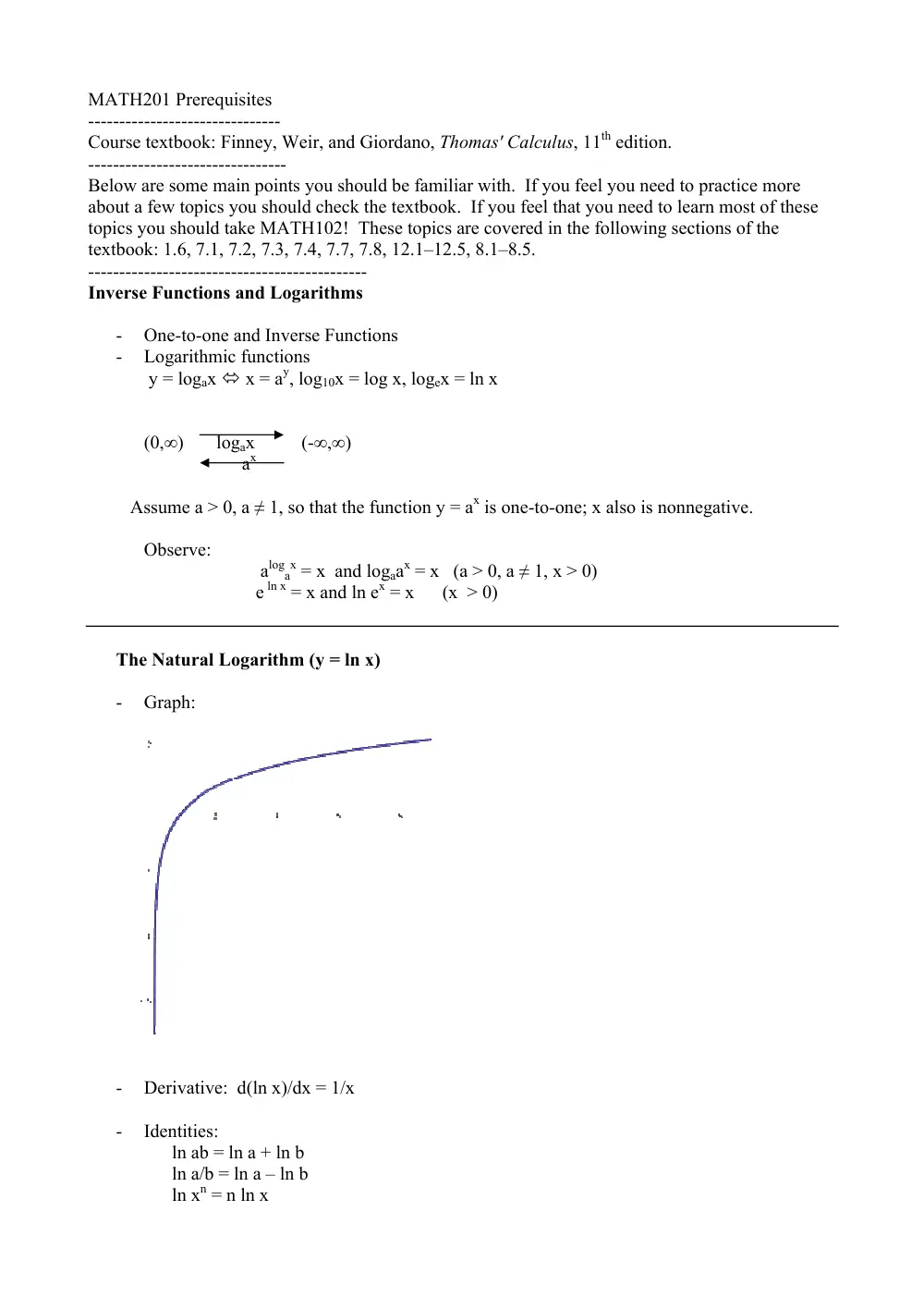
Graph:
-
Derivative: d(ln x)/dx = 1/x
-
Identities:
ln ab = ln a + ln b
ln a/b = ln a – ln b
ln xn = n ln x
-
Logarithmic differentiation
e.g. Use logarithmic differentiation to find the derivative of y = (θsinθ) / √(sec θ).
The exponential Function
-
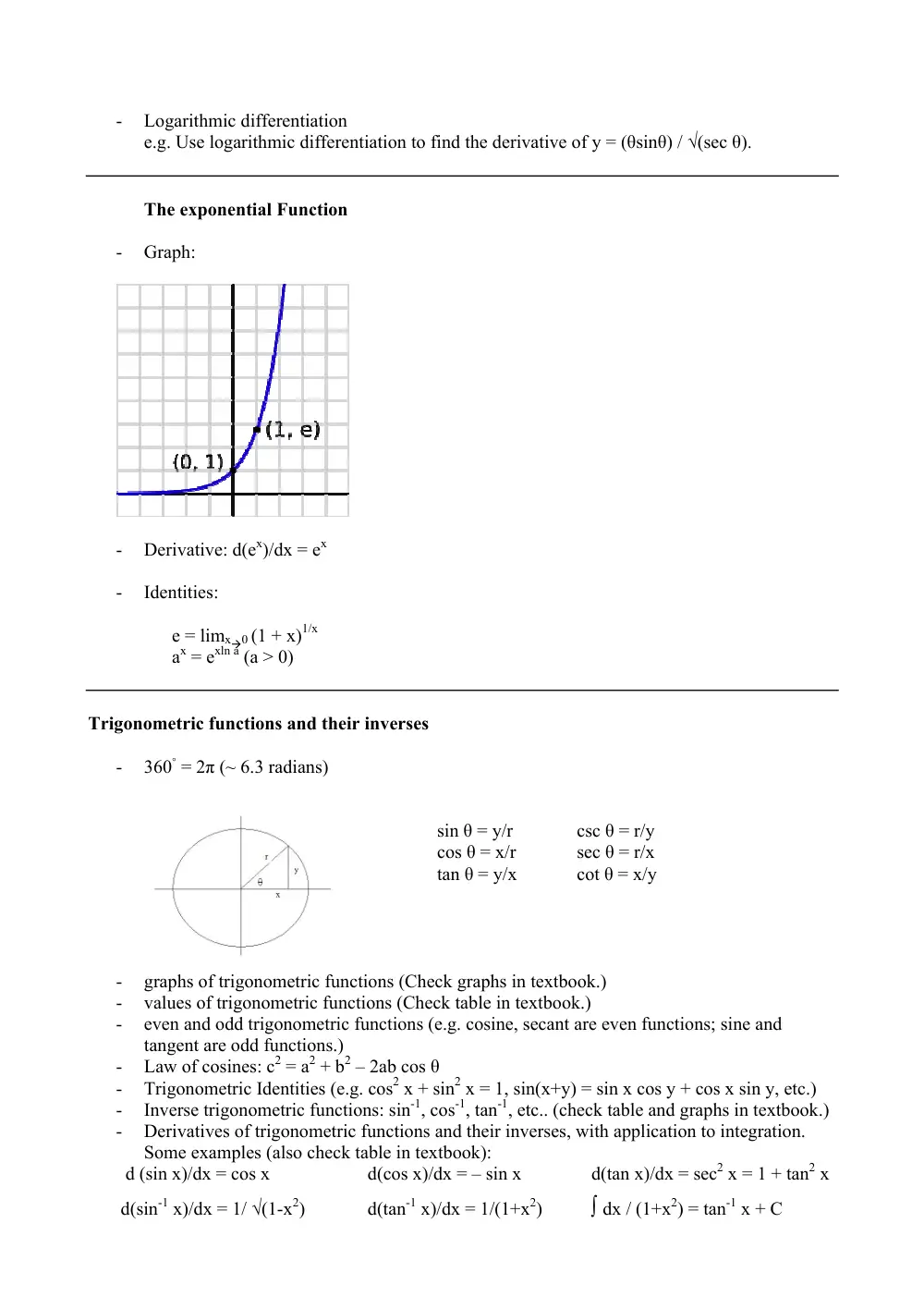
Graph:
-
Derivative: d(ex)/dx = ex
-
Identities:
e = limx�0 (1 + x)1/x
ax = exln a (a > 0)
Trigonometric functions and their inverses
-
360◦ = 2π (~ 6.3 radians)
sin θ = y/r
csc θ = r/y
cos θ = x/r
sec θ = r/x
tan θ = y/x
cot θ = x/y
-
graphs of trigonometric functions (Check graphs in textbook.)
-
values of trigonometric functions (Check table in textbook.)
-
even and odd trigonometric functions (e.g. cosine, secant are even functions; sine and
tangent are odd functions.)
-
Law of cosines: c2 = a2 + b2 – 2ab cos θ
-
Trigonometric Identities (e.g. cos2 x + sin2 x = 1, sin(x+y) = sin x cos y + cos x sin y, etc.)
-
Inverse trigonometric functions: sin-1, cos-1, tan-1, etc.. (check table and graphs in textbook.)
-
Derivatives of trigonometric functions and their inverses, with application to integration.
Some examples (also check table in textbook):
d (sin x)/dx = cos x
d(cos x)/dx = – sin x
d(tan x)/dx = sec2 x = 1 + tan2 x
d(sin-1 x)/dx = 1/ √(1-x2)
d(tan-1 x)/dx = 1/(1+x2)
∫ dx / (1+x2) = tan-1 x + C
Cartesian Systems
-
Cartesian coordinates P(x,y,z)
-
vector coordinates P1P2 (x2-x1, y2-y1, z2-z1) or v (v1,v2,v3)
-
sums of vectors (u1+v1, u2 + v2, u3+v3)
-
distance between two points √ [(x2-x1)2+(y2-y1)2+(z2-z1)2]
-
equation of sphere of radius a and center P0(x0,y0,z0)
(x-x0)2+(y-y0)2+(z-z0)2 = a2
-
Dot product
It is a number, u.v = |u||v|cos θ = u1v1 + u2v2+ u3v3
-
Projection of u onto v
projv u = ( u.v / |v|2 ) v
-
Cross product
u x v = ( |u||v|sin θ ) n so it is a vector orthogonal to both vectors u and v.
u x v = i
j
k
u1
u2
u3
v1
v2
v3
-
Parametrization: r(t) = ro + tv, t any real number.
-
Parametrization of a line passing through P0(x0,y0,z0) and parallel to (v1,v2,v3)
x = x0 + tv1
y = y0 + tv2
z = z0 + tv3
- Equation of a plane containing P0 and normal to vector (A,B,C)
A(x-x0) + B(y-y0) + C(z-z0) = 0
Integration
-
Basic Integration formulas and integration by substitution
e.g. Use integration by substitution to find ∫ x2 √(1 + 2x3) dx and ∫ [cos(ln y)/y] dy.
-
Integration by parts
e.g. Use integration by parts to find ∫ x sin (x/2) dx and ∫ tan-1y dy.
-
Partial fractions
e.g. (6x+7)/[(x+2)(x+3)] = A / (x+2) + B / (x+3) ; find A and B.
also (5x-3)/(x+2)2 = A / (x+2) + B / (x+2)2 ; find A and B.
-
Trigonometric substitutions
e.g. x = a tan θ allows us to replace
√(a2+ x2) = a sec θ
dx = a sec2 θ dθ
-
L'Hopital's Rule (we will learn a better method using series
in MATH201):
If f(a) = g(a) = 0, f'(a) and g'(a) exist, and g'(a) ≠ 0
then limx�a f(x)/g(x) = f'(a)/g'(a).
e.g. Find limx�0 [√(1+x) – 1] / x .