
MATH 202 Final, Spring 2002
American University of Beirut · Differential Equations · 13 pages




Showing the first 10 of 13 pages. Download the PDF to see all of it.
More MATH 202 files
- Final SAMPLE · Spring 2019Final examView
- Final Student Copy · Spring 2017Final examView
- Final · Summer 2016Final examView
- Final · Spring 2015Final examView
- Notes Final Summary · Fall 2015Final examView
- Final Common Final · Spring 2014Final examView
- Final · Fall 2013Final examView
- Final · Fall 2012Final examView
Show the text of this final exam
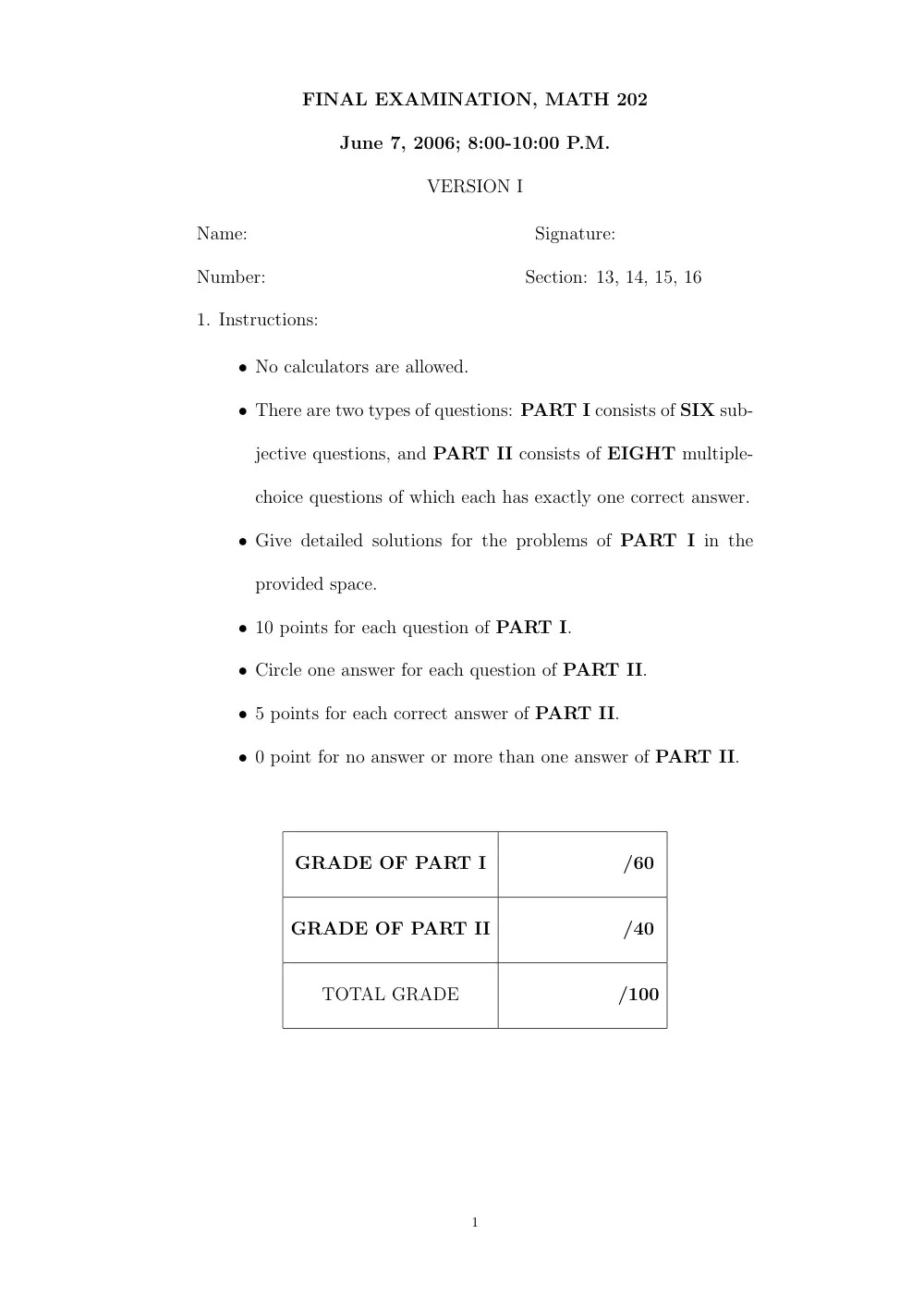
FINAL EXAMINATION, MATH 202
June 7, 2006; 8:00-10:00 P.M.
VERSION I
Name:
Signature:
Number:
Section: 13, 14, 15, 16
1. Instructions:
• No calculators are allowed.
• There are two types of questions: PART I consists of SIX sub-
jective questions, and PART II consists of EIGHT multiple-
choice questions of which each has exactly one correct answer.
• Give detailed solutions for the problems of PART I in the
provided space.
• 10 points for each question of PART I.
• Circle one answer for each question of PART II.
• 5 points for each correct answer of PART II.
• 0 point for no answer or more than one answer of PART II.
GRADE OF PART I
/60
GRADE OF PART II
/40
TOTAL GRADE
/100
1
2
Part I(1). solve, without using Laplace transforms, the initial-value
problem
dx
dt
=
2x + 4y
dy
dt
=
−x + 6y
with initial conditions x(0) = −1, y(0) = 6.
3
Extra Page
4
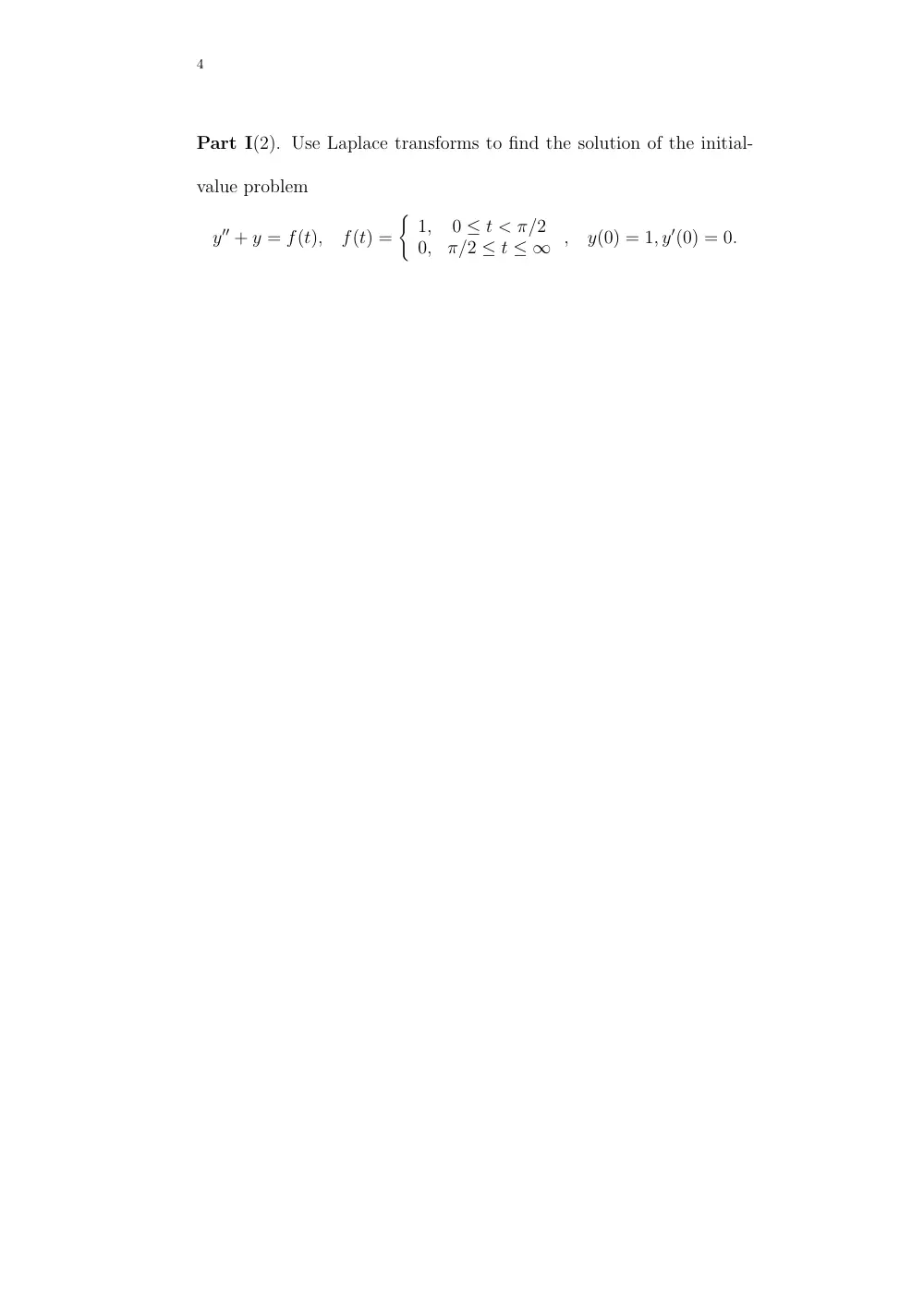
Part I(2). Use Laplace transforms to find the solution of the initial-
value problem
y′′ + y = f(t),
f(t) =
�
1,
0 ≤ t < π/2
0,
π/2 ≤ t ≤ ∞ ,
y(0) = 1, y′(0) = 0.
5
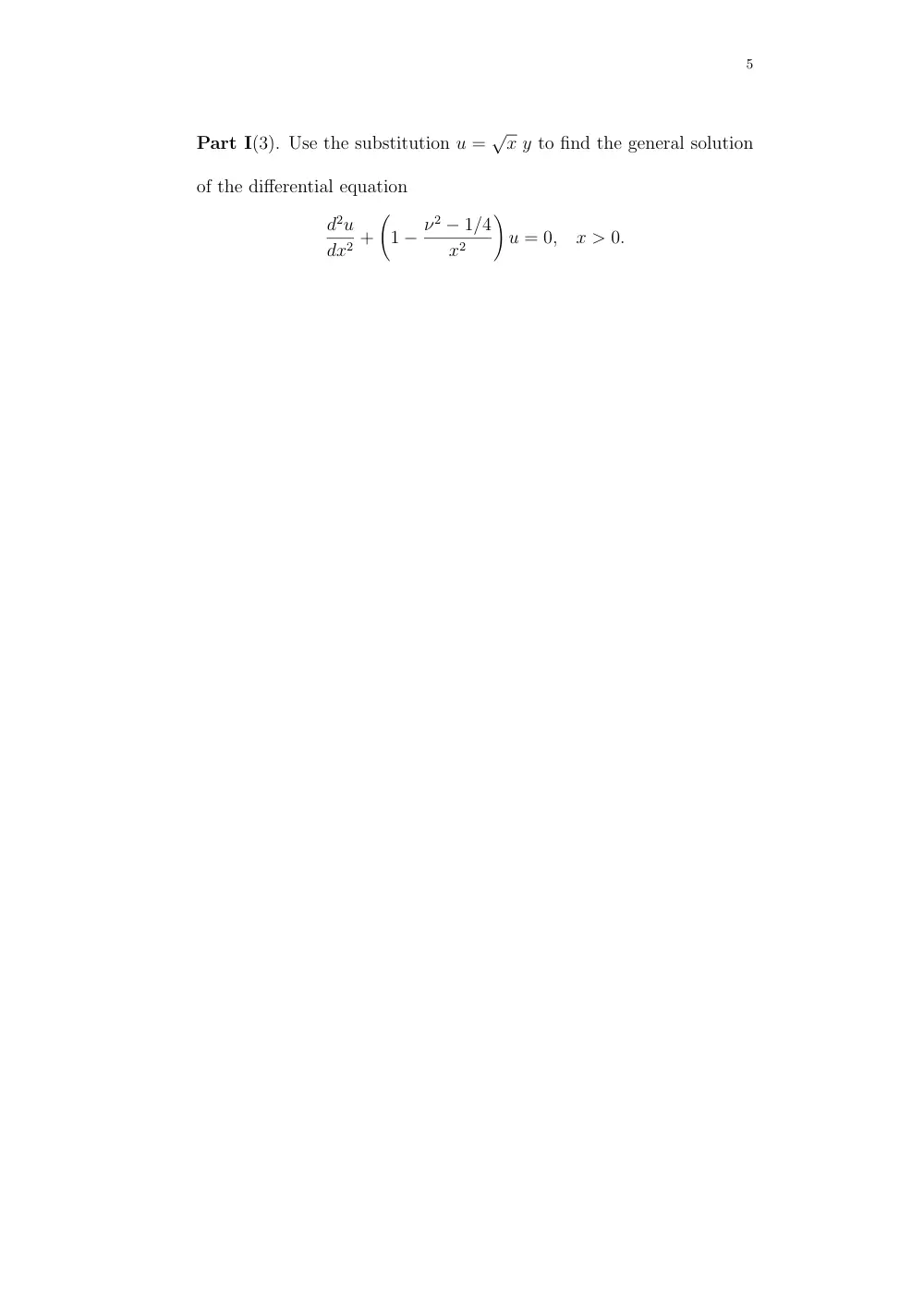
Part I(3). Use the substitution u = √x y to find the general solution
of the differential equation
d2u
dx2 +
�
1 − ν2 − 1/4
x2
�
u = 0,
x > 0.
6
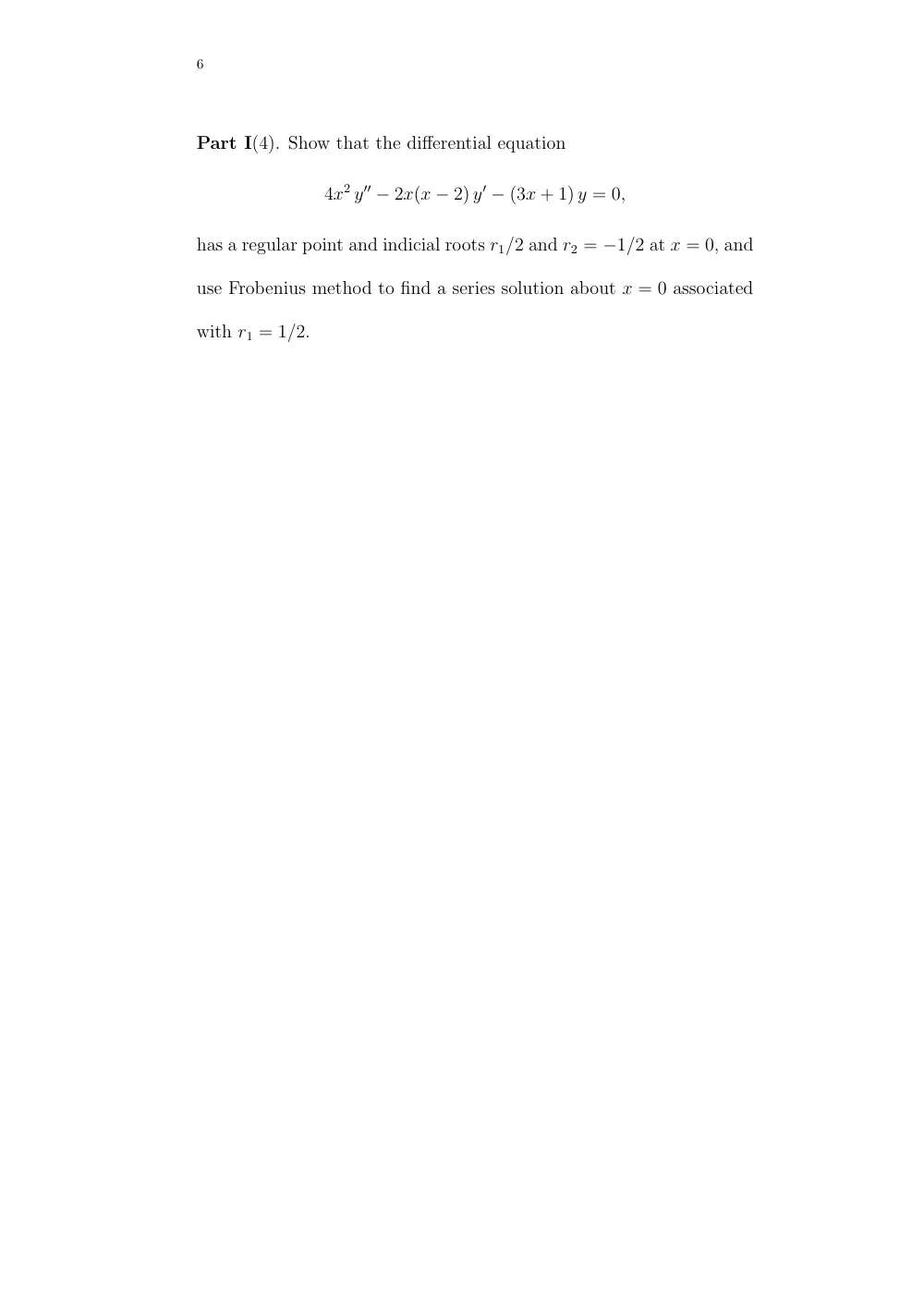
Part I(4). Show that the differential equation
4x2 y′′ − 2x(x − 2) y′ − (3x + 1) y = 0,
has a regular point and indicial roots r1/2 and r2 = −1/2 at x = 0, and
use Frobenius method to find a series solution about x = 0 associated
with r1 = 1/2.
7
Extra Page
8
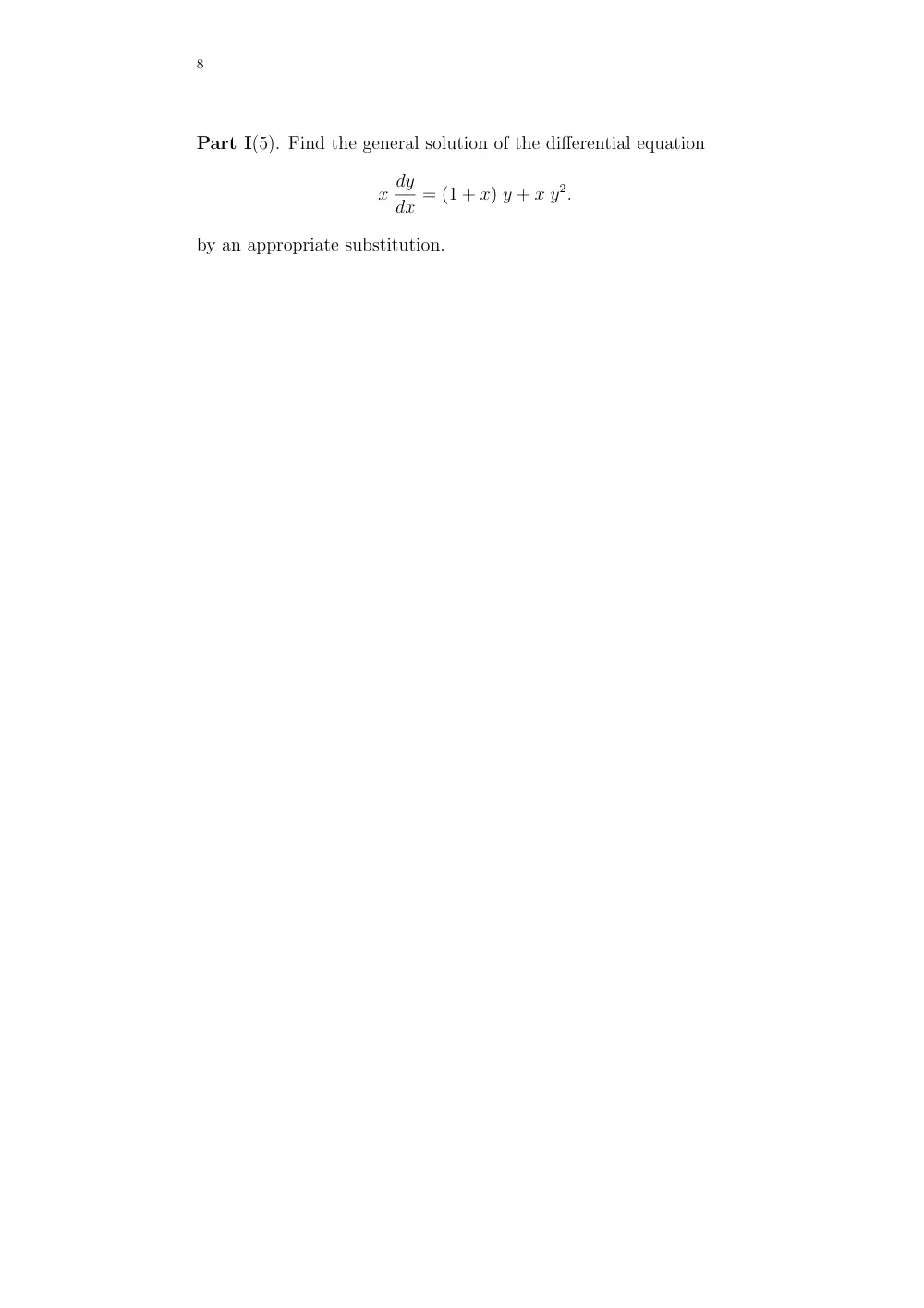
Part I(5). Find the general solution of the differential equation
x dy
dx = (1 + x) y + x y2.
by an appropriate substitution.
9
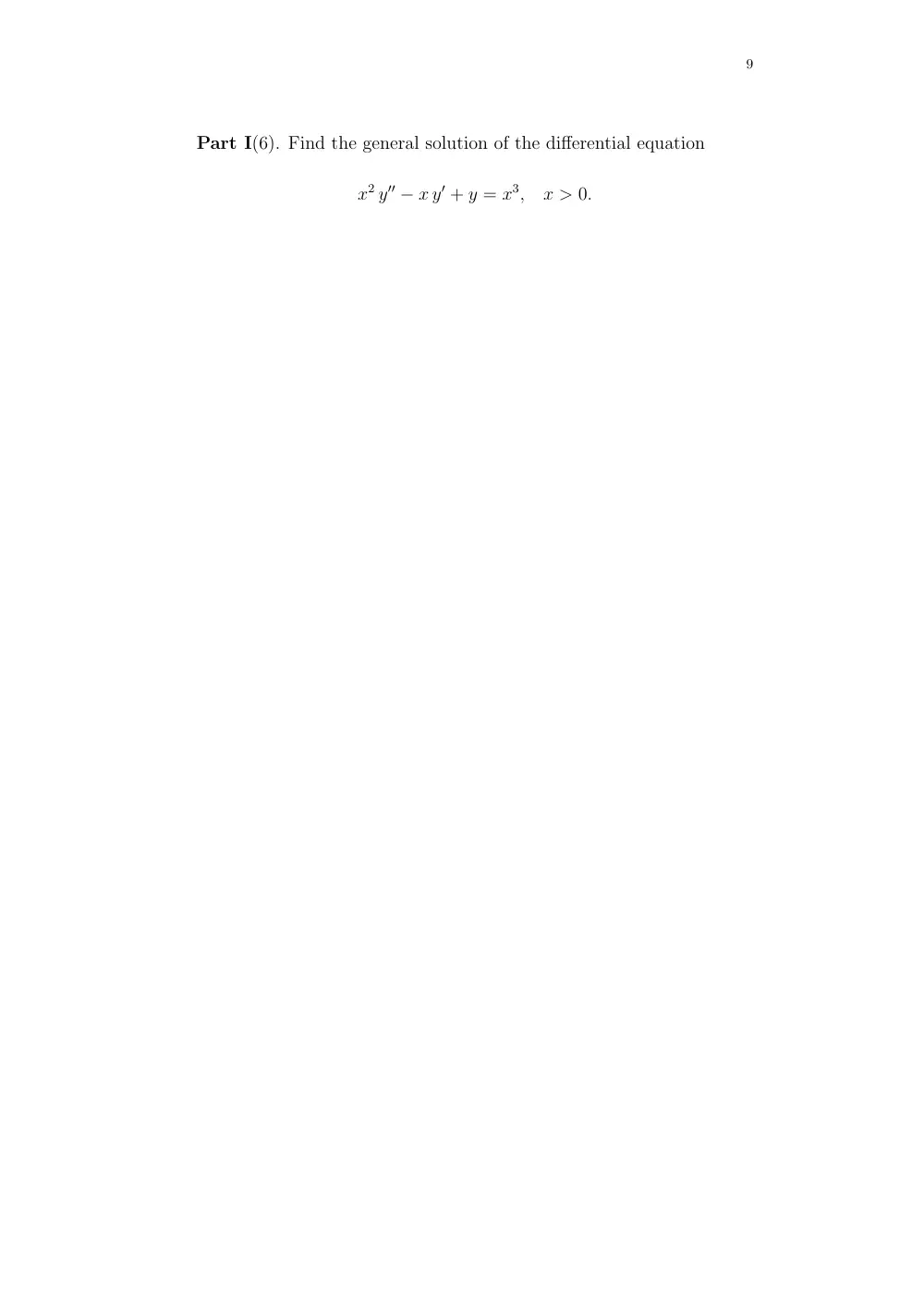
Part I(6). Find the general solution of the differential equation
x2 y′′ − x y′ + y = x3,
x > 0.
10
Extra Page
11
Part II: Multiple Choice Problems.
Part II(1). The solution of the initial-value problem
y′(t) = 1 − sin t −
� t
0 y(τ)dτ,
y(0) = 0,
satisfies
(a) y(t) = cos t + sin t ∗ cos t.
(b) y(t) = cos t − sin t ∗ cos t.
(c) y(t) = sin t + sin t ∗ cos t.
(d) y(t) = sin t − sin t ∗ cos t.
(e) None of the above.
Part II(2).
L−1
�e−s
s2 + tan s
�
=
(a) (t + 1)U(t + 1) + (sin t)/t.
(b) (t − 1)U(t − 1) − (sin t)/t.
(c) (t − 1)U(t − 1) − (cos t)/t.
(d) (t + 1)U(t + 1) − (sin t)/t.
(e) None of the above.
Part II(3). The solution of the initial-value problem
dy
dx = −1
2(x + y − 1)3 − 1,
y(1) = 1,
satisfies
(a) y(4) = −5/2.
(b) y(4) = 5/2.
(c) y(3) = 5/2.
(d) y(3) = −5/2.
(e) None of the above.
12
Part II(4). The solution of the initial-value problem
�sin 2x
y
+ x
�
dx +
�
y − sin2 x
y2
�
dy, y(0) = 1,
is given implicitly by the equation x2y + 2 sin2 x = h(y), where
(a) h(1) = 0.
(b) h(1) = 2.
(c) h(1) = 4.
(d) h(1) = 6.
(e) None of the above.
Part II(5). The differential equation
(x2 + 1)y′′ − 4xy′ + 6y = 0
has an ordinary point at x = 0 and two power series solutions �∞
n=0 cnxn,
whose coefficients cn, n = 0, 1, 2, · · · , satisfy the recurrence relation
(a) cn+2 = (n − 2)(n − 3)
(n + 1)(n + 2)cn,
n = 0, 1, 2, · · · .
(b) cn+2 = −(n − 2)(n − 3)
(n + 1)(n + 2)cn,
n = 0, 1, 2, · · · .
(c) cn+2 = −(n − 3)(n − 4)
(n + 1)(n + 2)cn,
n = 0, 1, 2, · · · .
(d) cn+2 = (n − 1)(n − 2)
(n + 1)(n + 2)cn,
n = 0, 1, 2, · · · .
(e) None of the above.
Part II(6). The solution of the initial-value problem
�
x cos2
�y
x
�
− y
�
dx + x dy = 0,
y(1) = π
4
satisfies
(a) y(e−2) = 0.
(b) y(e−1) = 0.
(c) y(e) = 0.
(d) y(e2) = 0.
(e) None of the above.
13
Part II(7). Answer TRUE (T) or (FALSE) only:
(a) —– The Laplace transform of a function f is
L(f(t)) =
� ∞
0
e−stf(t) dt.
(b) —- The convolution of functions f and g on [0, ∞) is defined by
(f ∗ g)(t) =
� t
0 f(τ)g(t − τ) dτ.
(c) —- The general solution of the parametric Bessel equation
x2 y′′ + x y′ + (λ2x2 − ν2)y = 0
is y = c1Jν(λx) + c2Yν(λx).
(d) —- If the set of two functions f1 and f2 is linearly independent
on an interval I, then the Wronskian W(f1, f2) ̸= 0 for all x ∈ I.
(e) —- The initial-value problem dy/dx = √y, y(x0) = y0 has no
solution for y0 < 0.
Part II(8). If y1 = (sin x)/x is one solution of the differential equa-
tion,
x y′′ + 2 y′ + x y = 0,
then the solution of the associated boundary-value problem with bound-
ary conditions y(π/2) = 0 and y(π) = 1/2 satisfies
(a) y(π/4) = −
√
2.
(b) y(π/4) =
√
2.
(c) y(π/4) = −
√
2/2.
(d) y(π/4) =
√
2/2.
(e) None of the above.