
MATH 202 Final, Spring 2005
American University of Beirut · Differential Equations · 2 pages
More MATH 202 files
- Final SAMPLE · Spring 2019Final examView
- Final Student Copy · Spring 2017Final examView
- Final · Summer 2016Final examView
- Final · Spring 2015Final examView
- Notes Final Summary · Fall 2015Final examView
- Final Common Final · Spring 2014Final examView
- Final · Fall 2013Final examView
- Final · Fall 2012Final examView
Show the text of this final exam
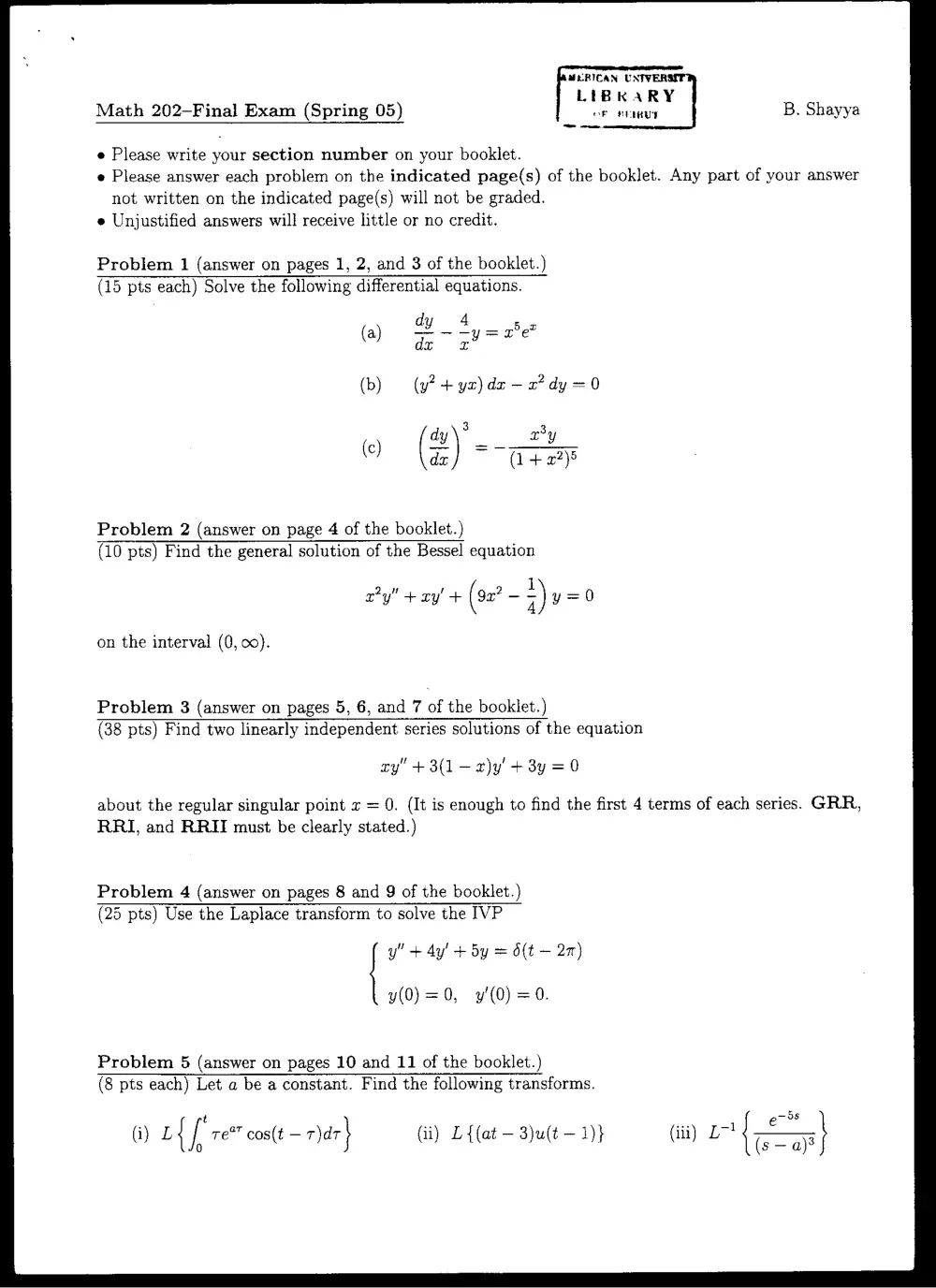
MERICAN UNTVER!
. . LIBKARY
Math 202-Final Exam (Spring 05) OF SEIRUT
e Please write your section number on your booklet.
e Please answer each problem on the indicated page(s) of the booklet. Any part of your answer
not written on the indicated page(s) will not be graded.
e Unjustified answers will receive little or no credit.
Problem 1 (answer on pages 1, 2, and 3 of the booklet.)
(15 pts each) Solve the following differential equations.
dy 4
(a) s--ty=s
5 2
e
dt 2
(y? + yz) dz — x? dy =0
Problem 2 (answer on page 4 of the booklet.)
(10 pts) Find the general solution of the Bessel equation
1
zy” + zy! + (92" - 3) y=0
on the interval (0,00).
Problem 3 (answer on pages 5, 6, and 7 of the booklet.)
(38 pts) Find two linearly independent series solutions of the equation
cy” +3(1—z)y' + 3y =0
about the regular singular point z = 0. (It is enough to find the first 4 terms of each series. GRR,
RRI, and RRII must be clearly stated.)
Problem 4 (answer on pages 8 and 9 of the booklet.)
(25 pts) Use the Laplace transform to solve the IVP
| y" + 4y' + by = 6(t — 27)
y(0)=9, y'(0)=0.
Problem 5 (answer on pages 10 and 11 of the booklet.)
(8 pts each) Let a be a constant. Find the following transforms.
(i) L {f re cos(t ~ 7)dr} Gi) L{(at —3)u(t—1)}
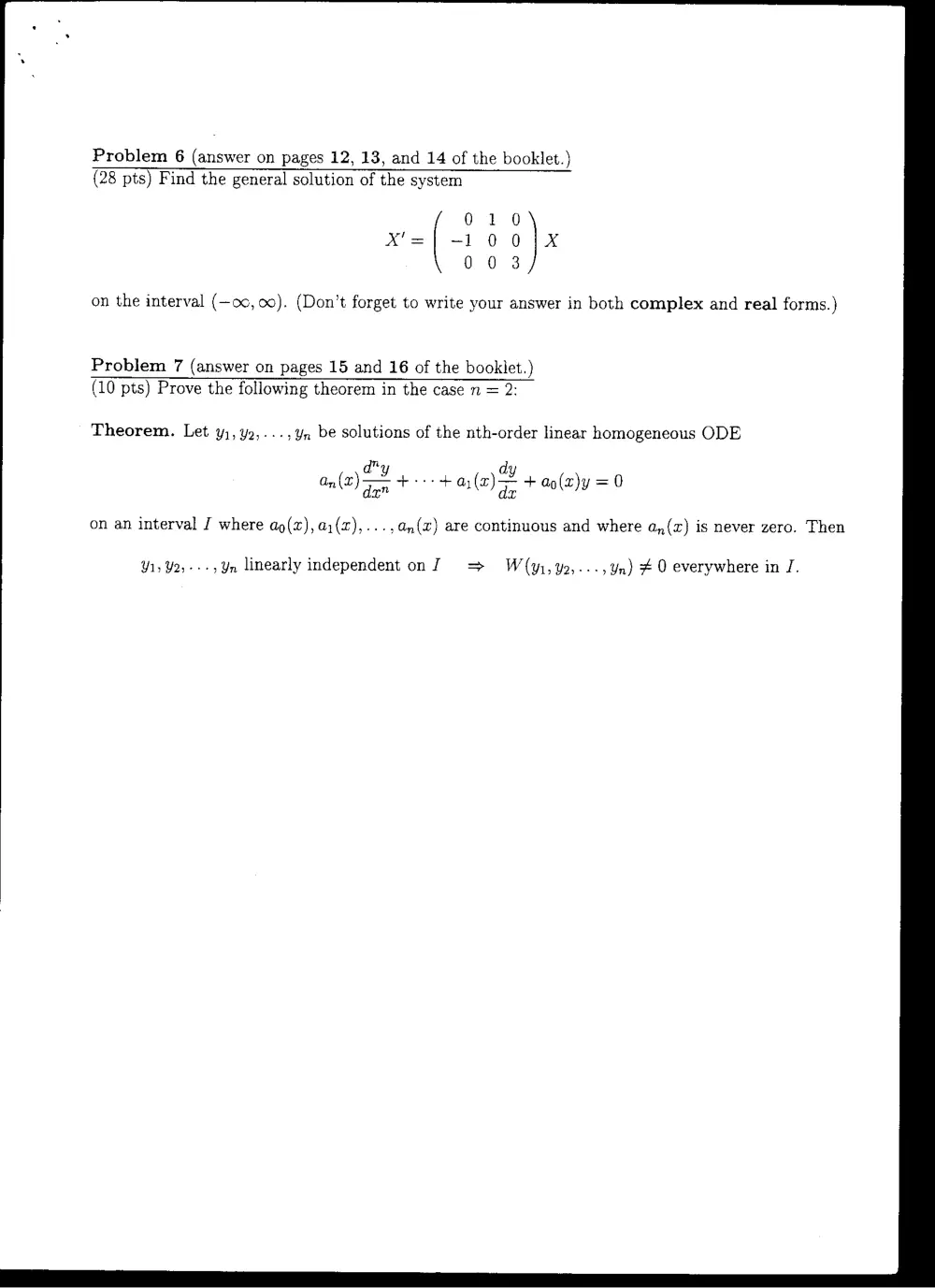
Problem 6 (answer on pages 12, 13, and 14 of the booklet.)
(28 pts) Find the general solution of the system
010
X'=/] -1004X
0 0 3
on the interval (—0o, 00). (Don’t forget to write your answer in both complex and real forms.)
Problem 7 (answer on pages 15 and 16 of the booklet.)
(10 pts) Prove the following theorem in the case n = 2:
Theorem. Let 1, y2,..., Yn be solutions of the nth-order linear homogeneous ODE
d"y dy
On (2) as a(x)" + ao(z)y = 0
on an interval J where @o(z),a;(x),...,@,(z) are continuous and where a,(z) is never zero. Then
Yi; Y2,---,Yn linearly independent on I == W(y1, yo,---, Yn) # 0 everywhere in J.