
MATH 202 Final, Spring 2005
American University of Beirut · Differential Equations · 2 pages
More MATH 202 files
- Final SAMPLE · Spring 2019Final examView
- Final Student Copy · Spring 2017Final examView
- Final · Summer 2016Final examView
- Final · Spring 2015Final examView
- Notes Final Summary · Fall 2015Final examView
- Final Common Final · Spring 2014Final examView
- Final · Fall 2013Final examView
- Final · Fall 2012Final examView
Show the text of this final exam
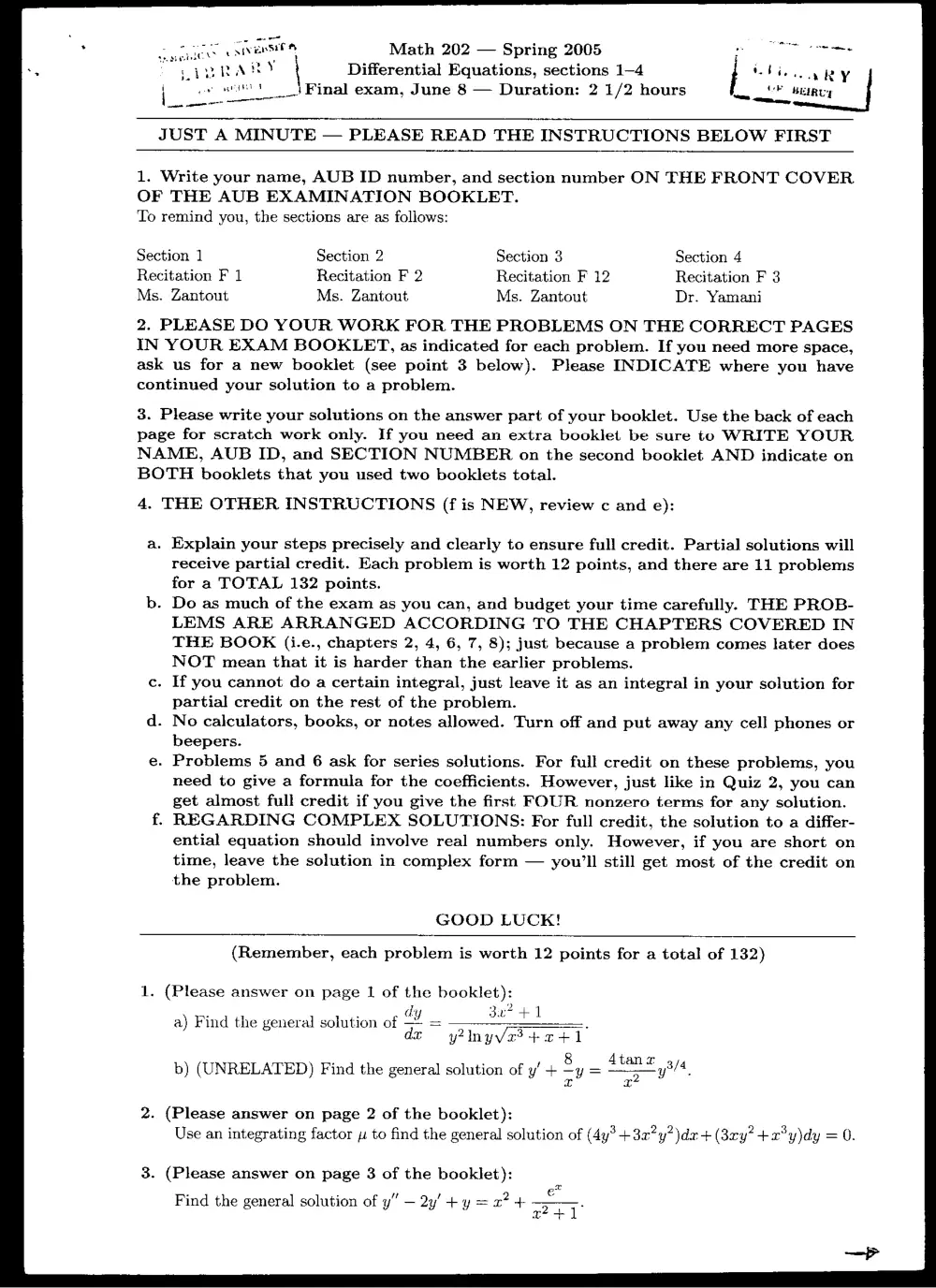
Math 202 — Spring 2005 pe nme
; \ Differential Equations, sections 1-4 i tliewaRry
_.-'Final exam, June 8 — Duration: 2 1/2 hours OF BERRUY
‘on
1.
JUST A MINUTE — PLEASE READ THE INSTRUCTIONS BELOW FIRST
1. Write your name, AUB ID number, and section number ON THE FRONT COVER
OF THE AUB EXAMINATION BOOKLET.
To remind you, the sections are as follows:
Section 1 Section 2 Section 3 Section 4
Recitation F 1 Recitation F 2 Recitation F 12 Recitation F 3
Ms. Zantout Ms. Zantout Ms. Zantout Dr. Yamani
2. PLEASE DO YOUR WORK FOR THE PROBLEMS ON THE CORRECT PAGES
IN YOUR EXAM BOOKLET, as indicated for each problem. If you need more space,
ask us for a new booklet (see point 3 below). Please INDICATE where you have
continued your solution to a problem.
3. Please write your solutions on the answer part of your booklet. Use the back of each
page for scratch work only. If you need an extra booklet be sure to WRITE YOUR
NAME, AUB ID, and SECTION NUMBER on the second booklet AND indicate on
BOTH booklets that you used two booklets total.
4. THE OTHER INSTRUCTIONS (f is NEW, review c and e):
a. Explain your steps precisely and clearly to ensure full credit. Partial solutions will
receive partial credit. Each problem is worth 12 points, and there are 11 problems
for a TOTAL 132 points.
- Do as much of the exam as you can, and budget your time carefully. THE PROB-
LEMS ARE ARRANGED ACCORDING TO THE CHAPTERS COVERED IN
THE BOOK (i.e., chapters 2, 4, 6, 7, 8); just because a problem comes later does
NOT mean that it is harder than the earlier problems.
. If you cannot do a certain integral, just leave it as an integral in your solution for
partial credit on the rest of the problem.
- No calculators, books, or notes allowed. Turn off and put away any cell phones or
beepers.
. Problems 5 and 6 ask for series solutions. For full credit on these problems, you
need to give a formula for the coefficients. However, just like in Quiz 2, you can
get almost full credit if you give the first FOUR nonzero terms for any solution.
. REGARDING COMPLEX SOLUTIONS: For full credit, the solution to a differ-
ential equation should involve real numbers only. However, if you are short on
time, leave the solution in complex form — you’ll still get most of the credit on
the problem.
GOOD LUCK!
(Remember, each problem is worth 12 points for a total of 132)
1. (Please answer on page 1 of the booklet):
. . dy Ba? +1
a) Find the general solution of — = .
) 8 dry? nyV23 +a +1
b) (UNRELATED) Find the general solution of y’ + =y = {tan =
yl,
Hr
2. (Please answer on page 2 of the booklet):
Use an integrating factor y to find the general solution of (4y°+327y?)dx+ (3ry*+2°y)dy = 0.
3. (Please answer on page 3 of the booklet):
et
Find the general solution of y” — 2y’ + y = 2? + Pal
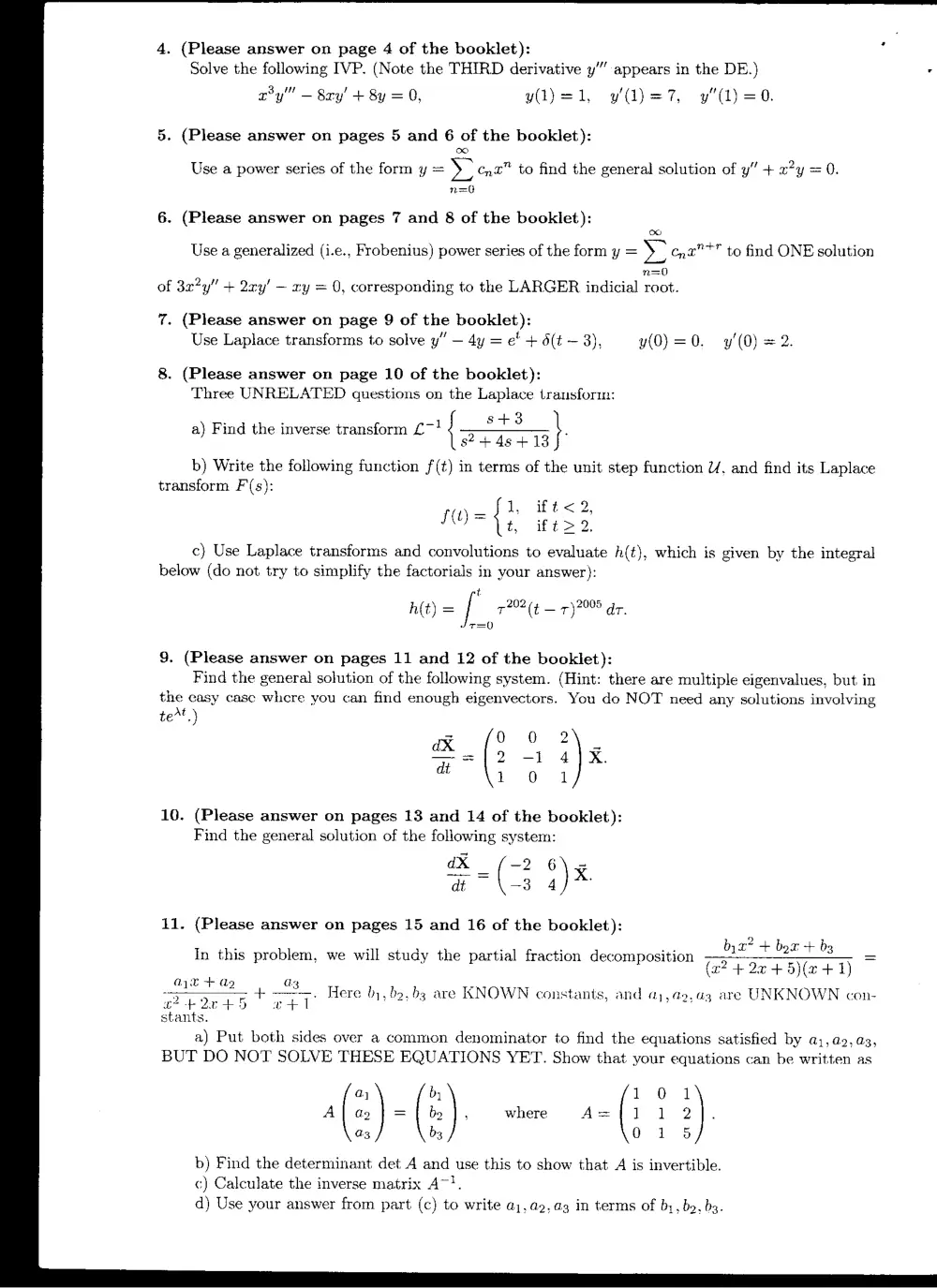
4. (Please answer on page 4 of the booklet):
Solve the following IVP. (Note the THIRD derivative y’” appears in the DE.)
ry!" — Say! + 8y = 0, yD=l YO=7 y"(M)=0.
5. (Please answer on pages 5 and 6 of the booklet):
fo a)
Use a power series of the form y = Ss nx” to find the general solution of y” + x*y = 0.
n=O
6. (Please answer on pages 7 and 8 of the booklet):
lo. <)
Use a generalized (i.e., Frobenius) power series of the form y = S Cnt"™** to find ONE solution
n=0
of 327y" + 2xy’ — zy = 0, corresponding to the LARGER indicial root.
7. (Please answer on page 9 of the booklet):
Use Laplace transforms to solve y” — 4y = e' + 6(t ~ 3), y(0)=0, y'(0) = 2.
8. (Please answer on page 10 of the booklet):
Three UNRELATED questions on the Laplace transform:
3
a) Find the inverse transform £7! {asta}
b) Write the following function f(t) in terms of the unit step function U/, and find its Laplace
transform F'(s):
_ fi, ift<2,
no= th ift> 2.
c) Use Laplace transforms and convolutions to evaluate h(t), which is given by the integral
below (do not try to simplify the factorials in your answer):
t
nit) =f 1%(e = 7)" ar.
Jr=0
9. (Please answer on pages 11 and 12 of the booklet):
Find the generai solution of the following system. (Hint: there are multiple eigenvalues, but in
the easy casc where you can find enough eigenvectors. You do NOT need any solutions involving
te.)
= 0 0 2
Halo 1 4)x%
d 1041
10. (Please answer on pages 13 and 14 of the booklet):
Find the general solution of the following system:
dX /-2 6\5
dt (= 1) x.
11. (Please answer on pages 15 and 16 of the booklet):
In this problem, we will study the partial fraction decomposition bya” + boa + bs =
me P ; yame P om (2? + 2 + 5)(@ + 1)
aye + Ag ag -
se to Here I, b2,b3 are KNOWN constants, and a),4@2,4a3 are UNKNOWN con-
o + 2e4+5 «+1
stants.
a) Put both sides over a common denominator to find the equations satisfied by @1, @2,@3,
BUT DO NOT SOLVE THESE EQUATIONS YET. Show that your equations can be written as
ay by 101
Ala. }={ bo]. where A=zt1 1 2
a3 b3 01°55
b) Find the determinant det A and use this to show that A is invertible.
c) Calculate the inverse matrix A7?.
d) Use your answer from part (c) to write a),a2,a3 in terms of b;, by, bs.