
MATH 202 Final, Spring 2005
American University of Beirut · Differential Equations · 5 pages


More MATH 202 files
- Final SAMPLE · Spring 2019Final examView
- Final Student Copy · Spring 2017Final examView
- Final · Summer 2016Final examView
- Final · Spring 2015Final examView
- Notes Final Summary · Fall 2015Final examView
- Final Common Final · Spring 2014Final examView
- Final · Fall 2013Final examView
- Final · Fall 2012Final examView
Show the text of this final exam
fawrtuan t NIVERSET
| LIBKARY
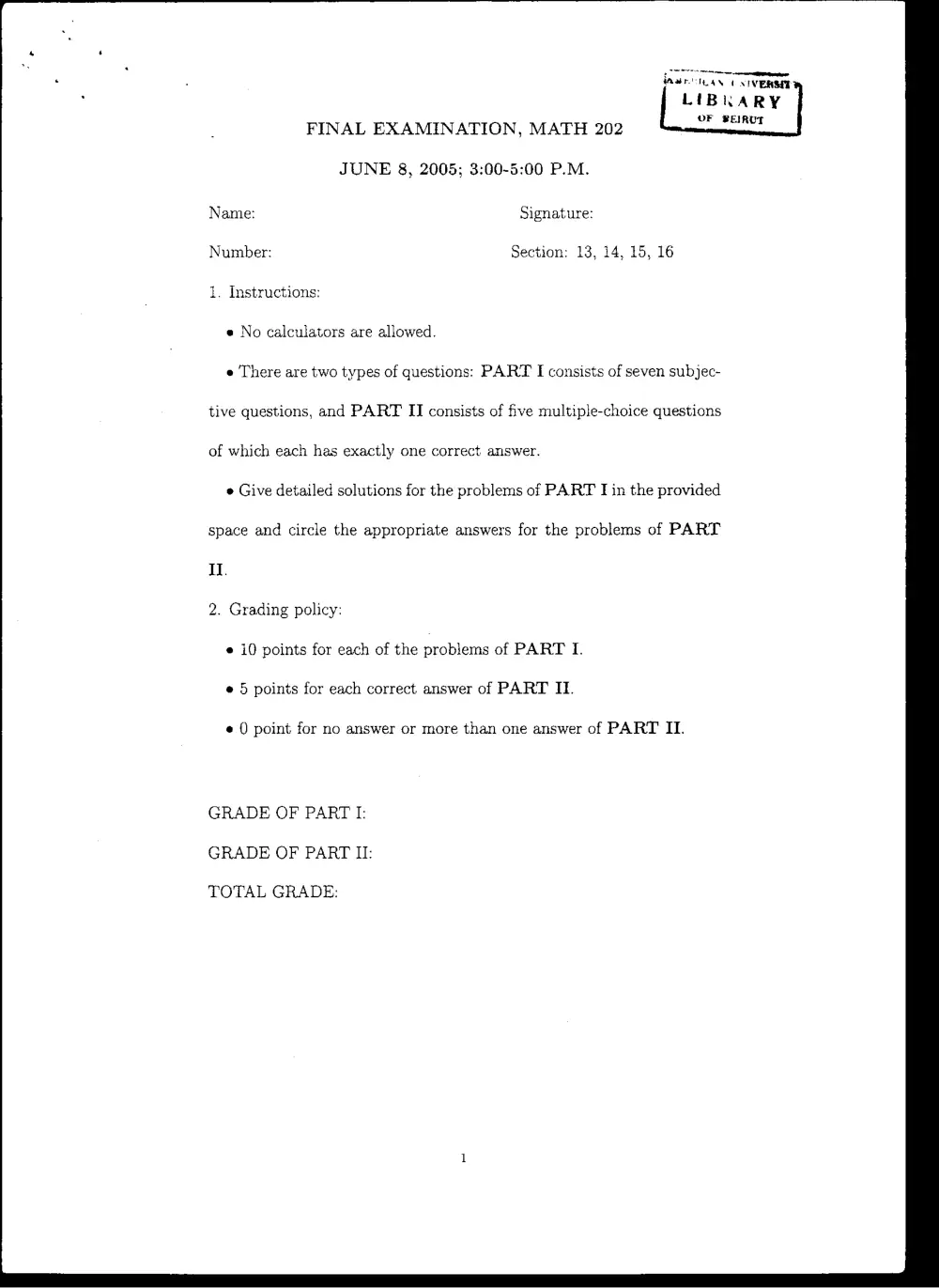
FINAL EXAMINATION, MATH 202 et
JUNE 8, 2005; 3:00-5:00 P.M.
Name: Signature:
Number: Section: 13, 14, 15, 16
1. Instructions:
e No calculators are allowed.
e There are two types of questions: PART I consists of seven subjec-
tive questions, and PART II consists of five multiple-choice questions
of which each has exactly one correct answer.
e Give detailed solutions for the problems of PART I in the provided
space and circle the appropriate answers for the problems of PART
II.
2. Grading policy:
e 10 points for each of the problems of PART I.
e 5 points for each correct answer of PART II.
¢ 0 point for no answer or more than one answer of PART II.
GRADE OF PART I:
GRADE OF PART II:
TOTAL GRADE:
Part I(1). Find the general solution of the system X’ = AX where
7 -2 4
0 -2
0 -1
(2). Find the general solution of the differential equation
y" +y = 2sine + 5e.
. Part (3). Use Laplace transform to solve the initial value problem
. Part I(4). Find the general solution of the differential equation
mame El de + | tl ay =o
Very 2 Very 2, YO”
. Part 1(5). Show that y = /z J.(z) is a solution for the differential
equation
. Part I(6). Solve the differential equation
vy tir y=y?.
. Part I(7). Find the general solution of the differential equation
zy" ~ sry. +y=4alnz, «>0.
. Part II: Multiple Choice Problems.
Part II(1). The solution of the initial-value problem
ytl=e sing, y(0) =0,
passes through the point
(a) (x = 7/2,y = 7/2 —1n2).
(b) (@ = 1/2,y = —7/2 — In 2).
(c) (c = 24/2,y = 7/24 1n2).
(d) (2 = 1/2,y = —7/24+1n2).
(e) None of the above.
Part II(2). Knowing that the differential equation
227y" ~- 3ry' + (8+a)y =0
has a regular singular point at x = 0 with an indicial root r, then an
application of Frobenius method to find the associated series solution
Ro Cnt” yields for the coefficients cn, n > 1 the recurrence relation
(a) Cn = Cn-i/[(n +r + 1)(2n + 2r — 3)].
(b) Cn = —Cp-i/[(n + r — 1)(2n + 2r — 3)).
(c) Cp = ~Cn-1/[(n + 7 — 1)(2n + 2r + 3)).
(d) er = Cra/[(m + 7 — 1)(2n + 2r — 3),
(e) None of the above.
10
. Part II(3). Answer TRUE (T) or (FALSE) only:
(a) —~ If m is a positive integer and J, is Bessel’s function of the
first kind of order m, then J_m = {-1)"Jm.
(b) —- Bessel’s function of the first kind of order v is defined by
= ray (-1)" (@y""
Aa nt PC ni Tw +n) 2 ,
(c) —— The Gamma function is defined by
T(z) = [ ett? | dt, 2 >0.
Jo
{d) —- Picard’s theorem guarantees a unique solution for the initial
value problem
dy
Ge FE ¥), y(Zo) = Yo
o
if f and f, are continuous functions in some open rectangle containing
(Xo, Yo):
(e) —- The convolution of functions f and g on (0, 00) is defined by
t
(Fa gtt) = [ f@glr +8) ar
Part II(4).
(a) 6(t + 2) + (eb — e*)/t.
(b) 6(t + 2) — (e' — e*)/t.
(c) d(t — 2) + (ef —e*)/t.
(d) 6(t — 2) — (et -—e*)/t.
(e) None of the above.
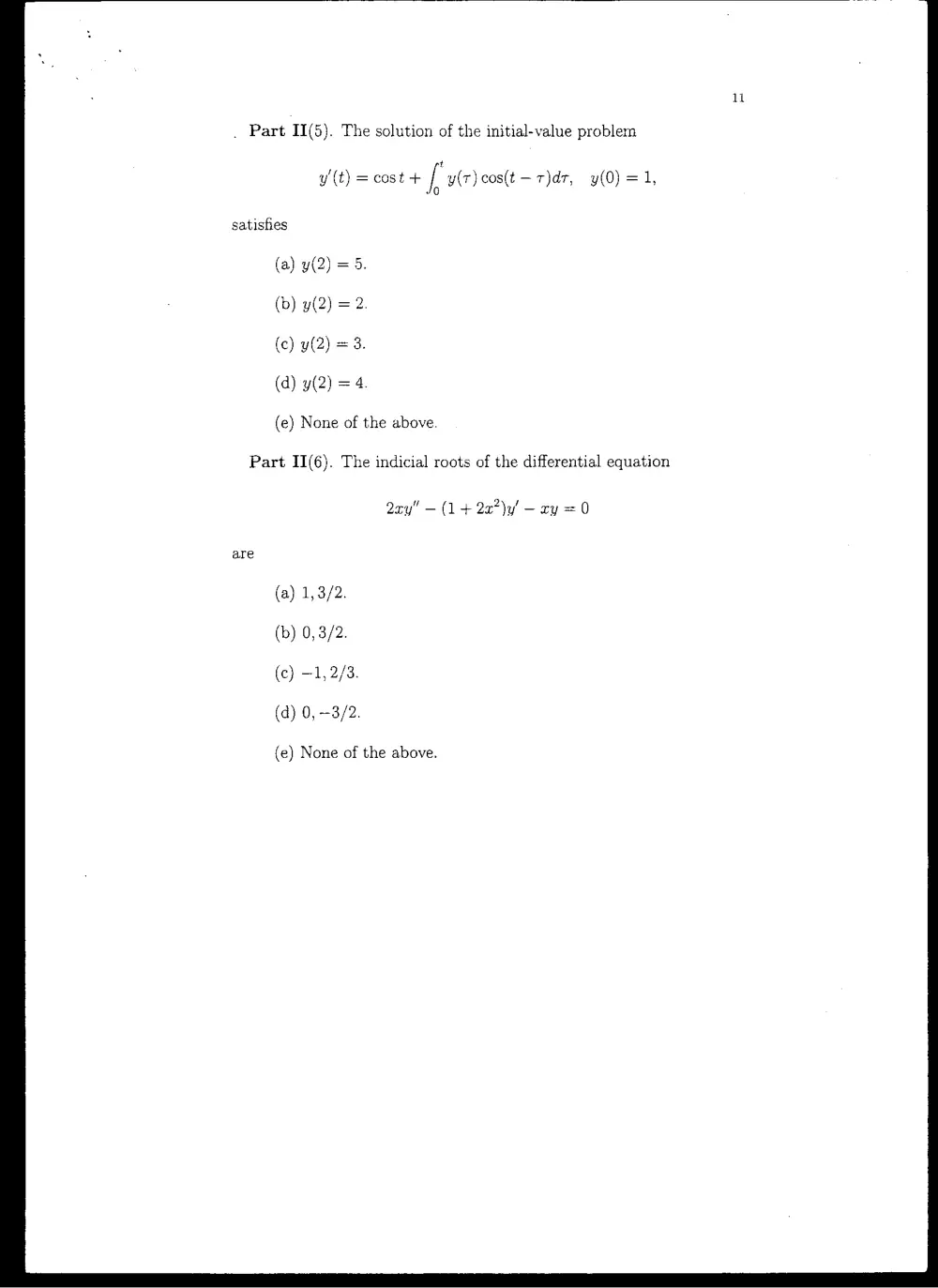
. Part II(5). The solution of the initial-value problem
y(t) =cost + [lr t)cos(t—7)dr, y(0) =1,
satisfies
(a) y(2) =5
(b) y(2) = 2
(c) y(2) =3
(4) y(2) =4
(e) None of the above.
Part II(6). The indicial roots of the differential equation
are
Qay" — (1+ 227) — zy =0
(a) 1,3/2.
(b) 0,3/2.
(c) -1, 2/3.
(d) 0, -3/2.
(e) None of the above.
11