
MATH 202 Final, Spring 2008
American University of Beirut · Differential Equations · 2 pages
More MATH 202 files
- Final SAMPLE · Spring 2019Final examView
- Final Student Copy · Spring 2017Final examView
- Final · Summer 2016Final examView
- Final · Spring 2015Final examView
- Notes Final Summary · Fall 2015Final examView
- Final Common Final · Spring 2014Final examView
- Final · Fall 2013Final examView
- Final · Fall 2012Final examView
Show the text of this final exam
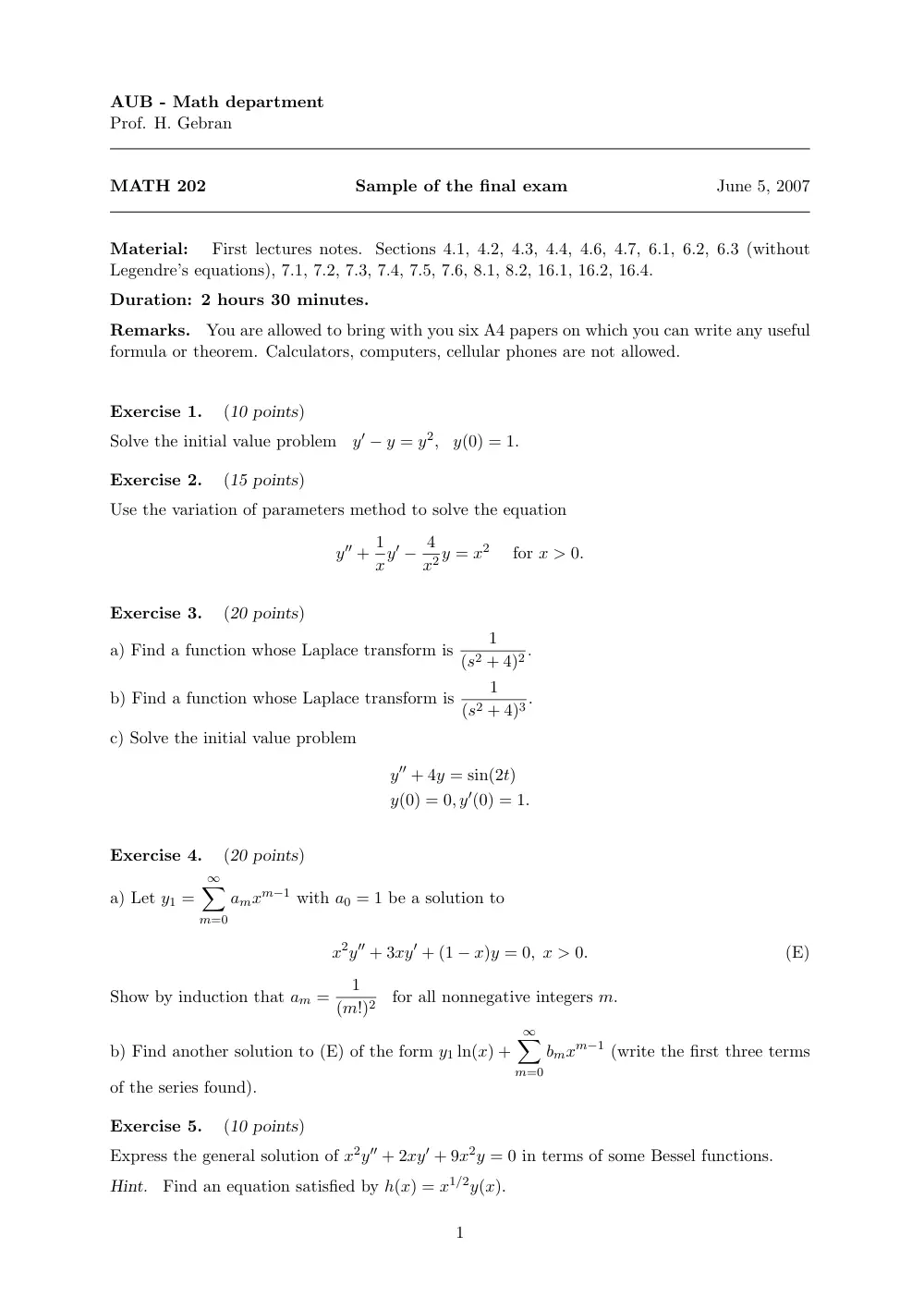
AUB - Math department
Prof. H. Gebran
MATH 202
Sample of the final exam
June 5, 2007
Material:
First lectures notes. Sections 4.1, 4.2, 4.3, 4.4, 4.6, 4.7, 6.1, 6.2, 6.3 (without
Legendre’s equations), 7.1, 7.2, 7.3, 7.4, 7.5, 7.6, 8.1, 8.2, 16.1, 16.2, 16.4.
Duration: 2 hours 30 minutes.
Remarks.
You are allowed to bring with you six A4 papers on which you can write any useful
formula or theorem. Calculators, computers, cellular phones are not allowed.
Exercise 1.
(10 points)
Solve the initial value problem
y′ − y = y2,
y(0) = 1.
Exercise 2.
(15 points)
Use the variation of parameters method to solve the equation
y′′ + 1
xy′ − 4
x2 y = x2
for x > 0.
Exercise 3.
(20 points)
a) Find a function whose Laplace transform is
1
(s2 + 4)2 .
b) Find a function whose Laplace transform is
1
(s2 + 4)3 .
c) Solve the initial value problem
y′′ + 4y = sin(2t)
y(0) = 0, y′(0) = 1.
Exercise 4.
(20 points)
a) Let y1 =
∞
�
m=0
amxm−1 with a0 = 1 be a solution to
x2y′′ + 3xy′ + (1 − x)y = 0, x > 0.
(E)
Show by induction that am =
1
(m!)2
for all nonnegative integers m.
b) Find another solution to (E) of the form y1 ln(x) +
∞
�
m=0
bmxm−1 (write the first three terms
of the series found).
Exercise 5.
(10 points)
Express the general solution of x2y′′ + 2xy′ + 9x2y = 0 in terms of some Bessel functions.
Hint.
Find an equation satisfied by h(x) = x1/2y(x).
1
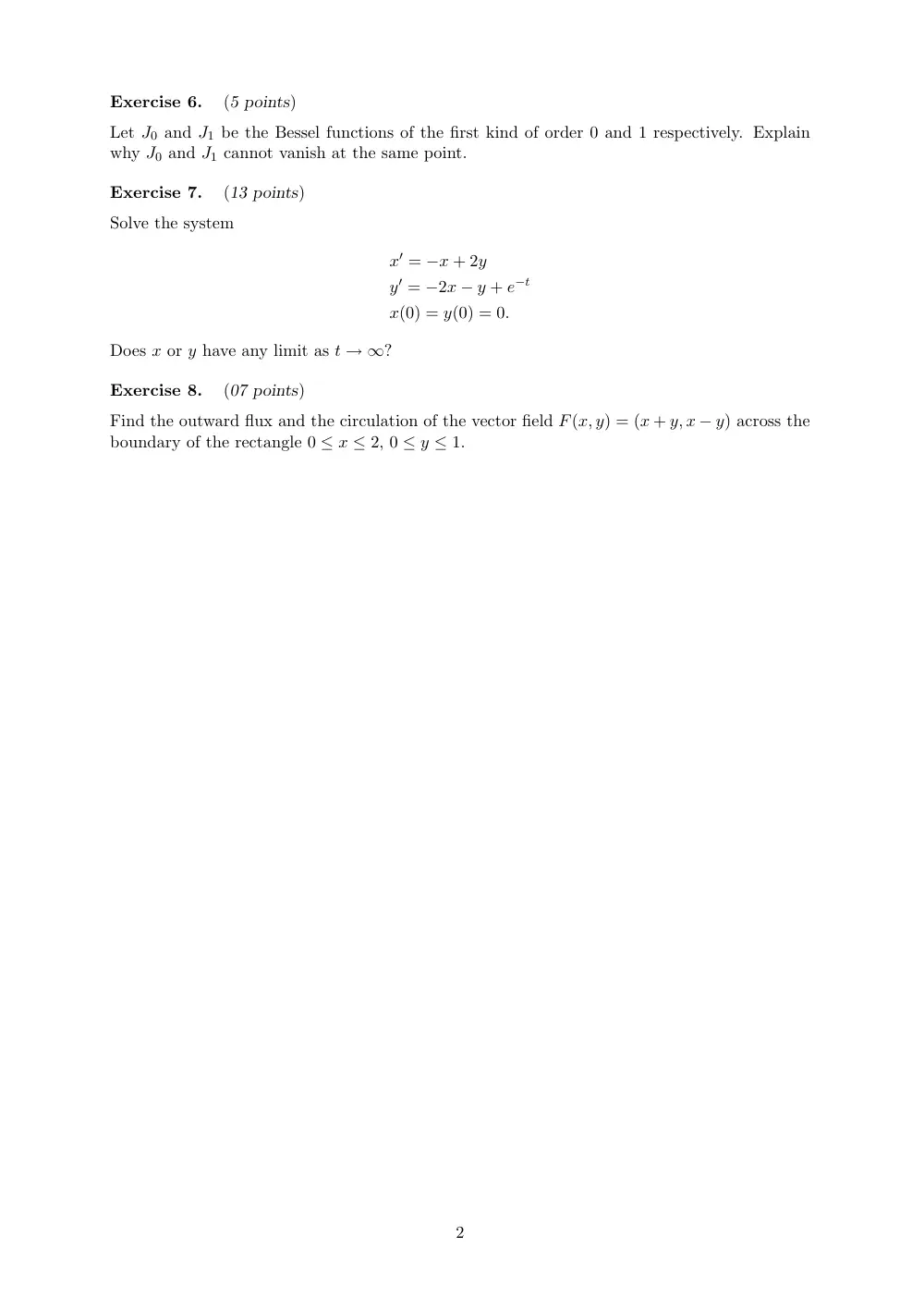
Exercise 6.
(5 points)
Let J0 and J1 be the Bessel functions of the first kind of order 0 and 1 respectively. Explain
why J0 and J1 cannot vanish at the same point.
Exercise 7.
(13 points)
Solve the system
x′ = −x + 2y
y′ = −2x − y + e−t
x(0) = y(0) = 0.
Does x or y have any limit as t → ∞?
Exercise 8.
(07 points)
Find the outward flux and the circulation of the vector field F(x, y) = (x + y, x − y) across the
boundary of the rectangle 0 ≤ x ≤ 2, 0 ≤ y ≤ 1.
2