
MATH 202 Final, Spring 2011
American University of Beirut · Differential Equations · 19 pages




Showing the first 10 of 19 pages. Download the PDF to see all of it.
More MATH 202 files
- Final SAMPLE · Spring 2019Final examView
- Final Student Copy · Spring 2017Final examView
- Final · Summer 2016Final examView
- Final · Spring 2015Final examView
- Notes Final Summary · Fall 2015Final examView
- Final Common Final · Spring 2014Final examView
- Final · Fall 2013Final examView
- Final · Fall 2012Final examView
Show the text of this final exam
Math 202 — Spring 2011
Differential Equations
Final exam, June 8 — Duration: 2 hours 15 minutes
GRADES (each problem is worth 10 points):
1
2
3
4
5
6
7
8
9
10
TOTAL/100
YOUR NAME:
YOUR AUB ID NUMBER:
YOUR SECTION NUMBER (SEE BELOW FOR A LIST):
Section 1 (Brock)
Section 2 (Brock)
Section 4 (Brock)
Lecture MWF 11:00
Lecture MWF 11:00
Lecture MWF 11:00
Recitation F 1:00
Recitation F 12:00
Recitation F 9:00
Ms. Jaber
Ms. Jaber
Ms. Jaber
Section 8 (Raji)
Section 9 (Raji)
Section 10 (Raji)
Section 11 (Raji)
Lecture MWF 2:00
Lecture MWF 2:00
Lecture MWF 2:00
Lecture MWF 2:00
Recitation Th 3:30
Recitation Th 2:00
Recitation Th 9:30
Recitation Th 12:30
Ms. Nassif
Ms. Mroue
Ms. Mroue
Ms. Mroue
Section 12 (Kobeissi)
Section 13 (Kobeissi)
Section 14 (Kobeissi)
Section 15 (Kobeissi)
Lecture MWF 12:00
Lecture MWF 12:00
Lecture MWF 12:00
Lecture MWF 12:00
Recitation F 2:00
Recitation F 3:00
Recitation F 4:00
Recitation F 5:00
Dr. Kobeissi
Ms. Mroue
Ms. Mroue
Ms. Mroue
Section 16 (Makdisi)
Section 17 (Makdisi)
Section 18 (Makdisi)
Section 19 (Makdisi)
Lecture MWF 8:00
Lecture MWF 8:00
Lecture MWF 8:00
Lecture MWF 8:00
Recitation Tu 12:30
Recitation Tu 3:30
Recitation Tu 5:00
Recitation Tu 2:00
Prof. Makdisi
Ms. Jaber
Ms. Jaber
Ms. Jaber
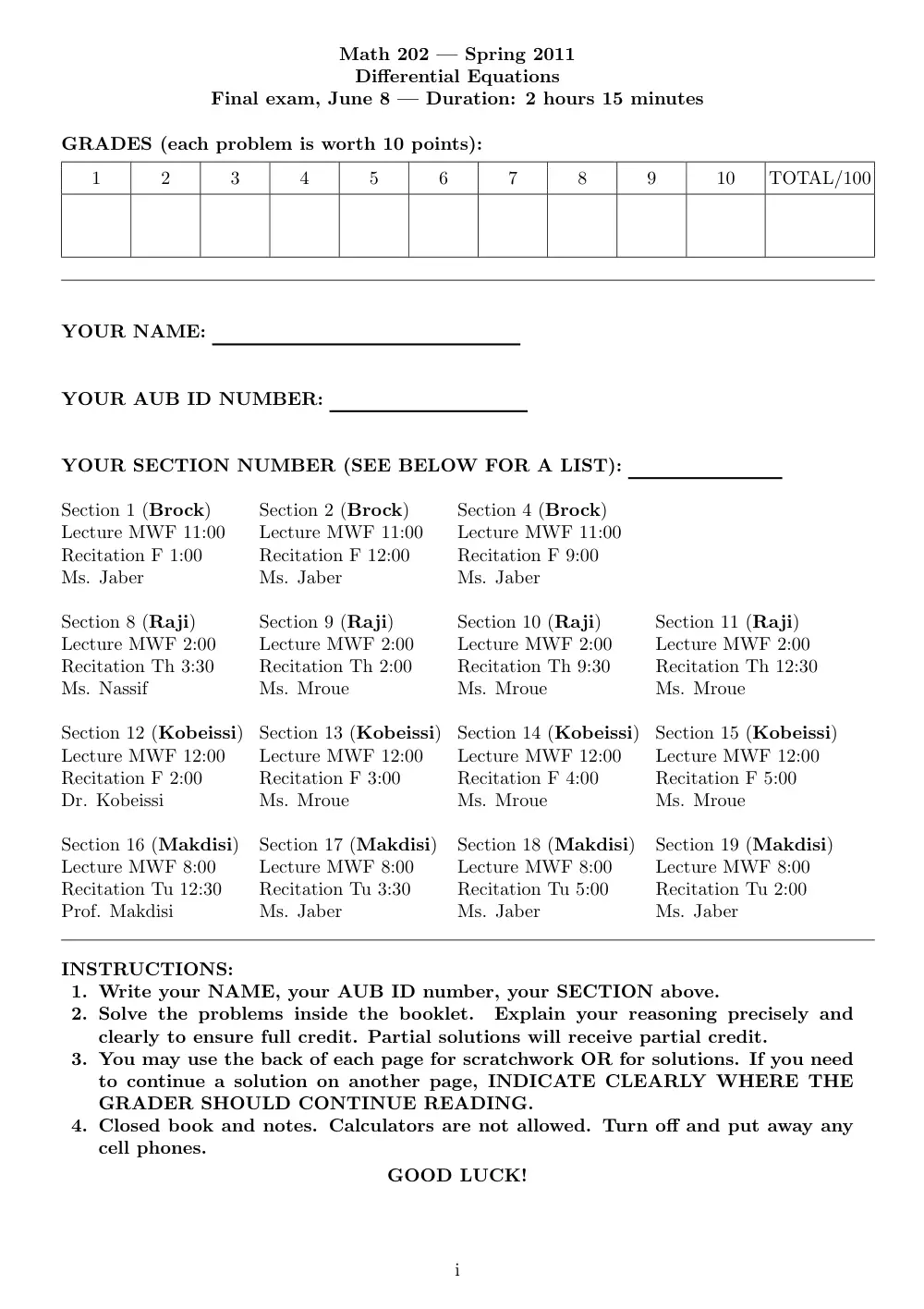
INSTRUCTIONS:
1. Write your NAME, your AUB ID number, your SECTION above.
2. Solve the problems inside the booklet.
Explain your reasoning precisely and
clearly to ensure full credit. Partial solutions will receive partial credit.
3. You may use the back of each page for scratchwork OR for solutions. If you need
to continue a solution on another page, INDICATE CLEARLY WHERE THE
GRADER SHOULD CONTINUE READING.
4. Closed book and notes. Calculators are not allowed. Turn off and put away any
cell phones.
GOOD LUCK!
i
An overview of the exam problems. Each problem is worth 10 points.
The problems are arranged according to the chapters covered in the course
(i.e., chapters 16, 2, 4, 6, 7, 8), NOT according to difficulty.
Take a few minutes to look at all the questions, BEFORE you start solving.
PLEASE ANSWER THE PROBLEMS INSIDE THE BOOKLET.
EACH PROBLEM HAS ITS OWN PAGE.
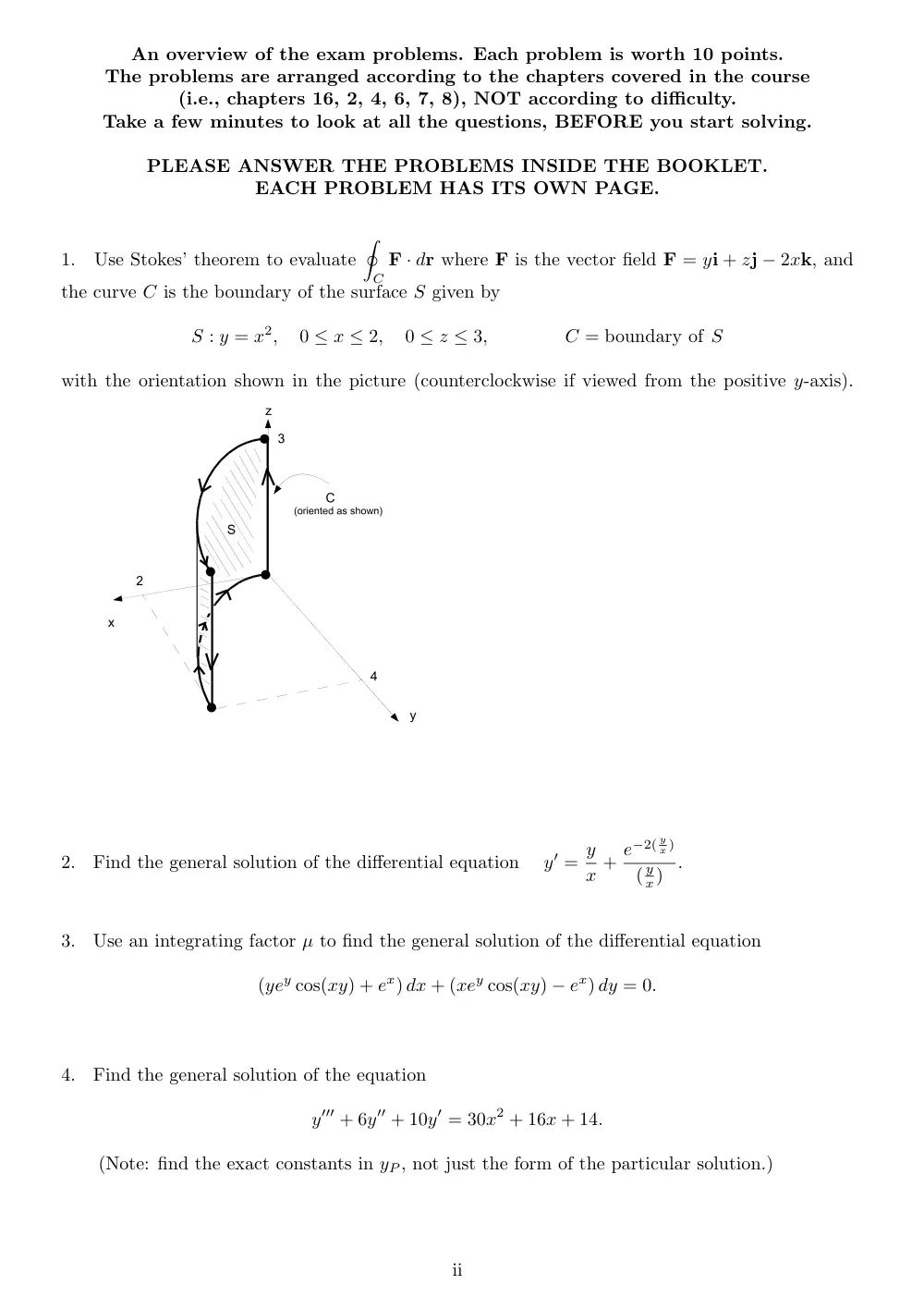
1.
Use Stokes’ theorem to evaluate
�
C
F · dr where F is the vector field F = yi + zj − 2xk, and
the curve C is the boundary of the surface S given by
S : y = x2,
0 ≤ x ≤ 2,
0 ≤ z ≤ 3,
C = boundary of S
with the orientation shown in the picture (counterclockwise if viewed from the positive y-axis).
2.
Find the general solution of the differential equation
y′ = y
x + e−2( y
x )
( y
x) .
3.
Use an integrating factor µ to find the general solution of the differential equation
(yey cos(xy) + ex) dx + (xey cos(xy) − ex) dy = 0.
4.
Find the general solution of the equation
y′′′ + 6y′′ + 10y′ = 30x2 + 16x + 14.
(Note: find the exact constants in yP , not just the form of the particular solution.)
ii
An overview of the exam problems. Each problem is worth 10 points.
The problems are arranged according to the chapters covered in the course
(i.e., chapters 16, 2, 4, 6, 7, 8), NOT according to difficulty.
Take a few minutes to look at all the questions, BEFORE you start solving.
PLEASE ANSWER THE PROBLEMS INSIDE THE BOOKLET.
EACH PROBLEM HAS ITS OWN PAGE.
5.
Find the general solution of the Cauchy-Euler equation
x2y′′ − 3xy′ + 4y =
x2
1 + (ln x)2 .
(Note: put the DE into standard form before finding yP .)
6.
We wish to find a series solution centered at x = 0 for the differential equation
(x2 + 2)y′′ + 6xy′ + 6y = 0.
(∗)
a) (1 point) BEFORE solving (∗), what radius of convergence do you expect the series solution
to have? Why?
b) (9 points) Find the general solution of (∗) in the form y = c0y1 + c1y2. Note: it is enough
to find just the first four nonzero terms in the series for y1 and y2.
7.
a) (9 points) Using a Frobenius series centered at x = 0, find ONE solution y1 (corresponding
to the LARGER indicial root r1) for the following differential equation.
3xy′′ + y′ − y = 0.
Note: it is enough to find just the first four nonzero terms in the series.
b) (1 point) WITHOUT SOLVING, does the second solution y2 contain ln x? Why or why
not?
8.
Use Laplace transforms to solve the Volterra integral equation
f(t) −
� t
τ=0
(t − τ)e−2(t−τ)f(τ) dτ = 2et.
(Note: there is a table of Laplace transforms at the end of this booklet.)
9.
Find the solution of y′′ + 2y′ + 10y = δ(t − 2) + 13et,
y(0) = 0,
y′(0) = 13.
(Note: there is a table of Laplace transforms at the end of this booklet.)
10.
Find the general solution of the following linear system:
X′ =
5
−4
0
1
0
2
0
2
5
X.
iii
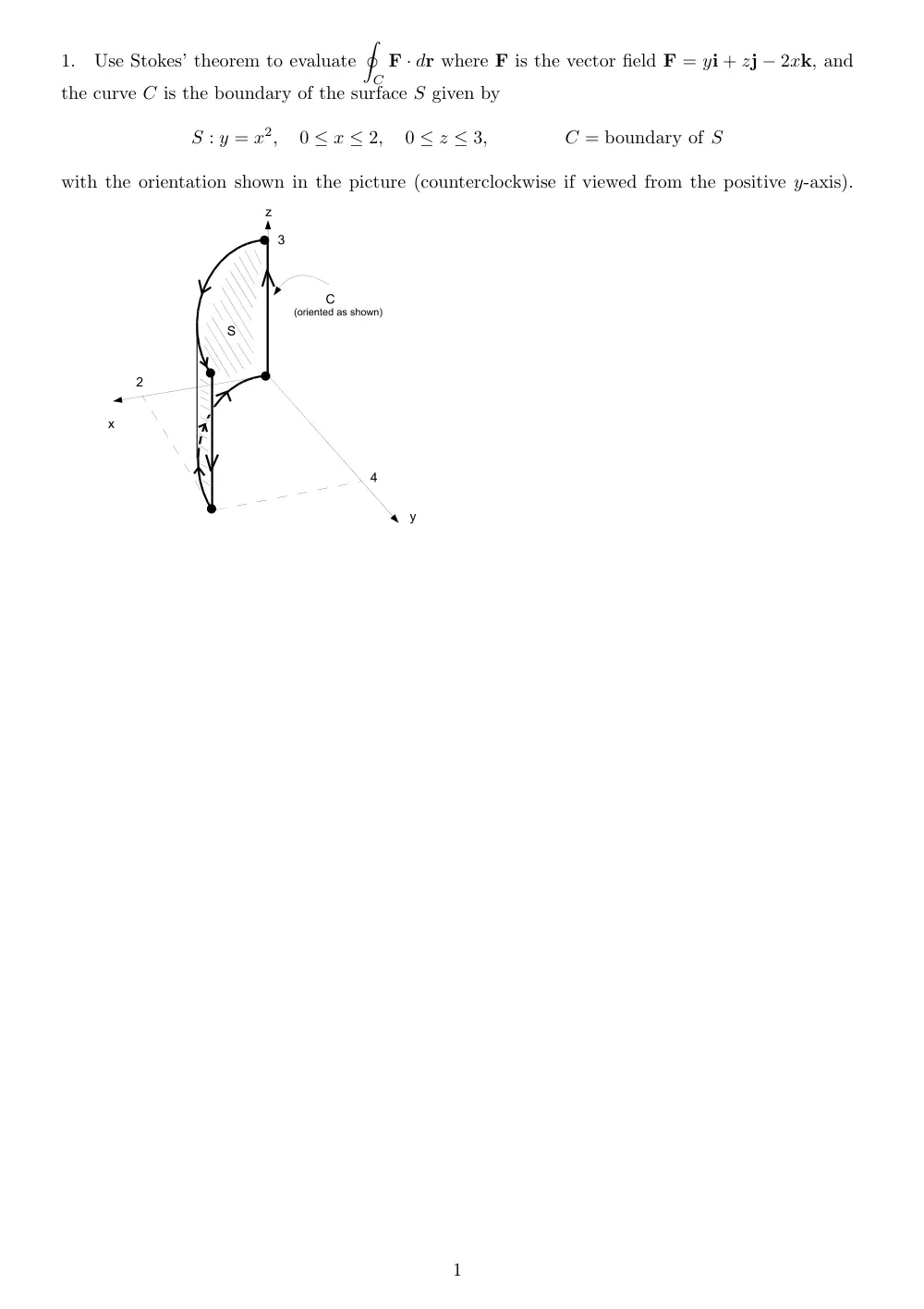
1.
Use Stokes’ theorem to evaluate
�
C
F · dr where F is the vector field F = yi + zj − 2xk, and
the curve C is the boundary of the surface S given by
S : y = x2,
0 ≤ x ≤ 2,
0 ≤ z ≤ 3,
C = boundary of S
with the orientation shown in the picture (counterclockwise if viewed from the positive y-axis).
1
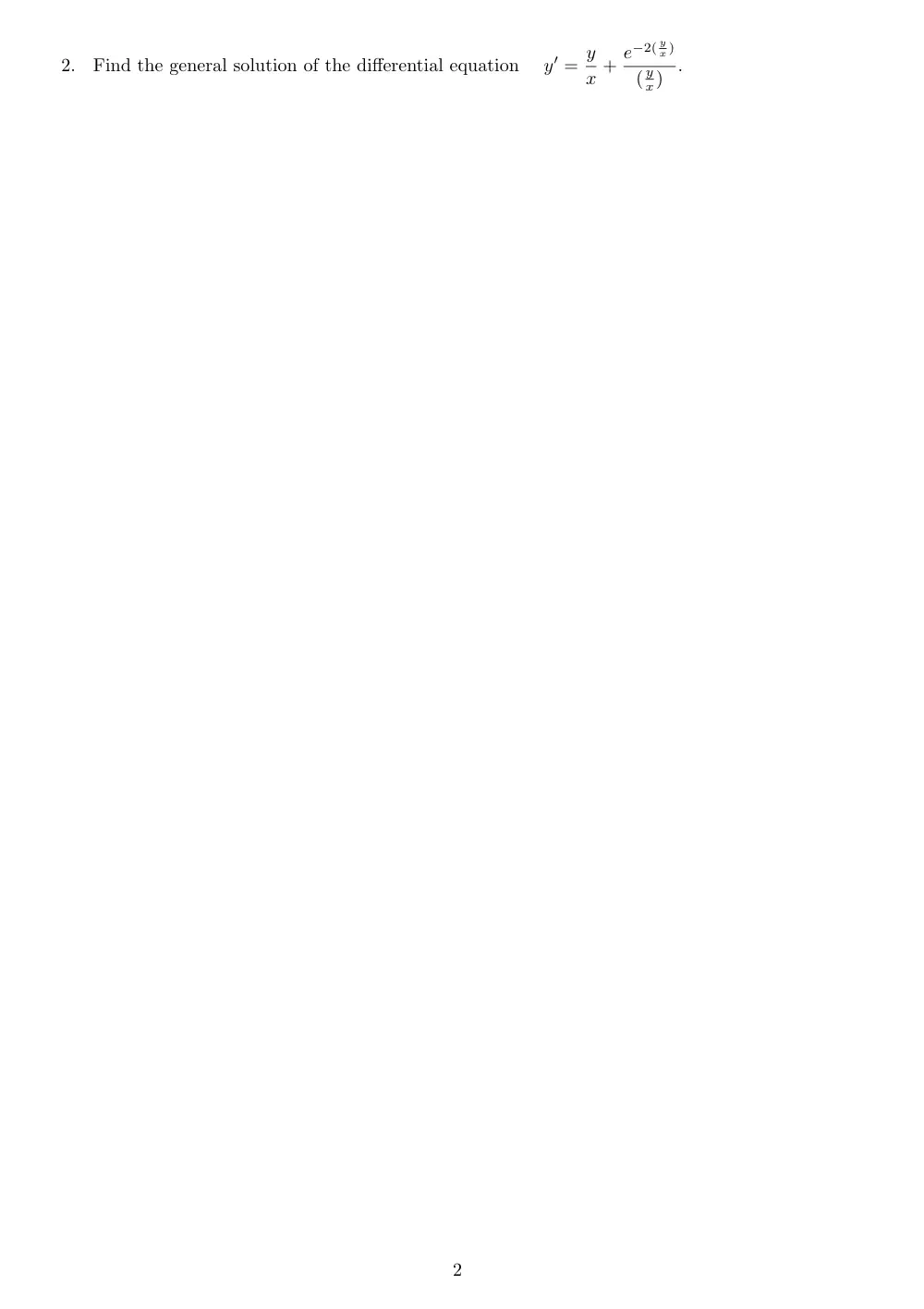
2.
Find the general solution of the differential equation
y′ = y
x + e−2( y
x )
( y
x) .
2
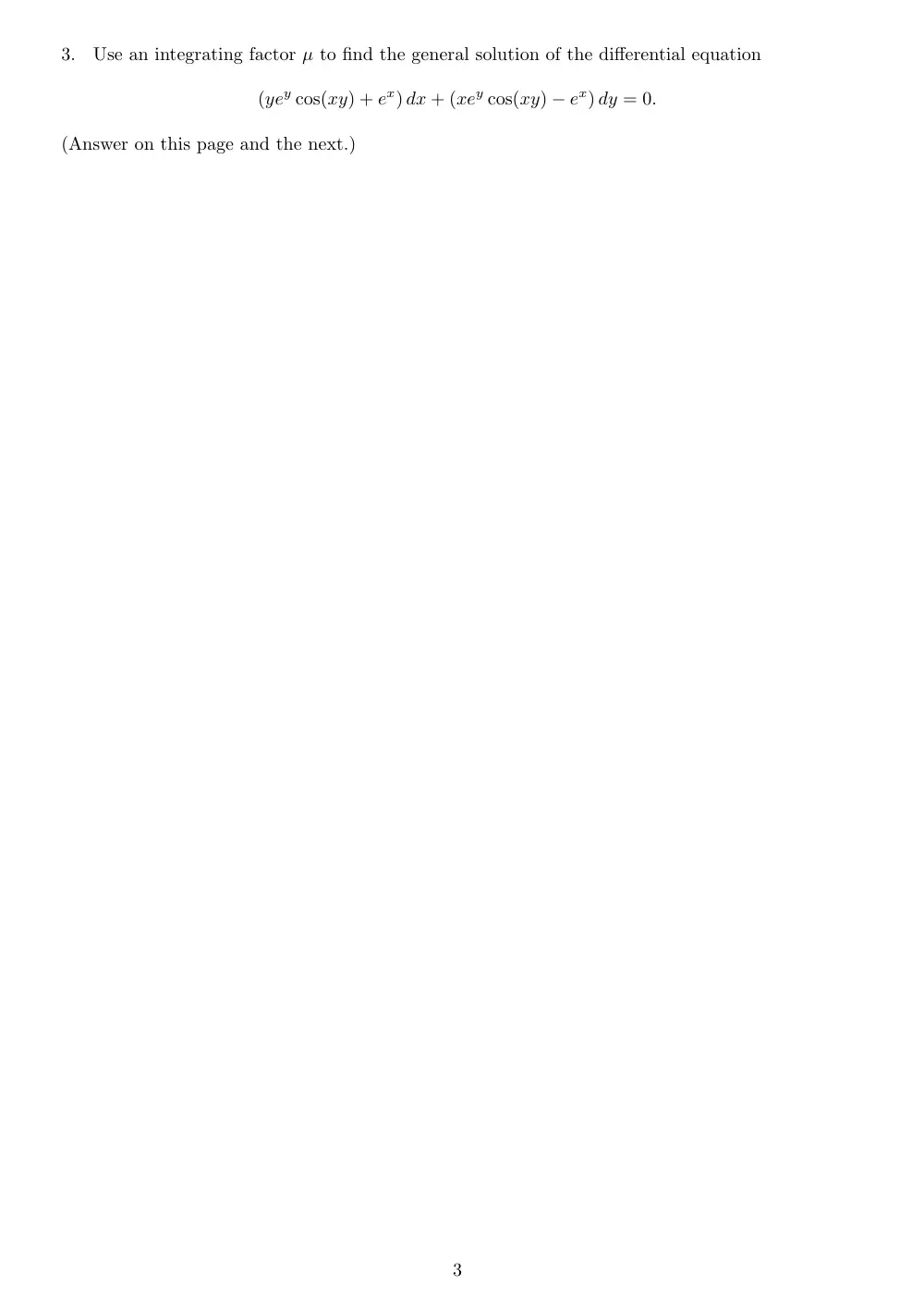
3.
Use an integrating factor µ to find the general solution of the differential equation
(yey cos(xy) + ex) dx + (xey cos(xy) − ex) dy = 0.
(Answer on this page and the next.)
3
Your solution for question 3, continued.
4
4.
Find the general solution of the equation
y′′′ + 6y′′ + 10y′ = 30x2 + 16x + 14.
(Note: find the exact constants in yP , not just the form of the particular solution.)
5
5.
Find the general solution of the Cauchy-Euler equation
x2y′′ − 3xy′ + 4y =
x2
1 + (ln x)2 .
(Note: put the DE into standard form before finding yP .)
(Answer on this page and the next.)
6
Your solution for question 5, continued.
7
6.
We wish to find a series solution centered at x = 0 for the differential equation
(x2 + 2)y′′ + 6xy′ + 6y = 0.
(∗)
a) (1 point) BEFORE solving (∗), what radius of convergence do you expect the series solution
to have? Why?
b) (9 points) Find the general solution of (∗) in the form y = c0y1 + c1y2. Note: it is enough
to find just the first four nonzero terms in the series for y1 and y2.
(Answer on this page and the next.)
8
Your solution for question 6, continued.
9
7.
a) (9 points) Using a Frobenius series centered at x = 0, find ONE solution y1 (corresponding
to the LARGER indicial root r1) for the following differential equation.
3xy′′ + y′ − y = 0.
Note: it is enough to find just the first four nonzero terms in the series.
b) (1 point) WITHOUT SOLVING, does the second solution y2 contain ln x? Why or why
not?
10
8.
Use Laplace transforms to solve the Volterra integral equation
f(t) −
� t
τ=0
(t − τ)e−2(t−τ)f(τ) dτ = 2et.
(Note: there is a table of Laplace transforms at the end of this booklet.)
(Answer on this page and the next.)
11
Your solution for question 8, continued.
12
9.
Find the solution of y′′ + 2y′ + 10y = δ(t − 2) + 13et,
y(0) = 0,
y′(0) = 13.
(Note: there is a table of Laplace transforms at the end of this booklet.)
(Answer on this page and the next.)
13
Your solution for question 9, continued.
14
10.
Find the general solution of the following linear system:
X′ =
5
−4
0
1
0
2
0
2
5
X.
(Answer on this page and the next.)
15
Your solution for question 10, continued.
16