
MATH 202 Final, Summer 1996
American University of Beirut · Differential Equations · 12 pages
Showing the first 10 of 12 pages. Download the PDF to see all of it.
More MATH 202 files
- Final SAMPLE · Spring 2019Final examView
- Final Student Copy · Spring 2017Final examView
- Final · Summer 2016Final examView
- Final · Spring 2015Final examView
- Notes Final Summary · Fall 2015Final examView
- Final Common Final · Spring 2014Final examView
- Final · Fall 2013Final examView
- Final · Fall 2012Final examView
Show the text of this final exam
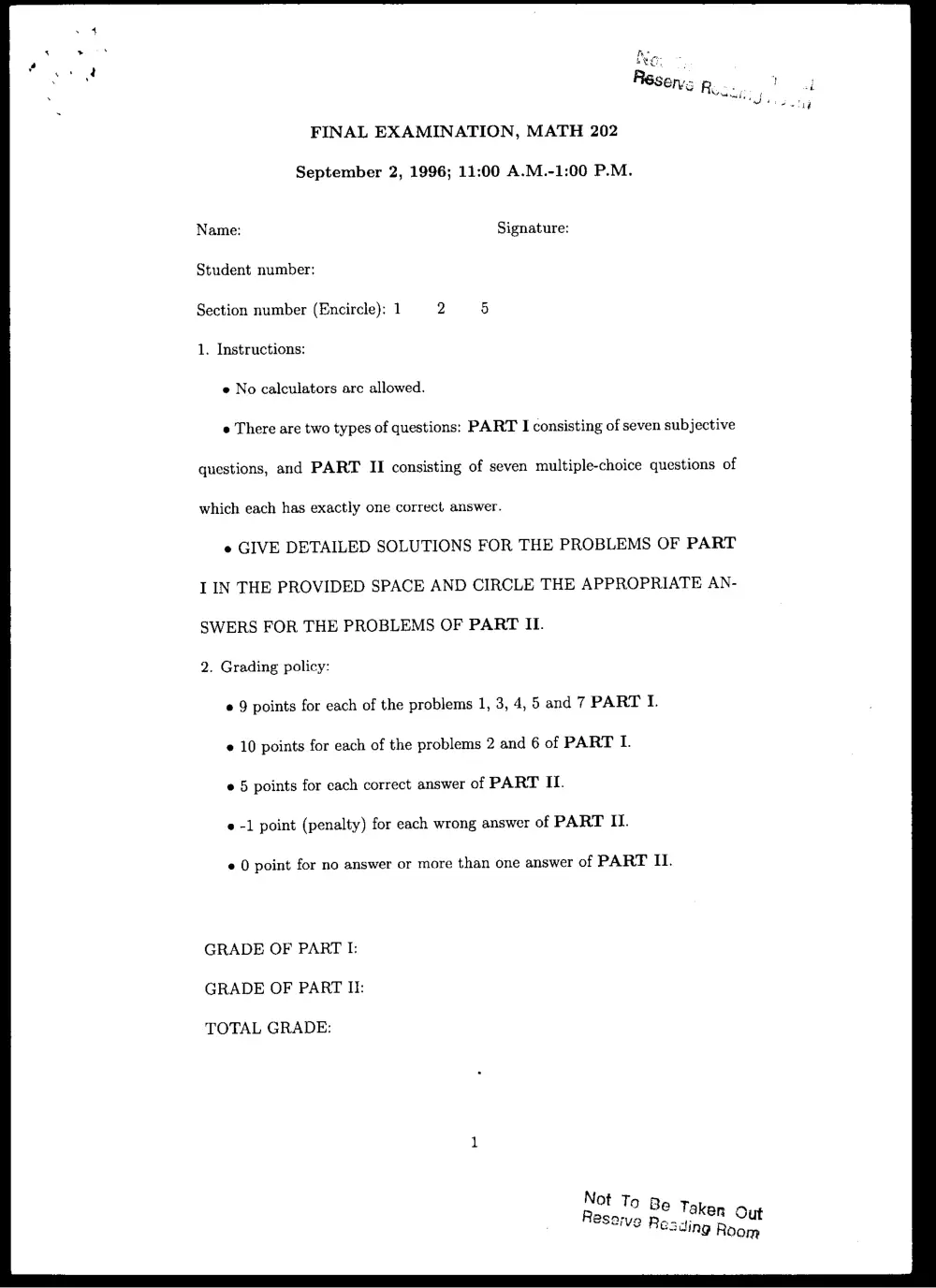
FINAL EXAMINATION, MATH 202
September 2, 1996; 11:00 A.M.-1:00 P.M.
Name: Signature:
Student number:
Section number (Encircle): 1
1. Instructions:
e No calculators arc allowed.
e There are two types of questions: PART I consisting of seven subjective
questions, and PART II consisting of seven multiple-choice questions of
which each has exactly one correct answer.
e GIVE DETAILED SOLUTIONS FOR THE PROBLEMS OF PART
1 IN THE PROVIDED SPACE AND CIRCLE THE APPROPRIATE AN-
SWERS FOR THE PROBLEMS OF PART II.
2. Grading policy:
e 9 points for each of the problems 1, 3, 4, 5 and 7 PART I.
10 points for each of the problems 2 and 6 of PART I.
e 5 points for each correct answer of PART II.
« -1 point (penalty) for each wrong answer of PART II.
e¢ 0 point for no answer or more than one answer of PART II.
GRADE OF PART I:
GRADE OF PART II:
TOTAL GRADE:
Not To
Resarve
Be Taken Out
Resding Room
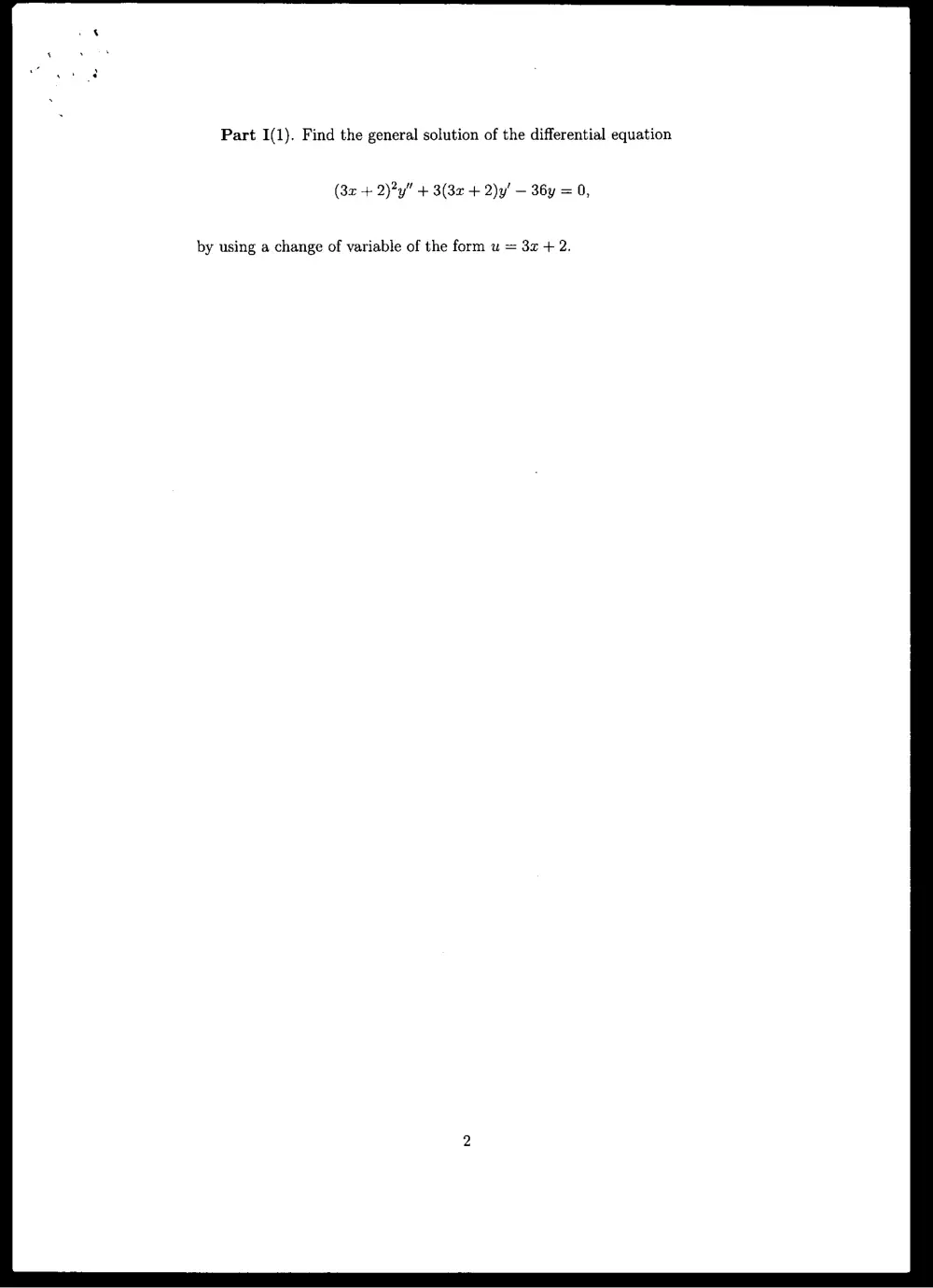
Part I(1). Find the general solution of the differential equation
(3x + 2)?y" + 3(32 + 2)y’ — 36y = 0,
by using a change of variable of the form u = 3z + 2.
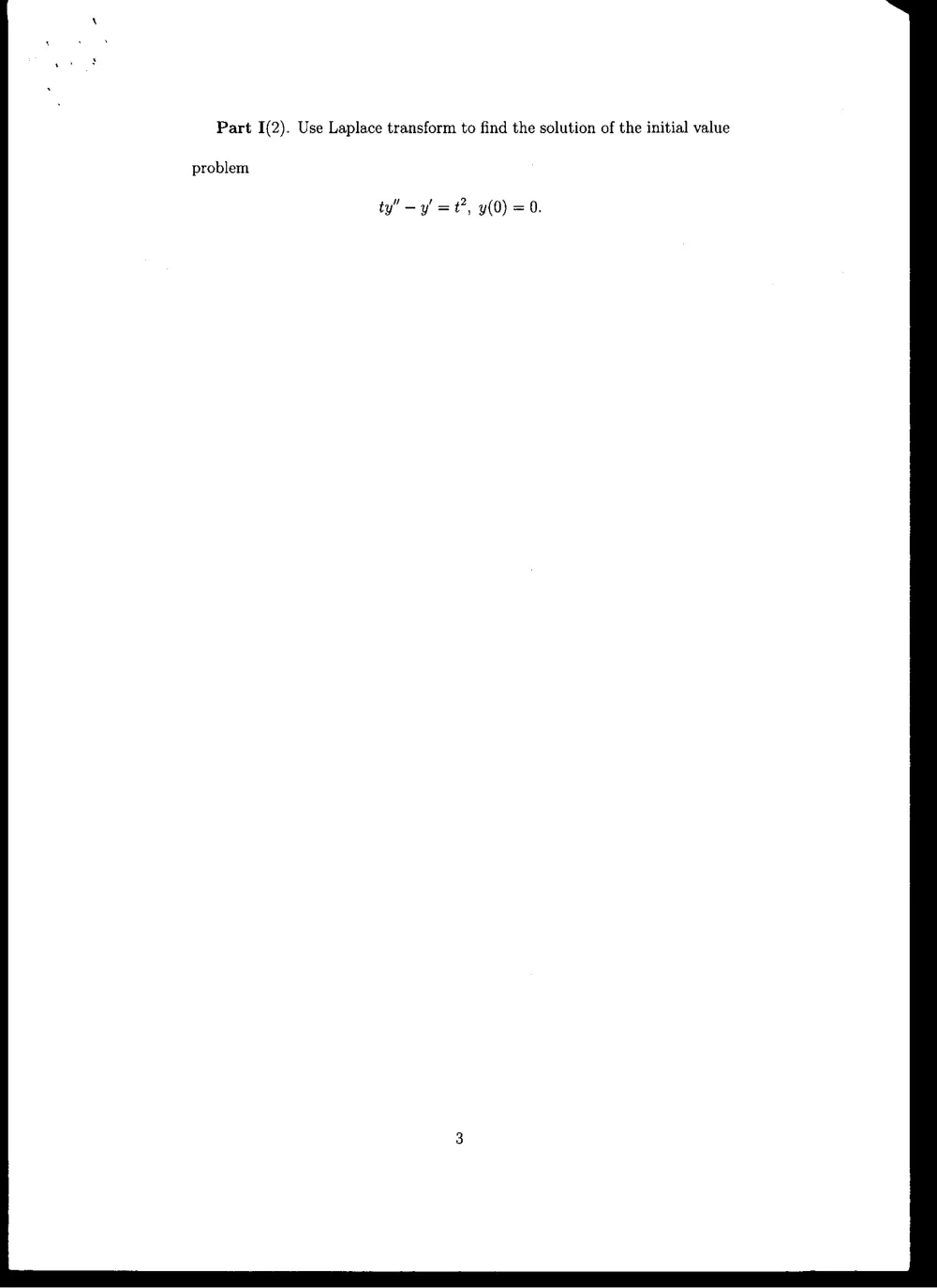
Part I(2). Use Laplace transform to find the solution of the initial value
problem
ty” -y' =0, y(0) =0.
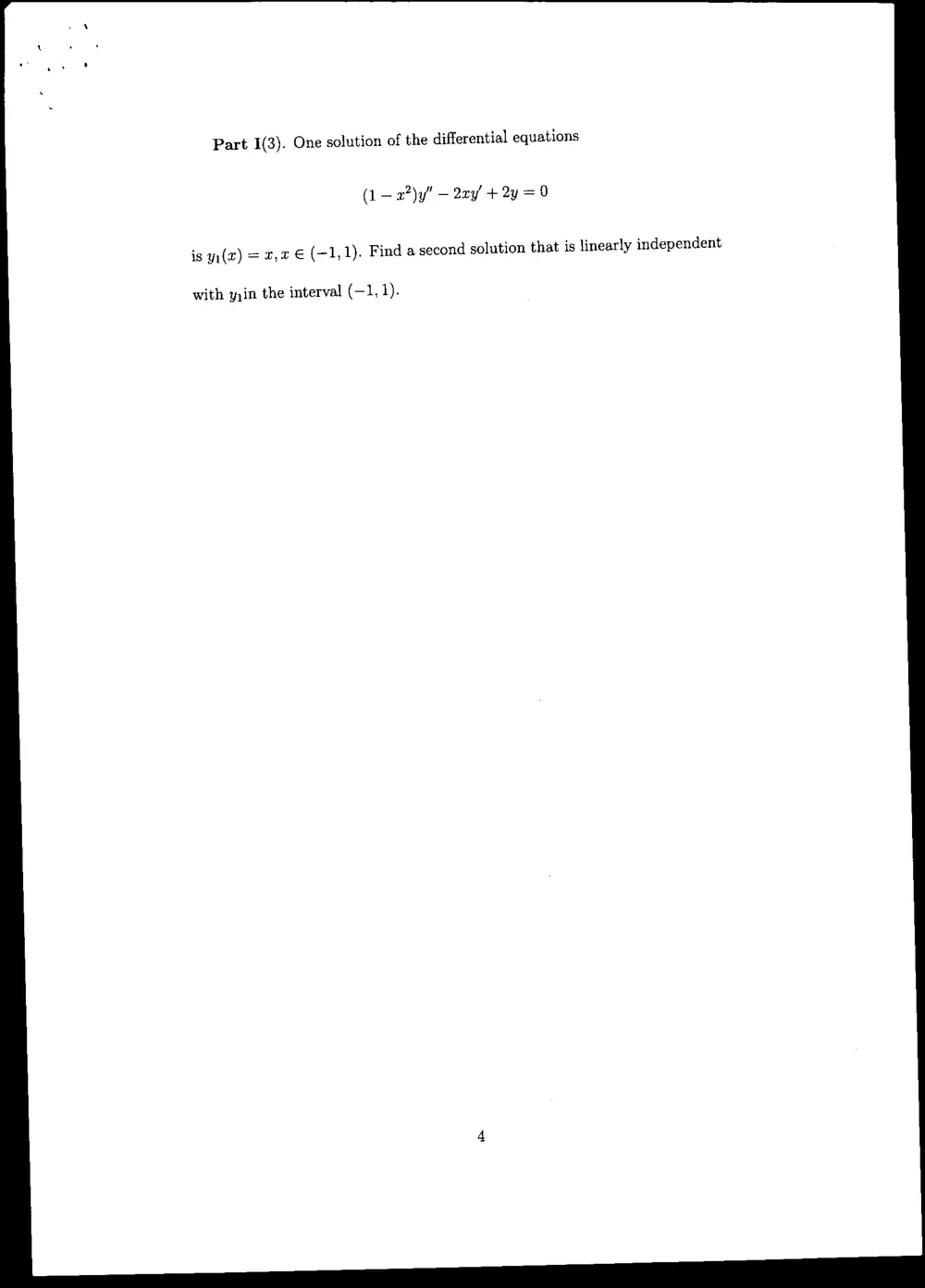
Part 1(3). One solution of the differential equations
(1 —2?)y” — 2ry' + 2y = 0
is yi(x) = 2,0 € (-1,1). Find a second solution that is linearly independent
with y,in the interval (—1, 1).
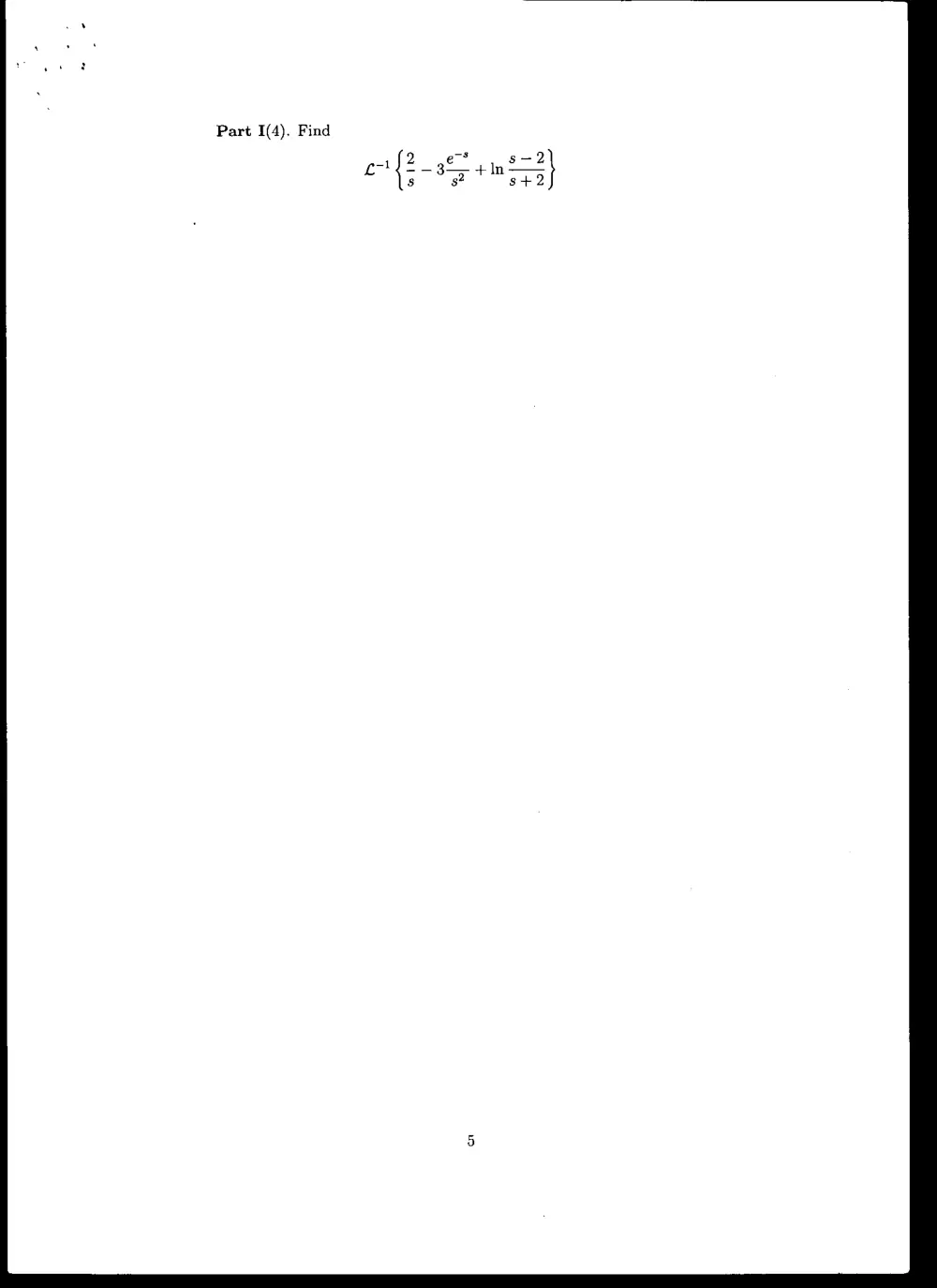
Part 1(4). Find
8 s? s+2
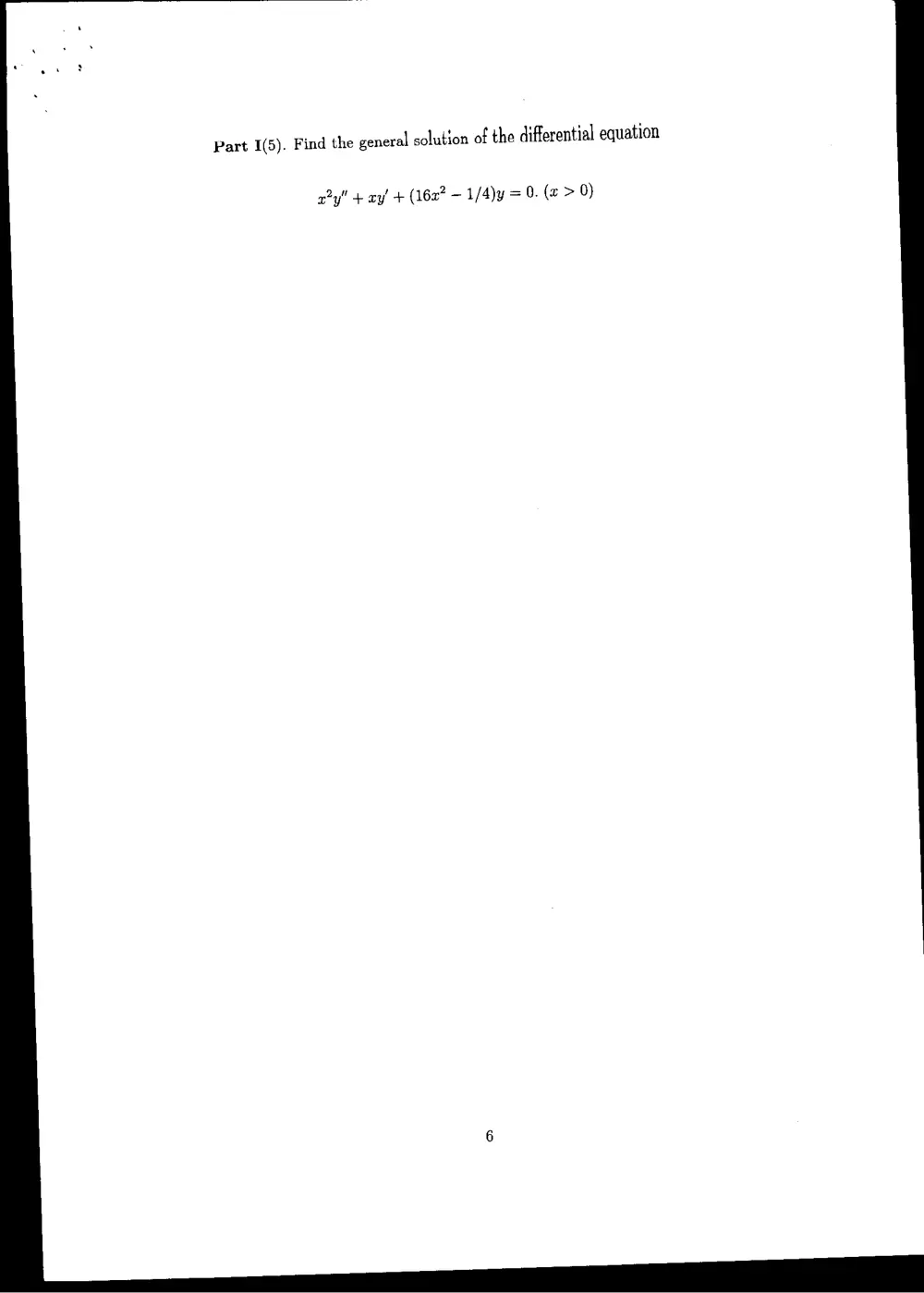
Part 1(5). Find the general solution of the differential equation
xy" + cy! + (16x? — 1/4)y = 0. (x > 0)
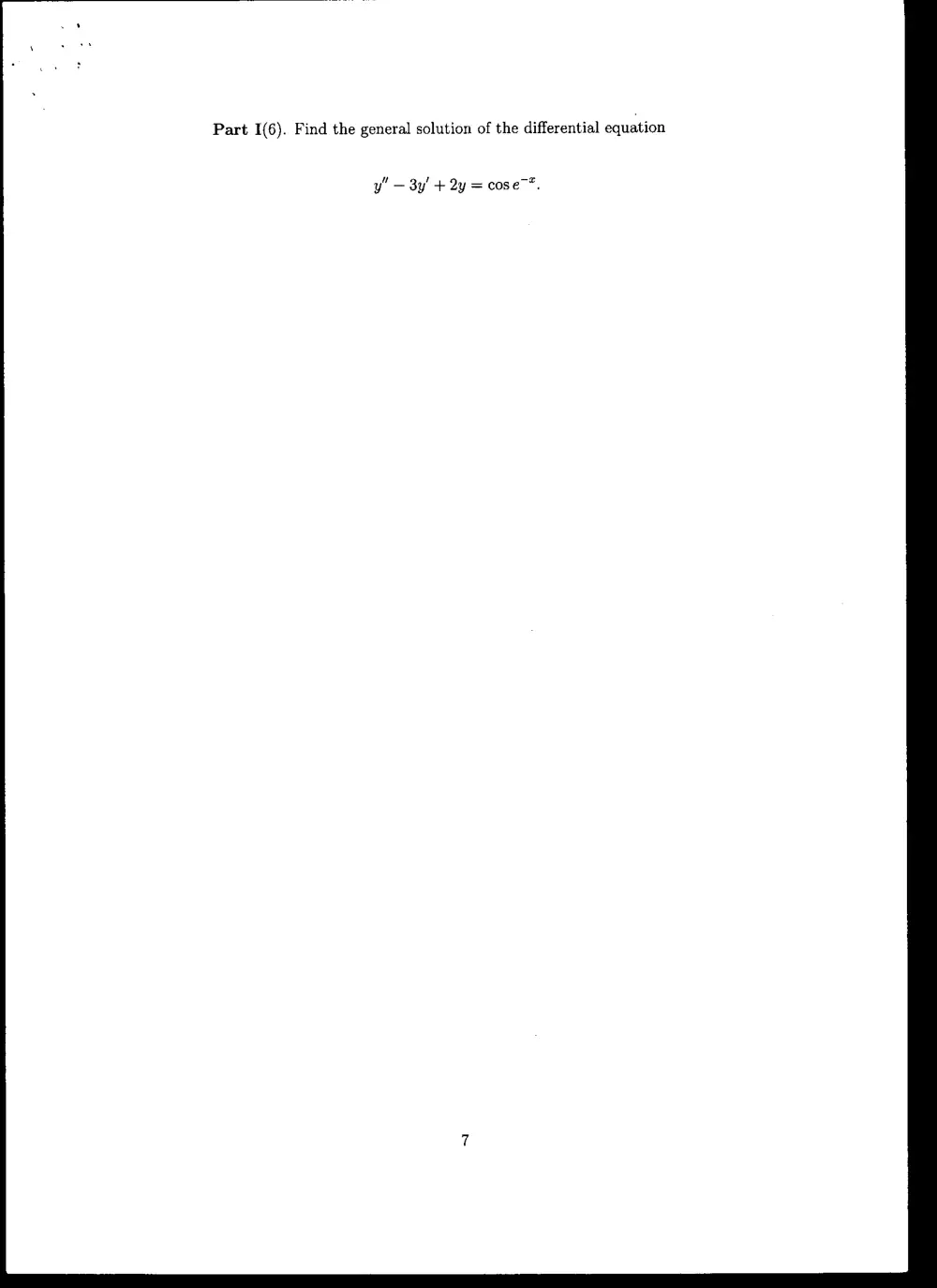
Part I(6). Find the general solution of the differential equation
©
y" — 3y’ + 2y = cose™*.
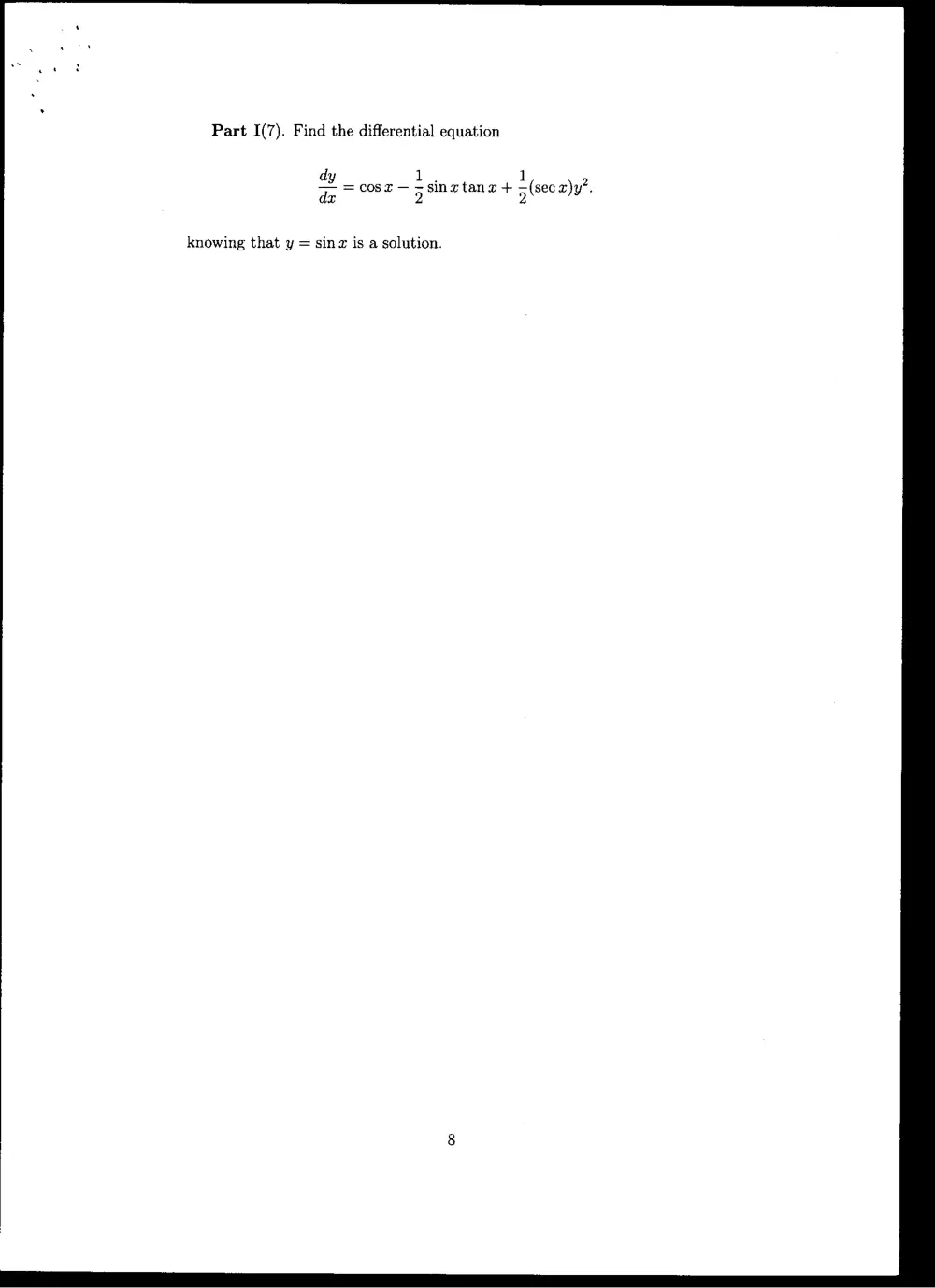
Part I(7). Find the differential equation
di 1
= =cosz — 3 sinztanz+ glsecz)y*.
knowing that y = sina is a solution.
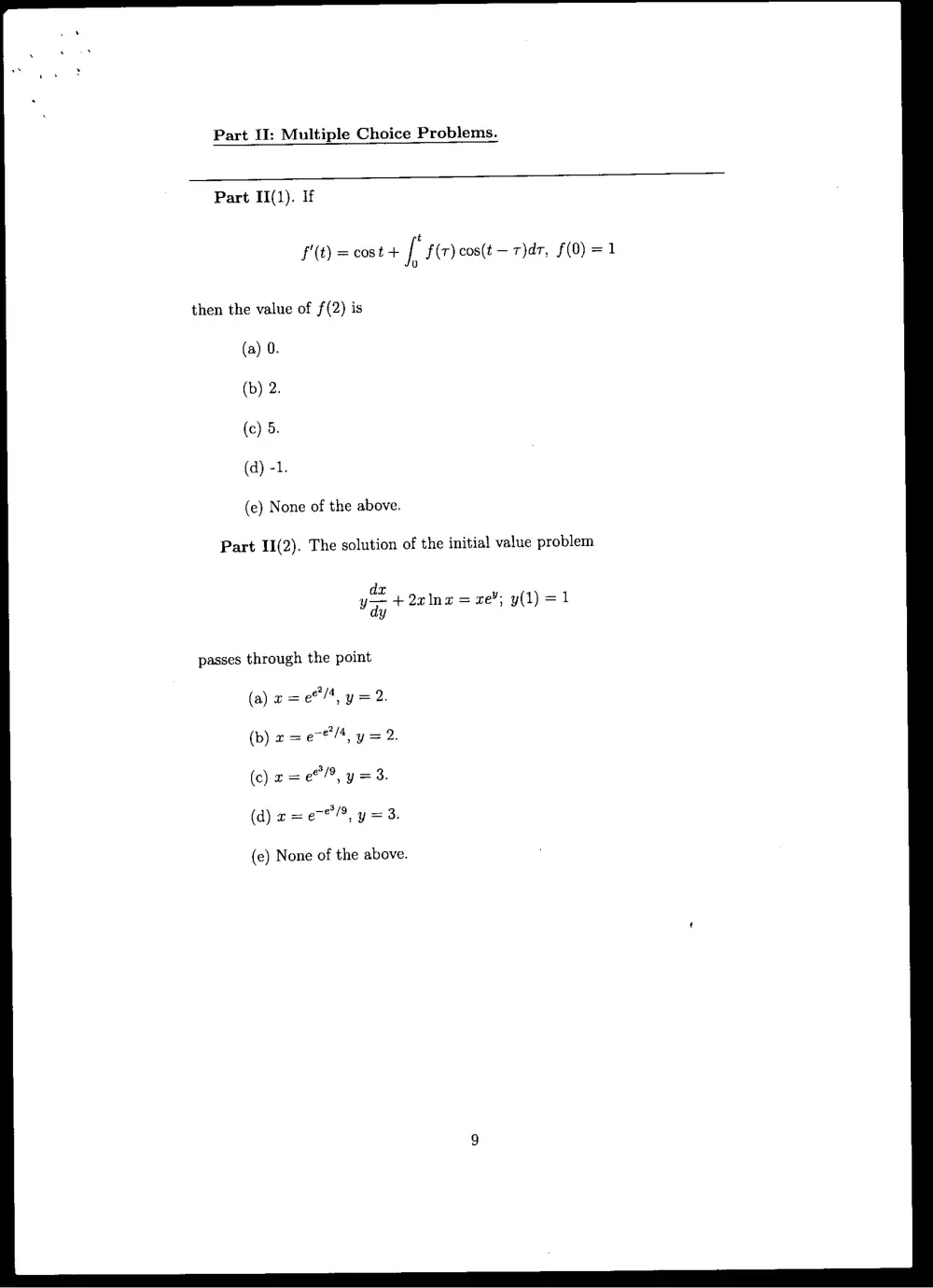
Part II: Multiple Choice Problems.
Part II(1). If
t
F(t) =cost +f f(r) cos(t — r)dr, f(0) =1
then the value of f(2) is
(d) -1.
(e) None of the above.
Part I1(2). The solution of the initial value problem
dx
wy +2¢ ina = ze’; y(1) =1
passes through the point
(a) c= ef /4 y= 2.
(b) cae? 4 y=d.
Ny = 3.
(c)z=e
(a) a =e? y = 3.
(e) None of the above.
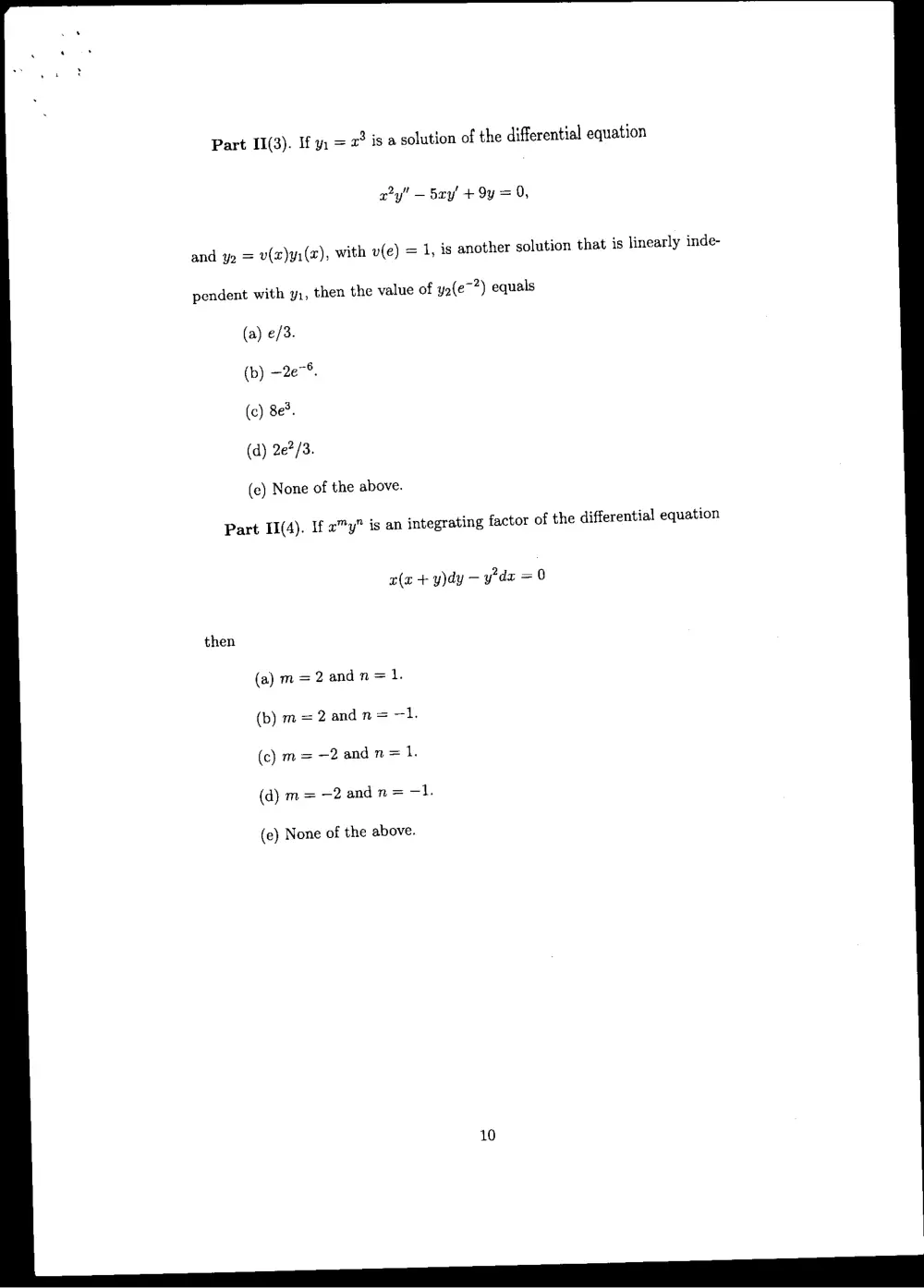
Part I1(3). If y: = 2° is a solution of the differential equation
xy" — Say’ + 9y = 0,
and yo = v(x)yi(x), with v(e) = 1, is another solution that is linearly inde-
pendent with y:, then the value of y2(e~2) equals
(a) e/3.
(d) 2e?/3.
(e) None of the above.
Part II(4). If cy" is an integrating factor of the differential equation
a(x + y)dy — yda = 0
(a) m=2 andn=1.
(b) m=2andn=~—1.
(c) m=—2 and n=1.
(d) m= —2 and n= —l.
(ec) None of the above.