
MATH 202 Final, Summer 1997
American University of Beirut · Differential Equations · 12 pages


Showing the first 10 of 12 pages. Download the PDF to see all of it.
More MATH 202 files
- Final SAMPLE · Spring 2019Final examView
- Final Student Copy · Spring 2017Final examView
- Final · Summer 2016Final examView
- Final · Spring 2015Final examView
- Notes Final Summary · Fall 2015Final examView
- Final Common Final · Spring 2014Final examView
- Final · Fall 2013Final examView
- Final · Fall 2012Final examView
Show the text of this final exam
Wocy Cumcoy enesay
Lo INO uarney aq OL ON
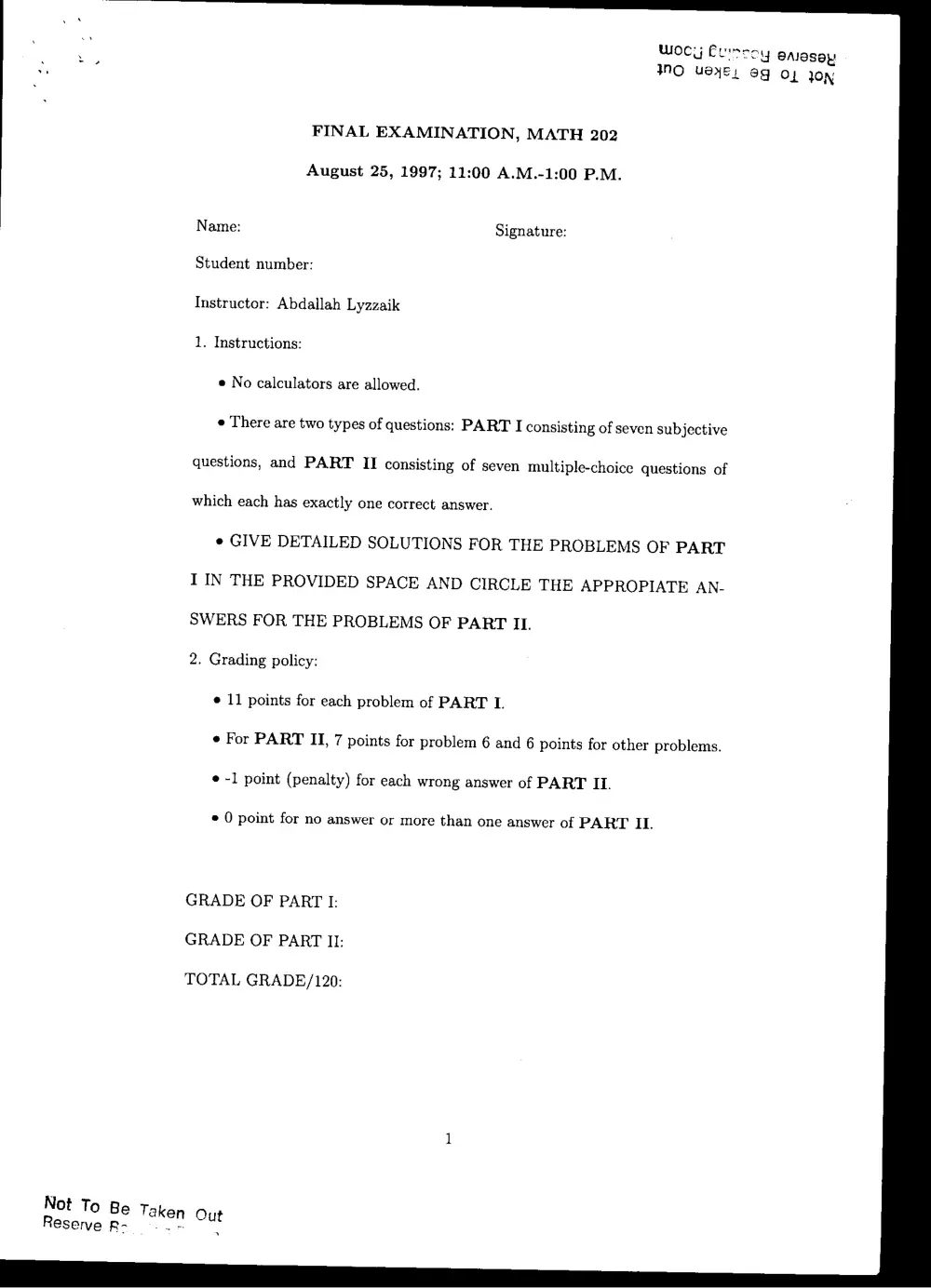
FINAL EXAMINATION, MATH 202
August 25, 1997; 11:00 A.M.-1:00 P.M.
Name: Signature:
Student number:
Instructor: Abdallah Lyzzaik
1. Instructions:
e No calculators are allowed.
e There are two types of questions: PART I consisting of seven subjective
questions, and PART II consisting of seven multiple-choice questions of
which each has exactly one correct answer.
¢ GIVE DETAILED SOLUTIONS FOR THE PROBLEMS OF PART
I IN THE PROVIDED SPACE AND CIRCLE THE APPROPIATE AN-
SWERS FOR THE PROBLEMS OF PART II.
2. Grading policy:
e 11 points for each problem of PART I.
e For PART II, 7 points for problem 6 and 6 points for other problems.
e -1 point (penalty) for each wrong answer of PART II.
© 0 point for no answer or more than one answer of PART IL.
GRADE OF PART I:
GRADE OF PART II:
TOTAL GRADE/120:
Not To Be Taken Out
Reseve R-
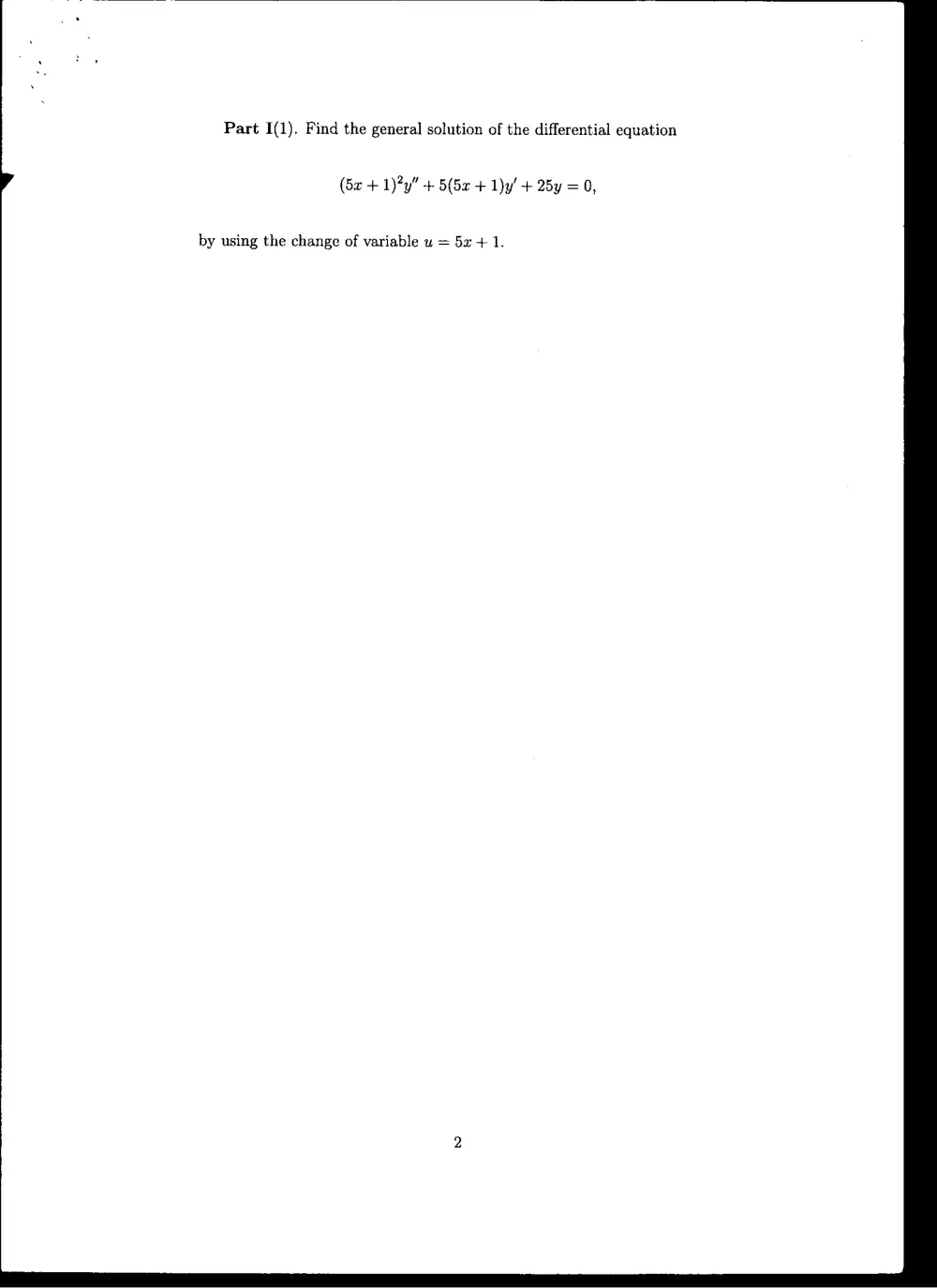
Part I(1). Find the general solution of the differential equation
(5c + 1)?y” + 5(5a + Ly’ + 25y =0,
by using the change of variable u = 52 + 1.
Part I(2). Use Laplace transform to find the set of all solutions y(t) of
the initial value problem
ty” + 2ty’ + 2y = 0, y(0) = 0.
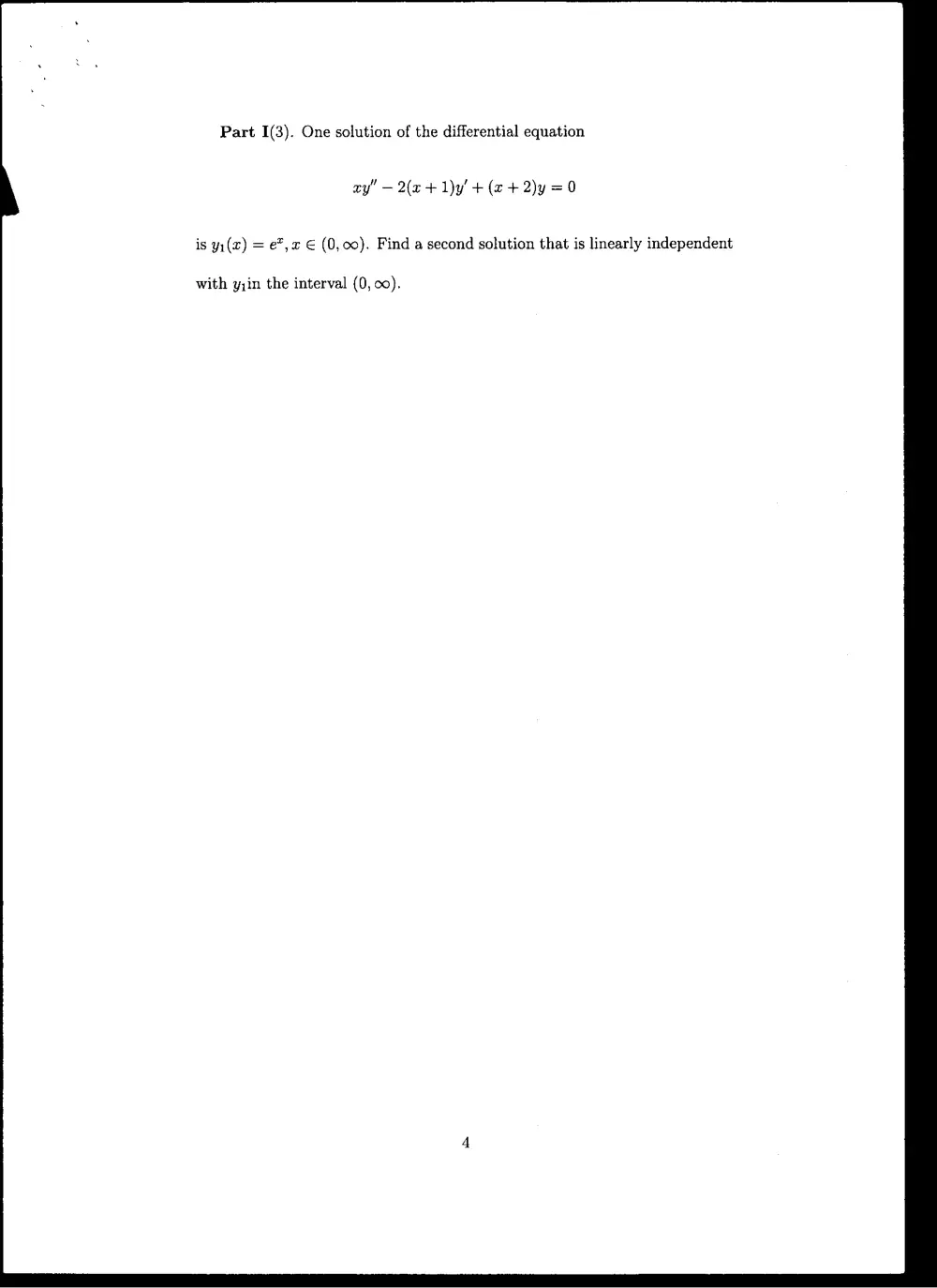
Part I(3). One solution of the differential equation
xy” —2(xt+1)y'+(c+2)y=0
is y:(x) = e”, x € (0,00). Find a second solution that is linearly independent
with yin the interval (0, 00).
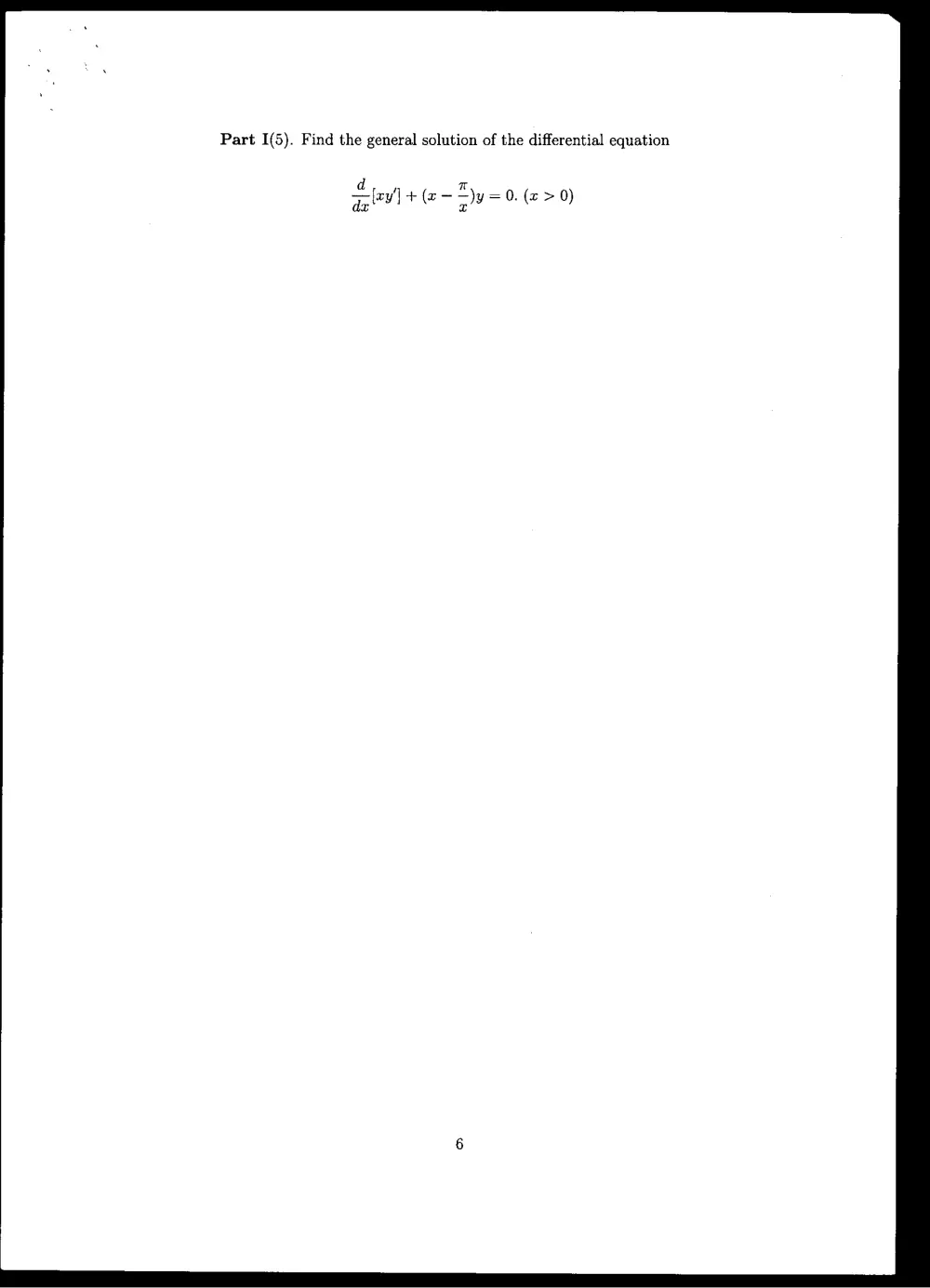
Part I(5). Find the general solution of the differential equation
ley) +(e ~ Sy =0. (2 > 0)
dx
Part I(6). Find the general solution of the differential equation
y” — 2y! + 2y = e*cot x.
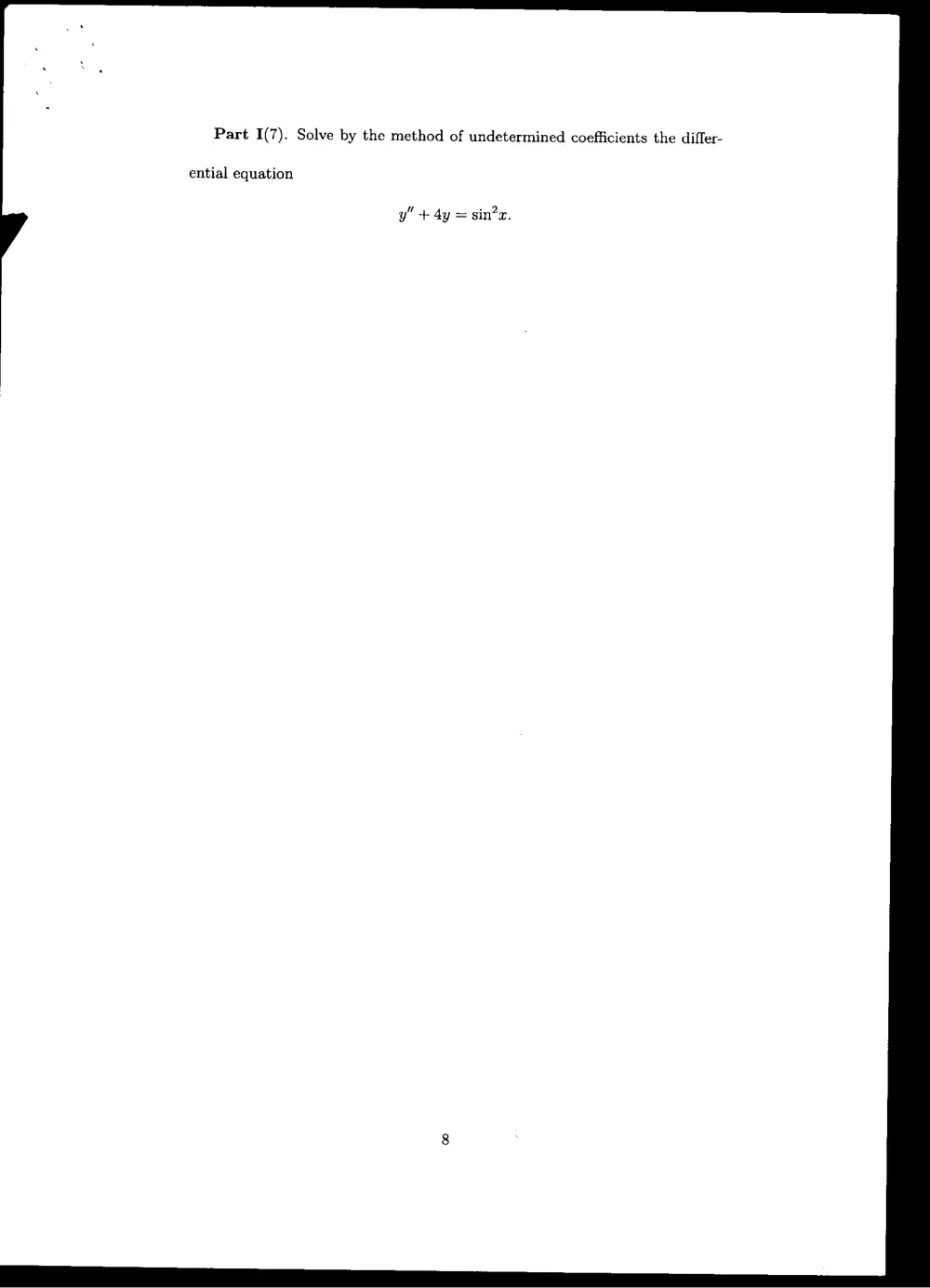
Part I(7). Solve by the method of undetermined coefficients the difler-
ential equation
y” + 4y = sin’.
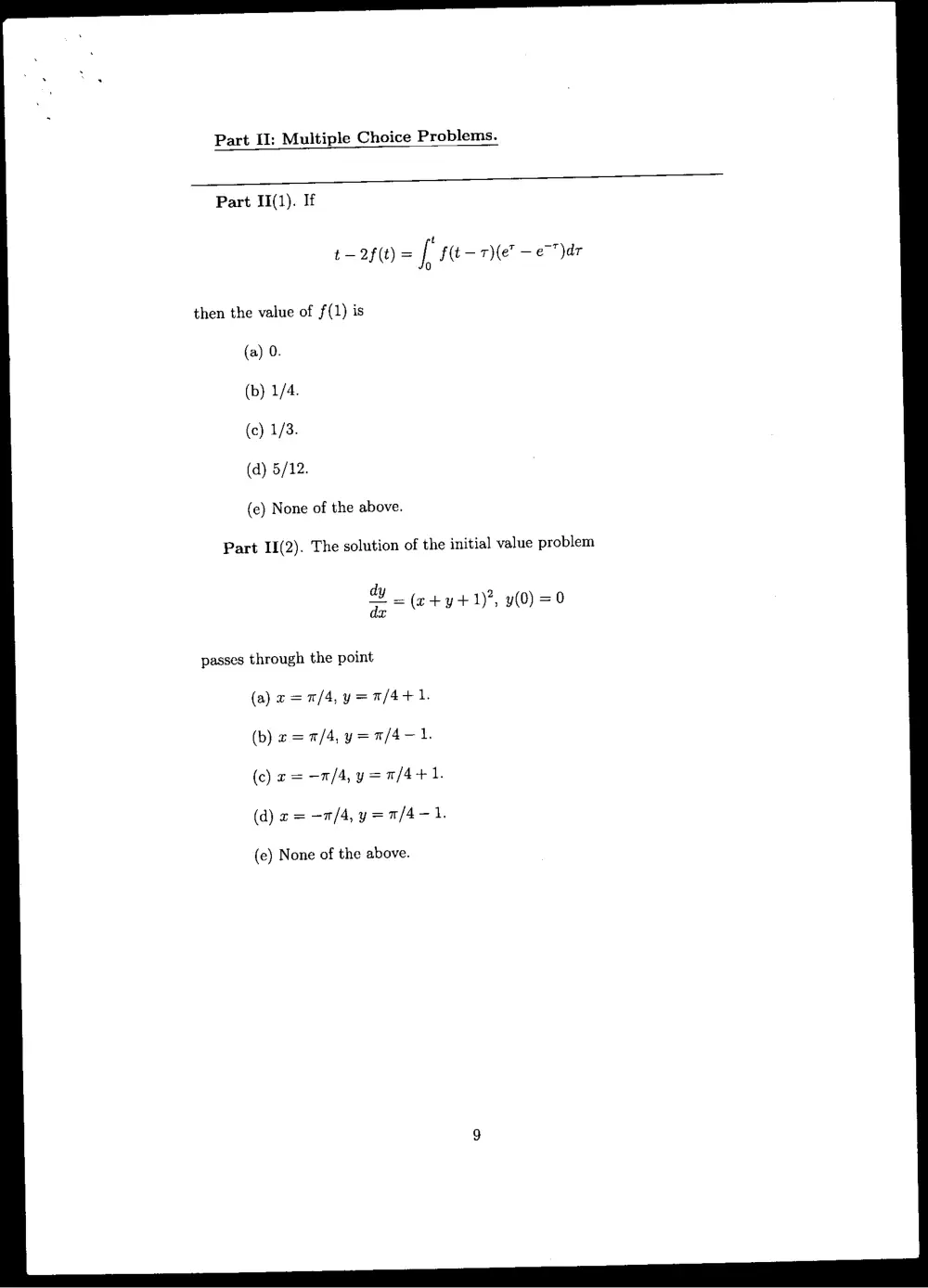
Part II; Multiple Choice Problems.
Part II(1). If
t—2f(t) = [ f(t—r)(e — edt
then the value of f(1) is
(a) 0.
(b) 1/4.
(c) 1/3.
(d) 5/12.
(e) None of the above.
Part II(2). The solution of the initial value problem
passes through the point
(a)c=n/4,y=r/4t1.
(b) c= 7/4, y=7/4-1.
(c)c=-7/4,y= 7/4 +1.
(d) c= —71/4,y = 7/4-1.
(e) None of the above.
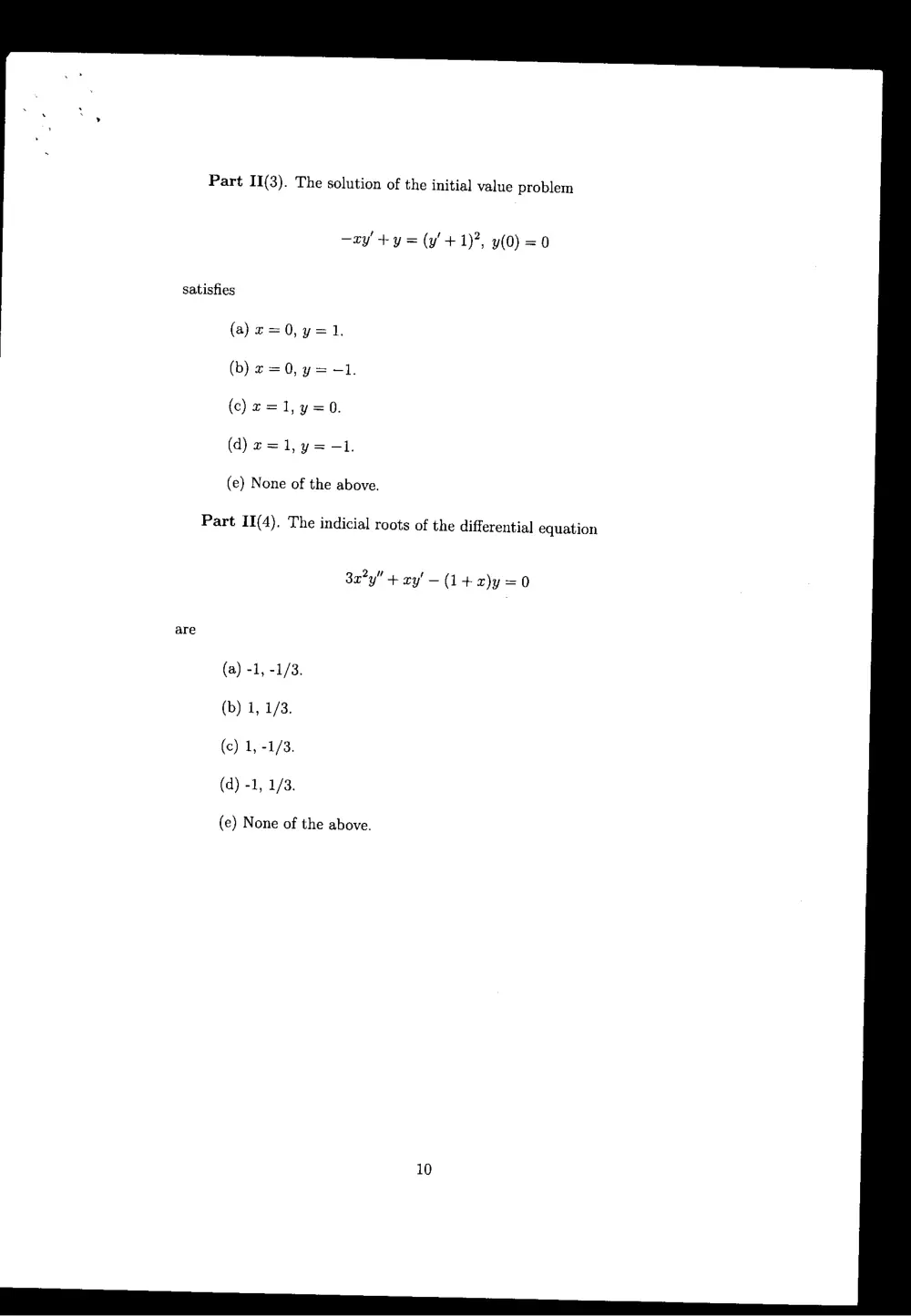
Part II(3). The solution of the initial value problem
—zy' +y = (y+ 1)’, y(0) =0
satisfies
(e) None of the above.
Part II(4). The indicial roots of the differential equation
3x7y" + zy’ — (1+2)y=0
(a) -1, -1/3.
(b) 1, 1/3.
(c) 1, -1/3.
(d) -1, 1/3.
(e) None of the above.