
MATH 202 Final, Summer 2011
American University of Beirut · Differential Equations · 10 pages



More MATH 202 files
- Final SAMPLE · Spring 2019Final examView
- Final Student Copy · Spring 2017Final examView
- Final · Summer 2016Final examView
- Final · Spring 2015Final examView
- Notes Final Summary · Fall 2015Final examView
- Final Common Final · Spring 2014Final examView
- Final · Fall 2013Final examView
- Final · Fall 2012Final examView
Show the text of this final exam
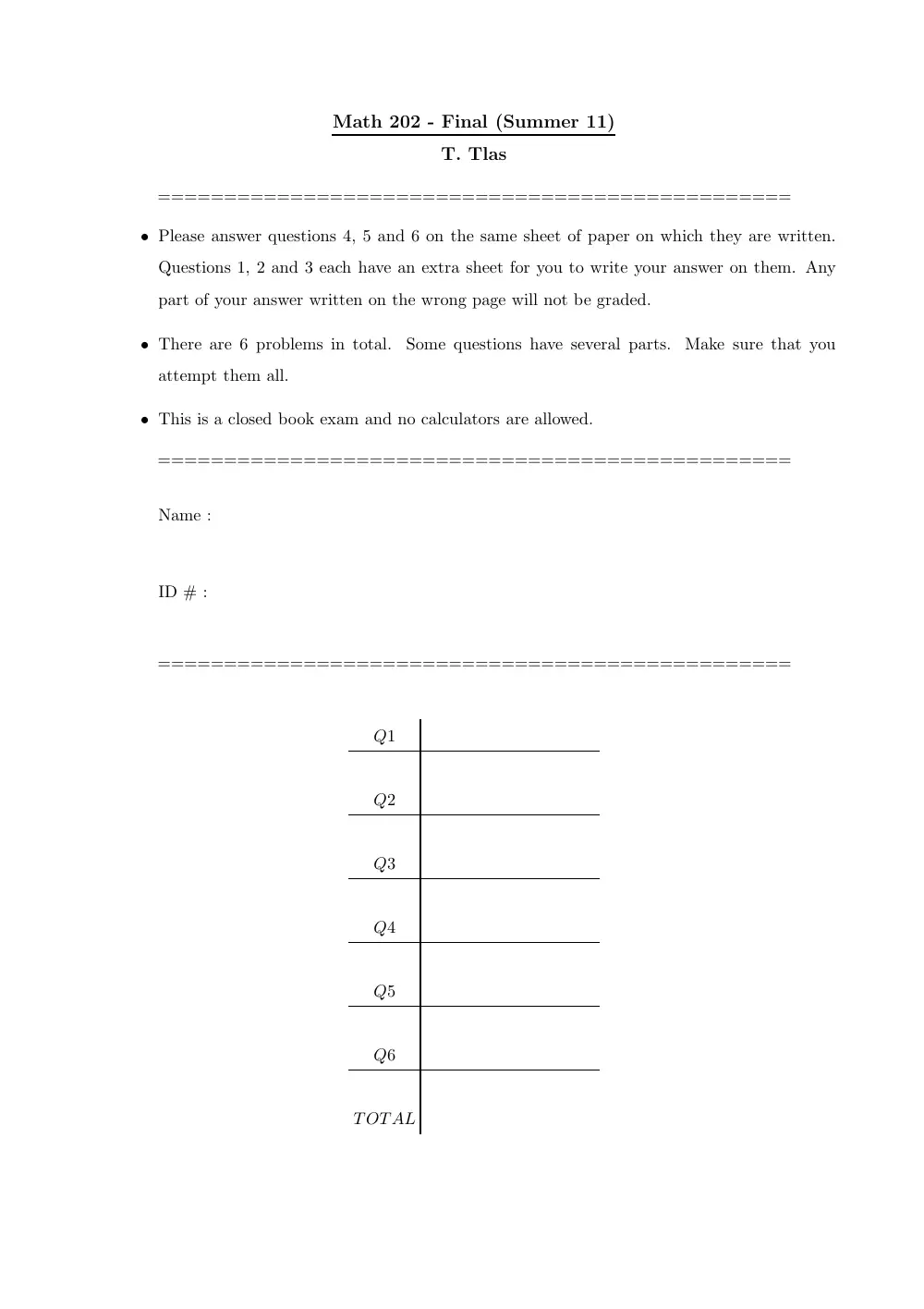
Math 202 - Final (Summer 11)
T. Tlas
================================================
• Please answer questions 4, 5 and 6 on the same sheet of paper on which they are written.
Questions 1, 2 and 3 each have an extra sheet for you to write your answer on them. Any
part of your answer written on the wrong page will not be graded.
• There are 6 problems in total.
Some questions have several parts.
Make sure that you
attempt them all.
• This is a closed book exam and no calculators are allowed.
================================================
Name :
ID # :
================================================
Q1
Q2
Q3
Q4
Q5
Q6
TOTAL
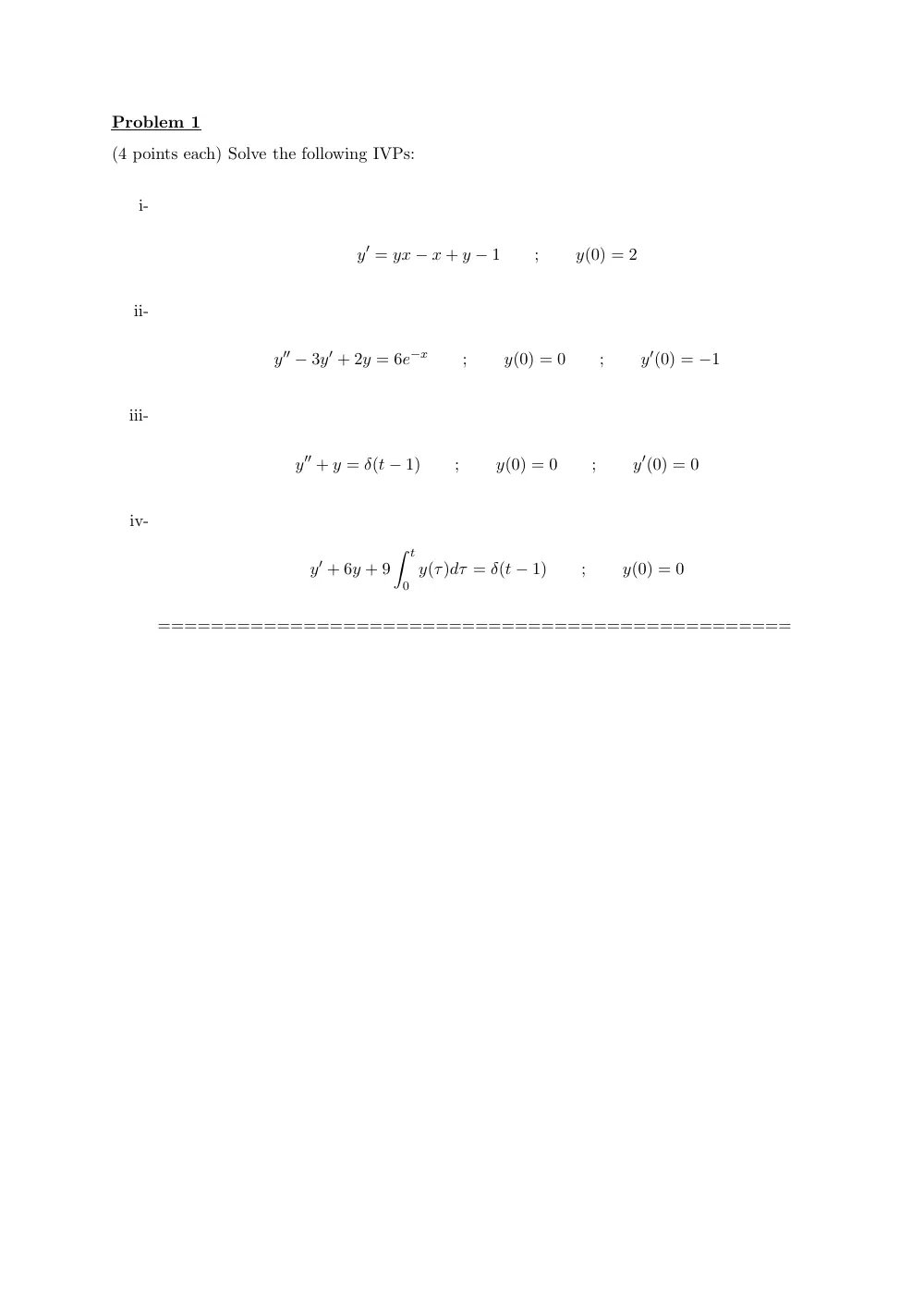
Problem 1
(4 points each) Solve the following IVPs:
i-
y′ = yx − x + y − 1
;
y(0) = 2
ii-
y′′ − 3y′ + 2y = 6e−x
;
y(0) = 0
;
y′(0) = −1
iii-
y′′ + y = δ(t − 1)
;
y(0) = 0
;
y′(0) = 0
iv-
y′ + 6y + 9
� t
0
y(τ)dτ = δ(t − 1)
;
y(0) = 0
================================================
ADDITIONAL SHEET FOR PROBLEM 1 ANSWER
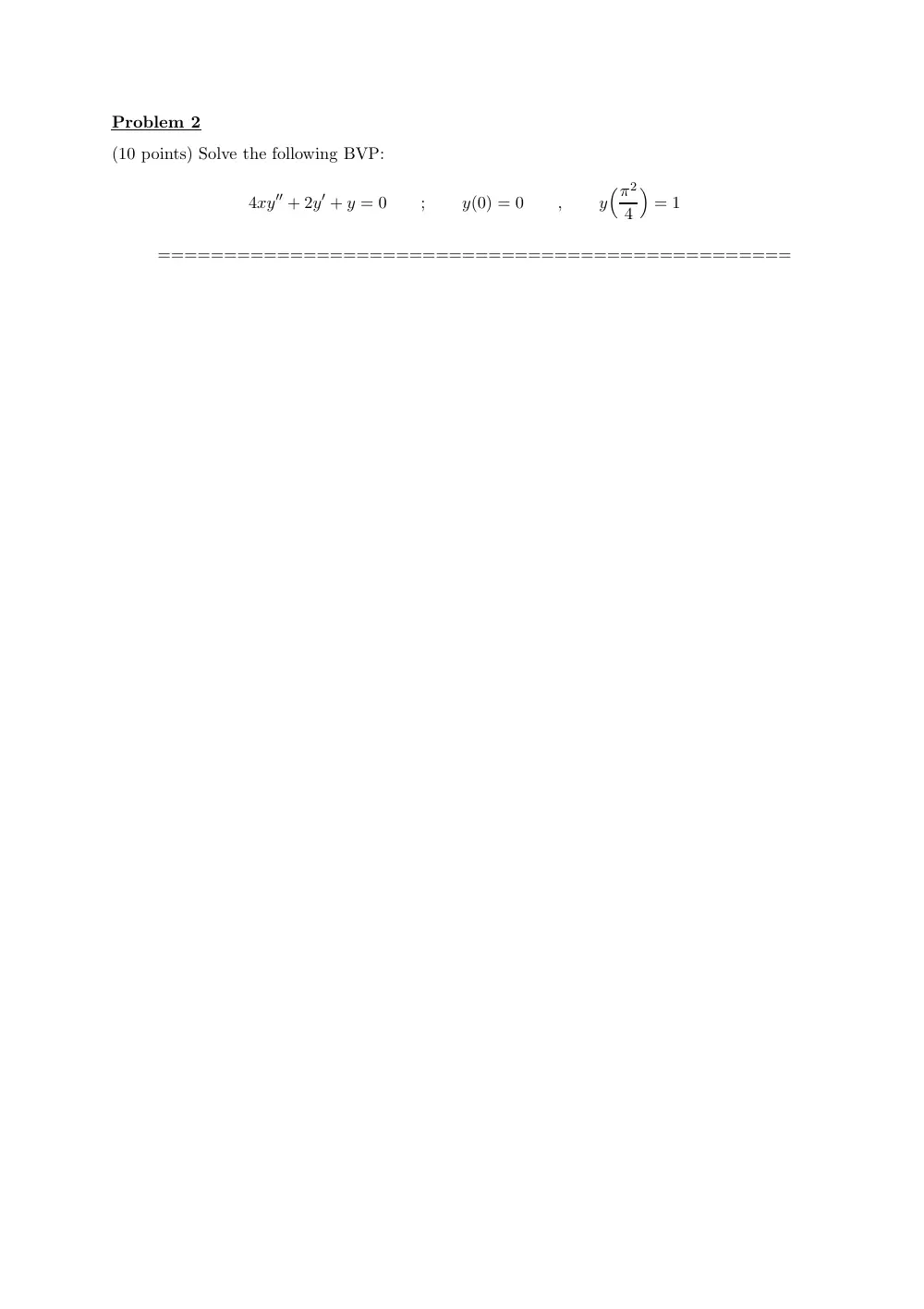
Problem 2
(10 points) Solve the following BVP:
4xy′′ + 2y′ + y = 0
;
y(0) = 0
,
y
�π2
4
�
= 1
================================================
ADDITIONAL SHEET FOR PROBLEM 2 ANSWER
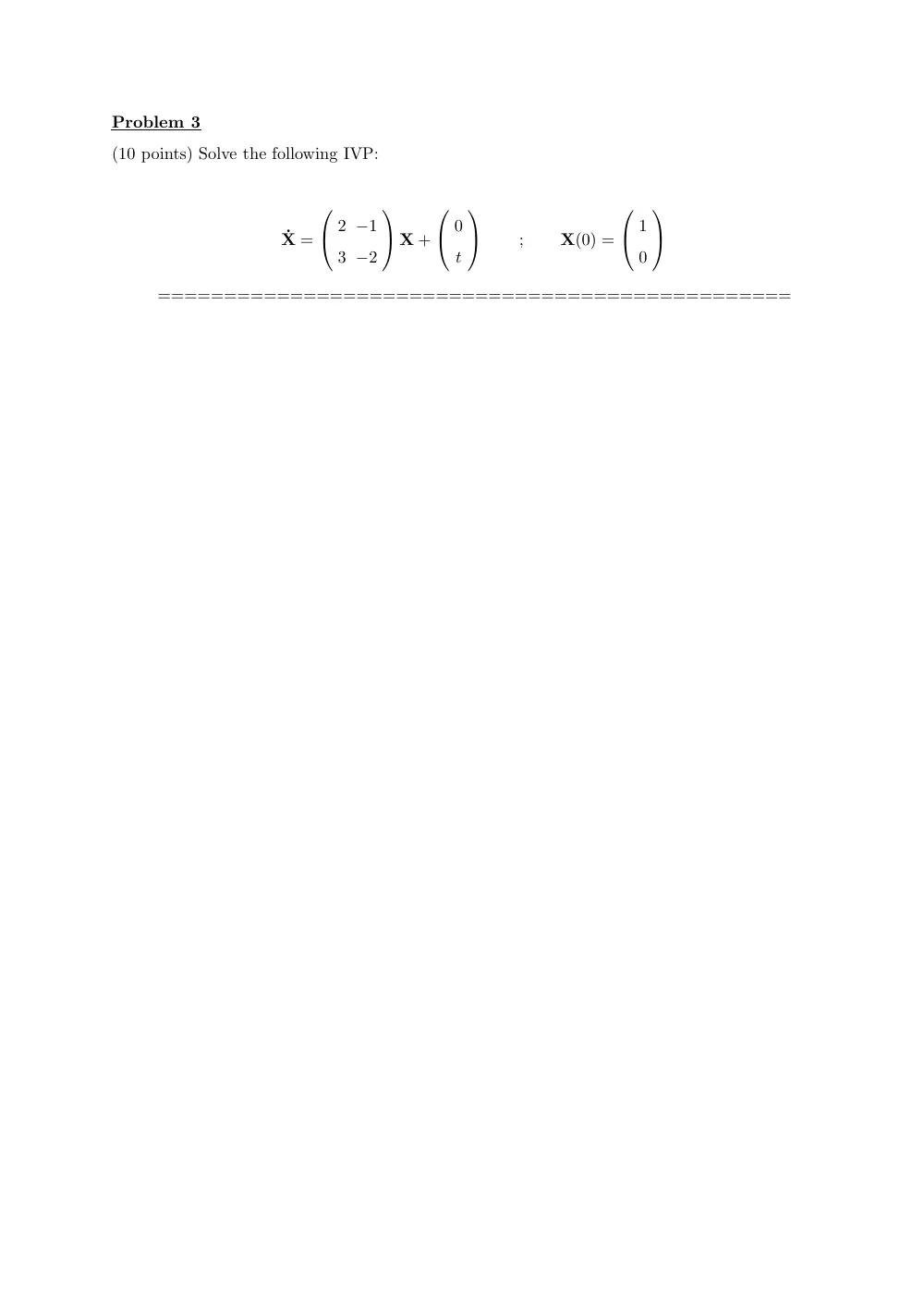
Problem 3
(10 points) Solve the following IVP:
˙X =
2 −1
3 −2
X +
0
t
;
X(0) =
1
0
================================================
ADDITIONAL SHEET FOR PROBLEM 3 ANSWER
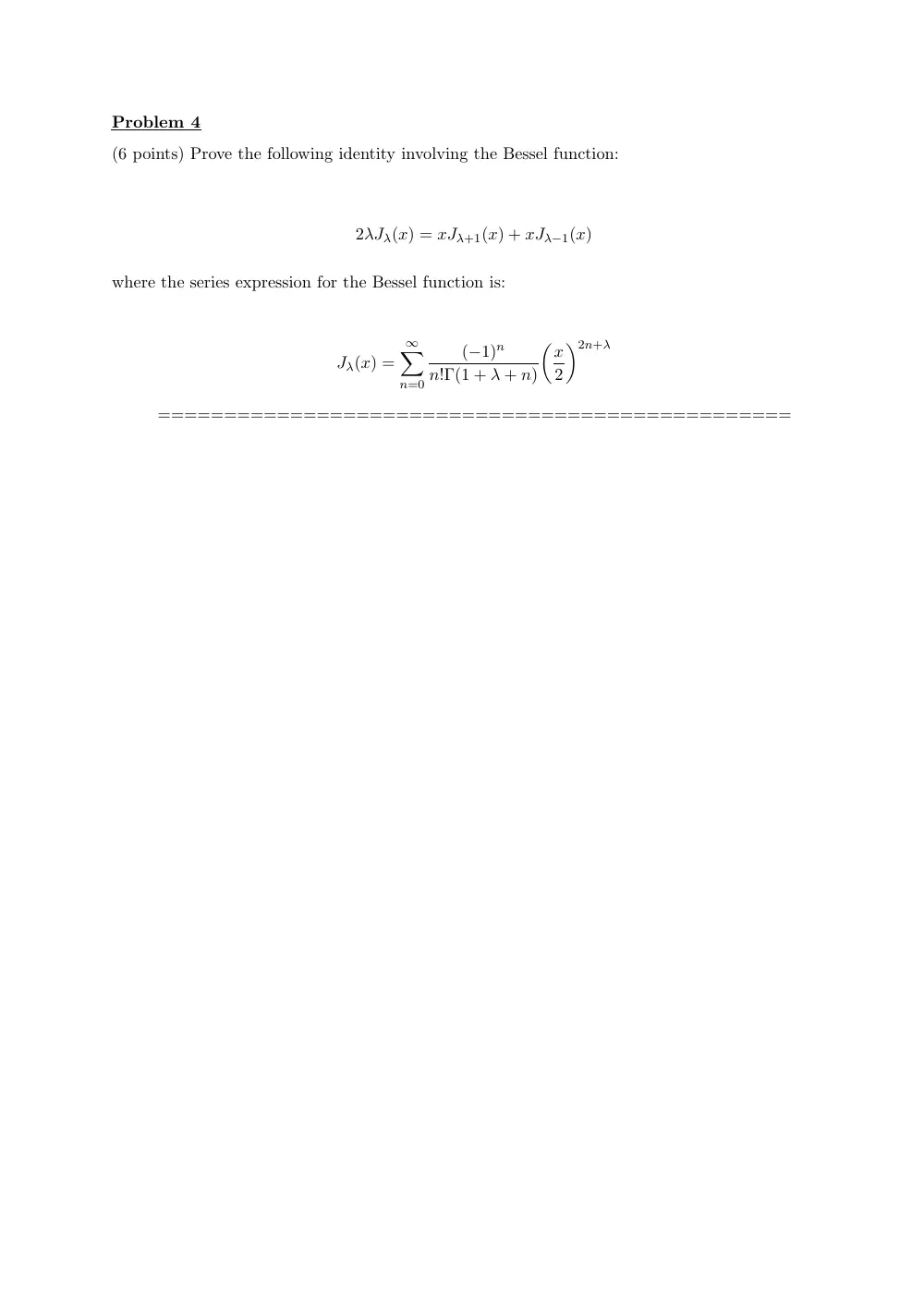
Problem 4
(6 points) Prove the following identity involving the Bessel function:
2λJλ(x) = xJλ+1(x) + xJλ−1(x)
where the series expression for the Bessel function is:
Jλ(x) =
∞
�
n=0
(−1)n
n!Γ(1 + λ + n)
�x
2
�2n+λ
================================================
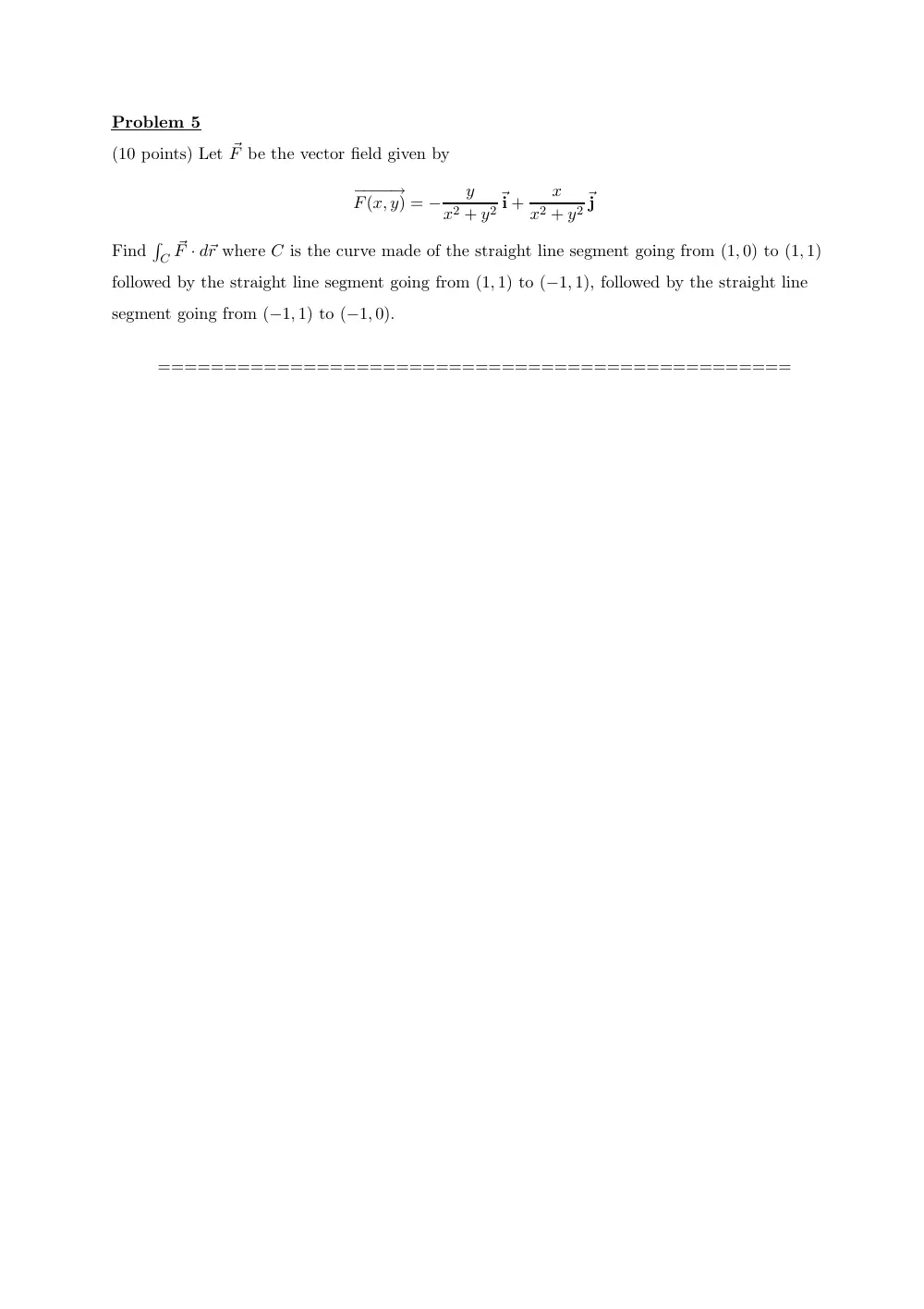
Problem 5
(10 points) Let ⃗F be the vector field given by
−−−−→
F(x, y) = −
y
x2 + y2 ⃗i +
x
x2 + y2 ⃗j
Find
�
C ⃗F · d⃗r where C is the curve made of the straight line segment going from (1, 0) to (1, 1)
followed by the straight line segment going from (1, 1) to (−1, 1), followed by the straight line
segment going from (−1, 1) to (−1, 0).
================================================
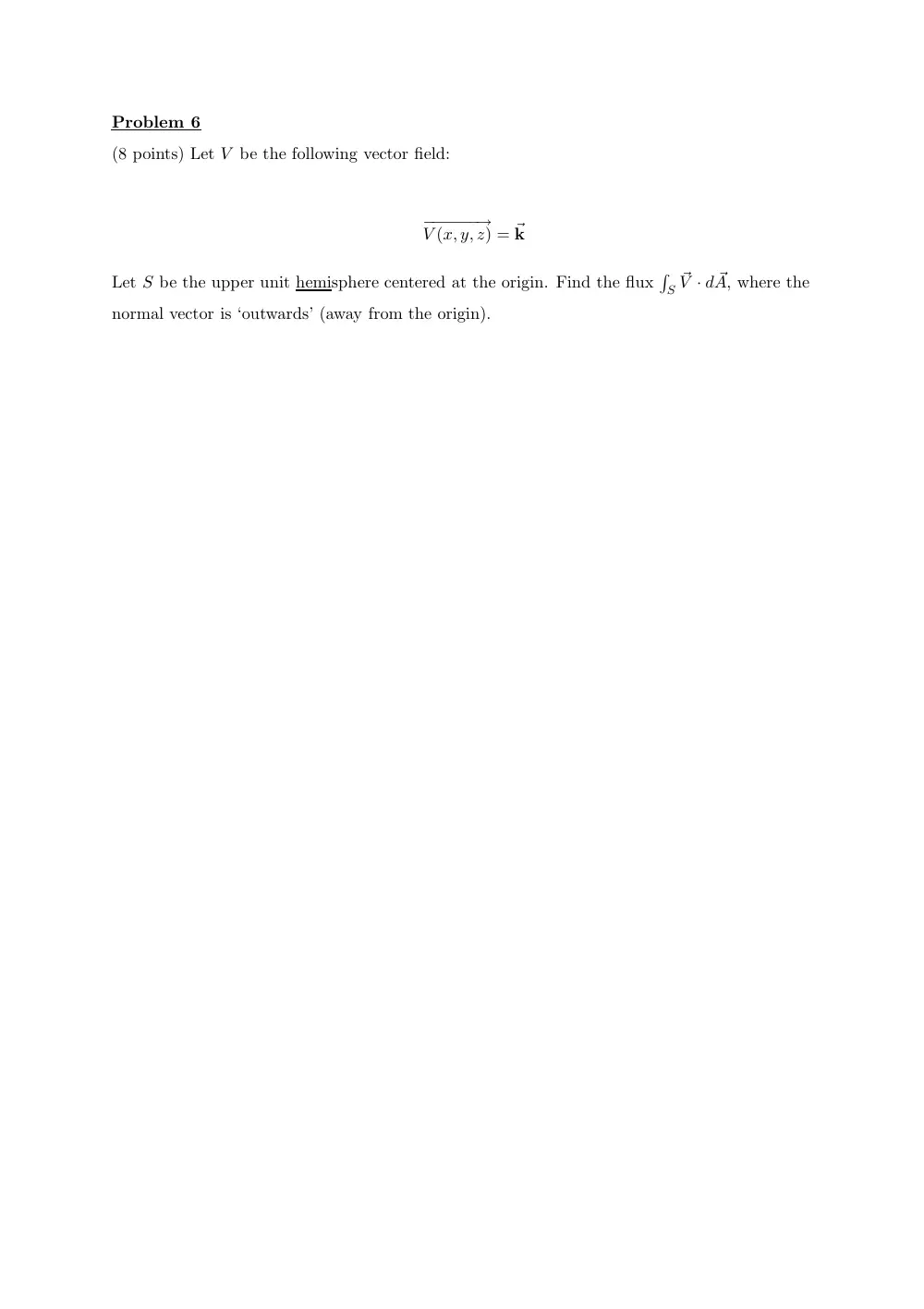
Problem 6
(8 points) Let V be the following vector field:
−−−−−−→
V (x, y, z) = ⃗k
Let S be the upper unit hemisphere centered at the origin. Find the flux
�
S ⃗V · d ⃗A, where the
normal vector is ‘outwards’ (away from the origin).