
MATH 202 Notes, Summer 2002
American University of Beirut · Differential Equations · 3 pages

More MATH 202 files
- Notes Complete Notes Laplace · Spring 2019NotesView
- Notes Summary of Chapter 16 · Spring 2016NotesView
- Notes Integrals of Simple Functions · Spring 2011NotesView
- Notes · Summer 2002NotesView
- Exam Solution to Sample Exam I · Spring 2019Exam · with solutionView
- Exam 2 Clean Copy · Spring 2019ExamView
- Exam 1 Quiz 1 Spring 18 · Spring 2019ExamView
- Exam 1 SAMPLE EXAM I · Spring 2019ExamView
Show the text of this notes
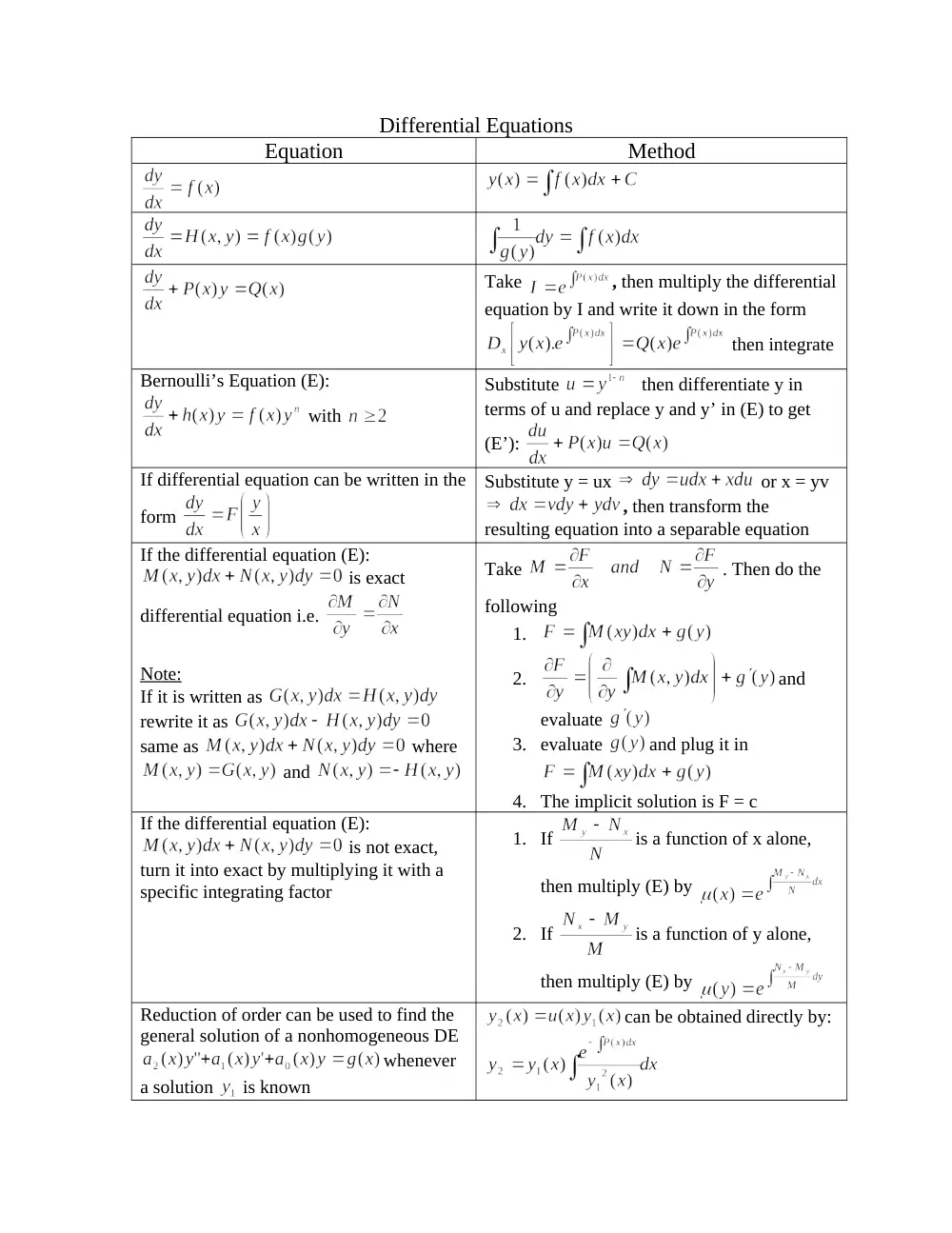
Differential Equations
Equation
Method
Take
, then multiply the differential
equation by I and write it down in the form
then integrate
Bernoulli’s Equation (E):
with
Substitute
then differentiate y in
terms of u and replace y and y’ in (E) to get
(E’):
If differential equation can be written in the
form
Substitute y = ux
or x = yv
, then transform the
resulting equation into a separable equation
If the differential equation (E):
is exact
differential equation i.e.
Note:
If it is written as
rewrite it as
same as
where
and
Take
. Then do the
following
1.
2.
and
evaluate
3. evaluate
and plug it in
4. The implicit solution is F = c
If the differential equation (E):
is not exact,
turn it into exact by multiplying it with a
specific integrating factor
1. If
is a function of x alone,
then multiply (E) by
2. If
is a function of y alone,
then multiply (E) by
Reduction of order can be used to find the
general solution of a nonhomogeneous DE
whenever
a solution
is known
can be obtained directly by:
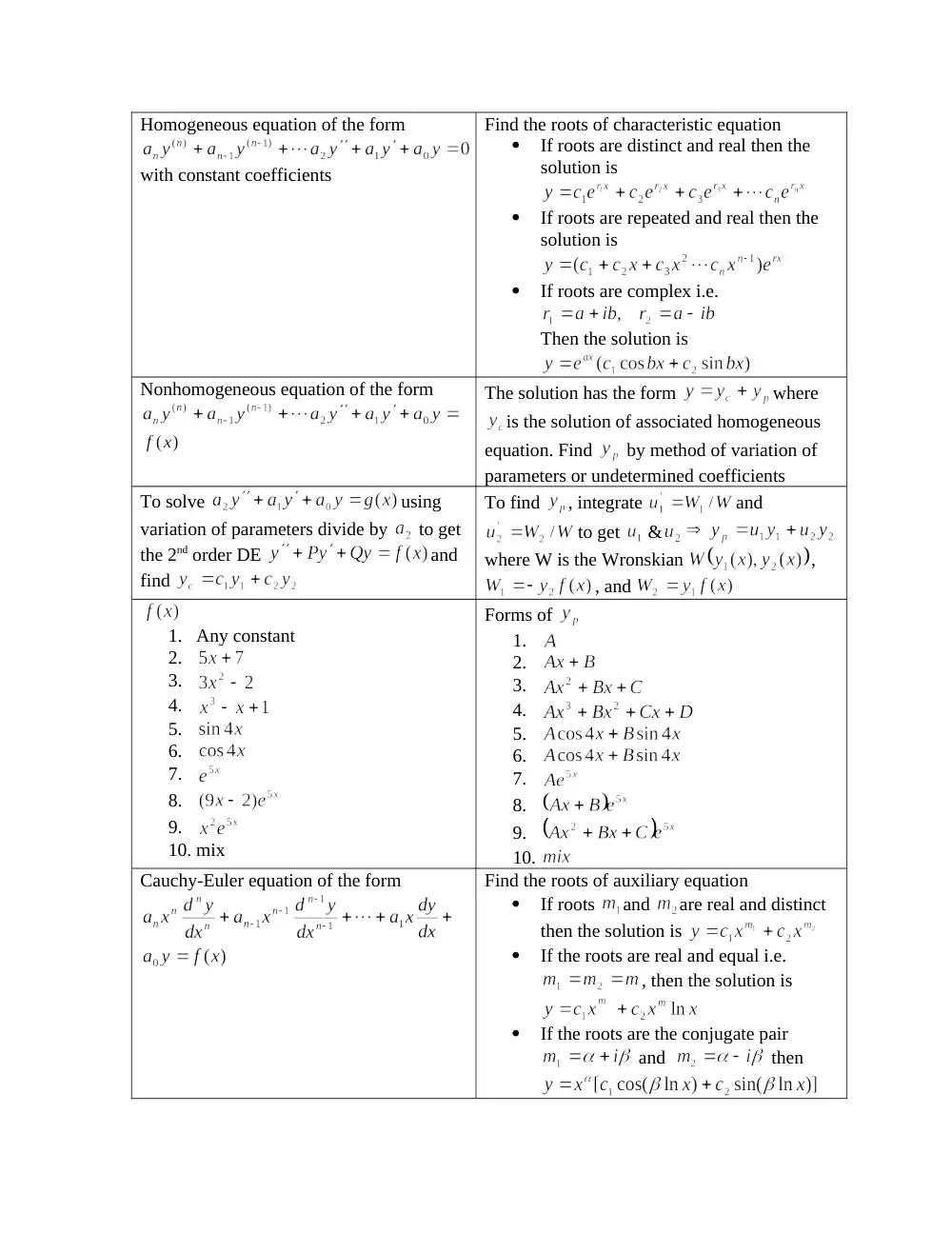
Homogeneous equation of the form
with constant coefficients
Find the roots of characteristic equation
If roots are distinct and real then the
solution is
If roots are repeated and real then the
solution is
If roots are complex i.e.
Then the solution is
Nonhomogeneous equation of the form
The solution has the form
where
is the solution of associated homogeneous
equation. Find
by method of variation of
parameters or undetermined coefficients
To solve
using
variation of parameters divide by
to get
the 2nd order DE
and
find
To find
, integrate
and
to get
&
where W is the Wronskian
,
, and
1. Any constant
2.
3.
4.
5.
6.
7.
8.
9.
10. mix
Forms of
1.
2.
3.
4.
5.
6.
7.
8.
9.
10.
Cauchy-Euler equation of the form
Find the roots of auxiliary equation
If roots
and
are real and distinct
then the solution is
If the roots are real and equal i.e.
, then the solution is
If the roots are the conjugate pair
and
then
Cauchy-Euler
DE with cte coefficients
Substitute
differentiate w.r.t. t
When a linear DE has variable coefficients,
find a solution in the form of infinite series
Use Power series method where
Definition of Laplace of f(t)
= F(s)
Laplace of a power function
Laplace of the function, whose
denominator can be written in factors.
Use partial fractions
Translation Theorem
Convolution of two functions
Convolution Theorem
Differentiation of Transforms
Integration of transforms
To solve the systems of first order linear
differential equations
Write down in matrix form and use eigen value
method
Eigen values
To find eigen values solve
Eigen vectors
To find an eigen vector, find V such that
If eigen values are distinct, then the
solution is
If eigen values are repeated and you can’t
find linearly independent eigen vectors
If the eigen values are complex
Find the eigen vector V for
Take
then separate its real and
imaginary parts
The solution is a linear combination of the real
and imaginary parts