
MATH 202 Questions, Fall 1998
American University of Beirut · Differential Equations · 5 pages
More MATH 202 files
- Questions Z · Spring 2016ProblemsView
- Exam Solution to Sample Exam I · Spring 2019Exam · with solutionView
- Syllabus · Spring 2019LabView
- Exam 2 Clean Copy · Spring 2019ExamView
- Notes Complete Notes Laplace · Spring 2019NotesView
- Final SAMPLE · Spring 2019Final examView
- Exam 1 Quiz 1 Spring 18 · Spring 2019ExamView
- Exam 1 SAMPLE EXAM I · Spring 2019ExamView
Show the text of this problems
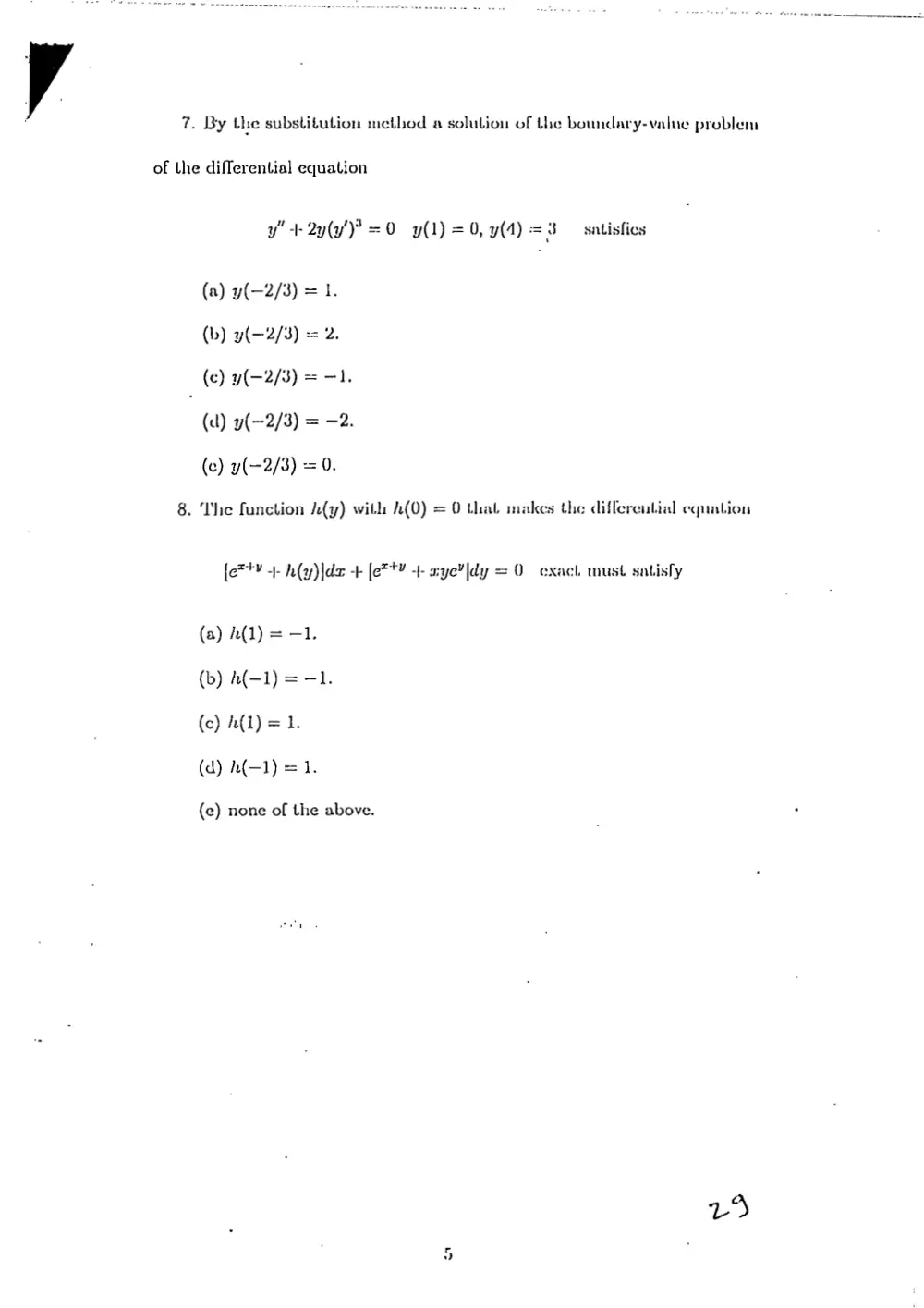
7. By the substitution method a solution of the boundary-value problem
of the differential equation
y" + 2y(y')? =O y(1) = 0, (4) = 3 satisfies
(a) y(—2/3) = 1.
(b) y(—2/3) = 2
(©) v(-2/8) = =I.
(a) y(-2/3) = —2.
(c) y(-2/8) = 0.
8. ‘The function k(y) wilh (0) = 0 thal makes the diflereutial equation
{e?¥ +- h(y)|dx - [e714 +e nye”|dy = 0 exach must satisfy
(a) h(1) = —1.
(b) h(-1) = 1.
(c) h(1) =1.
(d) h(-1) = 1.
(e) none of the above.
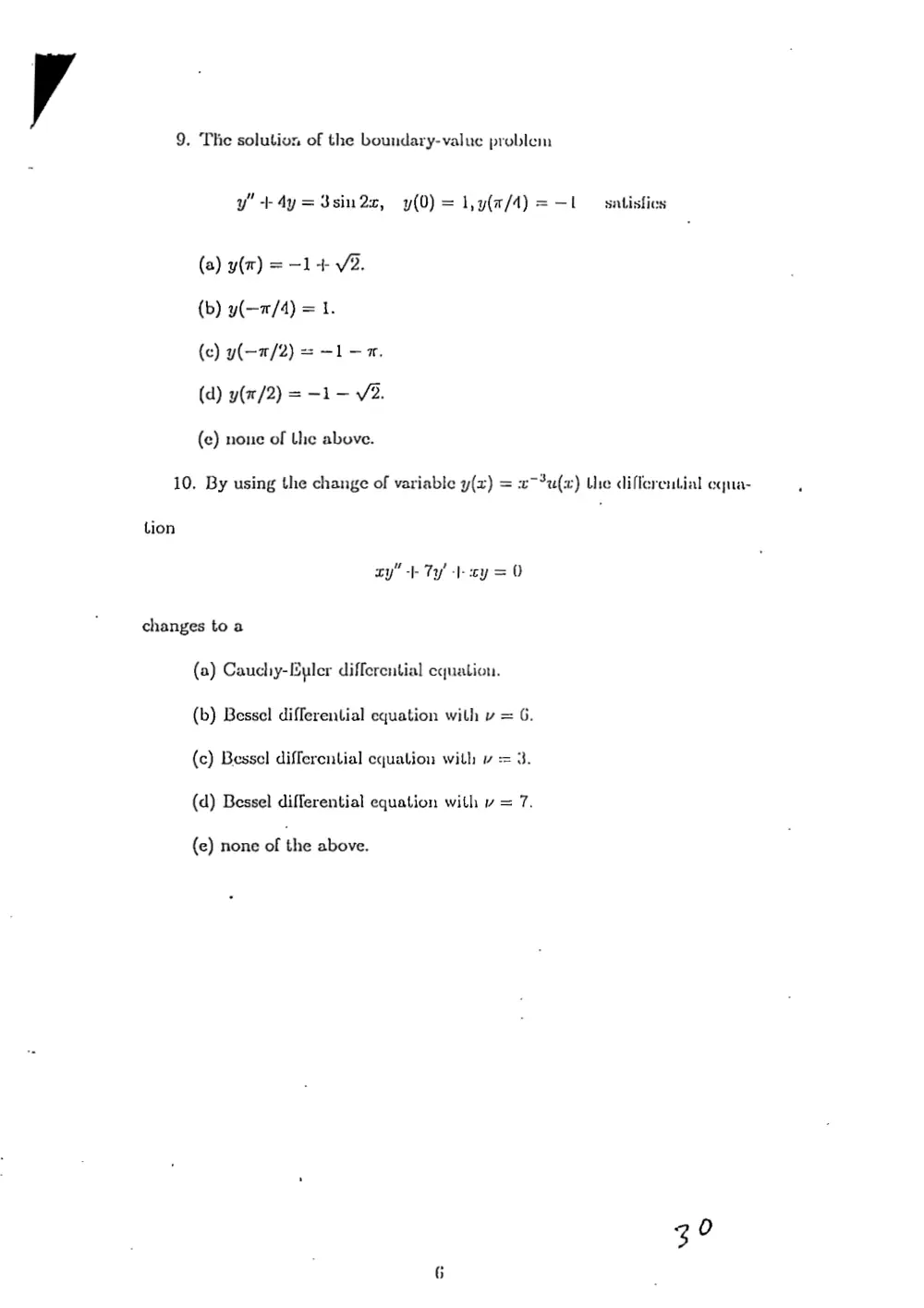
9. The solution of the boundary-value problem
y+ 4y = 3sin2s, y(0) = 1,y(r/4) =—-1 satisfies
(a) y(m) = -1 + V2.
(b) y(—m/4) = 1.
(c) y(-1/2) = -1—m.
(d) y(/2) = -1- V2.
(e) none of the above.
10. By using the change of variable y(x) = «7 ?u(x) Une diflercutial equa-
tion .
sy" -+ Ty’ | cy = 0
changes to a
(a) Cauchy-[yuler differential equation.
(b) Bessel differential equation with v = 6.
(c) Bessel differential equation with v = 3.
(d) Bessel differential equation with v = 7.
(e) none of the above.
6
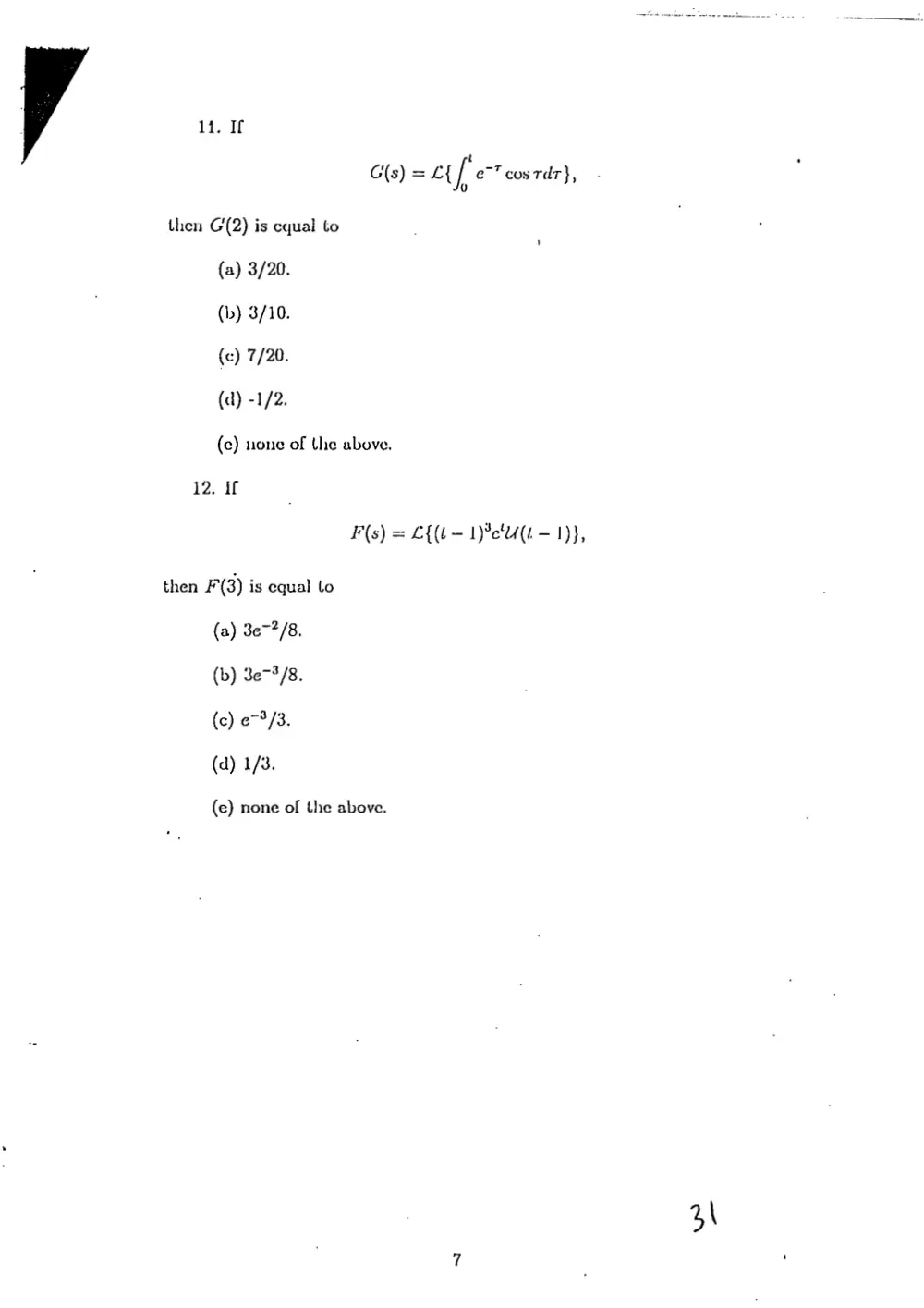
Lt. If
as) = ‘eT eos 7dr},
then G(2) is equal to
(a) 3/20.
(b) 3/10.
(c) 7/20.
(a) -1/2.
(c) none of the above.
12. if
F(s) = L{(t- Let - 1},
then F(3) is equal to
(a) 3e-2/8,
(b) 3073/8.
(c) °9/3.
(a) 1/3.
(e) none of the above.
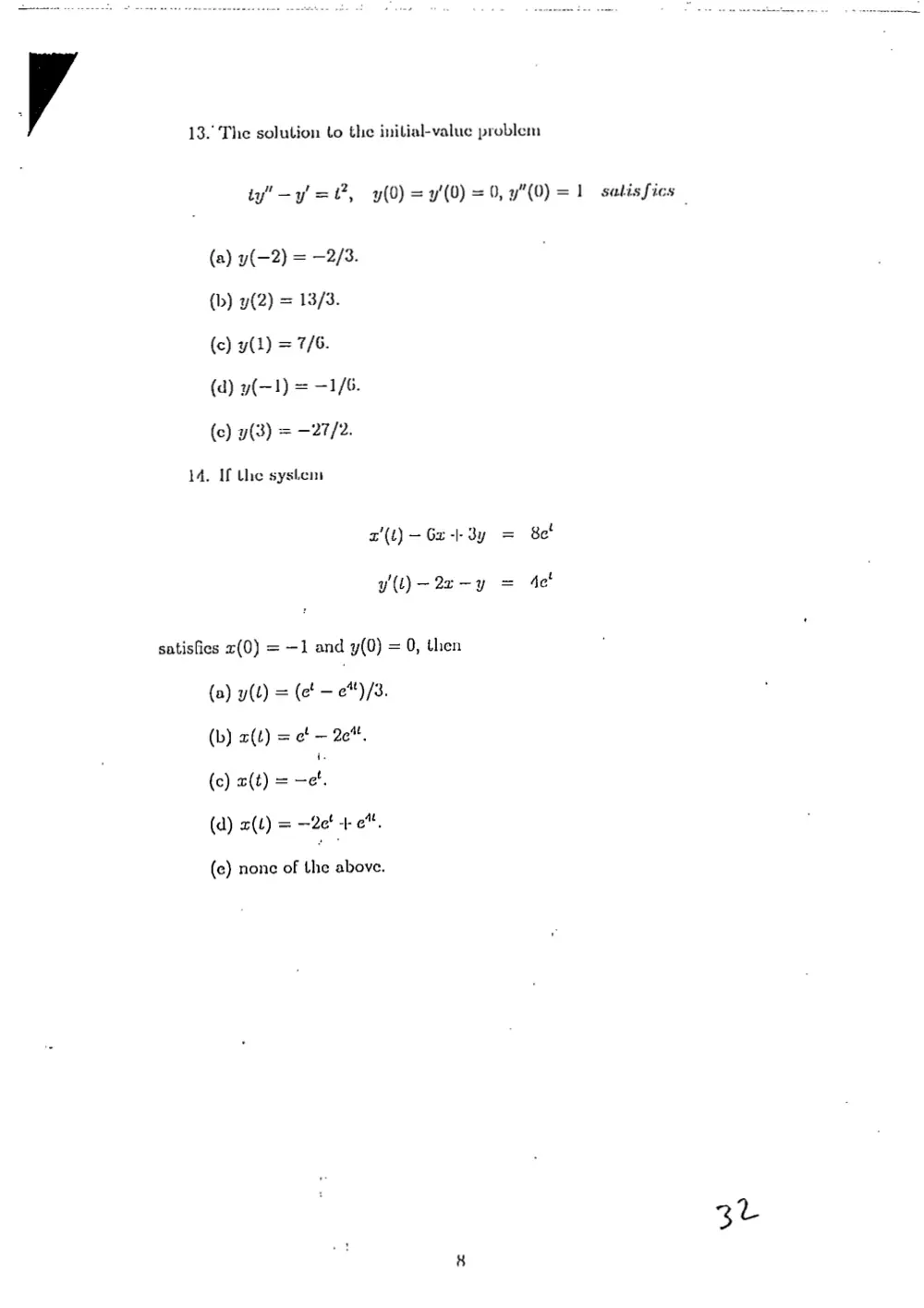
13.’ The solution to the initial-value problem
iy’ —y' =t?, (0) =y'(0) = 0, y"(0) = 1 satis fics
(a) y(—2) = —2/8.
(b) y(2) = 13/3.
(c) y) = 7/6.
(d) x(-1) = -1/6.
(c) y(3) = -27/2.
14. If the sysbem
z'(t) —Gx-3y = 8e!
4c!
y(t) — 2n-y
satisfies x(0) = —1 and (0) = 0, then
(a) y(t) = (e' — e%)/3.
(b) a(t) = et — 2c".
(a) x(t) = —2e! + e.
(e) none of the above.
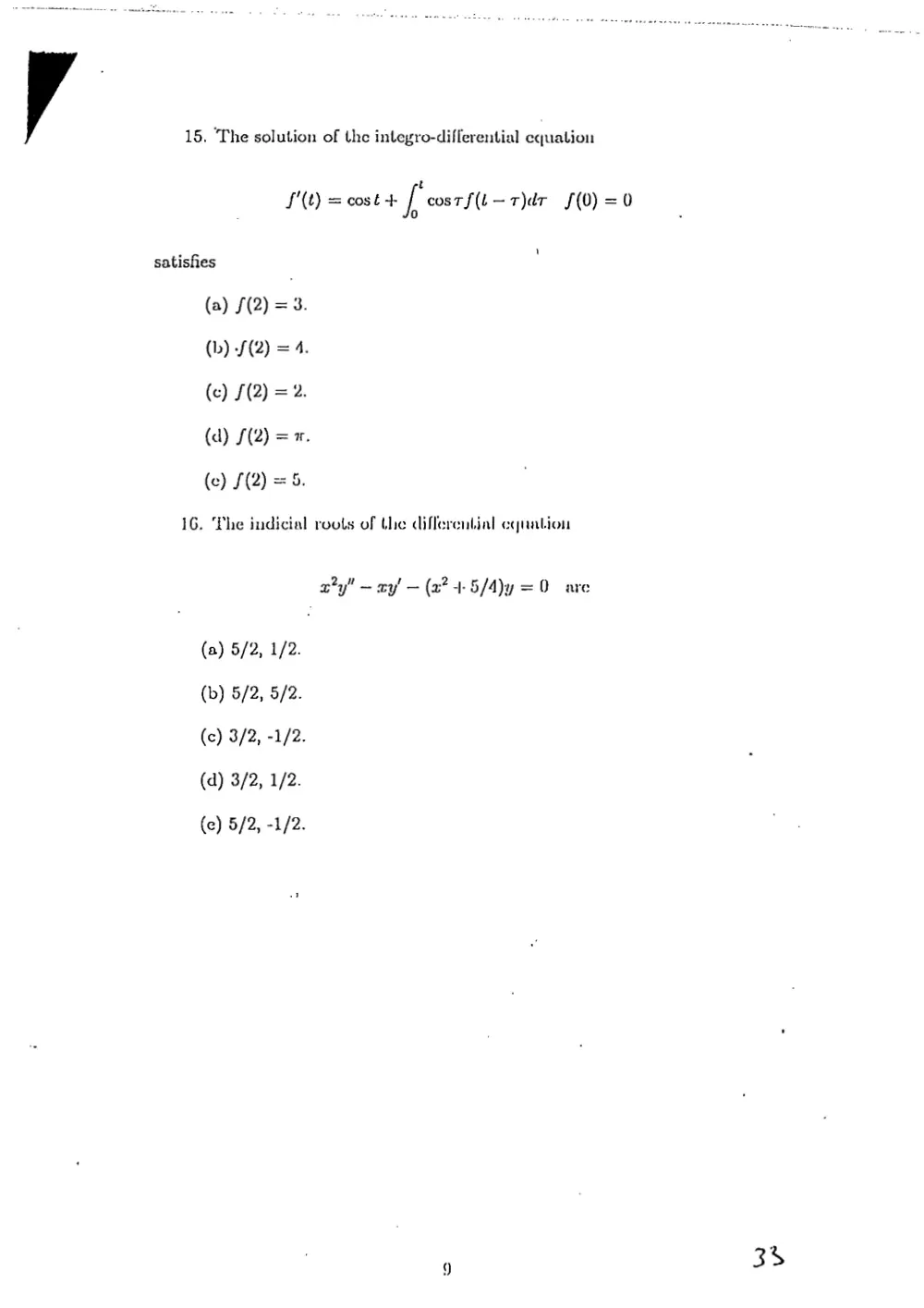
15. “The solution of the integro-diflerential equation
t
(t= cost + | costf(L—7)dr f(0) =0
satisfies
(a) (2) =3.
(b) (2) =4.
Il
(c) £(2)
(a) f(2) =x.
3
(c) f(2) = 5.
2.
1
1G. ‘Phe indicial roots of the differential equation
(a) 5/2, 1/2.
(b) 5/2, 5/2.
(c) 3/2, -1/2.
(d) 3/2, 1/2.
(e) 5/2, -1/2.
xy" ~ zy! — (2? +: 5/4)y =0 are
9
3%