
MATH 202 Syllabus, Spring 2018
American University of Beirut · Differential Equations · 4 pages · Dr. Richard Aoun

More MATH 202 files
Show the text of this lab
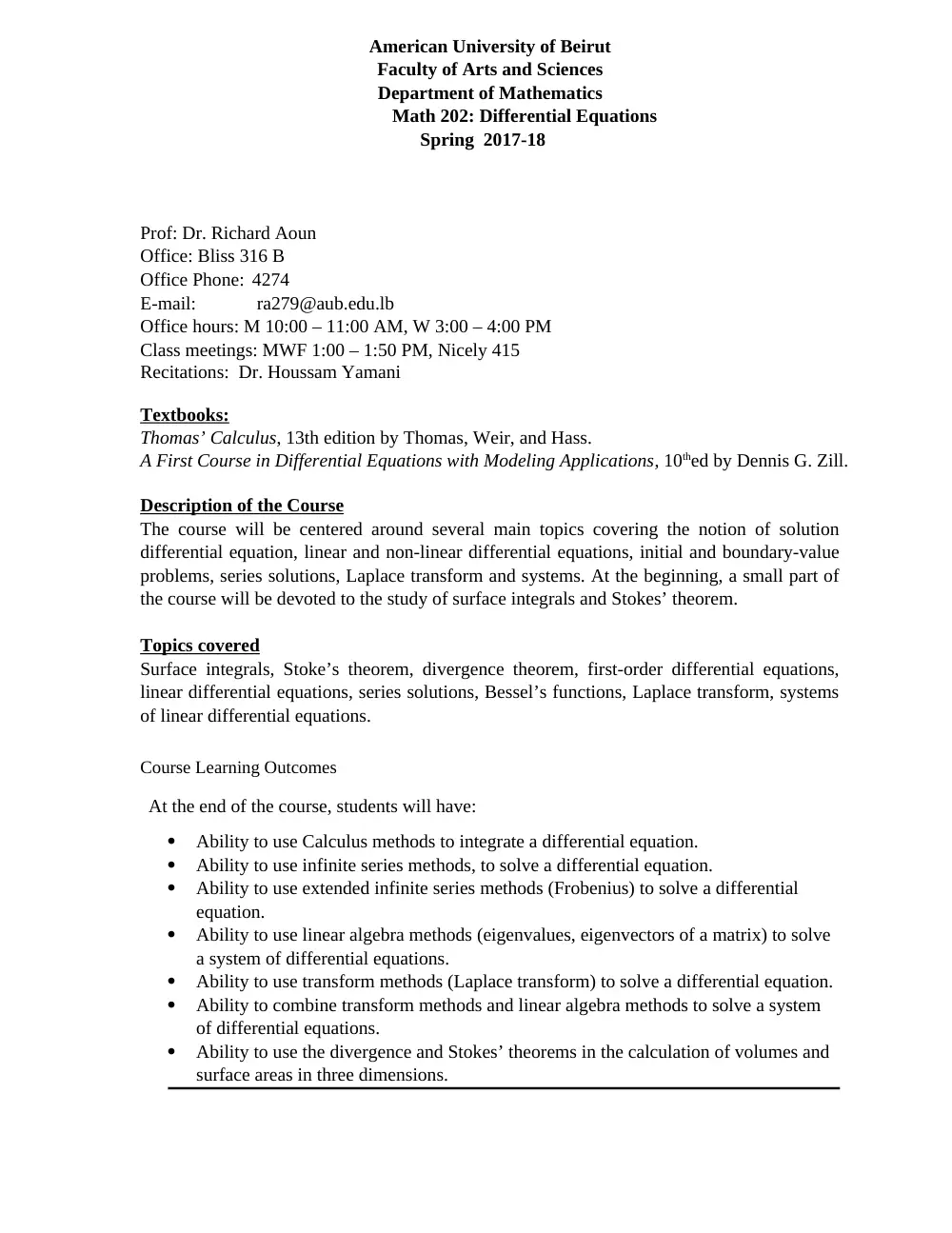
American University of Beirut
Faculty of Arts and Sciences
Department of Mathematics
Math 202: Differential Equations
Spring 2017-18
Prof: Dr. Richard Aoun
Office: Bliss 316 B
Office Phone: 4274
E-mail:
ra279@aub.edu.lb
Office hours: M 10:00 – 11:00 AM, W 3:00 – 4:00 PM
Class meetings: MWF 1:00 – 1:50 PM, Nicely 415
Recitations: Dr. Houssam Yamani
Textbooks:
Thomas’ Calculus, 13th edition by Thomas, Weir, and Hass.
A First Course in Differential Equations with Modeling Applications, 10thed by Dennis G. Zill.
Description of the Course
The course will be centered around several main topics covering the notion of solution
differential equation, linear and non-linear differential equations, initial and boundary-value
problems, series solutions, Laplace transform and systems. At the beginning, a small part of
the course will be devoted to the study of surface integrals and Stokes’ theorem.
Topics covered
Surface integrals, Stoke’s theorem, divergence theorem, first-order differential equations,
linear differential equations, series solutions, Bessel’s functions, Laplace transform, systems
of linear differential equations.
Course Learning Outcomes
At the end of the course, students will have:
Ability to use Calculus methods to integrate a differential equation.
Ability to use infinite series methods, to solve a differential equation.
Ability to use extended infinite series methods (Frobenius) to solve a differential
equation.
Ability to use linear algebra methods (eigenvalues, eigenvectors of a matrix) to solve
a system of differential equations.
Ability to use transform methods (Laplace transform) to solve a differential equation.
Ability to combine transform methods and linear algebra methods to solve a system
of differential equations.
Ability to use the divergence and Stokes’ theorems in the calculation of volumes and
surface areas in three dimensions.
AUB strives to make learning experiences as accessible as possible. If you anticipate
or experience academic barriers due to a disability (including mental health, chronic
or temporary medical conditions), and in order to help establish reasonable
accommodations and facilitate a smooth accommodations process, you are
encouraged to contact the Accessible Education Office in West Hall 314.
Non-Discrimination
AUB is committed to facilitating a campus free of all forms of discrimination
including sex/gender-based harassment prohibited by Title IX. The University’s non-
discrimination policy applies to, and protects, all students, faculty, and staff. If you
think you have experienced discrimination or harassment, including sexual
misconduct, we encourage you to tell someone promptly. If you speak to a faculty or
staff member about an issue such as harassment, sexual violence, or discrimination,
the information will be kept as private as possible, however, faculty and designated
staff are required to bring it to the attention of the University’s Title IX Coordinator.
Faculty can refer you to fully confidential resources, and you can find information
and contacts at www.aub.edu.lb/titleix . To report an incident, contact the University's
Title IX Coordinator Trudi Hodges at 01-350000 ext. 2514, or titleix@aub.edu.lb .
An anonymous report may be submitted online via EthicsPoint at
www.aub.ethicspoint.com
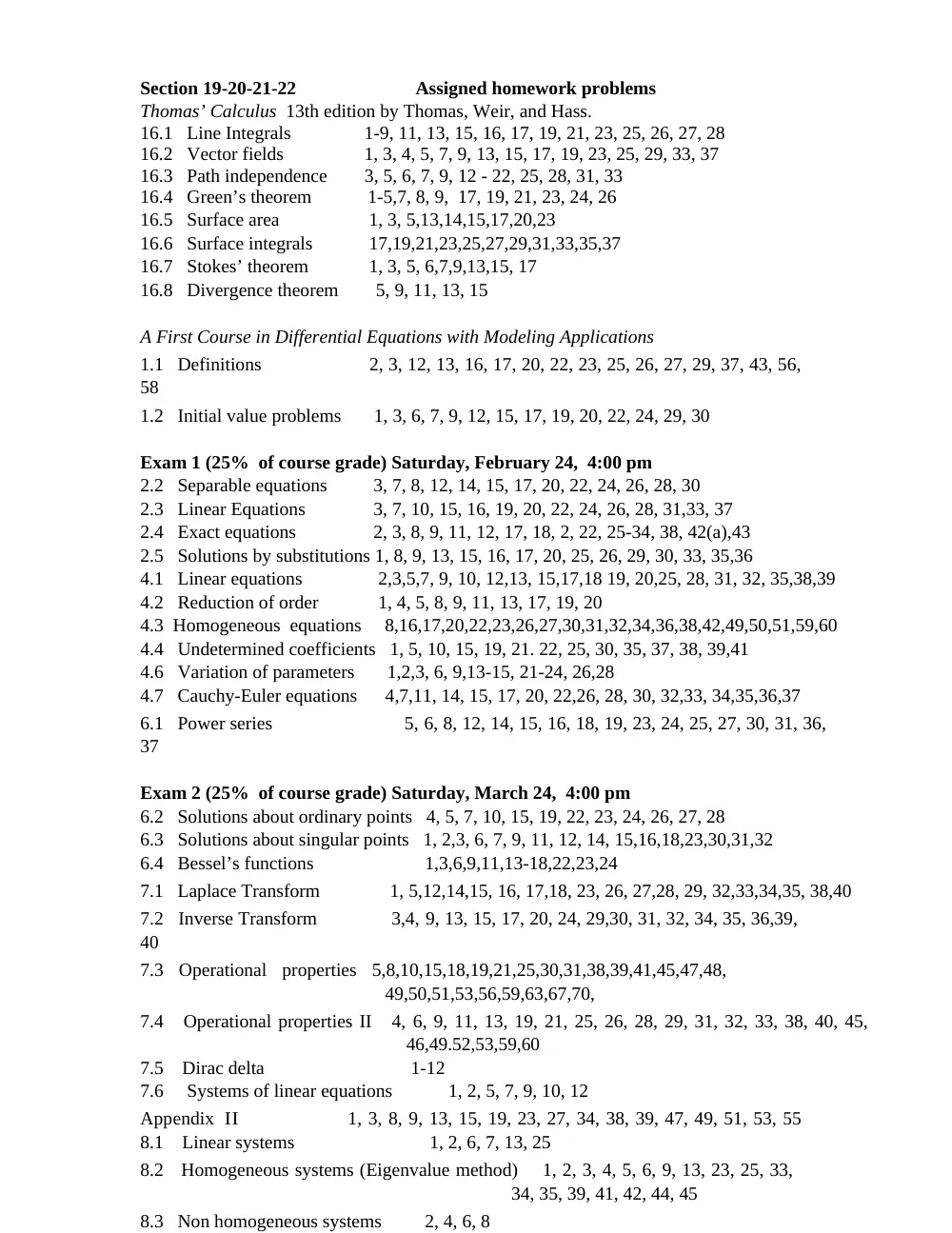
Section 19-20-21-22 Assigned homework problems
Thomas’ Calculus 13th edition by Thomas, Weir, and Hass.
16.1 Line Integrals
1-9, 11, 13, 15, 16, 17, 19, 21, 23, 25, 26, 27, 28
16.2 Vector fields
1, 3, 4, 5, 7, 9, 13, 15, 17, 19, 23, 25, 29, 33, 37
16.3 Path independence 3, 5, 6, 7, 9, 12 - 22, 25, 28, 31, 33
16.4 Green’s theorem 1-5,7, 8, 9, 17, 19, 21, 23, 24, 26
16.5 Surface area
1, 3, 5,13,14,15,17,20,23
16.6 Surface integrals
17,19,21,23,25,27,29,31,33,35,37
16.7 Stokes’ theorem
1, 3, 5, 6,7,9,13,15, 17
16.8 Divergence theorem 5, 9, 11, 13, 15
A First Course in Differential Equations with Modeling Applications
1.1 Definitions
2, 3, 12, 13, 16, 17, 20, 22, 23, 25, 26, 27, 29, 37, 43, 56,
58
1.2 Initial value problems 1, 3, 6, 7, 9, 12, 15, 17, 19, 20, 22, 24, 29, 30
Exam 1 (25% of course grade) Saturday, February 24, 4:00 pm
2.2 Separable equations
3, 7, 8, 12, 14, 15, 17, 20, 22, 24, 26, 28, 30
2.3 Linear Equations
3, 7, 10, 15, 16, 19, 20, 22, 24, 26, 28, 31,33, 37
2.4 Exact equations
2, 3, 8, 9, 11, 12, 17, 18, 2, 22, 25-34, 38, 42(a),43
2.5 Solutions by substitutions 1, 8, 9, 13, 15, 16, 17, 20, 25, 26, 29, 30, 33, 35,36
4.1 Linear equations
2,3,5,7, 9, 10, 12,13, 15,17,18 19, 20,25, 28, 31, 32, 35,38,39
4.2 Reduction of order
1, 4, 5, 8, 9, 11, 13, 17, 19, 20
4.3 Homogeneous equations 8,16,17,20,22,23,26,27,30,31,32,34,36,38,42,49,50,51,59,60
4.4 Undetermined coefficients 1, 5, 10, 15, 19, 21. 22, 25, 30, 35, 37, 38, 39,41
4.6 Variation of parameters 1,2,3, 6, 9,13-15, 21-24, 26,28
4.7 Cauchy-Euler equations 4,7,11, 14, 15, 17, 20, 22,26, 28, 30, 32,33, 34,35,36,37
6.1 Power series
5, 6, 8, 12, 14, 15, 16, 18, 19, 23, 24, 25, 27, 30, 31, 36,
37
Exam 2 (25% of course grade) Saturday, March 24, 4:00 pm
6.2 Solutions about ordinary points 4, 5, 7, 10, 15, 19, 22, 23, 24, 26, 27, 28
6.3 Solutions about singular points 1, 2,3, 6, 7, 9, 11, 12, 14, 15,16,18,23,30,31,32
6.4 Bessel’s functions
1,3,6,9,11,13-18,22,23,24
7.1 Laplace Transform 1, 5,12,14,15, 16, 17,18, 23, 26, 27,28, 29, 32,33,34,35, 38,40
7.2 Inverse Transform 3,4, 9, 13, 15, 17, 20, 24, 29,30, 31, 32, 34, 35, 36,39,
40
7.3 Operational properties 5,8,10,15,18,19,21,25,30,31,38,39,41,45,47,48,
49,50,51,53,56,59,63,67,70,
7.4 Operational properties II 4, 6, 9, 11, 13, 19, 21, 25, 26, 28, 29, 31, 32, 33, 38, 40, 45,
46,49.52,53,59,60
7.5 Dirac delta
1-12
7.6 Systems of linear equations 1, 2, 5, 7, 9, 10, 12
Appendix II 1, 3, 8, 9, 13, 15, 19, 23, 27, 34, 38, 39, 47, 49, 51, 53, 55
8.1 Linear systems
1, 2, 6, 7, 13, 25
8.2 Homogeneous systems (Eigenvalue method) 1, 2, 3, 4, 5, 6, 9, 13, 23, 25, 33,
34, 35, 39, 41, 42, 44, 45
8.3 Non homogeneous systems
2, 4, 6, 8
Final Exam (50% of course grade) comprehensive
TBA