
MATH 210 Final, Fall 2001
American University of Beirut · Introduction to Analysis · 4 pages
More MATH 210 files
Show the text of this final exam
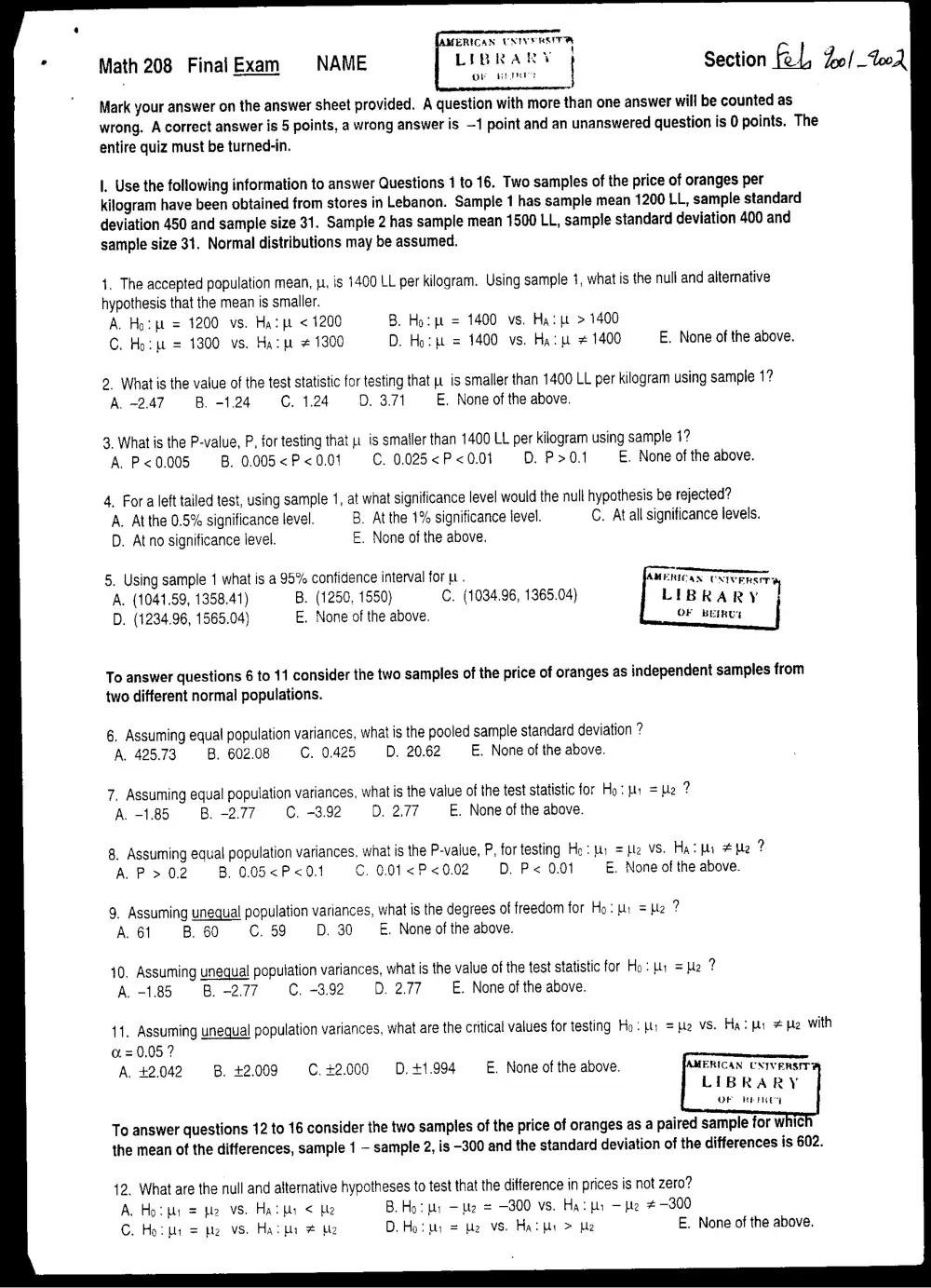
ERICAN UNIY® SIT
Math 208 FinalExam NAME LIBRARY | Section fel, Zo/_tood
OF Bra:
Mark your answer on the answer sheet provided. A question with more than one answer will be counted as
wrong. A correct answer is 5 points, a wrong answer is —1 point and an unanswered question is 0 points. The
entire quiz must be turned-in.
|. Use the following information to answer Questions 1 to 16. Two samples of the price of oranges per
kilogram have been obtained from stores in Lebanon. Sample 1 has sample mean 1200 LL, sample standard
deviation 450 and sample size 31. Sample 2 has sample mean 1500 LL, sample standard deviation 400 and
sample size 31. Normal distributions may be assumed.
1. The accepted population mean, 1, is 1400 LL per kilogram. Using sample 1, what is the null and alternative
hypothesis that the mean is smaller.
A. Ho:pt = 1200 vs. Ha: pi < 1200 B. Ho: = 1400 vs. Ha: pt > 1400
C. Ho:gt = 1300 vs. Ha: # 1300 D. Ho:p = 1400 vs. Ha: #1400 E. None of the above.
2. What is the value of the test statistic for testing that pis smaller than 1400 LL per kilogram using sample 1?
A. -2.47 B.-124 ©1124 0.371 E. None of the above.
3. What is the P-value, P, for testing that ji is smatler than 1400 LL per kilogram using sample 1?
A. P< 0.005 B. 0.005 <P <0.01 C. 0.025 < P< 0.01 D. P>01 E. None of the above.
4. Fora left tailed test, using sample 1, at what significance level would the null hypothesis be rejected?
A. At the 0.5% significance level. B. At the 1% significance level. C. Atall significance levels.
D. At no significance level. E. None of the above.
5. Using sample 1 what is a 95% confidence interval for 11 . AMERICAN UNICRnaIT
A. (1041.59, 1358.41) B. (1250, 1550) C. (1034.96, 1365.04) LIBRARY
D. (1234.96, 1565.04) E. None of the above. OF BEIRUG
To answer questions 6 to 11 consider the two samples of the price of oranges as independent samples from
two different normal populations.
6, Assuming equal population variances, what is the pooled sample standard deviation ?
A. 425.73 B. 602.08 C. 0,425 D. 20.62 E. None of the above.
7, Assuming equal population variances, what is the value of the test statistic for Ho: ps = be ?
A. -1.85 B. -2.77 C. -3.92 D. 2.77 E. None of the above.
8. Assuming equal population variances, what is the P-vaiue, P, fortesting Ho: t1 = ple VS. Hatt # pe ?
A. P > 0.2 B. 0.05<P<0.1 C. 0.01 <P <0.02 D. P< 0.01 E. None of the above.
9. Assuming unequa! population variances, what is the degrees of freedom for Ho: pi = Me ?
A. 61 B. 60 36. «59 D. 30 __E. None of the above.
10. Assuming unequal population variances, what is the value of the test statistic for Ho: flr = be ?
A.-185 6B. -277 C.-392 D.2.77 E. None ofthe above.
11, Assuming unequal population variances, what are the critical values for testing Ho: ft: = 4l2 VS. Ha: pr # pe with
a@=0.05 ?
A, +2.042 B. 42.009 C.+2.000 D.+1.994 E. None of the above. AMERICAN UNIVERSIT:
LIBRARY
OF REIKEL
To answer questions 12 to 16 consider the two samples of the price of oranges as a paired sample for whic
the mean of the differences, sample 1 — sample 2, is -300 and the standard deviation of the differences is 602.
42. What are the null and alternative hypotheses to test that the difference in prices is not zero?
A. Ho: br = bla VS. Has bi < He B. Ho: 1 — Ute = —300 vs. Ha: pr — pe #-300
C. Hot li = He vs. Hai ba % be D. Ho: tr = He VS. Hai > be E. None of the above.
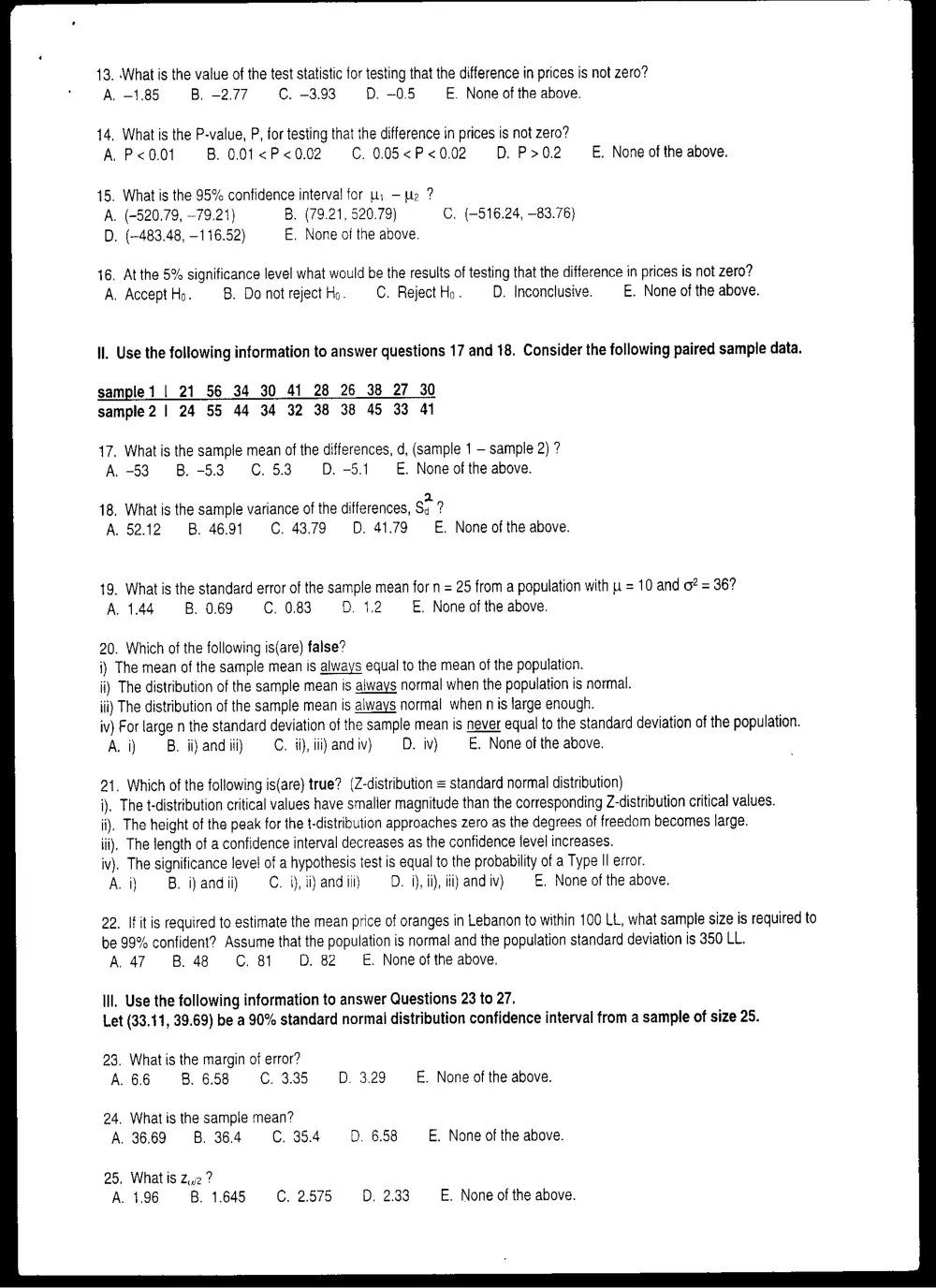
13. .What is the value of the test statistic for testing that the difference in prices is not zero?
A. -1.85 B.-2.77. C.-393 0D. -05 E. None of the above.
14, What is the P-value, P, for testing that the difference in prices is not zero?
A. P< 0.01 B. 0.01<P<0.02 C.0.05<P<0.02 D.P>02 E. None ofthe above.
15. What is the 95% confidence interval for Ui — Ue ?
A. (-520.79, -79.21) B. (79.21, 520.79) C. (-516.24, -83.76}
D. (-483.48, -116.52) E. None of the above.
16. At the 5% significance level what would be the results of testing that the difference in prices is not zero?
A. Accept Ho. B. Do not reject Ho. C. Reject Ho . D. Inconclusive. E. None of the above.
Il. Use the following information to answer questions 17 and 18. Consider the following paired sample data.
samplei1 | 21 56 34 30 41 28 26 38 27 30
sample 2 | 24 55 44 34 32 38 38 45 33 41
17. What is the sample mean of the differences, d, (sample 1 — sample 2) ?
A.-53 B.-53 ©. 53 D.-5.1 — E. None of the above.
18, What is the sample variance of the differences, st ?
A. 5212 8B. 46.91 ©. 43.79 OD. 41.79 — E. None of the above.
19. What is the standard error of the sample mean for n = 25 from a population with u = 10 and o? = 36?
A. 144 B.069 C.083 0.12 — &. None of the above.
20. Which of the following is(are) false?
i) The mean of the sample mean is always equal to the mean of the population.
ii) The distribution of the sample mean is always normal when the population is normal.
ii) The distribution of the sample mean is always normal when nis large enough.
iv) For large n the standard deviation of the sample mean is never equal to the standard deviation of the population.
A. i) B. ii) and iii) C. ii), iii) and iv) D. iv) E, None of the above.
21. Which of the following is(are) true? (Z-distribution = standard normal distribution)
i). The t-distribution critical values have smaller magnitude than the corresponding Z-distribution critical values.
ii), The height of the peak for the t-distribution approaches zero as the degrees of freedom becomes large.
iii). The length of a confidence interval decreases as the confidence level increases.
iv). The significance level of a hypothesis test is equal to the probability of a Type II error.
A. i) B. i) and ii) C. 4}, ii) and iil) D. ij, il), ili) and iv) E. None of the above.
22. If it is required to estimate the mean price of oranges in Lebanon to within 100 LL, what sample size is required to
be 99% confident? Assume that the population is normal and the population standard deviation is 350 LL.
A. 47 +B. 48 C. 81 OD. 82 E. None ofthe above.
II. Use the following information to answer Questions 23 to 27.
Let (33.11, 39.69) be a 90% standard normal distribution confidence interval from a sample of size 25.
23. What is the margin of error?
A. 6.6 8.6.58 C.335 D.329 — E. None of the above.
24, What is the sample mean?
A. 36.69 BB. 36.4 C. 35.4 D. 6.58 E. None of the above.
25, What is 2,2 ?
A. 1.96 B. 1.645 C. 2.575 D. 2.33 E. None of the above.
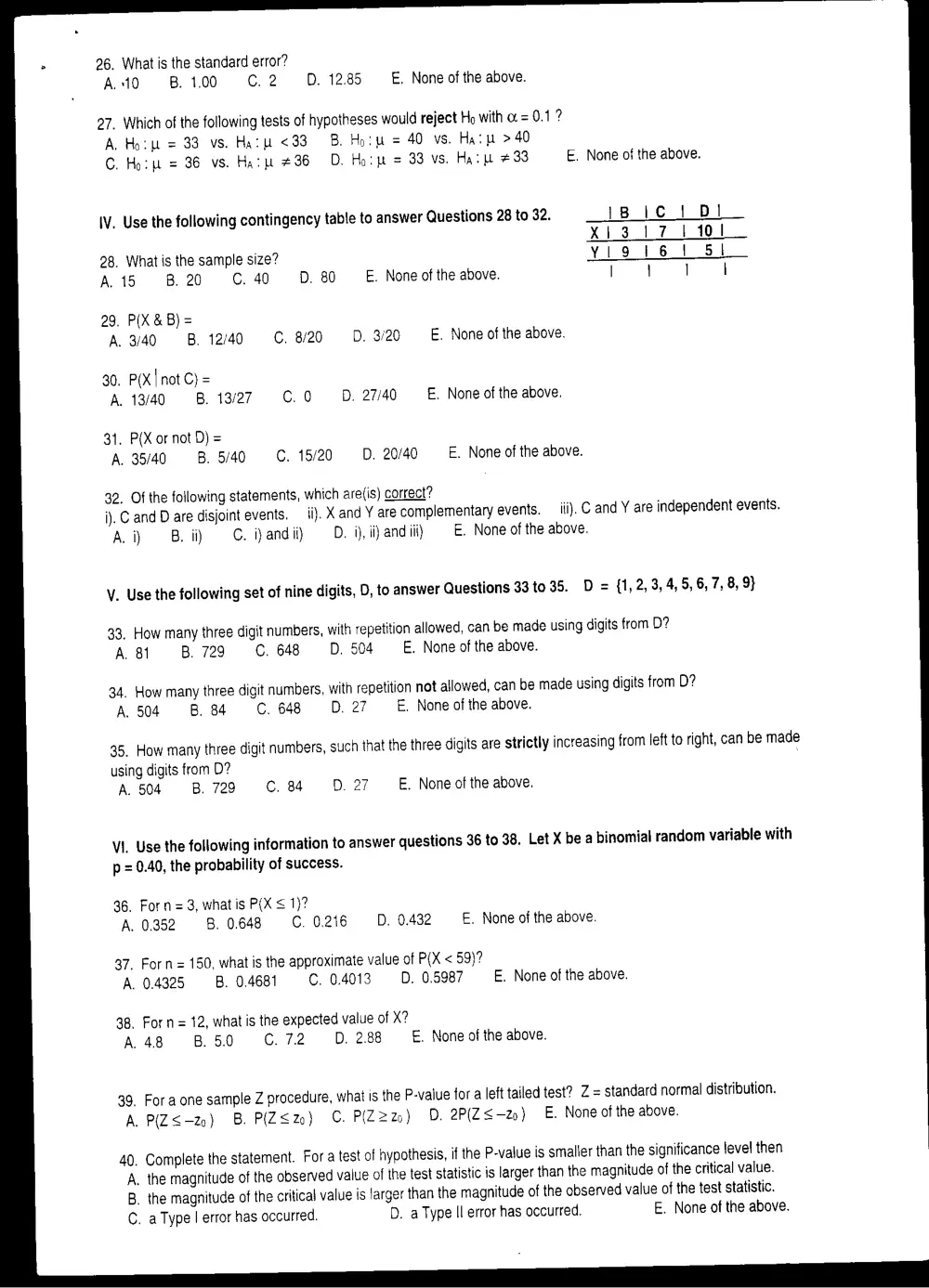
26. What is the standard error?
A. 10 B. 1.00 C. 2 D. 12.85 E. None of the above.
27. Which of the following tests of hypotheses would reject Ho with a= 0.1 ?
A. Ho: = 33 vs. Ha: <33 0B. Hoi = 40 vs. Ha: p > 40
C. Hoi = 36 vs. Hat #36) D. Ho: pt = 33 vs. Hai #33 E. None of the above.
IV. Use the following contingency table to answer Questions 28 to 32. LB
28. What is the sample size? YI
A. 15 B. 20 Cc. 40 D. 80 E. None of the above. | \ | \
29. P(X & B)=
A. 3/40 B. 12/40 C. 8/20 D. 3/20 E. None of the above.
30. P(X | not C) =
A. 13/40 B. 13/27 C. 0 D. 27/40 E. None of the above.
31. P(X or not D) =
A. 35/40 B. 5/40 C. 15/20 D. 20/40 E. None of the above.
32. Of the following statements, which are(is) correct?
i). C and D are disjoint events. ii). X and Y are complementary events. ili). C and Y are independent events.
A. i) B. ii) C. i} and il) D. i), ii) and iii) E. None of the above.
V. Use the following set of nine digits, D, to answer Questions 33 to 35. D = {1, 2,3, 4,5, 6, 7, 8, 9}
33. How many three digit numbers, with repetition allowed, can be made using digits from D?
A. 81 B. 729 C. 648 0D. 504 __ E. None of the above.
34. How many three digit numbers, with repetition not allowed, can be made using digits from D?
A. 504 B. 84 C. 648 D. 27 E. None of the above.
35. How many three digit numbers, such that the three digits are strictly increasing from left to right, can be made
using digits from D?
A504 2B. 729 C.84 OD. 27 E. None ofthe above.
VI. Use the following information to answer questions 36 to 38. Let X be a binomial random variable with
p = 0.40, the probability of success.
36. Forn = 3, what is P(X < 1)?
A. 0.352 B. 0.648 C. 0.216 D. 0.432 E. None of the above.
37. For n= 150, what is the approximate value of P(X < 59)?
A. 0.4325 B. 0.4681 C. 0.4013 D. 0.5987 E. None of the above.
38. For n= 12, what is the expected value of X?
A. 48 B. 5.0 C. 7.2 D. 2.88 E. None of the above.
39. Fora one sample Z procedure, what is the P-value for a left tailed test? Z = standard normal distribution.
A. P(Z<-2) B. P(ZS2) ©. P(Z>z) DO. 2P(Z<-zo) E. None of the above.
40. Complete the statement. For a test of hypothesis, if the P-value is smaller than the significance level then
A. the magnitude of the observed value of the test statistic is larger than the magnitude of the critical value.
B. the magnitude of the critical value is larger than the magnitude of the observed value of the test statistic.
C. a Type | error has occurred. D. a Type Il error has occurred. E. None of the above.
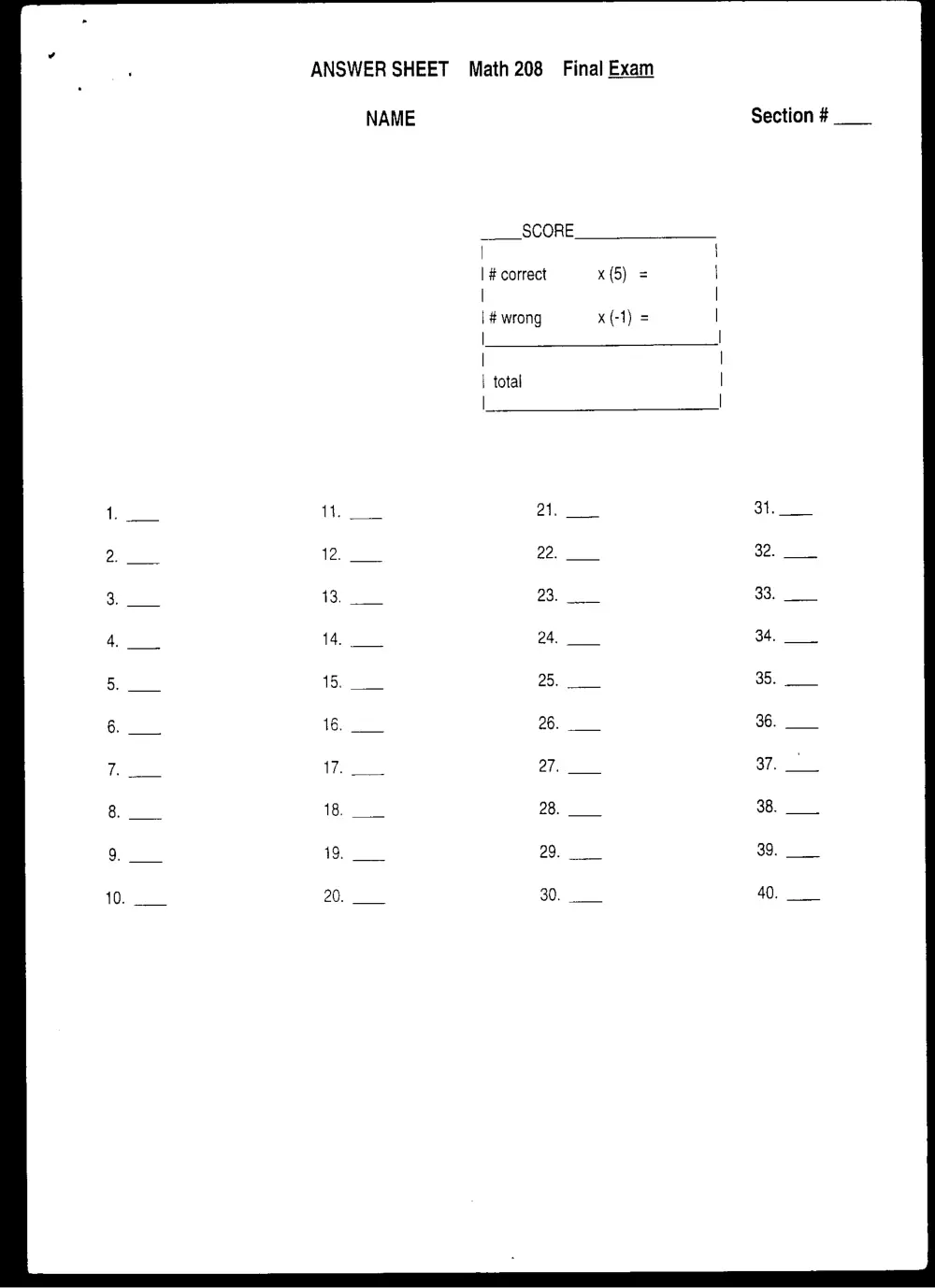
ANSWER SHEET Math 208 Final Exam
NAME Section #
SCORE
|
| # correct x (5)
|
| # wrong x (-1)
|
|
1 total
|