
MATH 210 Final, Fall 2017
American University of Beirut · Introduction to Analysis · 2 pages · Dr. Florian Bertrand
More MATH 210 files
Show the text of this final exam
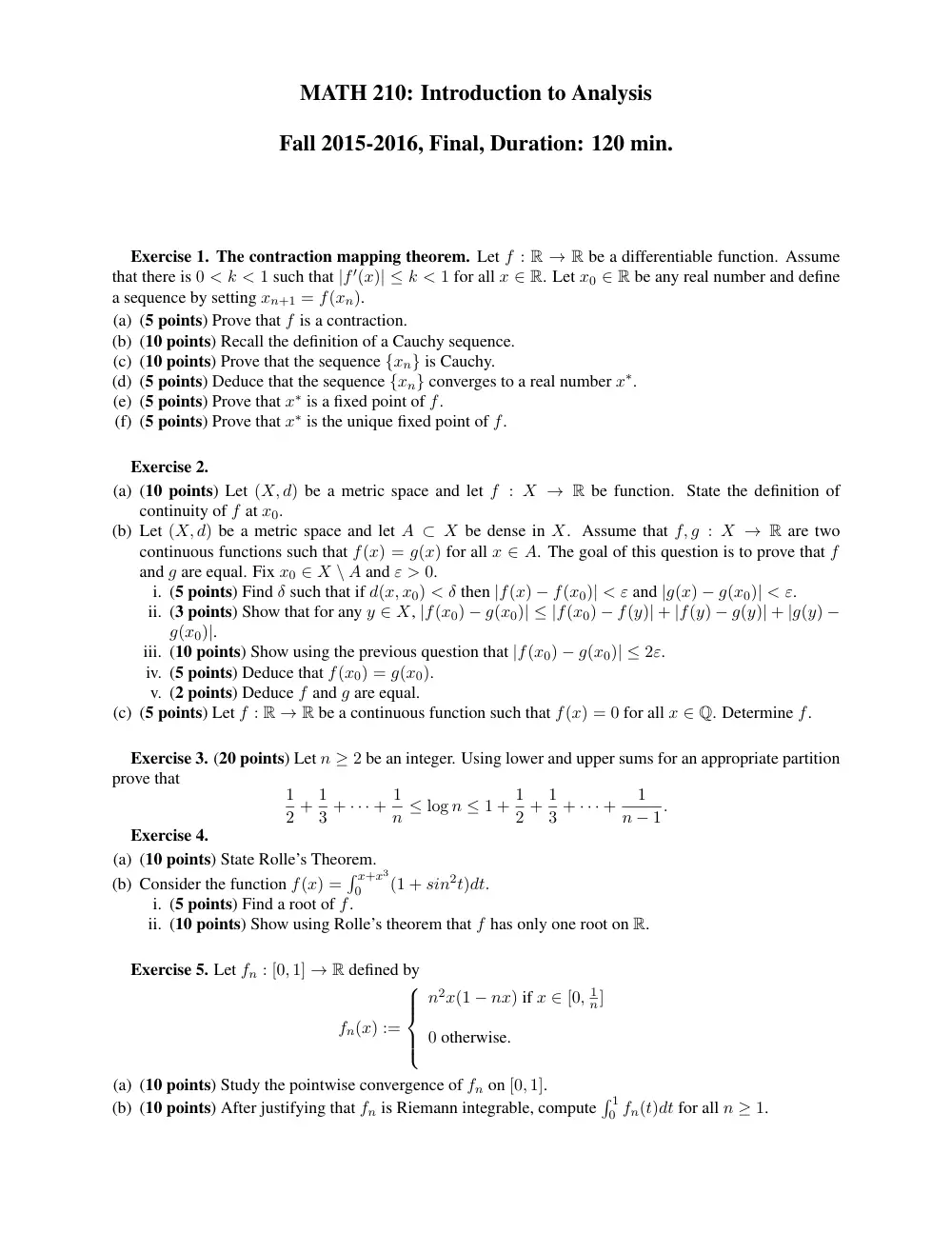
MATH 210: Introduction to Analysis
Fall 2015-2016, Final, Duration: 120 min.
Exercise 1. The contraction mapping theorem. Let f : R → R be a differentiable function. Assume
that there is 0 < k < 1 such that |f′(x)| ≤ k < 1 for all x ∈ R. Let x0 ∈ R be any real number and define
a sequence by setting xn+1 = f(xn).
(a) (5 points) Prove that f is a contraction.
(b) (10 points) Recall the definition of a Cauchy sequence.
(c) (10 points) Prove that the sequence {xn} is Cauchy.
(d) (5 points) Deduce that the sequence {xn} converges to a real number x∗.
(e) (5 points) Prove that x∗ is a fixed point of f.
(f) (5 points) Prove that x∗ is the unique fixed point of f.
Exercise 2.
(a) (10 points) Let (X, d) be a metric space and let f : X → R be function. State the definition of
continuity of f at x0.
(b) Let (X, d) be a metric space and let A ⊂ X be dense in X. Assume that f, g : X → R are two
continuous functions such that f(x) = g(x) for all x ∈ A. The goal of this question is to prove that f
and g are equal. Fix x0 ∈ X \ A and ε > 0.
i. (5 points) Find δ such that if d(x, x0) < δ then |f(x) − f(x0)| < ε and |g(x) − g(x0)| < ε.
ii. (3 points) Show that for any y ∈ X, |f(x0) − g(x0)| ≤ |f(x0) − f(y)| + |f(y) − g(y)| + |g(y) −
g(x0)|.
iii. (10 points) Show using the previous question that |f(x0) − g(x0)| ≤ 2ε.
iv. (5 points) Deduce that f(x0) = g(x0).
v. (2 points) Deduce f and g are equal.
(c) (5 points) Let f : R → R be a continuous function such that f(x) = 0 for all x ∈ Q. Determine f.
Exercise 3. (20 points) Let n ≥ 2 be an integer. Using lower and upper sums for an appropriate partition
prove that
1
2 + 1
3 + · · · + 1
n ≤ log n ≤ 1 + 1
2 + 1
3 + · · · +
1
n − 1.
Exercise 4.
(a) (10 points) State Rolle’s Theorem.
(b) Consider the function f(x) =
� x+x3
0
(1 + sin2t)dt.
i. (5 points) Find a root of f.
ii. (10 points) Show using Rolle’s theorem that f has only one root on R.
Exercise 5. Let fn : [0, 1] → R defined by
fn(x) :=
n2x(1 − nx) if x ∈ [0, 1
n]
0 otherwise.
(a) (10 points) Study the pointwise convergence of fn on [0, 1].
(b) (10 points) After justifying that fn is Riemann integrable, compute
� 1
0 fn(t)dt for all n ≥ 1.
2
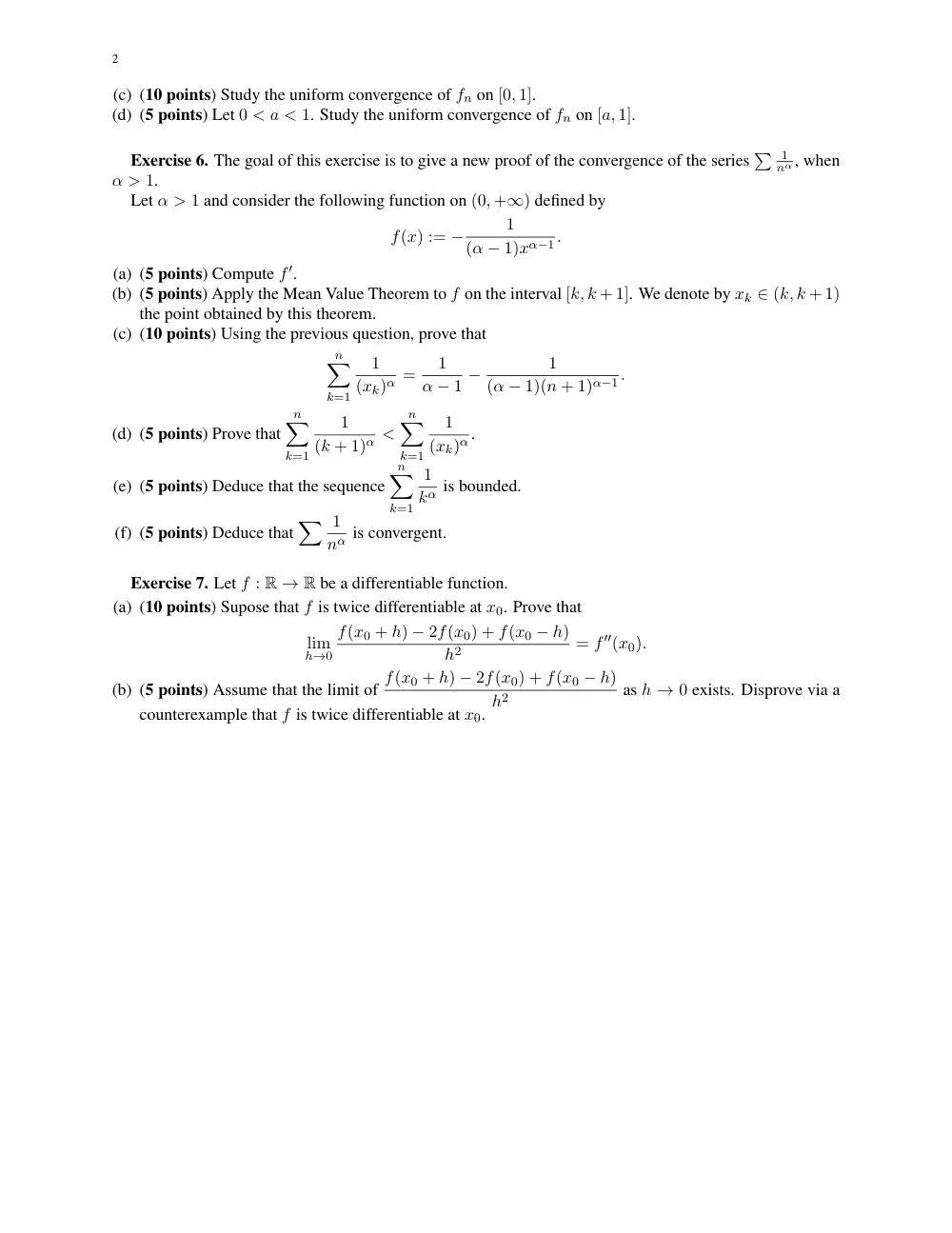
(c) (10 points) Study the uniform convergence of fn on [0, 1].
(d) (5 points) Let 0 < a < 1. Study the uniform convergence of fn on [a, 1].
Exercise 6. The goal of this exercise is to give a new proof of the convergence of the series � 1
nα , when
α > 1.
Let α > 1 and consider the following function on (0, +∞) defined by
f(x) := −
1
(α − 1)xα−1 .
(a) (5 points) Compute f′.
(b) (5 points) Apply the Mean Value Theorem to f on the interval [k, k + 1]. We denote by xk ∈ (k, k + 1)
the point obtained by this theorem.
(c) (10 points) Using the previous question, prove that
n
�
k=1
1
(xk)α =
1
α − 1 −
1
(α − 1)(n + 1)α−1 .
(d) (5 points) Prove that
n
�
k=1
1
(k + 1)α <
n
�
k=1
1
(xk)α .
(e) (5 points) Deduce that the sequence
n
�
k=1
1
kα is bounded.
(f) (5 points) Deduce that
� 1
nα is convergent.
Exercise 7. Let f : R → R be a differentiable function.
(a) (10 points) Supose that f is twice differentiable at x0. Prove that
lim
h→0
f(x0 + h) − 2f(x0) + f(x0 − h)
h2
= f′′(x0).
(b) (5 points) Assume that the limit of f(x0 + h) − 2f(x0) + f(x0 − h)
h2
as h → 0 exists. Disprove via a
counterexample that f is twice differentiable at x0.