
MATH 211 Final, Spring 2008
American University of Beirut · Discrete Structures · 11 pages

Showing the first 10 of 11 pages. Download the PDF to see all of it.
More MATH 211 files
Show the text of this final exam
AMERICAN UNIVERSITY OF BEIRUT
Faculty of Arts and Sciences
Mathematics Department
MATH 211
FINAL EXAM
Spring 2007-2008
Wednesday June 4, 11:30 am
Closed Book, 2H
WRITE YOUR ANSWERS ON THE QUESTION SHEET
STUDENT NAME
ID NUMBER
Problem
Out of
Grade
1
20
2
20
3
20
4
20
5
20
TOTAL
100
1
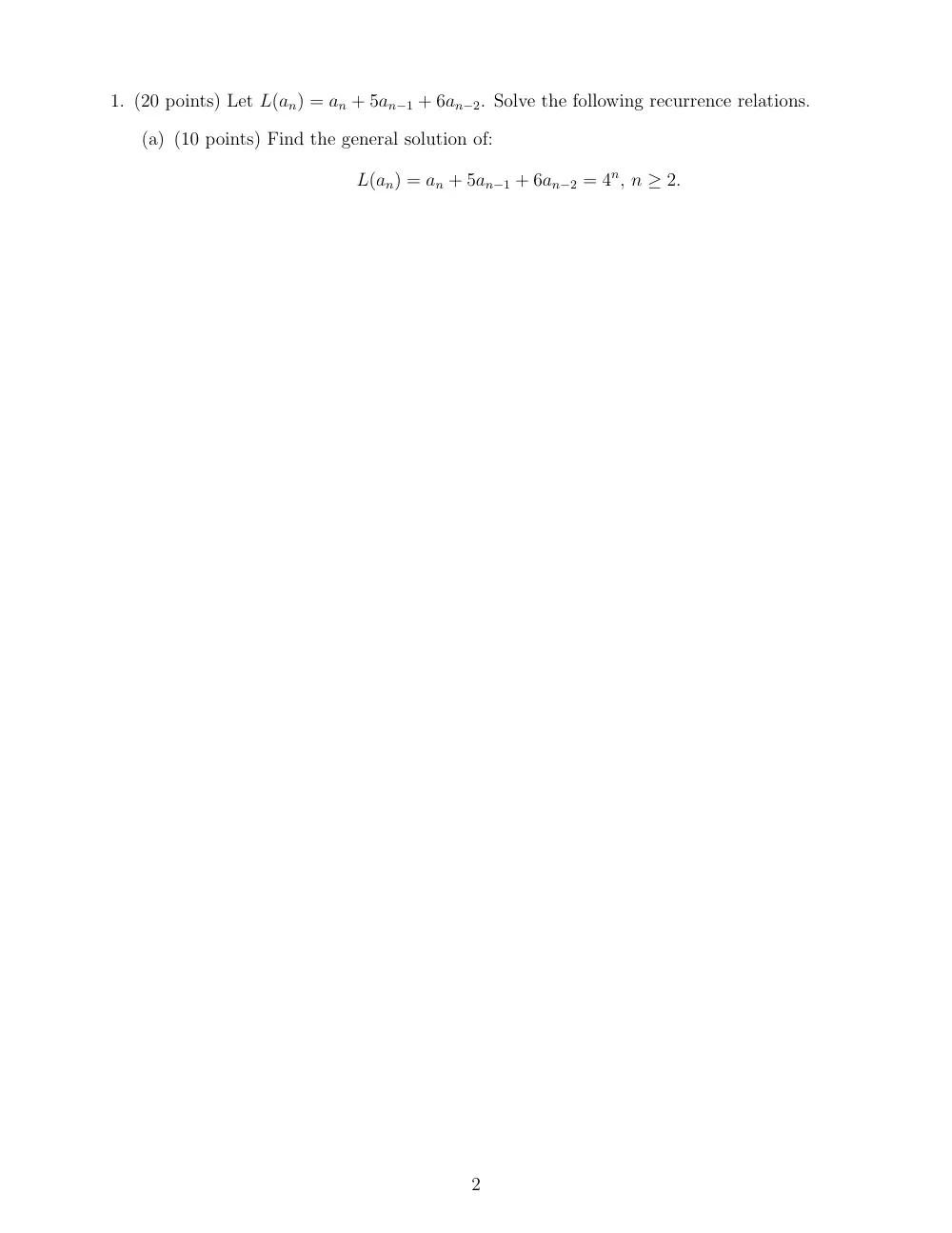
1. (20 points) Let L(an) = an + 5an−1 + 6an−2. Solve the following recurrence relations.
(a) (10 points) Find the general solution of:
L(an) = an + 5an−1 + 6an−2 = 4n, n ≥ 2.
2
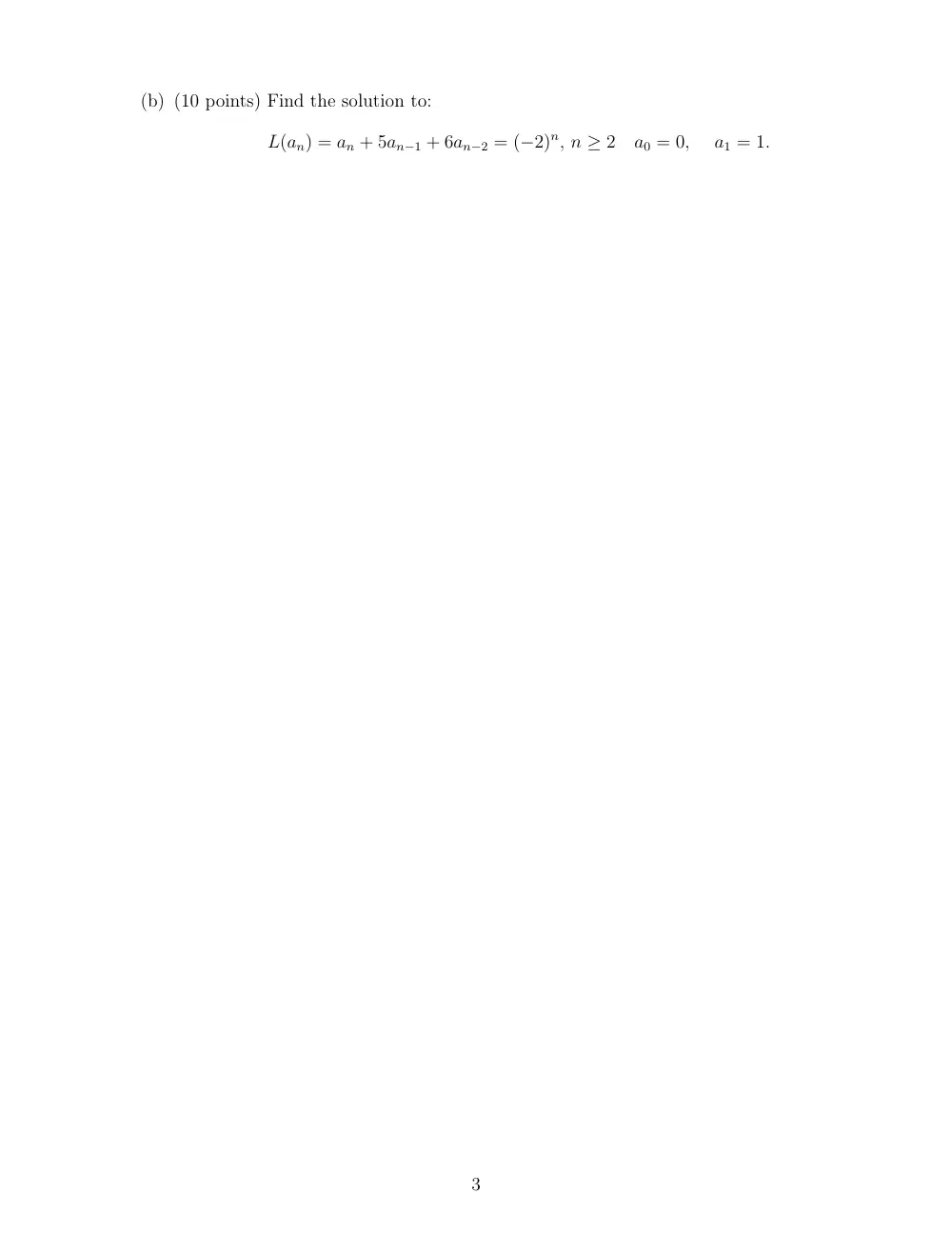
(b) (10 points) Find the solution to:
L(an) = an + 5an−1 + 6an−2 = (−2)n, n ≥ 2
a0 = 0,
a1 = 1.
3
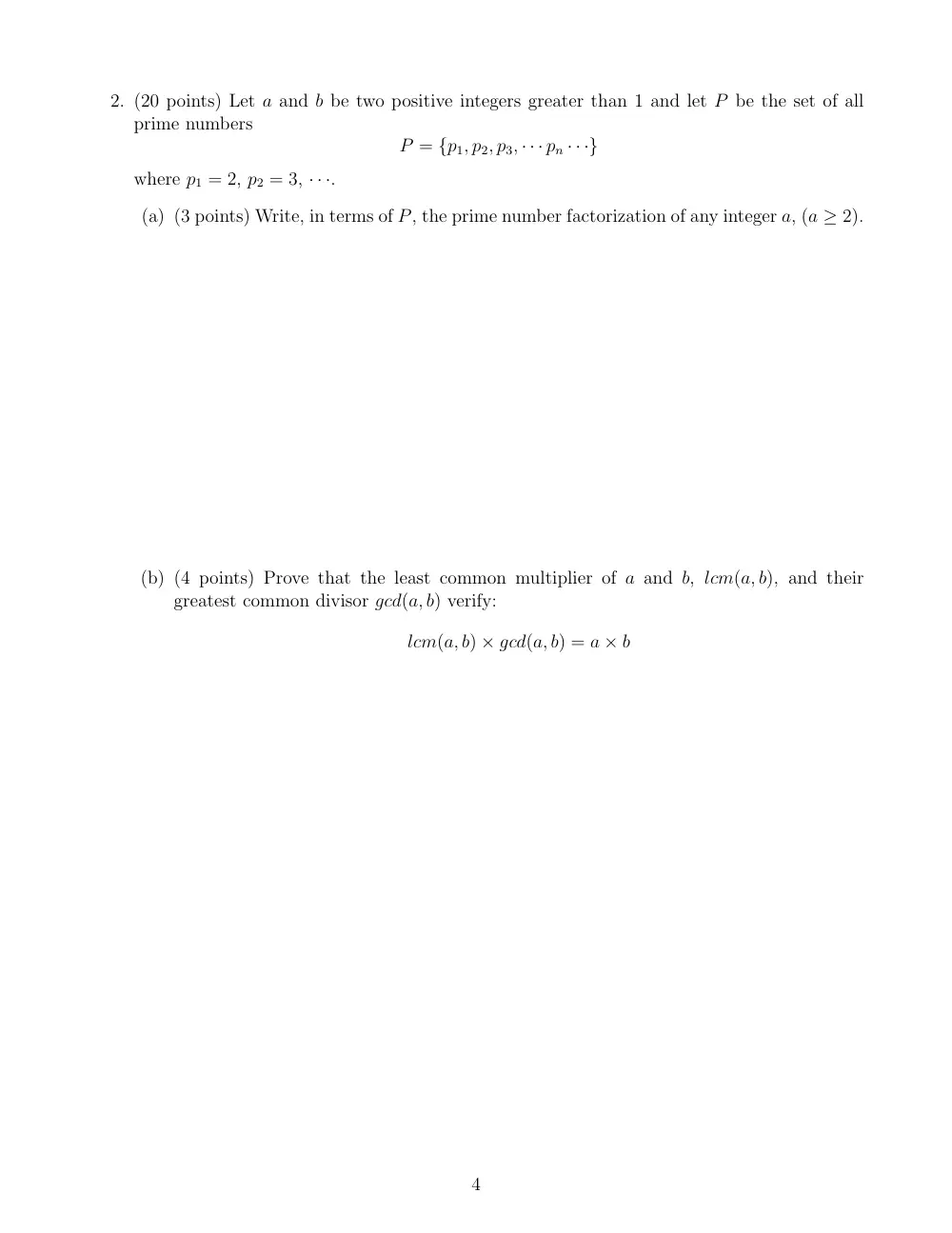
2. (20 points) Let a and b be two positive integers greater than 1 and let P be the set of all
prime numbers
P = {p1, p2, p3, · · · pn · · ·}
where p1 = 2, p2 = 3, · · ·.
(a) (3 points) Write, in terms of P, the prime number factorization of any integer a, (a ≥ 2).
(b) (4 points) Prove that the least common multiplier of a and b, lcm(a, b), and their
greatest common divisor gcd(a, b) verify:
lcm(a, b) × gcd(a, b) = a × b
4
(c) (3 points) Let a = 882 and b = 308. Find the prime factorization of a and b.
(d) (2 points) Find lcm(a, b) and gcd(a, b).
(e) (2 points) Are a and b relatively prime (justify your answer).
(f) (6 points) Let n and d be positive integers. How many positive integers not exceeding
n are divisible by d? (justify your answer)
5
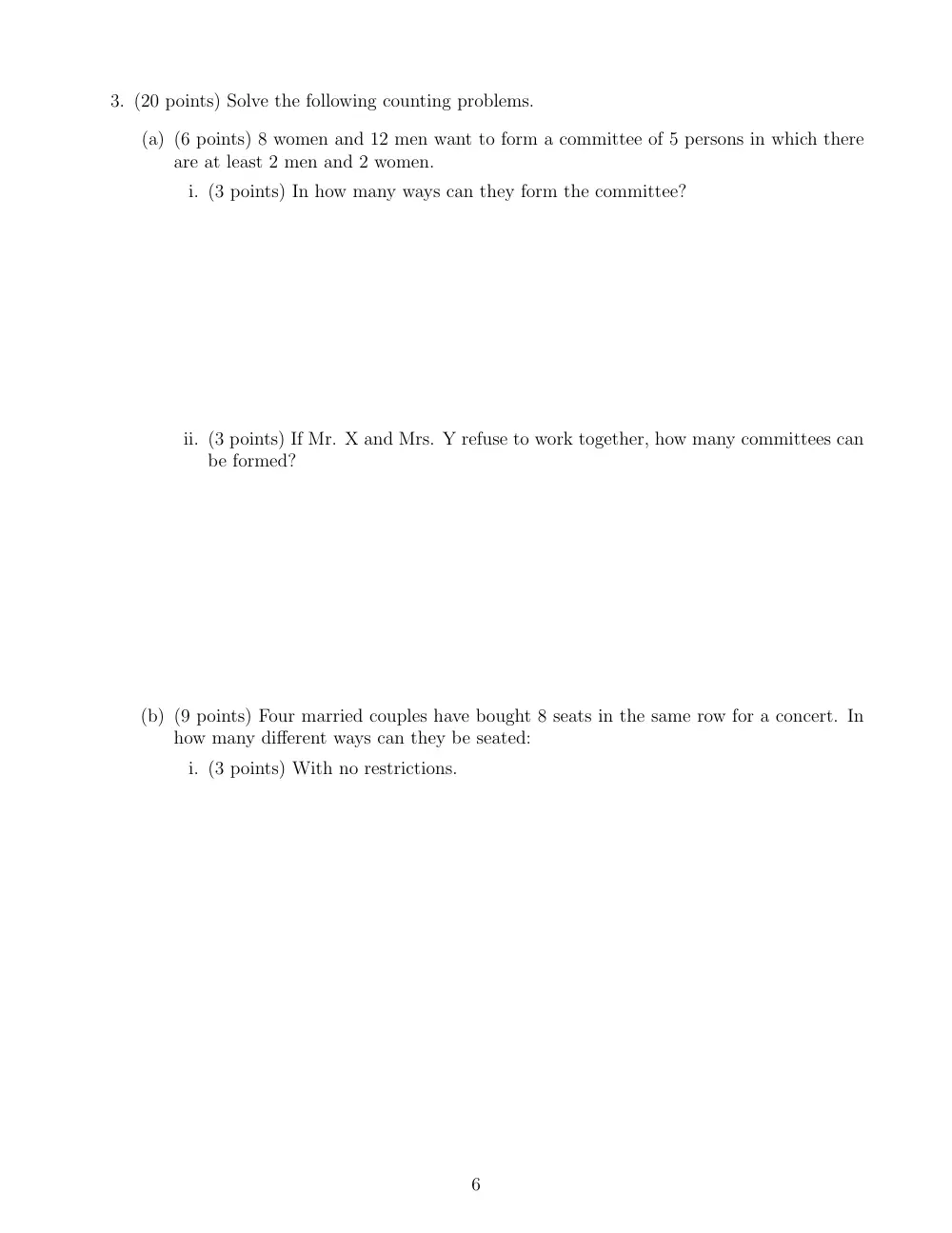
3. (20 points) Solve the following counting problems.
(a) (6 points) 8 women and 12 men want to form a committee of 5 persons in which there
are at least 2 men and 2 women.
i. (3 points) In how many ways can they form the committee?
ii. (3 points) If Mr. X and Mrs. Y refuse to work together, how many committees can
be formed?
(b) (9 points) Four married couples have bought 8 seats in the same row for a concert. In
how many different ways can they be seated:
i. (3 points) With no restrictions.
6
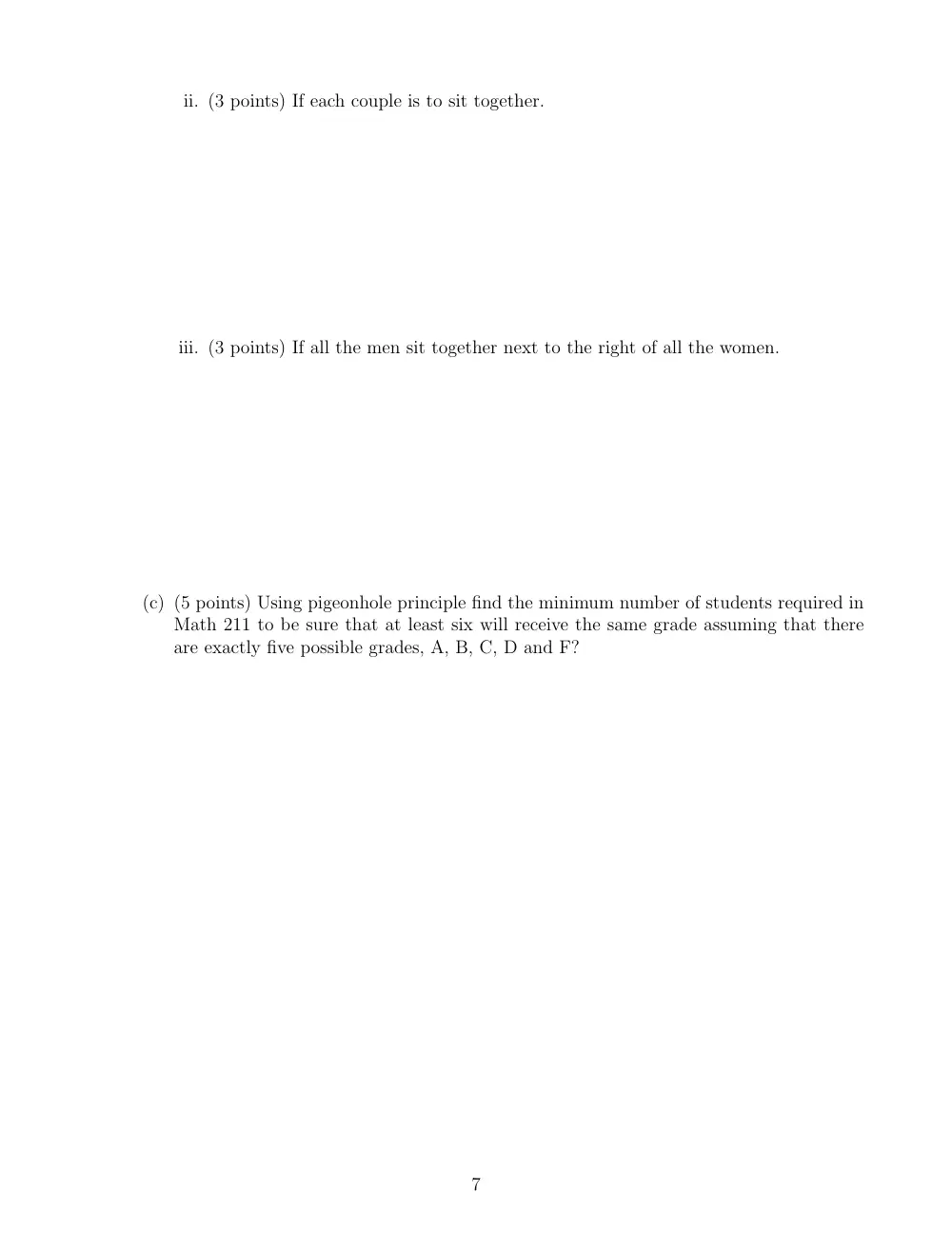
ii. (3 points) If each couple is to sit together.
iii. (3 points) If all the men sit together next to the right of all the women.
(c) (5 points) Using pigeonhole principle find the minimum number of students required in
Math 211 to be sure that at least six will receive the same grade assuming that there
are exactly five possible grades, A, B, C, D and F?
7
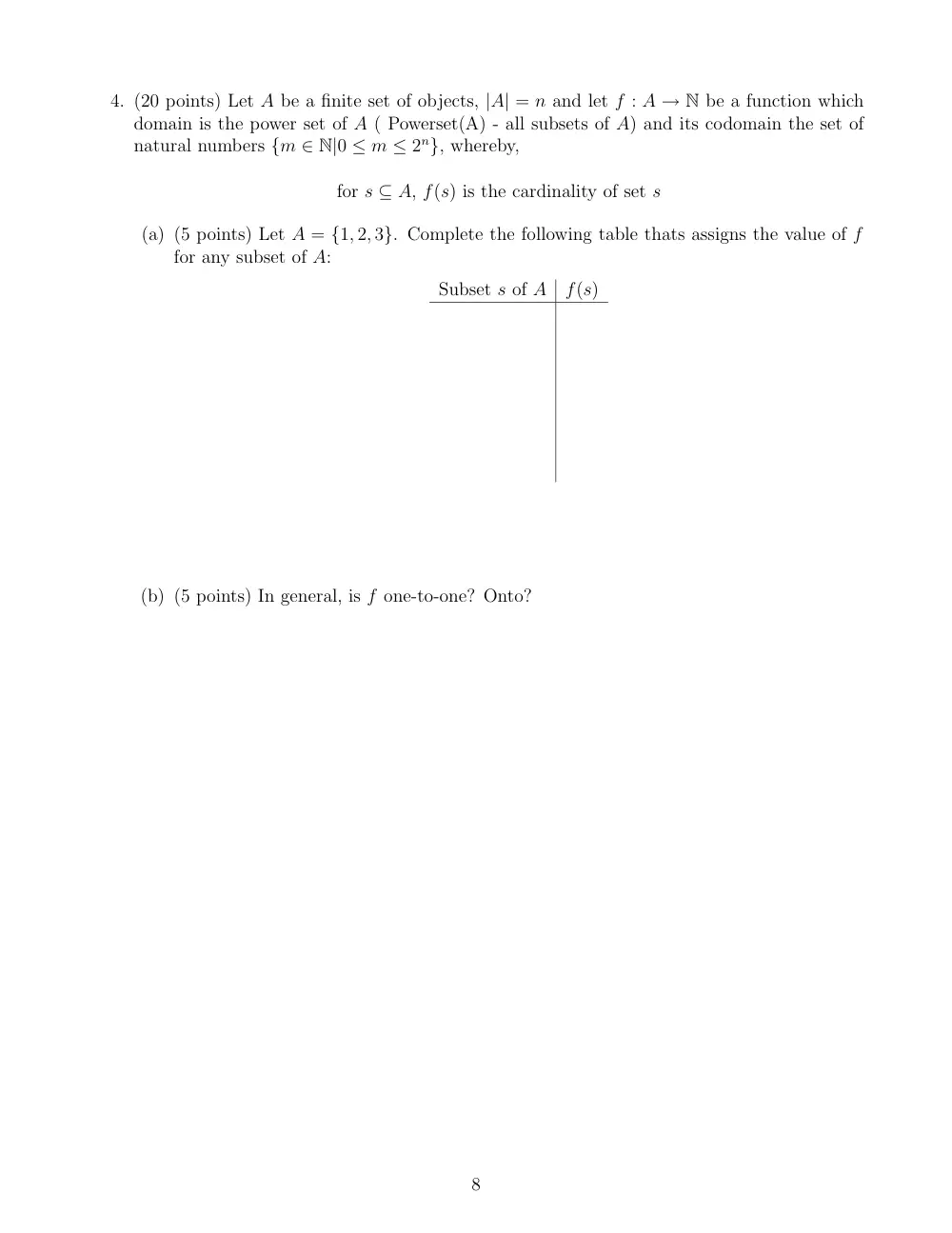
4. (20 points) Let A be a finite set of objects, |A| = n and let f : A → N be a function which
domain is the power set of A ( Powerset(A) - all subsets of A) and its codomain the set of
natural numbers {m ∈ N|0 ≤ m ≤ 2n}, whereby,
for s ⊆ A, f(s) is the cardinality of set s
(a) (5 points) Let A = {1, 2, 3}. Complete the following table thats assigns the value of f
for any subset of A:
Subset s of A
f(s)
(b) (5 points) In general, is f one-to-one? Onto?
8
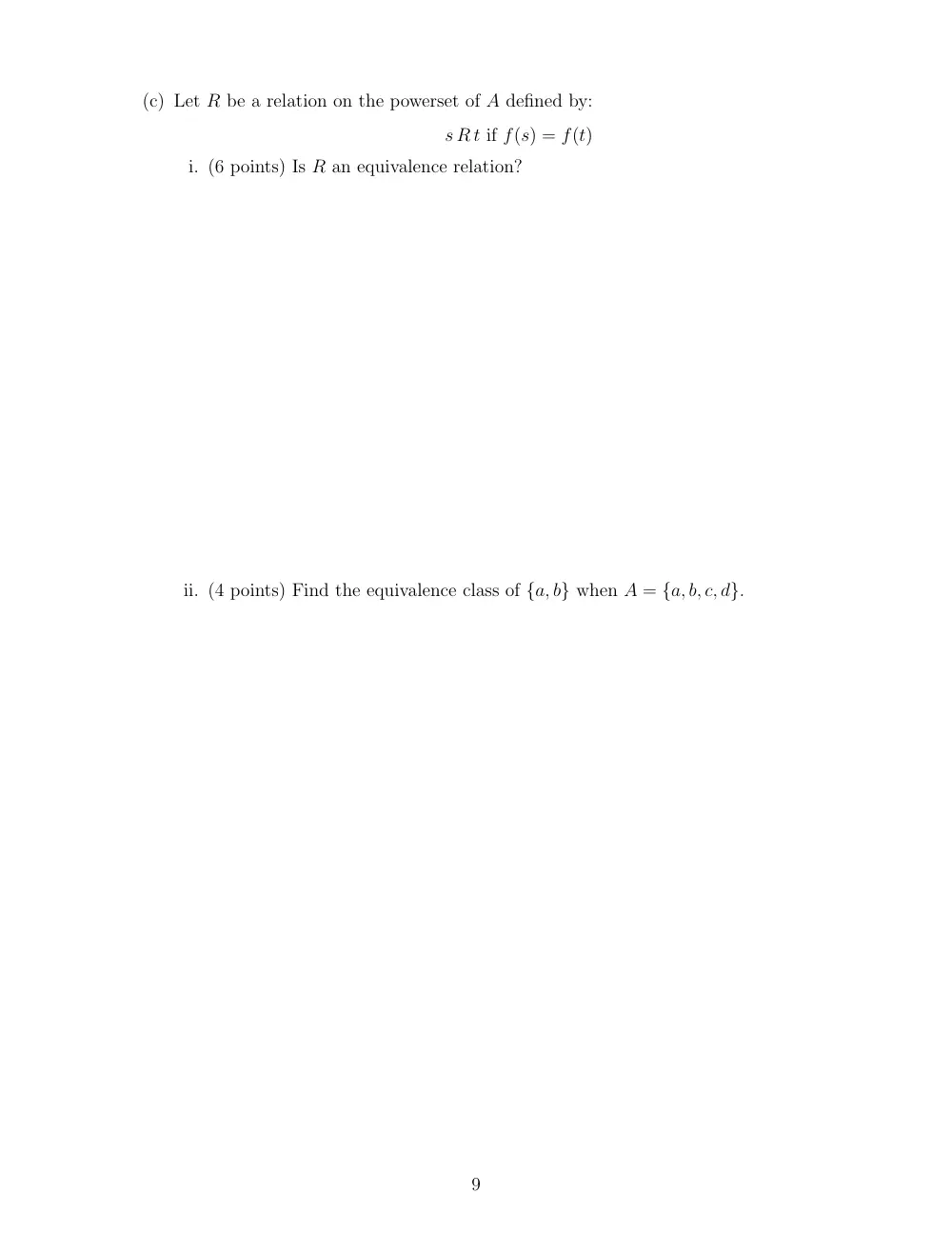
(c) Let R be a relation on the powerset of A defined by:
s R t if f(s) = f(t)
i. (6 points) Is R an equivalence relation?
ii. (4 points) Find the equivalence class of {a, b} when A = {a, b, c, d}.
9
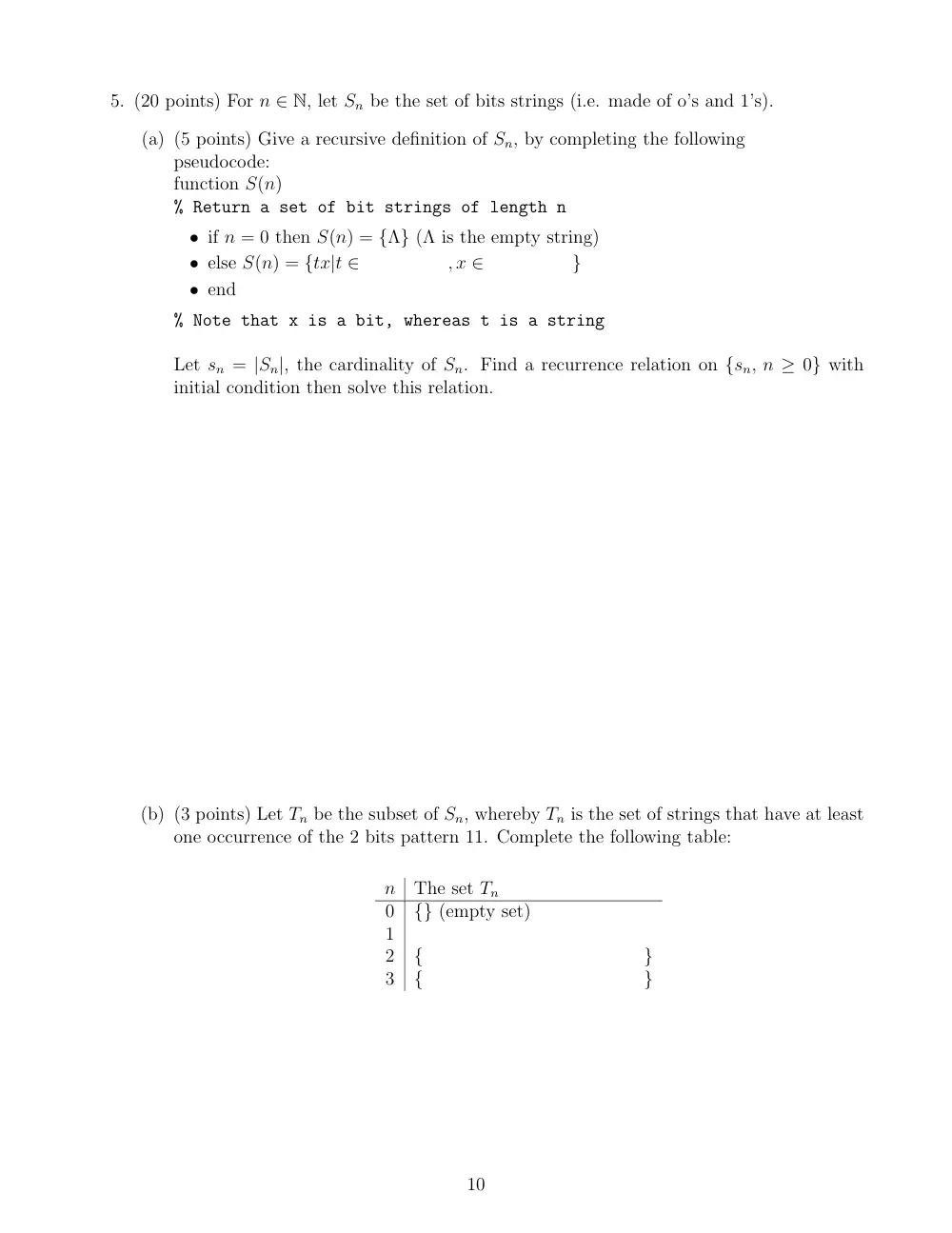
5. (20 points) For n ∈ N, let Sn be the set of bits strings (i.e. made of o’s and 1’s).
(a) (5 points) Give a recursive definition of Sn, by completing the following
pseudocode:
function S(n)
% Return a set of bit strings of length n
• if n = 0 then S(n) = {Λ} (Λ is the empty string)
• else S(n) = {tx|t ∈
, x ∈
}
• end
% Note that x is a bit, whereas t is a string
Let sn = |Sn|, the cardinality of Sn. Find a recurrence relation on {sn, n ≥ 0} with
initial condition then solve this relation.
(b) (3 points) Let Tn be the subset of Sn, whereby Tn is the set of strings that have at least
one occurrence of the 2 bits pattern 11. Complete the following table:
n
The set Tn
0
{} (empty set)
1
2
{
}
3
{
}
10
(c) (6 points) Give a recursive definition of Tn, by completing the following
pseudocode (that should use the previous one on S(n)):
function T(n)
% Return a set of bit strings of length n
• if n = 0 or n = 1 then T(n) = {}
• else if n ≥ 2, T(n) = {t0|t ∈
}∪{t11|t ∈
}∪{
}
• end
(d) (6 points) Let tn = |Tn|, the cardinality of Tn.
• Using (c) OR independently, find the recurrence relation and the initial conditions
verified by {tn}.
• Solve the resulting recurrence relation.
11