
MATH 211 Final, Spring 2009
American University of Beirut · Discrete Structures · 14 pages · Prof. Kamal Makdisi


Showing the first 10 of 14 pages. Download the PDF to see all of it.
More MATH 211 files
Show the text of this final exam
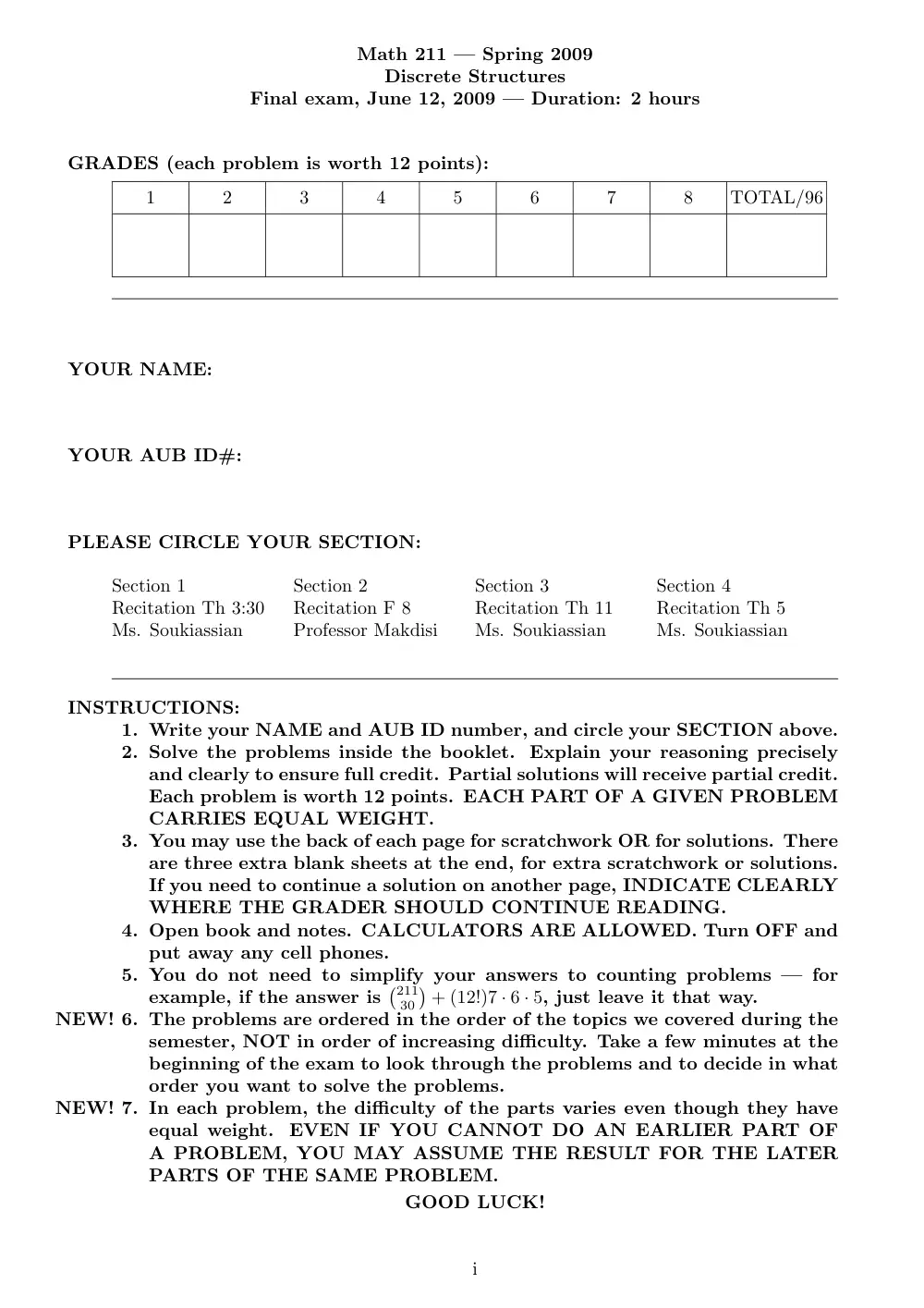
Math 211 — Spring 2009
Discrete Structures
Final exam, June 12, 2009 — Duration: 2 hours
GRADES (each problem is worth 12 points):
1
2
3
4
5
6
7
8
TOTAL/96
YOUR NAME:
YOUR AUB ID#:
PLEASE CIRCLE YOUR SECTION:
Section 1
Section 2
Section 3
Section 4
Recitation Th 3:30
Recitation F 8
Recitation Th 11
Recitation Th 5
Ms. Soukiassian
Professor Makdisi
Ms. Soukiassian
Ms. Soukiassian
INSTRUCTIONS:
1. Write your NAME and AUB ID number, and circle your SECTION above.
2. Solve the problems inside the booklet. Explain your reasoning precisely
and clearly to ensure full credit. Partial solutions will receive partial credit.
Each problem is worth 12 points. EACH PART OF A GIVEN PROBLEM
CARRIES EQUAL WEIGHT.
3. You may use the back of each page for scratchwork OR for solutions. There
are three extra blank sheets at the end, for extra scratchwork or solutions.
If you need to continue a solution on another page, INDICATE CLEARLY
WHERE THE GRADER SHOULD CONTINUE READING.
4. Open book and notes. CALCULATORS ARE ALLOWED. Turn OFF and
put away any cell phones.
5. You do not need to simplify your answers to counting problems — for
example, if the answer is
�211
30
�
+ (12!)7 · 6 · 5, just leave it that way.
NEW! 6. The problems are ordered in the order of the topics we covered during the
semester, NOT in order of increasing difficulty. Take a few minutes at the
beginning of the exam to look through the problems and to decide in what
order you want to solve the problems.
NEW! 7. In each problem, the difficulty of the parts varies even though they have
equal weight.
EVEN IF YOU CANNOT DO AN EARLIER PART OF
A PROBLEM, YOU MAY ASSUME THE RESULT FOR THE LATER
PARTS OF THE SAME PROBLEM.
GOOD LUCK!
i
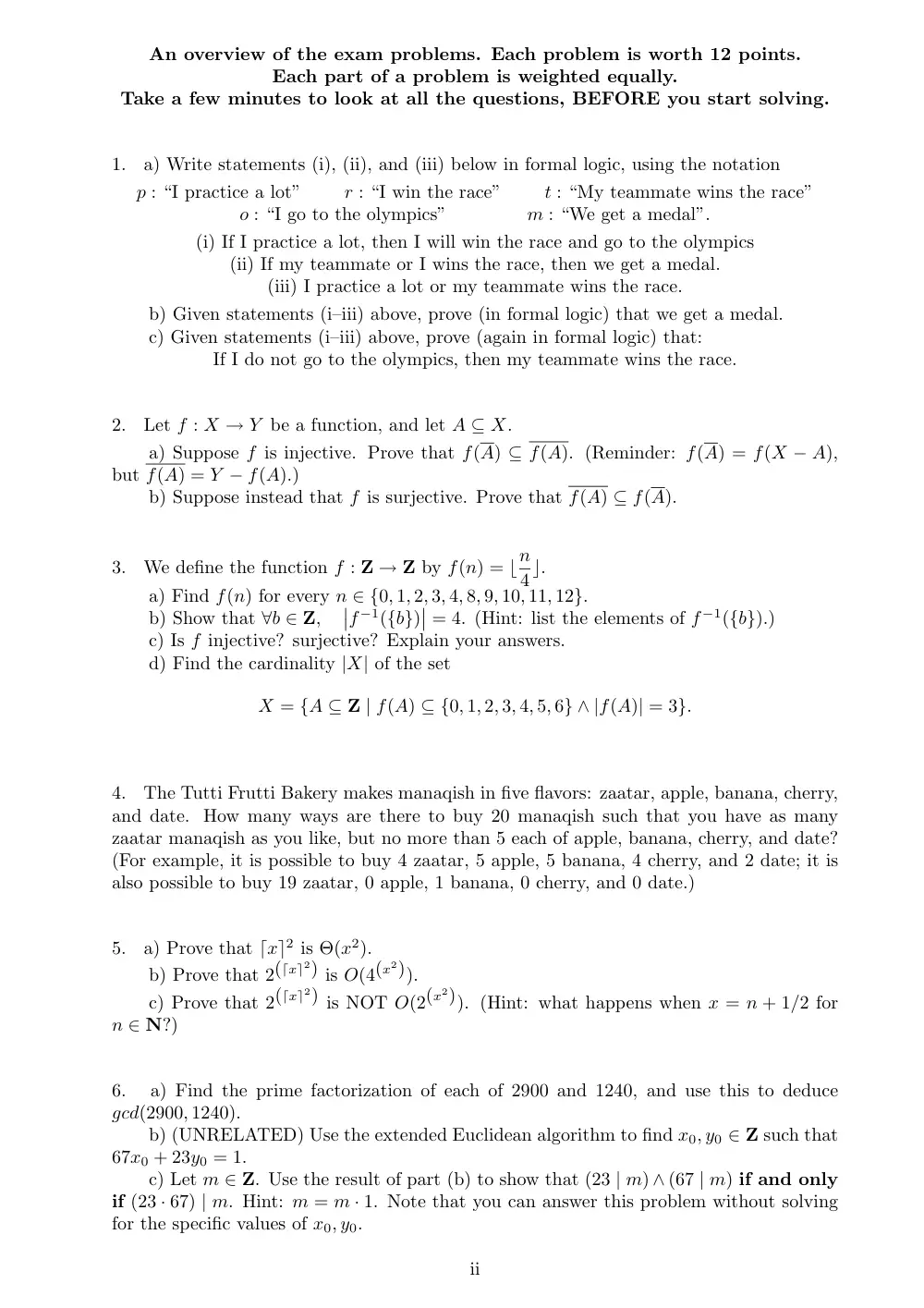
An overview of the exam problems. Each problem is worth 12 points.
Each part of a problem is weighted equally.
Take a few minutes to look at all the questions, BEFORE you start solving.
1.
a) Write statements (i), (ii), and (iii) below in formal logic, using the notation
p : “I practice a lot”
r : “I win the race”
t : “My teammate wins the race”
o : “I go to the olympics”
m : “We get a medal”.
(i) If I practice a lot, then I will win the race and go to the olympics
(ii) If my teammate or I wins the race, then we get a medal.
(iii) I practice a lot or my teammate wins the race.
b) Given statements (i–iii) above, prove (in formal logic) that we get a medal.
c) Given statements (i–iii) above, prove (again in formal logic) that:
If I do not go to the olympics, then my teammate wins the race.
2.
Let f : X → Y be a function, and let A ⊆ X.
a) Suppose f is injective. Prove that f(A) ⊆ f(A). (Reminder: f(A) = f(X − A),
but f(A) = Y − f(A).)
b) Suppose instead that f is surjective. Prove that f(A) ⊆ f(A).
3.
We define the function f : Z → Z by f(n) = ⌊n
4 ⌋.
a) Find f(n) for every n ∈ {0, 1, 2, 3, 4, 8, 9, 10, 11, 12}.
b) Show that ∀b ∈ Z,
��f −1({b})
�� = 4. (Hint: list the elements of f −1({b}).)
c) Is f injective? surjective? Explain your answers.
d) Find the cardinality |X| of the set
X = {A ⊆ Z | f(A) ⊆ {0, 1, 2, 3, 4, 5, 6} ∧ |f(A)| = 3}.
4.
The Tutti Frutti Bakery makes manaqish in five flavors: zaatar, apple, banana, cherry,
and date. How many ways are there to buy 20 manaqish such that you have as many
zaatar manaqish as you like, but no more than 5 each of apple, banana, cherry, and date?
(For example, it is possible to buy 4 zaatar, 5 apple, 5 banana, 4 cherry, and 2 date; it is
also possible to buy 19 zaatar, 0 apple, 1 banana, 0 cherry, and 0 date.)
5.
a) Prove that ⌈x⌉2 is Θ(x2).
b) Prove that 2(⌈x⌉2) is O(4(x2)).
c) Prove that 2(⌈x⌉2) is NOT O(2(x2)). (Hint: what happens when x = n + 1/2 for
n ∈ N?)
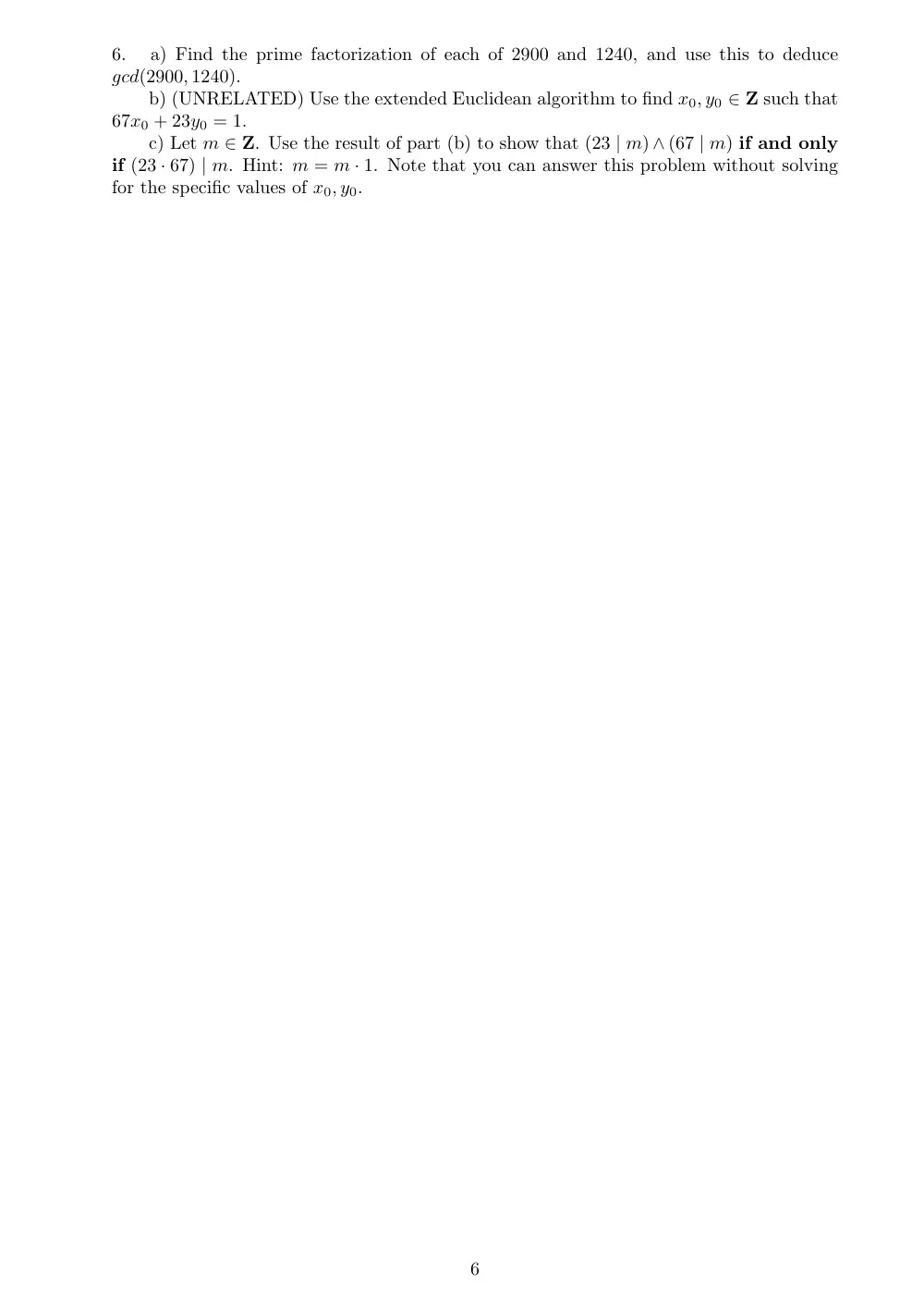
6.
a) Find the prime factorization of each of 2900 and 1240, and use this to deduce
gcd(2900, 1240).
b) (UNRELATED) Use the extended Euclidean algorithm to find x0, y0 ∈ Z such that
67x0 + 23y0 = 1.
c) Let m ∈ Z. Use the result of part (b) to show that (23 | m) ∧ (67 | m) if and only
if (23 · 67) | m. Hint: m = m · 1. Note that you can answer this problem without solving
for the specific values of x0, y0.
ii
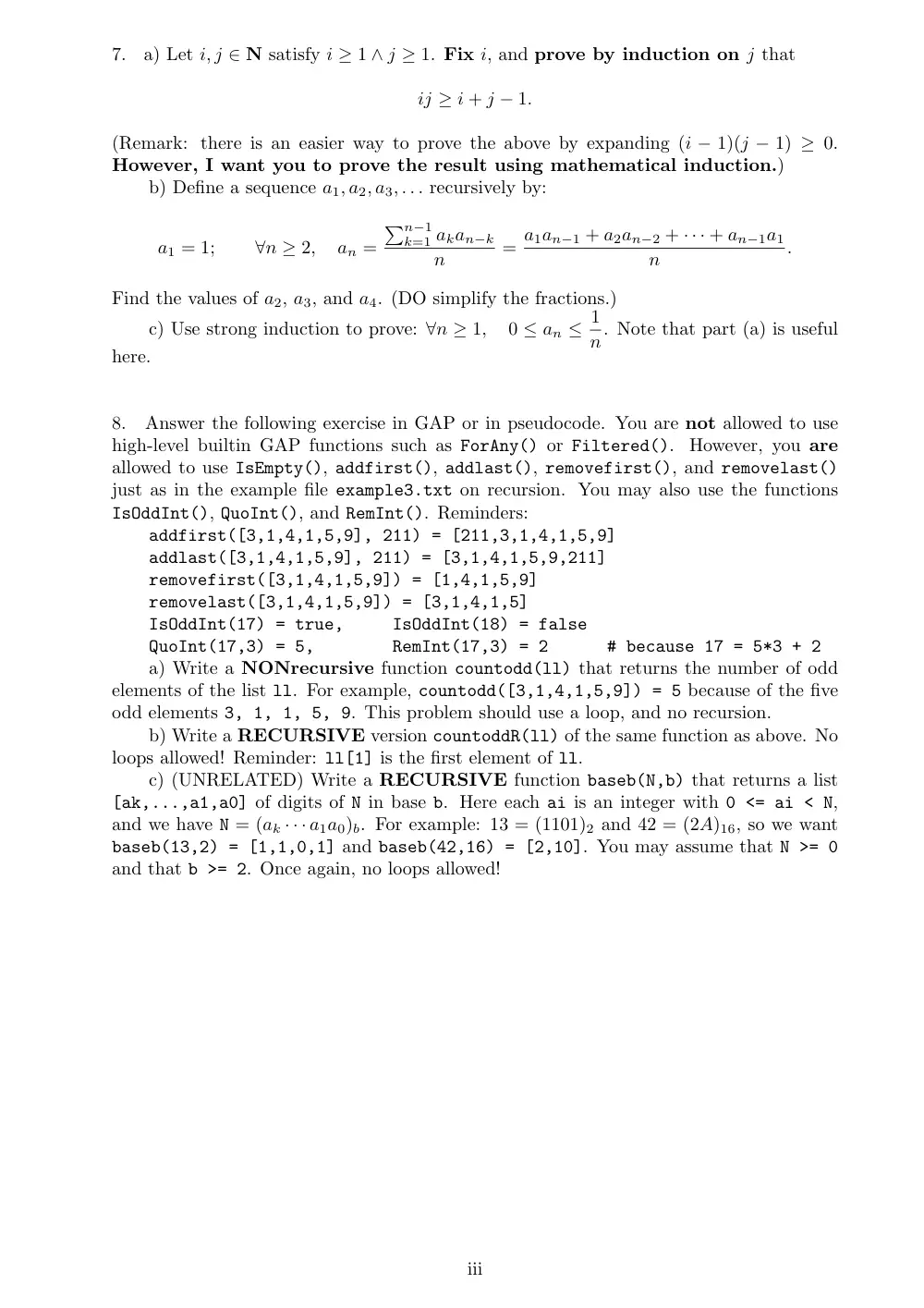
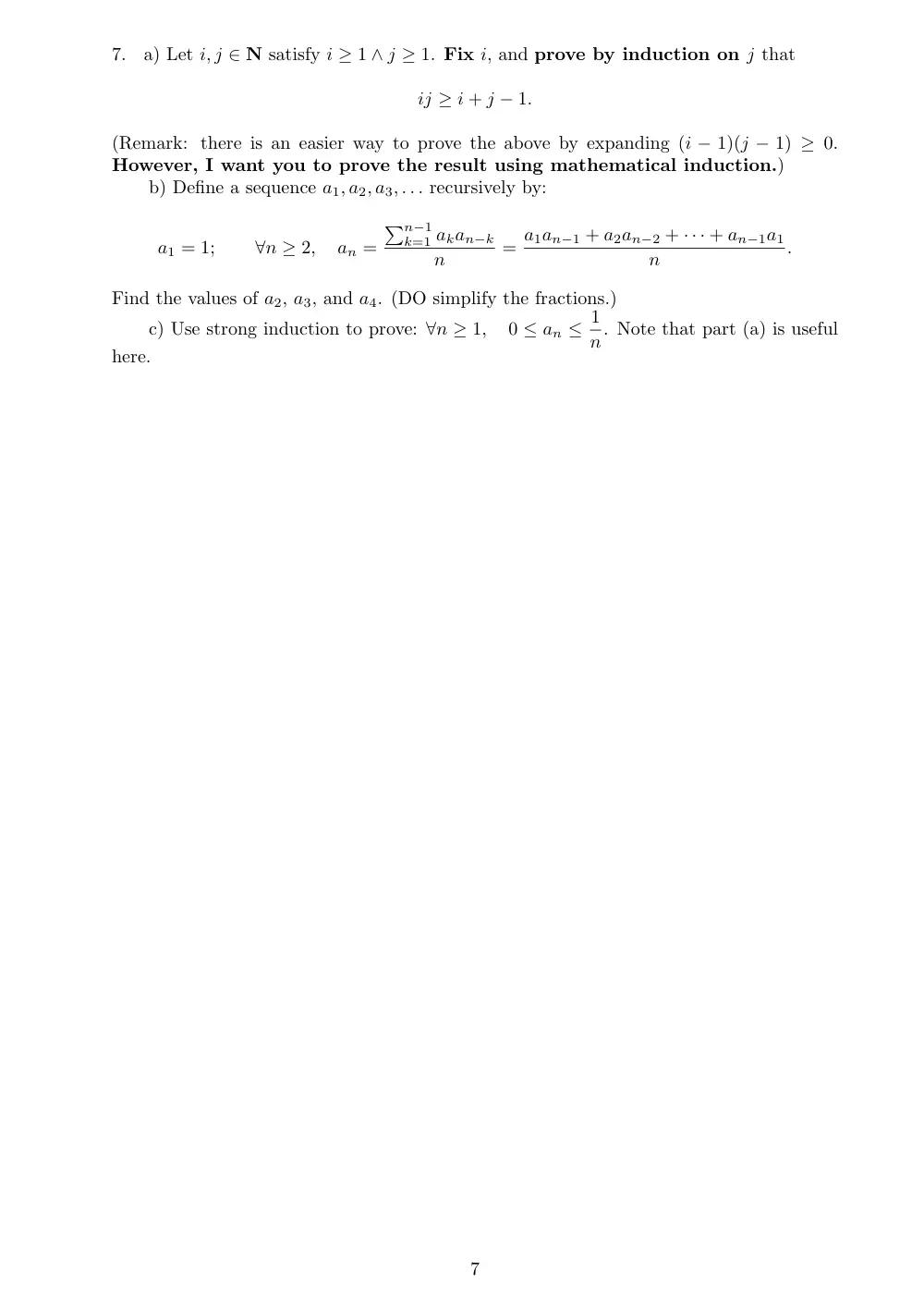
7.
a) Let i, j ∈ N satisfy i ≥ 1 ∧ j ≥ 1. Fix i, and prove by induction on j that
ij ≥ i + j − 1.
(Remark: there is an easier way to prove the above by expanding (i − 1)(j − 1) ≥ 0.
However, I want you to prove the result using mathematical induction.)
b) Define a sequence a1, a2, a3, . . . recursively by:
a1 = 1;
∀n ≥ 2,
an =
�n−1
k=1 akan−k
n
= a1an−1 + a2an−2 + · · · + an−1a1
n
.
Find the values of a2, a3, and a4. (DO simplify the fractions.)
c) Use strong induction to prove: ∀n ≥ 1,
0 ≤ an ≤ 1
n. Note that part (a) is useful
here.
8.
Answer the following exercise in GAP or in pseudocode. You are not allowed to use
high-level builtin GAP functions such as ForAny() or Filtered().
However, you are
allowed to use IsEmpty(), addfirst(), addlast(), removefirst(), and removelast()
just as in the example file example3.txt on recursion. You may also use the functions
IsOddInt(), QuoInt(), and RemInt(). Reminders:
addfirst([3,1,4,1,5,9], 211) = [211,3,1,4,1,5,9]
addlast([3,1,4,1,5,9], 211) = [3,1,4,1,5,9,211]
removefirst([3,1,4,1,5,9]) = [1,4,1,5,9]
removelast([3,1,4,1,5,9]) = [3,1,4,1,5]
IsOddInt(17) = true,
IsOddInt(18) = false
QuoInt(17,3) = 5,
RemInt(17,3) = 2
# because 17 = 5*3 + 2
a) Write a NONrecursive function countodd(ll) that returns the number of odd
elements of the list ll. For example, countodd([3,1,4,1,5,9]) = 5 because of the five
odd elements 3, 1, 1, 5, 9. This problem should use a loop, and no recursion.
b) Write a RECURSIVE version countoddR(ll) of the same function as above. No
loops allowed! Reminder: ll[1] is the first element of ll.
c) (UNRELATED) Write a RECURSIVE function baseb(N,b) that returns a list
[ak,...,a1,a0] of digits of N in base b. Here each ai is an integer with 0 <= ai < N,
and we have N = (ak · · · a1a0)b. For example: 13 = (1101)2 and 42 = (2A)16, so we want
baseb(13,2) = [1,1,0,1] and baseb(42,16) = [2,10]. You may assume that N >= 0
and that b >= 2. Once again, no loops allowed!
iii
1.
a) Write statements (i), (ii), and (iii) below in formal logic, using the notation
p : “I practice a lot”
r : “I win the race”
t : “My teammate wins the race”
o : “I go to the olympics”
m : “We get a medal”.
(i) If I practice a lot, then I will win the race and go to the olympics
(ii) If my teammate or I wins the race, then we get a medal.
(iii) I practice a lot or my teammate wins the race.
b) Given statements (i–iii) above, prove (in formal logic) that we get a medal.
c) Given statements (i–iii) above, prove (again in formal logic) that:
If I do not go to the olympics, then my teammate wins the race.
1
2.
Let f : X → Y be a function, and let A ⊆ X.
a) Suppose f is injective. Prove that f(A) ⊆ f(A). (Reminder: f(A) = f(X − A),
but f(A) = Y − f(A).)
b) Suppose instead that f is surjective. Prove that f(A) ⊆ f(A).
2
3.
We define the function f : Z → Z by f(n) = ⌊n
4 ⌋.
a) Find f(n) for every n ∈ {0, 1, 2, 3, 4, 8, 9, 10, 11, 12}.
b) Show that ∀b ∈ Z,
��f −1({b})
�� = 4. (Hint: list the elements of f −1({b}).)
c) Is f injective? surjective? Explain your answers.
d) Find the cardinality |X| of the set
X = {A ⊆ Z | f(A) ⊆ {0, 1, 2, 3, 4, 5, 6} ∧ |f(A)| = 3}.
3
4.
The Tutti Frutti Bakery makes manaqish in five flavors: zaatar, apple, banana, cherry,
and date. How many ways are there to buy 20 manaqish such that you have as many
zaatar manaqish as you like, but no more than 5 each of apple, banana, cherry, and date?
(For example, it is possible to buy 4 zaatar, 5 apple, 5 banana, 4 cherry, and 2 date; it is
also possible to buy 19 zaatar, 0 apple, 1 banana, 0 cherry, and 0 date.)
4
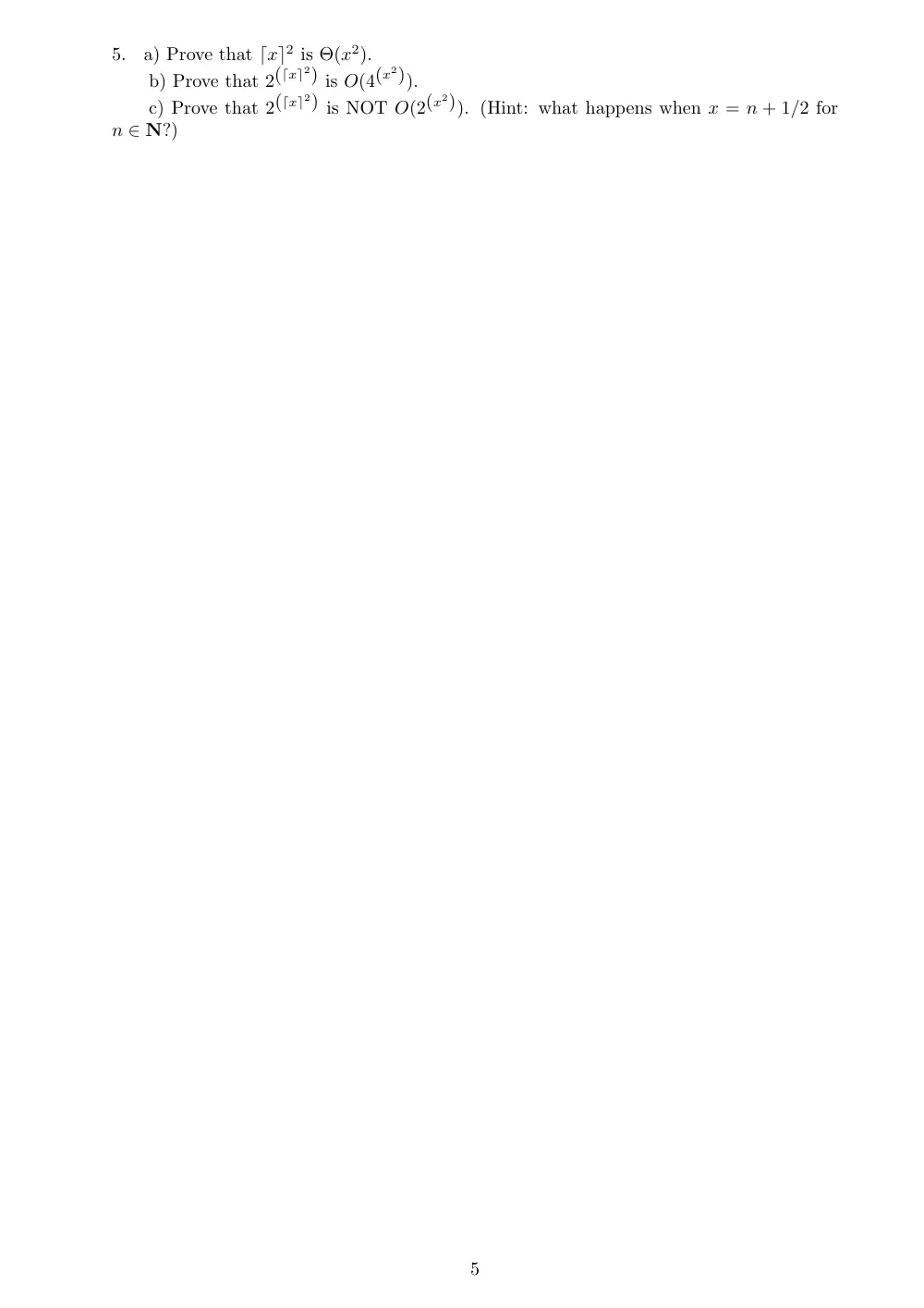
5.
a) Prove that ⌈x⌉2 is Θ(x2).
b) Prove that 2(⌈x⌉2) is O(4(x2)).
c) Prove that 2(⌈x⌉2) is NOT O(2(x2)). (Hint: what happens when x = n + 1/2 for
n ∈ N?)
5
6.
a) Find the prime factorization of each of 2900 and 1240, and use this to deduce
gcd(2900, 1240).
b) (UNRELATED) Use the extended Euclidean algorithm to find x0, y0 ∈ Z such that
67x0 + 23y0 = 1.
c) Let m ∈ Z. Use the result of part (b) to show that (23 | m) ∧ (67 | m) if and only
if (23 · 67) | m. Hint: m = m · 1. Note that you can answer this problem without solving
for the specific values of x0, y0.
6
7.
a) Let i, j ∈ N satisfy i ≥ 1 ∧ j ≥ 1. Fix i, and prove by induction on j that
ij ≥ i + j − 1.
(Remark: there is an easier way to prove the above by expanding (i − 1)(j − 1) ≥ 0.
However, I want you to prove the result using mathematical induction.)
b) Define a sequence a1, a2, a3, . . . recursively by:
a1 = 1;
∀n ≥ 2,
an =
�n−1
k=1 akan−k
n
= a1an−1 + a2an−2 + · · · + an−1a1
n
.
Find the values of a2, a3, and a4. (DO simplify the fractions.)
c) Use strong induction to prove: ∀n ≥ 1,
0 ≤ an ≤ 1
n. Note that part (a) is useful
here.
7
8.
Answer the following exercise in GAP or in pseudocode. You are not allowed to use
high-level builtin GAP functions such as ForAny() or Filtered().
However, you are
allowed to use IsEmpty(), addfirst(), addlast(), removefirst(), and removelast()
just as in the example file example3.txt on recursion. You may also use the functions
IsOddInt(), QuoInt(), and RemInt(). Reminders:
addfirst([3,1,4,1,5,9], 211) = [211,3,1,4,1,5,9]
addlast([3,1,4,1,5,9], 211) = [3,1,4,1,5,9,211]
removefirst([3,1,4,1,5,9]) = [1,4,1,5,9]
removelast([3,1,4,1,5,9]) = [3,1,4,1,5]
IsOddInt(17) = true,
IsOddInt(18) = false
QuoInt(17,3) = 5,
RemInt(17,3) = 2
# because 17 = 5*3 + 2
a) Write a NONrecursive function countodd(ll) that returns the number of odd
elements of the list ll. For example, countodd([3,1,4,1,5,9]) = 5 because of the five
odd elements 3, 1, 1, 5, 9. This problem should use a loop, and no recursion.
b) Write a RECURSIVE version countoddR(ll) of the same function as above. No
loops allowed! Reminder: ll[1] is the first element of ll.
c) (UNRELATED) Write a RECURSIVE function baseb(N,b) that returns a list
[ak,...,a1,a0] of digits of N in base b. Here each ai is an integer with 0 <= ai < N,
and we have N = (ak · · · a1a0)b. For example: 13 = (1101)2 and 42 = (2A)16, so we want
baseb(13,2) = [1,1,0,1] and baseb(42,16) = [2,10]. You may assume that N >= 0
and that b >= 2. Once again, no loops allowed!
8
Blank sheet.
9
Blank sheet.
10
Blank sheet.
11