
MATH 211 Lecture 3, Spring 2012
American University of Beirut · Discrete Structures · 5 pages · Ms. Sara Abu Diab


More MATH 211 files
Show the text of this lab
1
Summer 2007
S. Abu Diab
1
Ch1- 1.5: Rules of
Inference
Summer 2007
S. Abu Diab
2
Ch1- 1.5: Rules of Inference
Definition:
An argument in propositional logic is a
sequence of propositions. All but the
final proposition in the argument are
called premises and the final proposition
is called the conclusion.
An argument is valid if the truth of all its
premises implies that the conclusion is
true.
Summer 2007
S. Abu Diab
3
Ch1- 1.5: Rules of Inference
Note:
A sequence of compound arguments is
called an argument form.
From the definition, an argument with
prem ises and conclusion
is valid if
is a
tautology.
np
p p
,...,
,
2
1
q
(
)
q
p
p
p
n →
∧
∧
...
2
1
Summer 2007
S. Abu Diab
4
Ch1- 1.5: Rules of Inference
Sometimes we may have many propositional
variables so we can not draw a truth table to
determine the validity of an argument since
it will need rows.
We will now prove the validity of some
arguments, call them particular names, and
use them to prove the validity of an
argument form! We will call them Rules of
Inference.
1024
210 =
Summer 2007
S. Abu Diab
5
Ch1- 1.5: Rules of Inference
••
An
An Inference Rule
Inference Rule is
is
––
A pattern establishing that if we
A pattern establishing that if we
know that a set of
know that a set of premises
premises are all
are all
true, then we can deduce that a
true, then we can deduce that a
certain
certain conclusion
conclusion statement is true.
statement is true.
••
premise 1
premise 1
premise 2
premise 2 ……
∴
∴ conclusion
conclusion ““∴
∴”” means
means ““therefore
therefore””
*
Summer 2007
S. Abu Diab
6
Ch1- 1.5: Rules of Inference
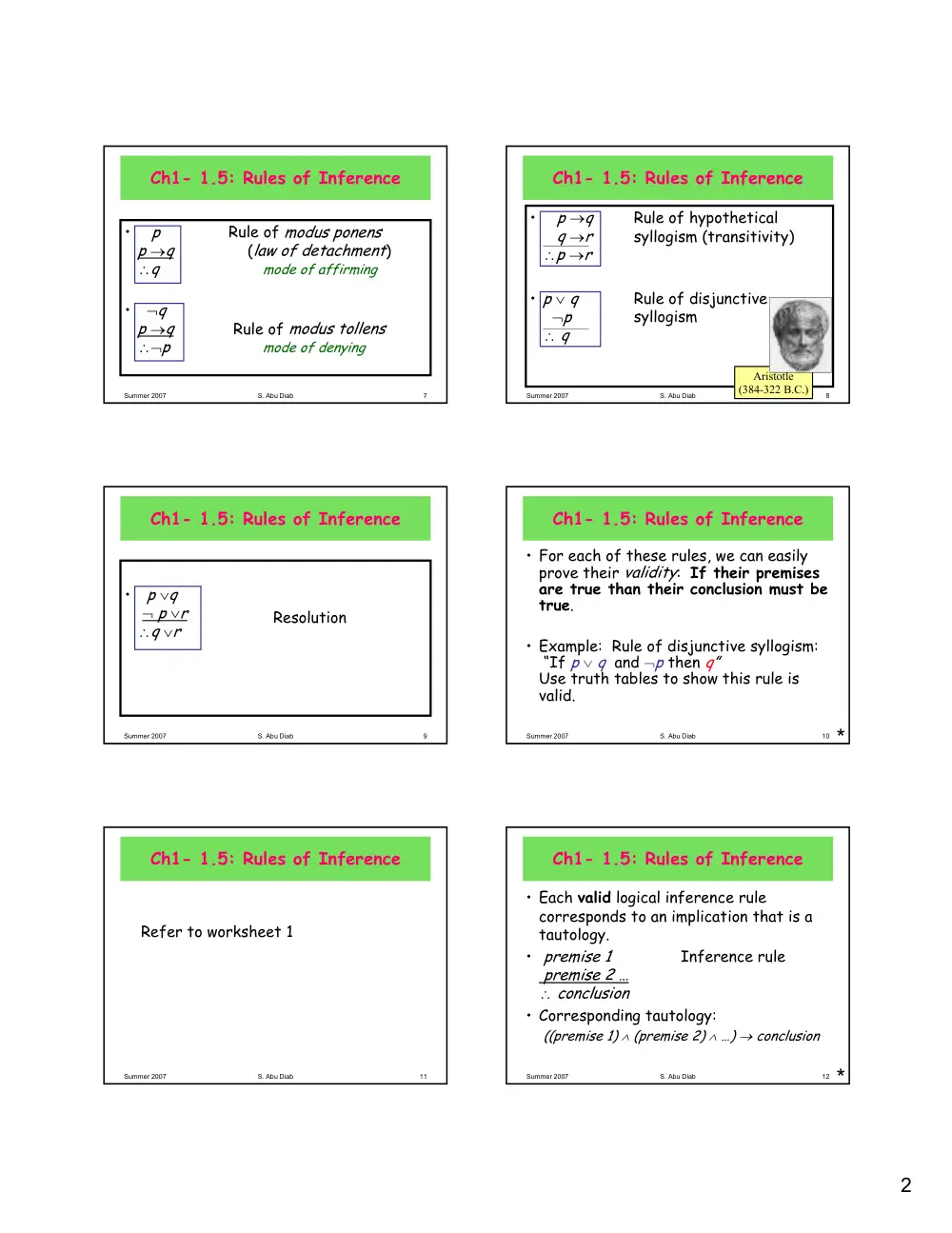
Some Rules of Inference:
•
p
Rule of Addition
∴ p∨q
•
p∧q
Rule of Simplification
∴ p
•
p
Rule of Conjunction
q
∴ p ∧q
2
Summer 2007
S. Abu Diab
7
Ch1- 1.5: Rules of Inference
•
p
Rule of modus ponens
p →q
(law of detachment)
∴q
mode of affirming
•
¬q
p →q
Rule of modus tollens
∴¬p
mode of denying
Summer 2007
S. Abu Diab
8
Ch1- 1.5: Rules of Inference
•
p →q
Rule of hypothetical
q →r
syllogism (transitivity)
∴p →r
• p ∨ q
Rule of disjunctive
¬p
syllogism
∴ q
Aristotle
(384-322 B.C.)
Summer 2007
S. Abu Diab
9
Ch1- 1.5: Rules of Inference
•
p ∨q
¬ p ∨r
∴q ∨r
Resolution
Summer 2007
S. Abu Diab
10
Ch1- 1.5: Rules of Inference
• For each of these rules, we can easily
prove their validity: If their premises
are true than their conclusion must be
true.
• Example: Rule of disjunctive syllogism:
“If p ∨ q and ¬p then q”
Use truth tables to show this rule is
valid.
*
Summer 2007
S. Abu Diab
11
Ch1- 1.5: Rules of Inference
Refer to worksheet 1
Summer 2007
S. Abu Diab
12
Ch1- 1.5: Rules of Inference
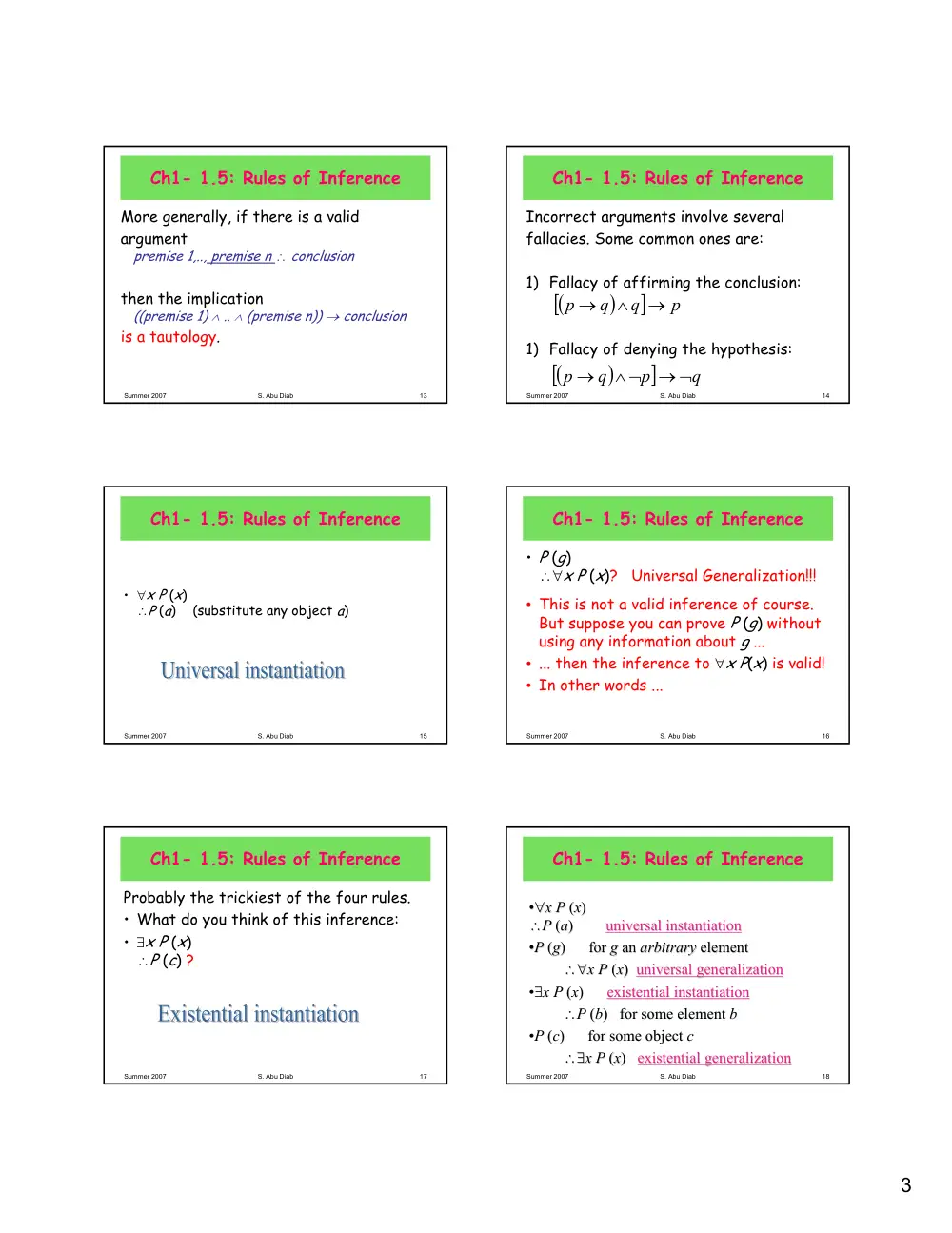
• Each valid logical inference rule
corresponds to an implication that is a
tautology.
• premise 1 Inference rule
premise 2 …
∴ conclusion
• Corresponding tautology:
((premise 1) ∧ (premise 2) ∧ …) → conclusion
*
3
Summer 2007
S. Abu Diab
13
Ch1- 1.5: Rules of Inference
More generally, if there is a valid
argument
premise 1,.., premise n ∴ conclusion
then the implication
((premise 1) ∧ .. ∧ (premise n)) → conclusion
is a tautology.
Summer 2007
S. Abu Diab
14
Ch1- 1.5: Rules of Inference
Incorrect arguments involve several
fallacies. Some common ones are:
1) Fallacy of affirming the conclusion:
1) Fallacy of denying the hypothesis:
(
)
[
]
p
q
q
p
→
∧
→
(
)
[
]
q
p
q
p
→ ¬
∧ ¬
→
Summer 2007
S. Abu Diab
15
Ch1- 1.5: Rules of Inference
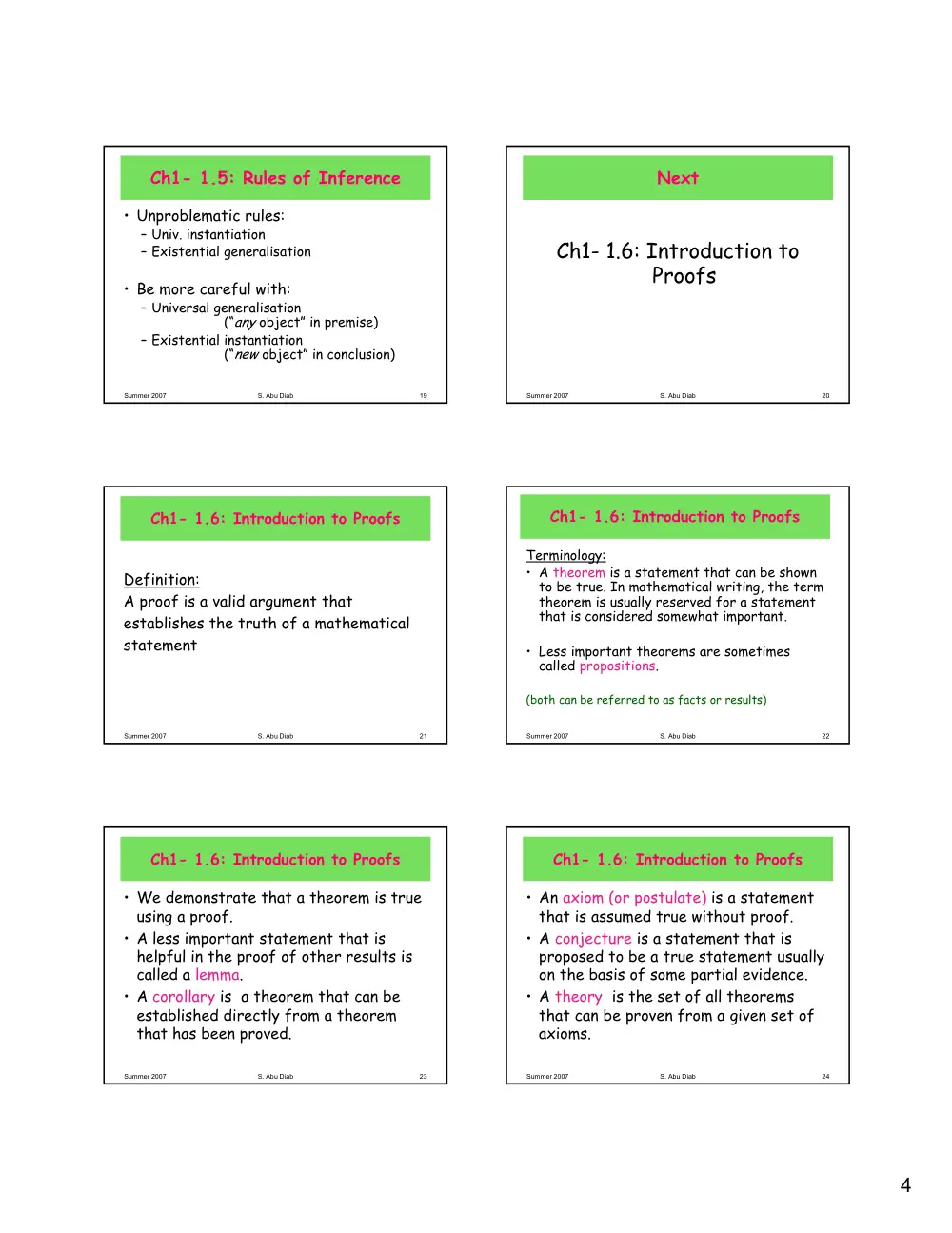
• ∀x P (x)
∴P (a)
(substitute any object a)
Summer 2007
S. Abu Diab
16
Ch1- 1.5: Rules of Inference
• P (g)
∴∀x P (x)? Universal Generalization!!!
• This is not a valid inference of course.
But suppose you can prove P (g) without
using any information about g ...
• ... then the inference to ∀x P(x) is valid!
• In other words ...
Summer 2007
S. Abu Diab
17
Ch1- 1.5: Rules of Inference
Probably the trickiest of the four rules.
• What do you think of this inference:
• ∃x P (x)
∴P (c) ?
Summer 2007
S. Abu Diab
18
Ch1- 1.5: Rules of Inference
••∀∀xx P
P ((xx))
∴
∴P
P ((aa))
universal instantiation
universal instantiation
••P
P ((gg) for
) for gg an
an arbitrary
arbitrary element
element
∴∀
∴∀xx P
P ((xx)
) universal generalization
universal generalization
••∃∃xx P
P ((xx)
) existential instantiation
existential instantiation
∴
∴P
P ((bb) for some element
) for some element bb
••P
P ((cc) for some object
) for some object cc
∴∃
∴∃xx P
P ((xx)
) existential generalization
existential generalization
4
Summer 2007
S. Abu Diab
19
Ch1- 1.5: Rules of Inference
• Unproblematic rules:
– Univ. instantiation
– Existential generalisation
• Be more careful with:
– Universal generalisation
(“any object” in premise)
– Existential instantiation
(“new object” in conclusion)
Summer 2007
S. Abu Diab
20
Next
Ch1- 1.6: Introduction to
Proofs
Summer 2007
S. Abu Diab
21
Ch1- 1.6: Introduction to Proofs
Definition:
A proof is a valid argument that
establishes the truth of a mathematical
statement
Summer 2007
S. Abu Diab
22
Ch1- 1.6: Introduction to Proofs
Terminology:
• A theorem is a statement that can be shown
to be true. In mathematical writing, the term
theorem is usually reserved for a statement
that is considered somewhat important.
• Less important theorems are sometimes
called propositions.
(both can be referred to as facts or results)
Summer 2007
S. Abu Diab
23
Ch1- 1.6: Introduction to Proofs
• We demonstrate that a theorem is true
using a proof.
• A less important statement that is
helpful in the proof of other results is
called a lemma.
• A corollary is a theorem that can be
established directly from a theorem
that has been proved.
Summer 2007
S. Abu Diab
24
Ch1- 1.6: Introduction to Proofs
• An axiom (or postulate) is a statement
that is assumed true without proof.
• A conjecture is a statement that is
proposed to be a true statement usually
on the basis of some partial evidence.
• A theory is the set of all theorems
that can be proven from a given set of
axioms.
5
Summer 2007
S. Abu Diab
25
Ch1- 1.6: Introduction to Proofs
• Methods for Proofs:
- Direct Proof
- Proof by contraposition
- Proof by contradiction
- Exhaustive proof or proof by cases
(section 1.7)
Refer to worksheet 1
Summer 2007
S. Abu Diab
26
Ch1- 1.7: Proof methods and Strategy
You may also want to know terms like:
-begging the question or circular reasoning
(one or more step of the proof are based on
the truth of the statement being proved. In
other words, a statement is proved using
itself or a statement equivalent to it)
-without loss of generality or WLOG
(after proving one case of a theorem, wlog
means that no additional argument is needed
for the other cases. I.e, other cases follow in
a similar way)
wrong
Use
carefully
Summer 2007
S. Abu Diab
27
Ch1- 1.7: Proof methods and Strategy
-existence proof (can be constructive or
non-constructive)
(show that an element x with a desired
property exists i.e., ∃x P (x) )
-uniqueness proof
(shows that if y
x then y does not have
the desired property)
≠
Summer 2007
S. Abu Diab
28
Ch1- 1.7: Proof methods and Strategy
-forward reasoning (start from the
premises use certain steps to reach the
conclusion)
-backward reasoning (find a statement
that will lead to the conclusion and move
backward in the same way to reach the
premises)
WARNING: You must never start from
the conclusion or assume that it is true.
Summer 2007
S. Abu Diab
29
Ch1- 1.7: Proof methods and Strategy
• Exercise:
Use backward reasoning to show that
the arithmetic mean of two positive real
numbers x and y, is greater than their
geometric mean, that is
xy
y
x
≥
+
2
Summer 2007
S. Abu Diab
30
Ch1- 1.7: Proof methods and Strategy
• Other proof methods and strategies will
be seen later in this course!