
MATH 211 Lecture Chapter 1 ( Section 1.6), Fall 2011
American University of Beirut · Discrete Structures · 25 pages

Showing the first 10 of 25 pages. Download the PDF to see all of it.
More MATH 211 files
Show the text of this lab
Introduction
Methods of Proof
Strategies of Proof
Ready? Tips and Tricks
References
Introduction to proofs, Proof methods and
strategies
S. Abu Diab
Mathematics Department
American University of Beirut
October 4, 2010
S. Abu Diab
Introduction to proofs, Proof methods and strategies
Introduction
Methods of Proof
Strategies of Proof
Ready? Tips and Tricks
References
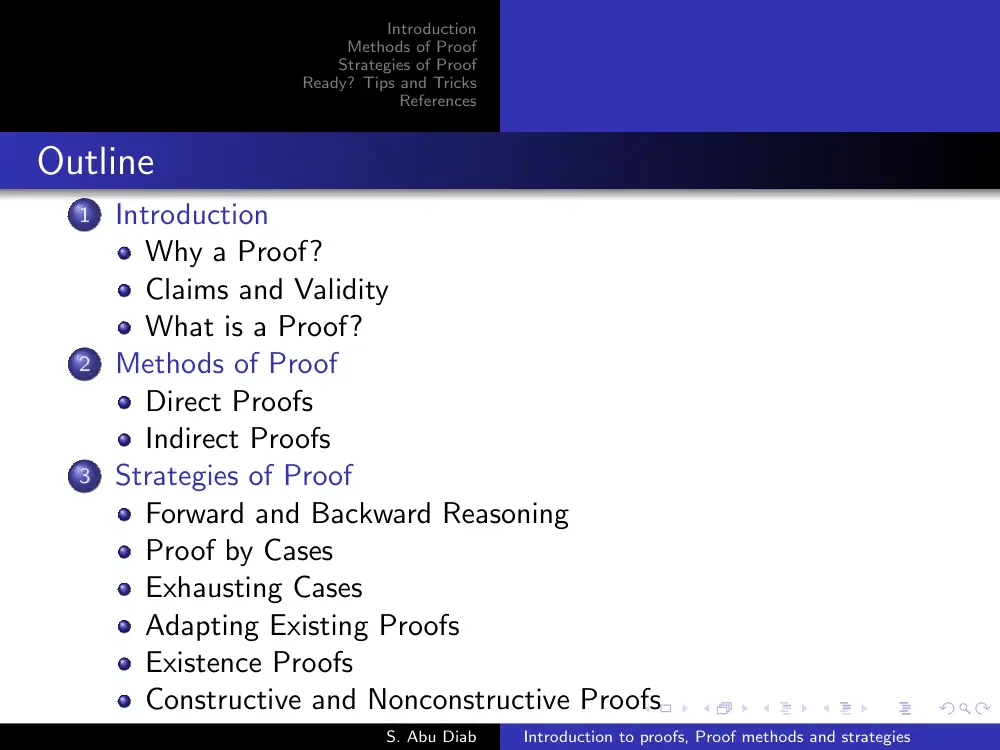
Outline
1
Introduction
Why a Proof?
Claims and Validity
What is a Proof?
2
Methods of Proof
Direct Proofs
Indirect Proofs
3
Strategies of Proof
Forward and Backward Reasoning
Proof by Cases
Exhausting Cases
Adapting Existing Proofs
Existence Proofs
Constructive and Nonconstructive Proofs
Others
S. Abu Diab
Introduction to proofs, Proof methods and strategies
Introduction
Methods of Proof
Strategies of Proof
Ready? Tips and Tricks
References
Why a Proof?
Claims and Validity
What is a Proof?
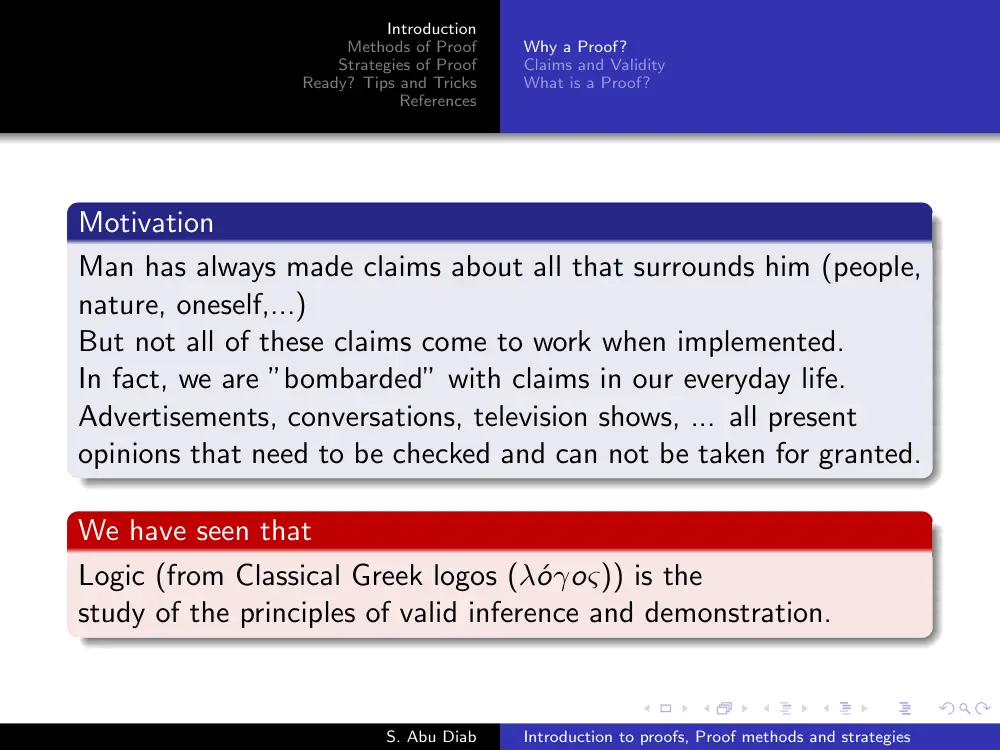
Motivation
Man has always made claims about all that surrounds him (people,
nature, oneself,...)
But not all of these claims come to work when implemented.
In fact, we are ”bombarded” with claims in our everyday life.
Advertisements, conversations, television shows, ... all present
opinions that need to be checked and can not be taken for granted.
We have seen that
Logic (from Classical Greek logos (λ´oγoς)) is the
study of the principles of valid inference and demonstration.
S. Abu Diab
Introduction to proofs, Proof methods and strategies
Introduction
Methods of Proof
Strategies of Proof
Ready? Tips and Tricks
References
Why a Proof?
Claims and Validity
What is a Proof?
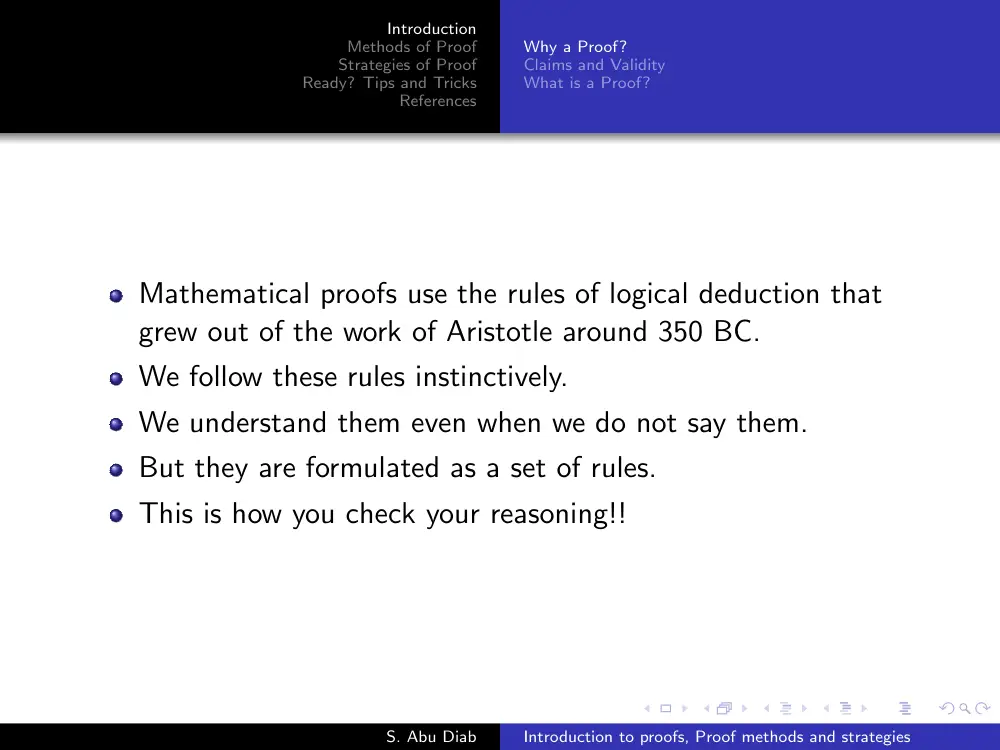
Mathematical proofs use the rules of logical deduction that
grew out of the work of Aristotle around 350 BC.
We follow these rules instinctively.
We understand them even when we do not say them.
But they are formulated as a set of rules.
This is how you check your reasoning!!
S. Abu Diab
Introduction to proofs, Proof methods and strategies
Introduction
Methods of Proof
Strategies of Proof
Ready? Tips and Tricks
References
Why a Proof?
Claims and Validity
What is a Proof?
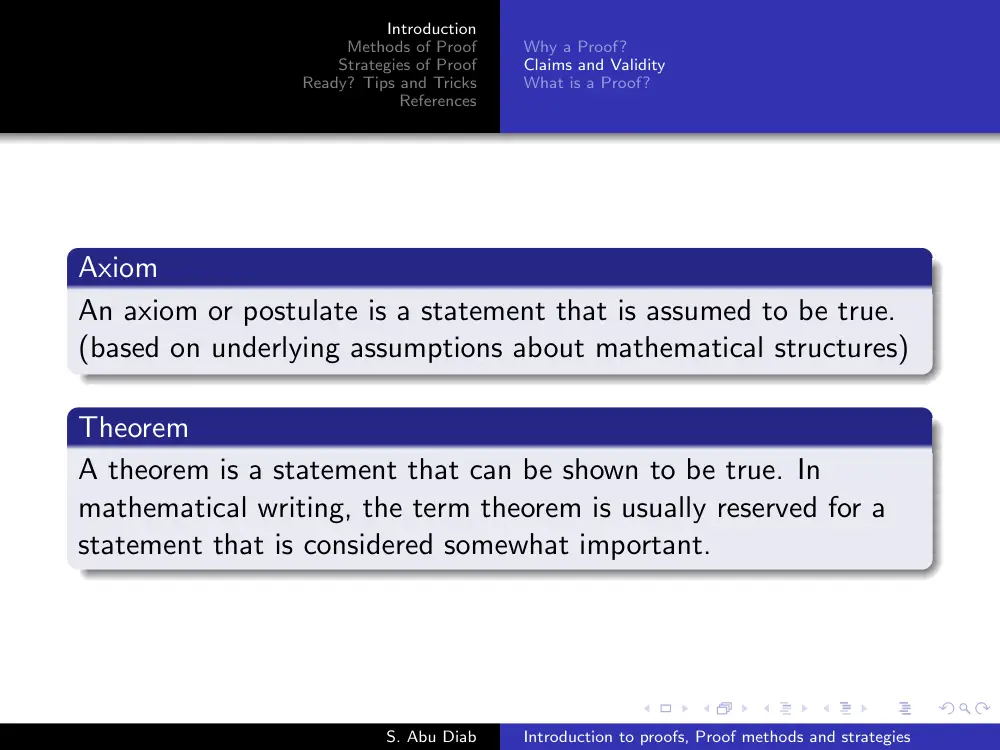
Axiom
An axiom or postulate is a statement that is assumed to be true.
(based on underlying assumptions about mathematical structures)
Theorem
A theorem is a statement that can be shown to be true. In
mathematical writing, the term theorem is usually reserved for a
statement that is considered somewhat important.
S. Abu Diab
Introduction to proofs, Proof methods and strategies
Introduction
Methods of Proof
Strategies of Proof
Ready? Tips and Tricks
References
Why a Proof?
Claims and Validity
What is a Proof?
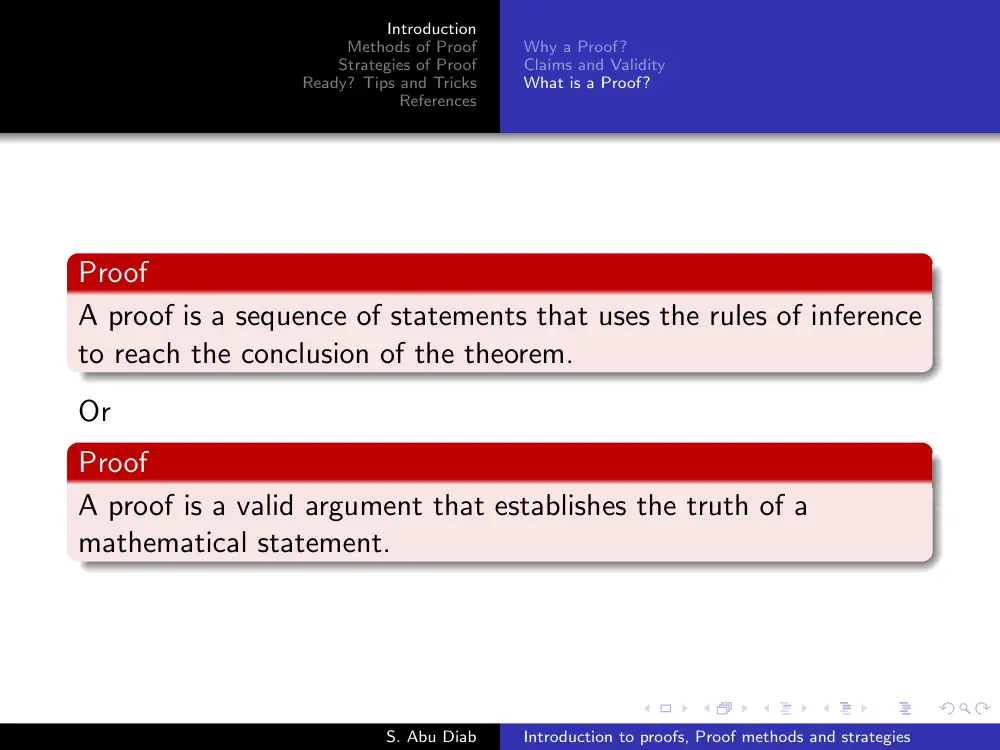
Proof
A proof is a sequence of statements that uses the rules of inference
to reach the conclusion of the theorem.
Or
Proof
A proof is a valid argument that establishes the truth of a
mathematical statement.
S. Abu Diab
Introduction to proofs, Proof methods and strategies
Introduction
Methods of Proof
Strategies of Proof
Ready? Tips and Tricks
References
Why a Proof?
Claims and Validity
What is a Proof?
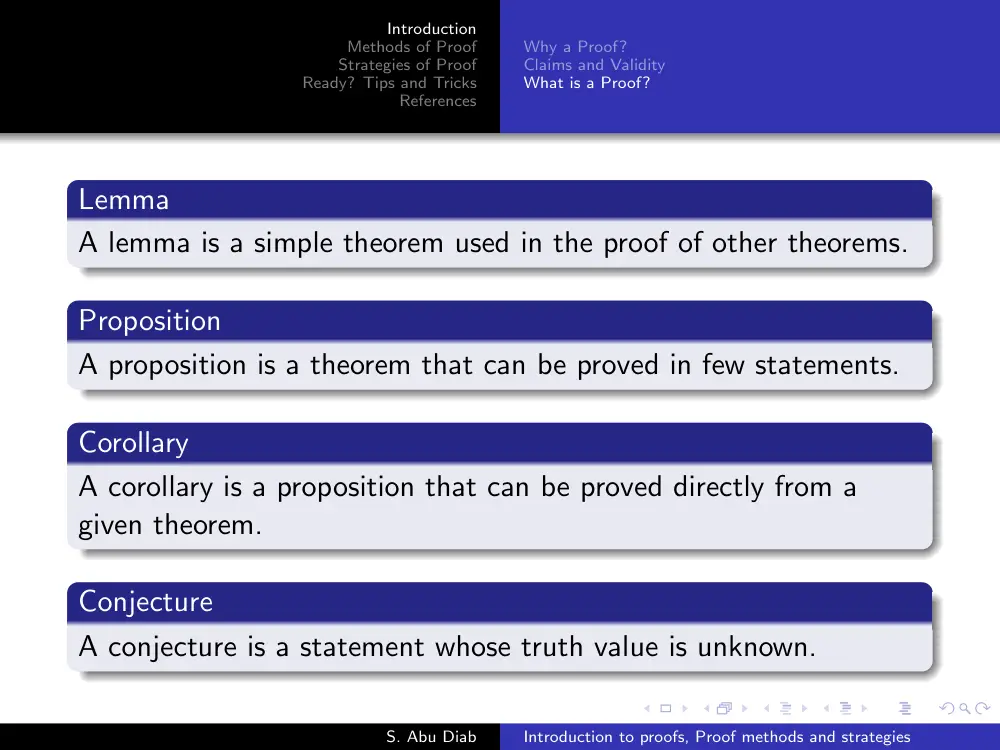
Lemma
A lemma is a simple theorem used in the proof of other theorems.
Proposition
A proposition is a theorem that can be proved in few statements.
Corollary
A corollary is a proposition that can be proved directly from a
given theorem.
Conjecture
A conjecture is a statement whose truth value is unknown.
S. Abu Diab
Introduction to proofs, Proof methods and strategies
Introduction
Methods of Proof
Strategies of Proof
Ready? Tips and Tricks
References
Direct Proofs
Indirect Proofs
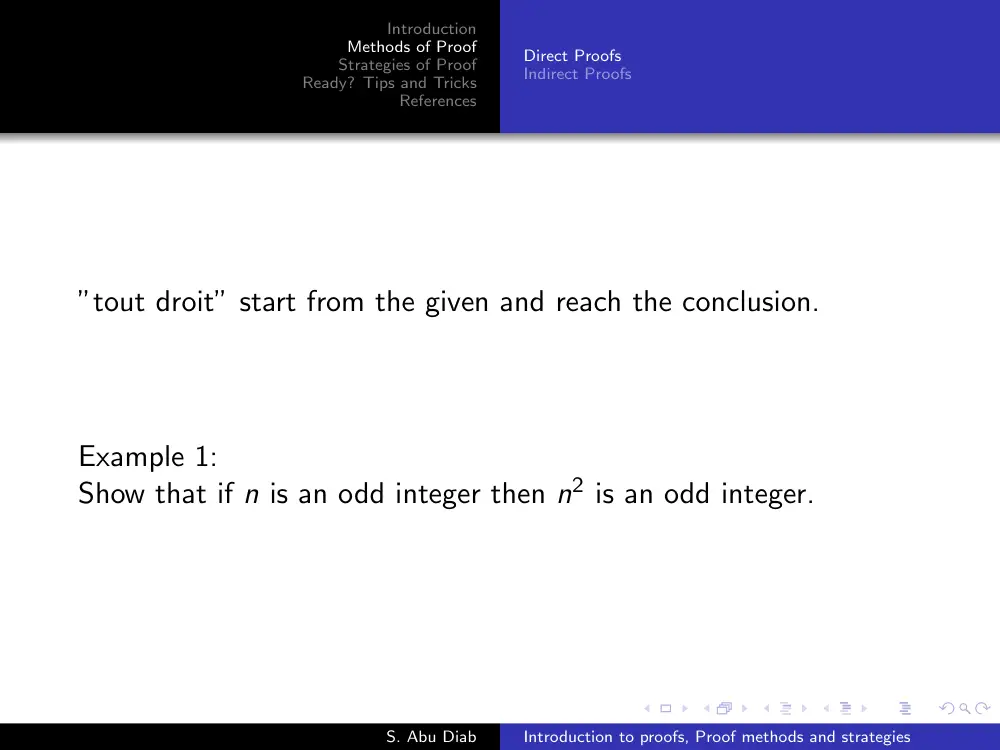
”tout droit” start from the given and reach the conclusion.
Example 1:
Show that if n is an odd integer then n2 is an odd integer.
S. Abu Diab
Introduction to proofs, Proof methods and strategies
Introduction
Methods of Proof
Strategies of Proof
Ready? Tips and Tricks
References
Direct Proofs
Indirect Proofs
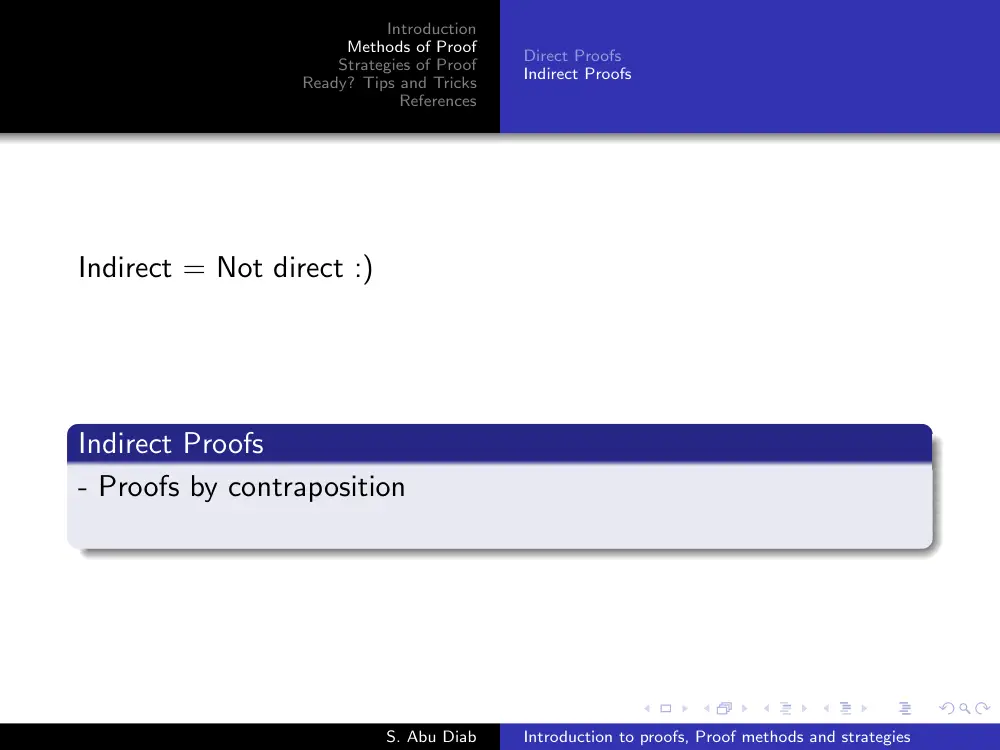
Indirect = Not direct :)
Indirect Proofs
- Proofs by contraposition
S. Abu Diab
Introduction to proofs, Proof methods and strategies
Introduction
Methods of Proof
Strategies of Proof
Ready? Tips and Tricks
References
Direct Proofs
Indirect Proofs
Indirect = Not direct :)
Indirect Proofs
- Proofs by contraposition
- Proofs by contradiction
S. Abu Diab
Introduction to proofs, Proof methods and strategies
Introduction
Methods of Proof
Strategies of Proof
Ready? Tips and Tricks
References
Direct Proofs
Indirect Proofs
Proof by contraposition: Instead of proving that p implies q, we
prove that ¬q implies ¬p.
Example 2:
Show that if n is an integer and n2 is odd then n is odd.
S. Abu Diab
Introduction to proofs, Proof methods and strategies
Introduction
Methods of Proof
Strategies of Proof
Ready? Tips and Tricks
References
Direct Proofs
Indirect Proofs
Proof by contradiction: We suppose that what you want to
reach is false and get a contradiction.
Example 3:
Show that
√
2 is irrational.
S. Abu Diab
Introduction to proofs, Proof methods and strategies
Introduction
Methods of Proof
Strategies of Proof
Ready? Tips and Tricks
References
Direct Proofs
Indirect Proofs
Proving an equivalence: two implications
Counterexamples: to prove that a statement of the form ∀x P(x) is
FALSE.
S. Abu Diab
Introduction to proofs, Proof methods and strategies
Introduction
Methods of Proof
Strategies of Proof
Ready? Tips and Tricks
References
Forward and Backward Reasoning
Proof by Cases
Exhausting Cases
Adapting Existing Proofs
Existence Proofs
Constructive and Nonconstructive Proofs
Others
You always need a starting point for your proof. To begin a direct
proof for an implication, you can start with the hypotheses. Using
the hypotheses, together with axioms and known theorems, you
can construct a proof by a sequence of steps that leads to the
conclusion. This type of reasoning, called forward reasoning is the
most common way to reach relatively simple results.
Similarly, with indirect proofs you will start with the negation of
your conclusion and using a sequence of steps reach the negation
of your assumption.
S. Abu Diab
Introduction to proofs, Proof methods and strategies
Introduction
Methods of Proof
Strategies of Proof
Ready? Tips and Tricks
References
Forward and Backward Reasoning
Proof by Cases
Exhausting Cases
Adapting Existing Proofs
Existence Proofs
Constructive and Nonconstructive Proofs
Others
However, it may be sometimes helpful to use backward reasoning.
This means that we find a new conclusion that will lead to the
original one and try to prove this new conclusion.
S. Abu Diab
Introduction to proofs, Proof methods and strategies
Introduction
Methods of Proof
Strategies of Proof
Ready? Tips and Tricks
References
Forward and Backward Reasoning
Proof by Cases
Exhausting Cases
Adapting Existing Proofs
Existence Proofs
Constructive and Nonconstructive Proofs
Others
Example 4:
Show that the arithmetic mean of two different positive real
numbers is always greater than their geometric mean, i.e., for any
a, b ∈ R
a + b
2
>
√
ab
If you think you know this, try showing that if a and b are distinct
positive numbers, and A = a+b
2 , B =
√
ab, then we have this
inequality
B < (a − b)2
8(A − B) < A
S. Abu Diab
Introduction to proofs, Proof methods and strategies
Introduction
Methods of Proof
Strategies of Proof
Ready? Tips and Tricks
References
Forward and Backward Reasoning
Proof by Cases
Exhausting Cases
Adapting Existing Proofs
Existence Proofs
Constructive and Nonconstructive Proofs
Others
We consider all possible cases and prove each one alone.
Example 5:
Show that if |xy| = |x| |y| for any two real numbers x and y.
S. Abu Diab
Introduction to proofs, Proof methods and strategies
Introduction
Methods of Proof
Strategies of Proof
Ready? Tips and Tricks
References
Forward and Backward Reasoning
Proof by Cases
Exhausting Cases
Adapting Existing Proofs
Existence Proofs
Constructive and Nonconstructive Proofs
Others
Exhausting cases means you consider all possible single examples.
S. Abu Diab
Introduction to proofs, Proof methods and strategies
Introduction
Methods of Proof
Strategies of Proof
Ready? Tips and Tricks
References
Forward and Backward Reasoning
Proof by Cases
Exhausting Cases
Adapting Existing Proofs
Existence Proofs
Constructive and Nonconstructive Proofs
Others
Euclid showed that there are infinitely many primes by supposing
that there are only finitely many primes p1, p2,..., pn. Then,
considering the number p1p2p3...pn + 1. This is not divisible by
any of the existing primes. Thus, it must be a prime.
Example 6:
Adapt Euclid’s proof that there are infinitely many primes to show
that there are infinitely many primes of the form 4k + 3 where k is
a nonnegative integer.
S. Abu Diab
Introduction to proofs, Proof methods and strategies
Introduction
Methods of Proof
Strategies of Proof
Ready? Tips and Tricks
References
Forward and Backward Reasoning
Proof by Cases
Exhausting Cases
Adapting Existing Proofs
Existence Proofs
Constructive and Nonconstructive Proofs
Others
This is when you show that ∃x P(x).
S. Abu Diab
Introduction to proofs, Proof methods and strategies
Introduction
Methods of Proof
Strategies of Proof
Ready? Tips and Tricks
References
Forward and Backward Reasoning
Proof by Cases
Exhausting Cases
Adapting Existing Proofs
Existence Proofs
Constructive and Nonconstructive Proofs
Others
A proof is constructive if you construct the answer. For instance,
you show that ∃x P(x)by finding this x. Otherwise, it is
nonconstructive.
Refer to page 91
S. Abu Diab
Introduction to proofs, Proof methods and strategies
Introduction
Methods of Proof
Strategies of Proof
Ready? Tips and Tricks
References
Forward and Backward Reasoning
Proof by Cases
Exhausting Cases
Adapting Existing Proofs
Existence Proofs
Constructive and Nonconstructive Proofs
Others
Many other strategies exist. In fact, it is hard to track the creative
process in an individual’s mind!
S. Abu Diab
Introduction to proofs, Proof methods and strategies
Introduction
Methods of Proof
Strategies of Proof
Ready? Tips and Tricks
References
As you noticed, you can never do a proof if you do not know
the definitions.
Keep in mind the different ideas that are used in doing a proof.
Always try to establish a link between your hypothesis and
your conclusion. This link will be the bridge that you will use
to reach the end result.
S. Abu Diab
Introduction to proofs, Proof methods and strategies
Introduction
Methods of Proof
Strategies of Proof
Ready? Tips and Tricks
References
When you want to prove a statement, be aware of the
psychological factor. You can never achieve something if in
your mind you believe that you can not do it.
In proving non obvious statements, there is a creative factor
sometimes.
S. Abu Diab
Introduction to proofs, Proof methods and strategies
Introduction
Methods of Proof
Strategies of Proof
Ready? Tips and Tricks
References
K. H. Rosen.
Discrete Mathematics and its Applications.
McGraw-Hill, 5th edition, 2003.
S. Abu Diab
Introduction to proofs, Proof methods and strategies