
MATH 218 Other, Fall 2010
American University of Beirut · Elementary Linear Algebra with Applications · 1 page
Stuck on a question? A tutor can walk you through it.
More MATH 218 files
- Useful File Summary · Spring 2016FileView
- Useful File Math 218 Solution Manual · Spring 2015File · with solutionView
- Other Textbook · Fall 2012FileView
- Other · Fall 2007FileView
- Syllabus · Spring 2019LabView
- Exam 1 Clean Copy · Spring 2019ExamView
- Final 218 2018 · Spring 2019Final examView
- Notes 1.4 · Spring 2018NotesView
Show the text of this file
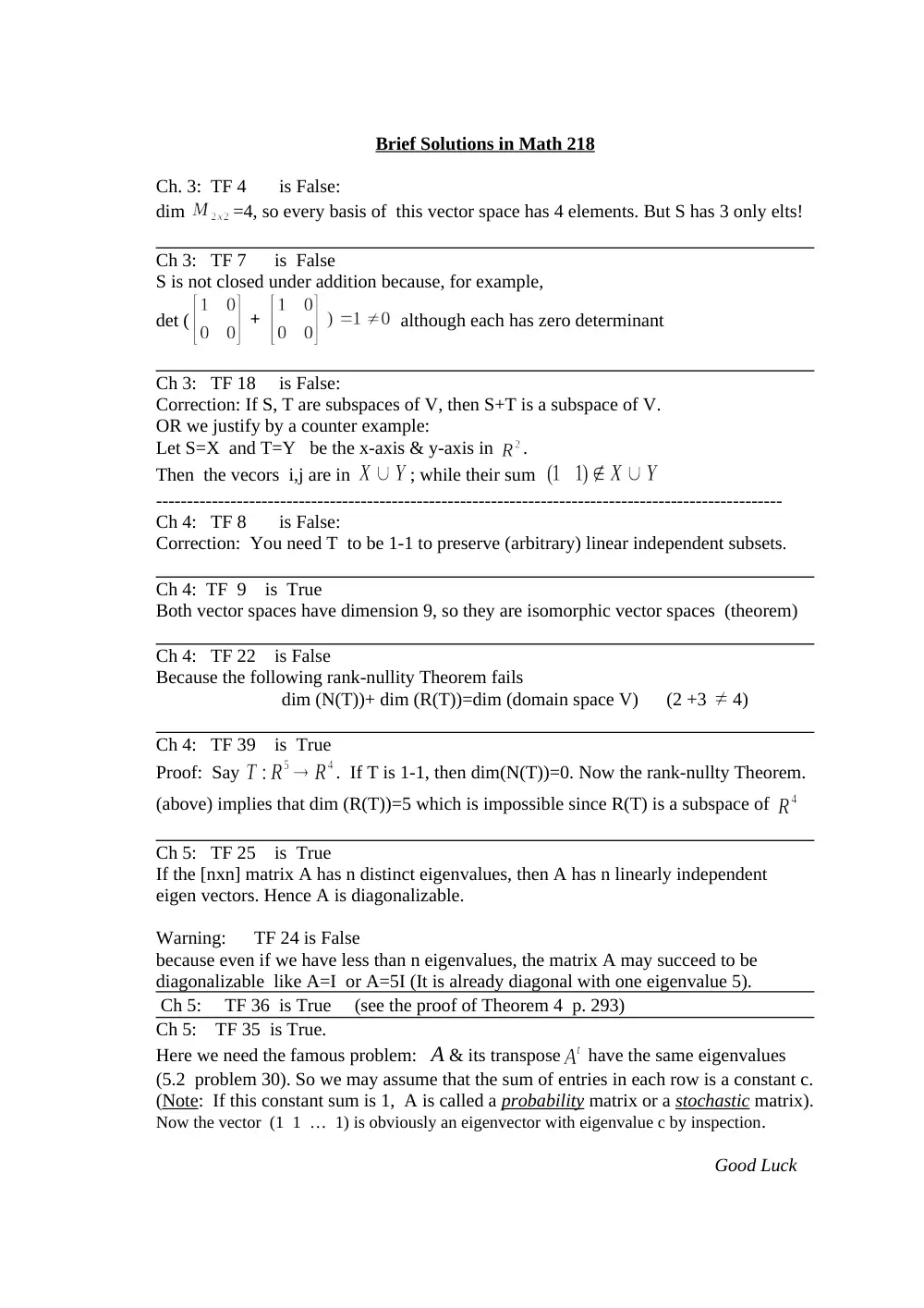
Brief Solutions in Math 218
Ch. 3: TF 4 is False:
dim
=4, so every basis of this vector space has 4 elements. But S has 3 only elts!
Ch 3: TF 7 is False
S is not closed under addition because, for example,
det (
although each has zero determinant
Ch 3: TF 18 is False:
Correction: If S, T are subspaces of V, then S+T is a subspace of V.
OR we justify by a counter example:
Let S=X and T=Y be the x-axis & y-axis in
.
Then the vecors i,j are in
; while their sum
-----------------------------------------------------------------------------------------------------
Ch 4: TF 8 is False:
Correction: You need T to be 1-1 to preserve (arbitrary) linear independent subsets.
Ch 4: TF 9 is True
Both vector spaces have dimension 9, so they are isomorphic vector spaces (theorem)
Ch 4: TF 22 is False
Because the following rank-nullity Theorem fails
dim (N(T))+ dim (R(T))=dim (domain space V) (2 +3
4)
Ch 4: TF 39 is True
Proof: Say
. If T is 1-1, then dim(N(T))=0. Now the rank-nullty Theorem.
(above) implies that dim (R(T))=5 which is impossible since R(T) is a subspace of
Ch 5: TF 25 is True
If the [nxn] matrix A has n distinct eigenvalues, then A has n linearly independent
eigen vectors. Hence A is diagonalizable.
Warning: TF 24 is False
because even if we have less than n eigenvalues, the matrix A may succeed to be
diagonalizable like A=I or A=5I (It is already diagonal with one eigenvalue 5).
Ch 5: TF 36 is True (see the proof of Theorem 4 p. 293)
Ch 5: TF 35 is True.
Here we need the famous problem: A & its transpose
have the same eigenvalues
(5.2 problem 30). So we may assume that the sum of entries in each row is a constant c.
(Note: If this constant sum is 1, A is called a probability matrix or a stochastic matrix).
Now the vector (1 1 … 1) is obviously an eigenvector with eigenvalue c by inspection.
Good Luck