
MATH 218 Other Textbook, Fall 2012
American University of Beirut · Elementary Linear Algebra with Applications · 509 pages


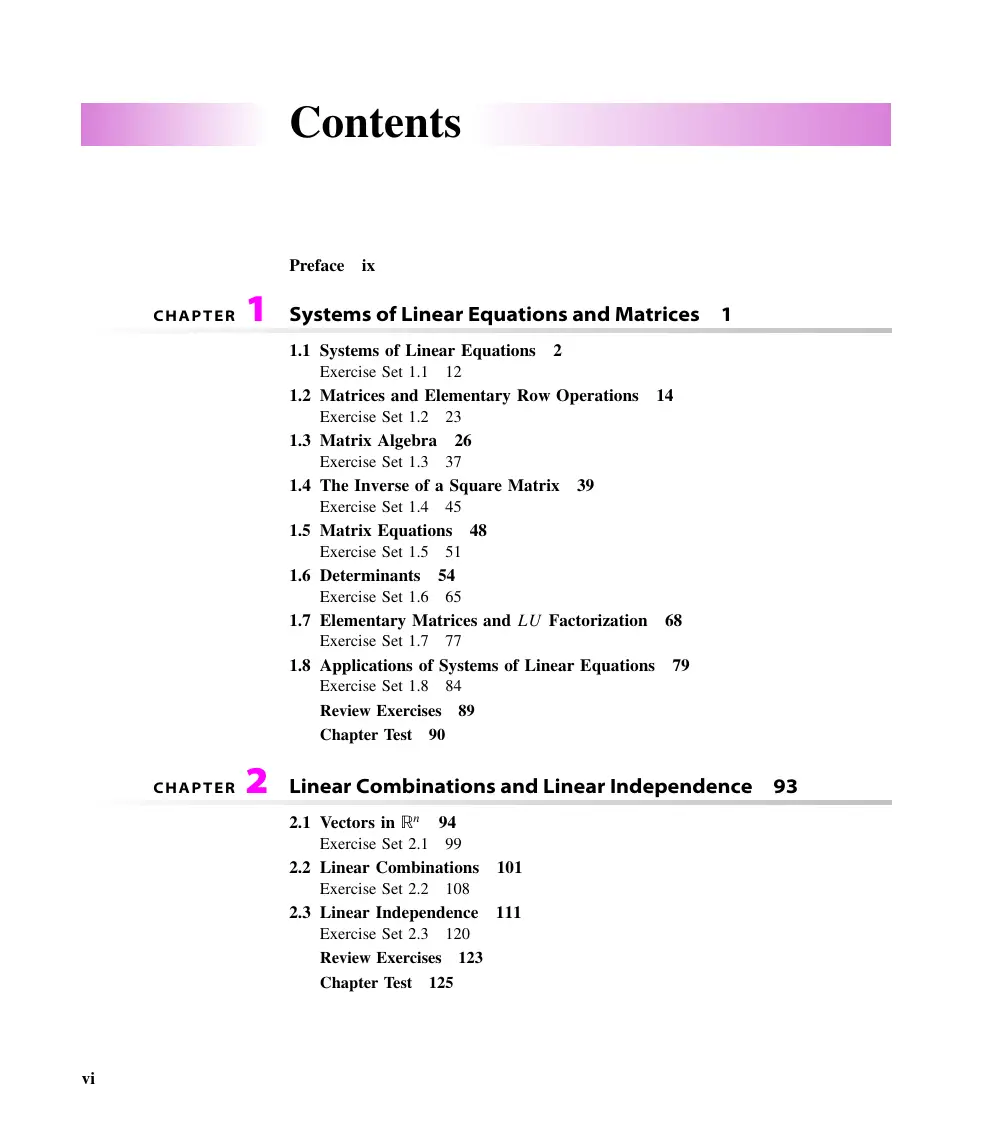
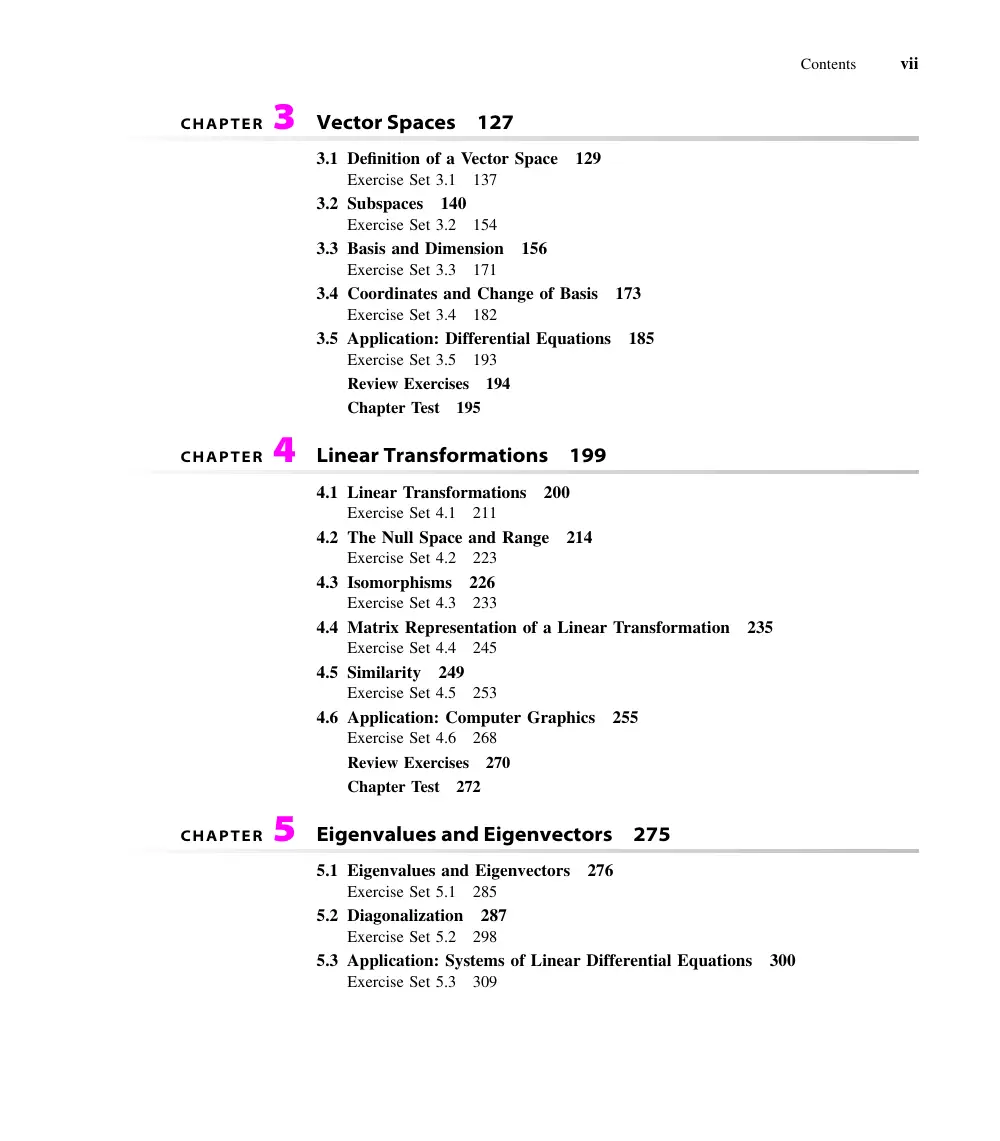
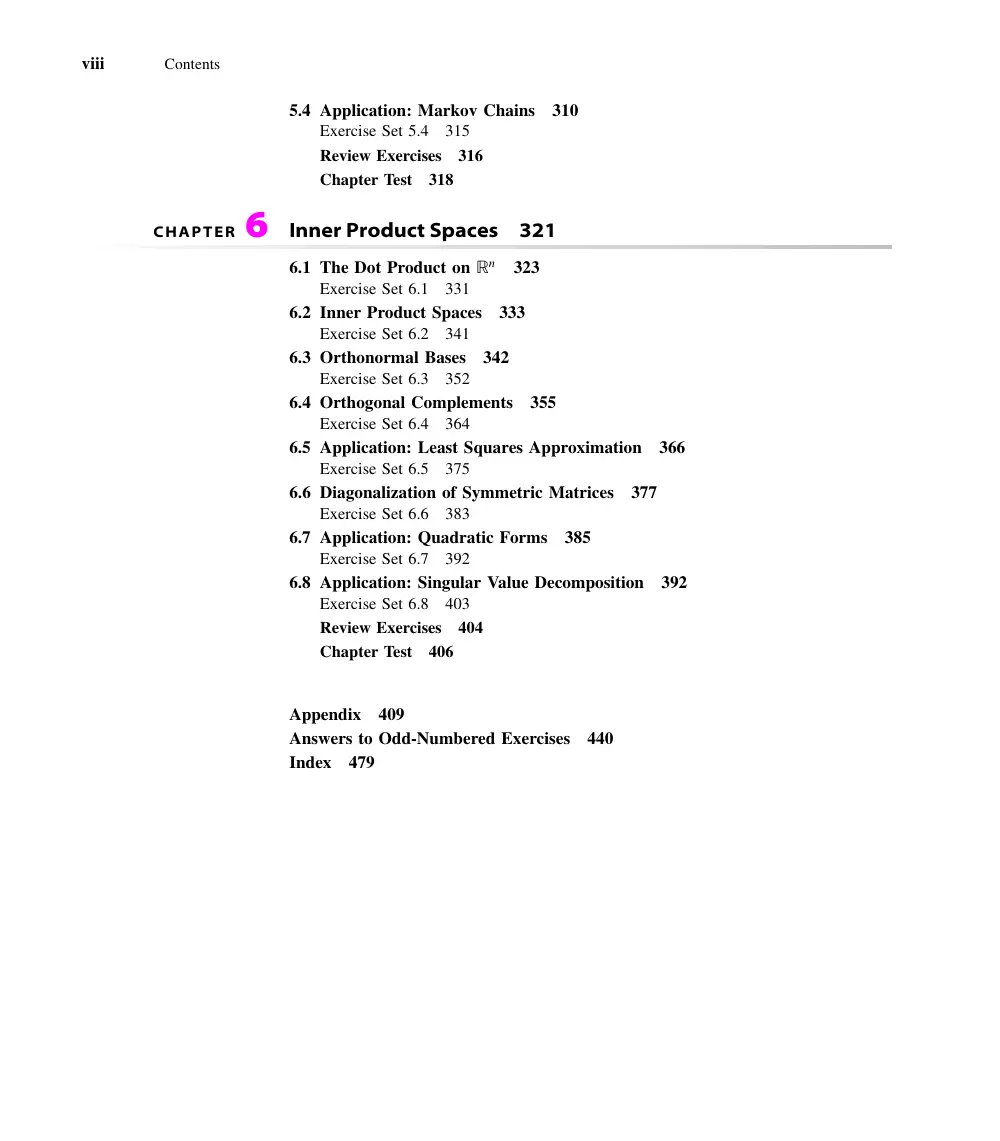
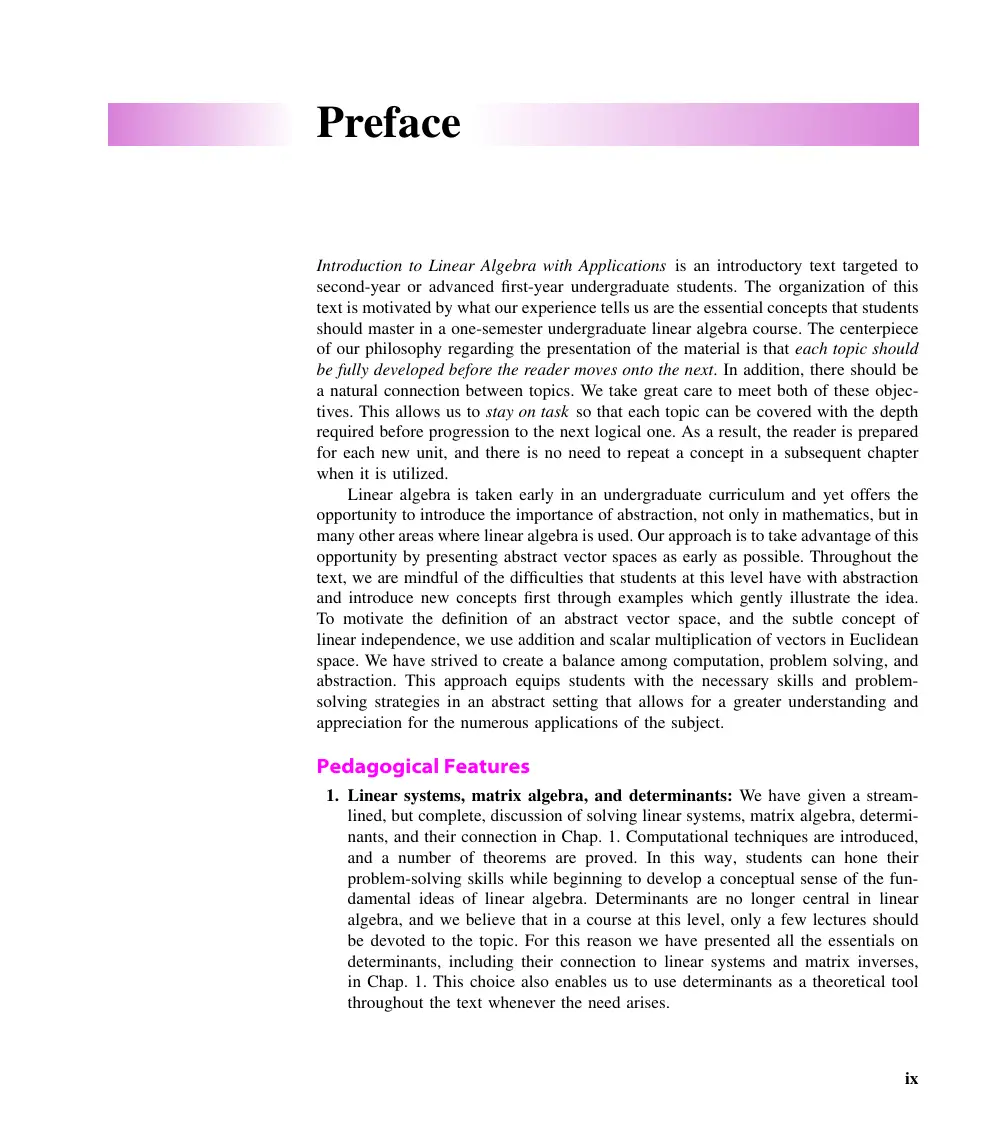
Showing the first 10 of 509 pages. Download the PDF to see all of it.
More MATH 218 files
- Useful File Summary · Spring 2016FileView
- Useful File Math 218 Solution Manual · Spring 2015File · with solutionView
- Other · Fall 2010FileView
- Other · Fall 2007FileView
- Syllabus · Spring 2019LabView
- Exam 1 Clean Copy · Spring 2019ExamView
- Final 218 2018 · Spring 2019Final examView
- Notes 1.4 · Spring 2018NotesView
Show the text of this file
Linear Algebra
INTRODUCTION TO
LINEAR ALGEBRA
WITH APPLICATIONS
Jim DeFranza
St. Lawrence University
Dan Gagliardi
SUNY Canton
INTRODUCTION TO LINEAR ALGEBRA WITH APPLICATIONS
Published by McGraw-Hill, a business unit of The McGraw-Hill Companies, Inc., 1221 Avenue of the Americas, New
York, NY 10020. Copyright 2009 by The McGraw-Hill Companies, Inc. All rights reserved. No part of this
publication may be reproduced or distributed in any form or by any means, or stored in a database or retrieval system,
without the prior written consent of The McGraw-Hill Companies, Inc., including, but not limited to, in any network or
other electronic storage or transmission, or broadcast for distance learning.
Some ancillaries, including electronic and print components, may not be available to customers outside the United States.
This book is printed on acid-free paper.
1 2 3 4 5 6 7 8 9 0 DOC/DOC 0 9 8
ISBN 978–0–07–353235–6
MHID 0–07–353235–5
Editorial Director: Stewart K. Mattson
Senior Sponsoring Editor: Elizabeth Covello
Director of Development: Kristine Tibbetts
Developmental Editor: Michelle Driscoll
Director of Marketing: Ryan Blankenship
Marketing Coordinator: Sabina Navsariwala
Project Manager: Joyce Watters
Senior Production Supervisor: Sherry L. Kane
Senior Media Project Manager: Tammy Juran
Designer: Laurie B. Janssen
Cover Designer: Ron Bissell
(USE) Cover Image: Royalty-Free/CORBIS
Senior Photo Research Coordinator: John C. Leland
Supplement Producer: Melissa M. Leick
Compositor: Laserwords Private Limited
Typeface: 10.25/12 Times
Printer: R. R. Donnelly Crawfordsville, IN
Library of Congress Cataloging-in-Publication Data
DeFranza, James, 1950–
Introduction to linear algebra / James DeFranza, Daniel Gagliardi. —1st ed.
p. cm.
Includes index.
ISBN 978–0–07–353235–6—ISBN 0–07–353235–5 (hard copy : alk. paper)
1. Algebras, Linear—Textbooks. 2. Algebras, Linear—Problems, exercises, etc. I. Gagliardi, Daniel. II. Title.
QA184.2.D44
2009
515′.5—dc22
2008026020
www.mhhe.com
To Regan, Sara, and David
—JD
To Robin, Zachary, Michael, and Eric
—DG
About the Authors
Jim DeFranza
was born in 1950 in Yonkers New York and grew up in Dobbs
Ferry New York on the Hudson River. Jim DeFranza is Professor of Mathematics
at St. Lawrence University in Canton New York where he has taught undergraduate
mathematics for 25 years. St. Lawrence University is a small Liberal Arts College
in upstate New York that prides itself in the close interaction that exists between
students and faculty. It is this many years of working closely with students that has
shaped this text in Linear Algebra and the other texts he has written. He received his
Ph.D. in Pure Mathematics from Kent State University in 1979. Dr. DeFranza has
coauthored PRECALCULUS, Fourth Edition and two other texts in single variable
and multivariable calculus. Dr. DeFranza has also published a dozen research articles
in the areas of Sequence Spaces and Classical Summability Theory. Jim is married
and has two children David and Sara. Jim and his wife Regan live outside of Canton
New York in a 150 year old farm house.
Daniel Gagliardi
is an Assistant Professor of Mathematics at SUNY Canton, in
Canton New York. Dr. Gagliardi began his career as a software engineer at IBM
in East Fishkill New York writing programs to support semiconductor development
and manufacturing. He received his Ph.D. in Pure Mathematics from North Carolina
State University in 2003 under the supervision of Aloysius Helminck. Dr. Gagliardi’s
principle area of research is in Symmetric Spaces. In particular, his current work
is concerned with developing algorithmic formulations to describe the fine structure
(characters and Weyl groups) of local symmetric spaces. Dr. Gagliardi also does
research in Graph Theory. His focus there is on the graphical realization of certain
types of sequences. In addition to his work as a mathematician, Dr. Gagliardi is an
accomplished double bassist and has recently recorded a CD of jazz standards with
Author/Pianist Bill Vitek. Dr. Gagliardi lives in northern New York in the picturesque
Saint Lawrence River Valley with his wife Robin, and children Zachary, Michael,
and Eric.
v
Contents
Preface
ix
CHAPTER 1
Systems of Linear Equations and Matrices
1
1.1 Systems of Linear Equations
2
Exercise Set 1.1
12
1.2 Matrices and Elementary Row Operations
14
Exercise Set 1.2
23
1.3 Matrix Algebra
26
Exercise Set 1.3
37
1.4 The Inverse of a Square Matrix
39
Exercise Set 1.4
45
1.5 Matrix Equations
48
Exercise Set 1.5
51
1.6 Determinants
54
Exercise Set 1.6
65
1.7 Elementary Matrices and LU Factorization
68
Exercise Set 1.7
77
1.8 Applications of Systems of Linear Equations
79
Exercise Set 1.8
84
Review Exercises
89
Chapter Test
90
CHAPTER 2
Linear Combinations and Linear Independence
93
2.1 Vectors in �n
94
Exercise Set 2.1
99
2.2 Linear Combinations
101
Exercise Set 2.2
108
2.3 Linear Independence
111
Exercise Set 2.3
120
Review Exercises
123
Chapter Test
125
vi
Contents
vii
CHAPTER 3
Vector Spaces
127
3.1 Definition of a Vector Space
129
Exercise Set 3.1
137
3.2 Subspaces
140
Exercise Set 3.2
154
3.3 Basis and Dimension
156
Exercise Set 3.3
171
3.4 Coordinates and Change of Basis
173
Exercise Set 3.4
182
3.5 Application: Differential Equations
185
Exercise Set 3.5
193
Review Exercises
194
Chapter Test
195
CHAPTER 4
Linear Transformations
199
4.1 Linear Transformations
200
Exercise Set 4.1
211
4.2 The Null Space and Range
214
Exercise Set 4.2
223
4.3 Isomorphisms
226
Exercise Set 4.3
233
4.4 Matrix Representation of a Linear Transformation
235
Exercise Set 4.4
245
4.5 Similarity
249
Exercise Set 4.5
253
4.6 Application: Computer Graphics
255
Exercise Set 4.6
268
Review Exercises
270
Chapter Test
272
CHAPTER 5
Eigenvalues and Eigenvectors
275
5.1 Eigenvalues and Eigenvectors
276
Exercise Set 5.1
285
5.2 Diagonalization
287
Exercise Set 5.2
298
5.3 Application: Systems of Linear Differential Equations
300
Exercise Set 5.3
309
viii
Contents
5.4 Application: Markov Chains
310
Exercise Set 5.4
315
Review Exercises
316
Chapter Test
318
CHAPTER 6
Inner Product Spaces
321
6.1 The Dot Product on �n
323
Exercise Set 6.1
331
6.2 Inner Product Spaces
333
Exercise Set 6.2
341
6.3 Orthonormal Bases
342
Exercise Set 6.3
352
6.4 Orthogonal Complements
355
Exercise Set 6.4
364
6.5 Application: Least Squares Approximation
366
Exercise Set 6.5
375
6.6 Diagonalization of Symmetric Matrices
377
Exercise Set 6.6
383
6.7 Application: Quadratic Forms
385
Exercise Set 6.7
392
6.8 Application: Singular Value Decomposition
392
Exercise Set 6.8
403
Review Exercises
404
Chapter Test
406
Appendix
409
Answers to Odd-Numbered Exercises
440
Index
479
Preface
Introduction to Linear Algebra with Applications is an introductory text targeted to
second-year or advanced first-year undergraduate students. The organization of this
text is motivated by what our experience tells us are the essential concepts that students
should master in a one-semester undergraduate linear algebra course. The centerpiece
of our philosophy regarding the presentation of the material is that each topic should
be fully developed before the reader moves onto the next. In addition, there should be
a natural connection between topics. We take great care to meet both of these objec-
tives. This allows us to stay on task so that each topic can be covered with the depth
required before progression to the next logical one. As a result, the reader is prepared
for each new unit, and there is no need to repeat a concept in a subsequent chapter
when it is utilized.
Linear algebra is taken early in an undergraduate curriculum and yet offers the
opportunity to introduce the importance of abstraction, not only in mathematics, but in
many other areas where linear algebra is used. Our approach is to take advantage of this
opportunity by presenting abstract vector spaces as early as possible. Throughout the
text, we are mindful of the difficulties that students at this level have with abstraction
and introduce new concepts first through examples which gently illustrate the idea.
To motivate the definition of an abstract vector space, and the subtle concept of
linear independence, we use addition and scalar multiplication of vectors in Euclidean
space. We have strived to create a balance among computation, problem solving, and
abstraction. This approach equips students with the necessary skills and problem-
solving strategies in an abstract setting that allows for a greater understanding and
appreciation for the numerous applications of the subject.
Pedagogical Features
1. Linear systems, matrix algebra, and determinants: We have given a stream-
lined, but complete, discussion of solving linear systems, matrix algebra, determi-
nants, and their connection in Chap. 1. Computational techniques are introduced,
and a number of theorems are proved. In this way, students can hone their
problem-solving skills while beginning to develop a conceptual sense of the fun-
damental ideas of linear algebra. Determinants are no longer central in linear
algebra, and we believe that in a course at this level, only a few lectures should
be devoted to the topic. For this reason we have presented all the essentials on
determinants, including their connection to linear systems and matrix inverses,
in Chap. 1. This choice also enables us to use determinants as a theoretical tool
throughout the text whenever the need arises.
ix
x
Preface
2. Vectors: Vectors are introduced in Chap. 1, providing students with a familiar
structure to work with as they start to explore the properties which are used later
to characterize abstract vector spaces.
3. Linear independence: We have found that many students have difficulties with
linear combinations and the concept of linear independence. These ideas are fun-
damental to linear algebra and are essential to almost every topic after linear
systems. When students fail to grasp them, the full benefits of the course cannot
be realized. In Introduction to Linear Algebra with Applications we have devoted
Chap. 2 to a careful exposition of linear combinations and linear independence
in the context of Euclidean space. This serves several purposes. First, by placing
these concepts in a separate chapter their importance in linear algebra is high-
lighted. Second, an instructor using the text can give exclusive focus to these ideas
before applying them to other problems and situations. Third, many of the impor-
tant ramifications of linear combinations and linear independence are considered
in the familiar territory of Euclidean spaces.
4. Euclidean spaces �n: The Euclidean spaces and their algebraic properties are
introduced in Chap. 2 and are used as a model for the abstract vectors spaces of
Chap. 3. We have found that this approach works well for students with limited
exposure to abstraction at this level.
5. Geometric representations: Whenever possible, we include figures with geomet-
ric representations and interpretations to illuminate the ideas being presented.
6. New concepts: New concepts are almost always introduced first through concrete
examples. Formal definitions and theorems are then given to describe the situation
in general. Additional examples are also provided to further develop the new idea
and to explore it in greater depth.
7. True/false chapter tests: Each chapter ends with a true/false Chapter Test with
approximately 40 questions. These questions are designed to help the student
connect concepts and better understand the facts presented in the chapter.
8. Rigor and intuition: The approach we have taken attempts to strike a balance
between presenting a rigorous development of linear algebra and building intu-
ition. For example, we have chosen to omit the proofs for theorems that are not
especially enlightening or that contain excessive computations. When a proof is
not present, we include a motivating discussion describing the importance and
use of the result and, if possible, the idea behind a proof.
9. Abstract vector spaces: We have positioned abstract vector spaces as a central
topic within Introduction to Linear Algebra with Applications by placing their
introduction as early as possible in Chap. 3. We do this to ensure that abstract
vector spaces receive the appropriate emphasis. In a typical undergraduate math-
ematics curriculum, a course on linear algebra is the first time that students are
exposed to this level of abstraction. However, Euclidean spaces still play a central
role in our approach because of their familiarity and since they are so widely
used. At the end of this chapter, we include a section on differential equations
which underscores the need for the abstract theory of vector spaces.
Preface
xi
10. Section fact summaries: Each section ends with a summary of the important facts
and techniques established in the section. They are written, whenever possible,
using nontechnical language and mostly without notation. These summaries are
not meant to give a recapitulation of the details and formulas of the section;
rather they are designed to give an overview of the main ideas of the section.
Our intention is to help students to make connections between the concepts of
the section as they survey the topic from a greater vantage point.
Applications
Over the last few decades the applications of linear algebra have mushroomed, increas-
ing not only in their numbers, but also in the diversity of fields to which they apply.
Much of this growth is fueled by the power of modern computers and the availability
of computer algebra systems used to carry out computations for problems involving
large matrices. This impressive power has made linear algebra more relevant than
ever. Recently, a consortium of mathematics educators has placed its importance, rel-
ative to applications, second only to calculus. Increasingly, universities are offering
courses in linear algebra that are specifically geared toward its applications. Whether
the intended audience is engineering, economics, science, or mathematics students,
the abstract theory is essential to understanding how linear algebra is applied.
In this text our introduction to the applications of linear algebra begins in Sec. 1.8
where we show how linear systems can be used to solve problems related to chemistry,
engineering, economics, nutrition, and urban planning. However, many types of appli-
cations involve the more sophisticated concepts we develop in the text. These appli-
cations require the theoretical notions beyond the basic ideas of Chap. 1, and are
presented at the end of a chapter as soon as the required background material is com-
pleted. Naturally, we have had to limit the number of applications considered. It is our
hope that the topics we have chosen will interest the reader and lead to further inquiry.
Specifically, in Sec. 4.6, we discuss the role of linear algebra in computer graph-
ics. An introduction to the connection between differential equations and linear algebra
is given in Secs. 3.5 and 5.3. Markov chains and quadratic forms are examined in
Secs. 5.4 and 6.7, respectively. Section 6.5 focuses on the problem of finding approx-
imate solutions to inconsistent linear systems. One of the most familiar applications
here is the problem of finding the equation of a line that best fits a set of data points.
Finally, in Sec. 6.8 we consider the singular value decomposition of a matrix and its
application to data compression.
Technology
Computations are an integral part of any introductory course in mathematics and
certainly in linear algebra. To gain mastery of the techniques, we encourage the student
to solve as many problems as possible by hand. That said, we also encourage the
student to make appropriate use of the available technologies designed to facilitate,
or to completely carry out, some of the more tedious computations. For example, it
is quite reasonable to use a computer algebra system, such as MAPLE or MATLAB,
xii
Preface
to row-reduce a large matrix. Our approach in Introduction to Linear Algebra with
Applications is to assume that some form of technology will be used, but leave the
choice to the individual instructor and student. We do not think that it is necessary to
include discussions or exercises that use particular software. Note that this text can be
used with or without technology. The degree to which it is used is left to the discretion
of the instructor. From our own experience, we have found that Scientific Notebook,TM
which offers a front end for LATEX along with menu access to the computer algebra
system MuPad, allows the student to gain experience using technology to carry out
computations while learning to write clear mathematics. Another option is to use LATEX
for writing mathematics and a computer algebra system to perform computations.
Another aspect of technology in linear algebra has to do with the accuracy and
efficiency of computations. Some applications, such as those related to Internet search
engines, involve very large matrices which require extensive processing. Moreover, the
accuracy of the results can be affected by computer roundoff error. For example, using
the characteristic equation to find the eigenvalues of a large matrix is not feasible.
Overcoming problems of this kind is extremely important. The field of study known as
numerical linear algebra is an area of vibrant research for both software engineers and
applied mathematicians who are concerned with developing practical solutions. In our
text, the fundamental concepts of linear algebra are introduced using simple examples.
However, students should be made aware of the computational difficulties that arise
when extending these ideas beyond the small matrices used in the illustrations.
Other Features
1. Chapter openers: The opening remarks for each chapter describe an application
that is directly related to the material in the chapter. These provide additional
motivation and emphasize the relevance of the material that is about to be covered.
2. Writing style: The writing style is clear, engaging, and easy to follow. Impor-
tant new concepts are first introduced with examples to help develop the reader’s
intuition. We limit the use of jargon and provide explanations that are as reader-
friendly as possible. Every explanation is crafted with the student in mind. Intro-
duction to Linear Algebra with Applications is specifically designed to be a
readable text from which a student can learn the fundamental concepts in linear
algebra.
3. Exercise sets: Exercise sets are organized with routine exercises at the beginning
and the more difficult problems toward the end. There is a mix of computational
and theoretical exercises with some requiring proof. The early portion of each
exercise set tests the student’s ability to apply the basic concepts. These exercises
are primarily computational, and their solutions follow from the worked examples
in the section. The latter portion of each exercise set extends the concepts and
techniques by asking the student to construct complete arguments.
4. Review exercise sets: The review exercise sets are organized as sample exams
with 10 exercises. These exercises tend to have multiple parts, which connect
the various techniques and concepts presented in the text. At least one problem
in each of these sets presents a new idea in the context of the material of the
chapter.
Preface
xiii
5. Length: The length of the text reflects the fact that it is specifically designed for
a one-semester course in linear algebra at the undergraduate level.
6. Appendix: The appendix contains background material on the algebra of sets,
functions, techniques of proof, and mathematical induction. With this feature, the
instructor is able to cover, as needed, topics that are typically included in a Bridge
Course to higher mathematics.
Course Outline
The topics we have chosen for Introduction to Linear Algebra with Applications
closely follow those commonly covered in a first introductory course. The order in
which we present these topics reflects our approach and preferences for emphasis.
Nevertheless, we have written the text to be flexible, allowing for some permutations
of the order of topics without any loss of consistency. In Chap. 1 we present all the
basic material on linear systems, matrix algebra, determinants, elementary matrices,
and the LU decomposition. Chap. 2 is entirely devoted to a careful exposition of lin-
ear combinations and linear independence in �n. We have found that many students
have difficulty with these essential concepts. The addition of this chapter gives us
the opportunity to develop all the important ideas in a familiar setting. As mentioned
earlier, to emphasize the importance of abstract vector spaces, we have positioned
their introduction as early as possible in Chap. 3. Also, in Chap. 3 is a discussion
of subspaces, bases, and coordinates. Linear transformations between vector spaces
are the subject of Chap. 4. We give descriptions of the null space and range of a
linear transformation at the beginning of the chapter, and later we show that every
finite dimensional vector space, of dimension n, is isomorphic to �n. Also, in Chap. 4
we introduce the four fundamental subspaces of a matrix and discuss the action of an
m × n matrix on a vector in �n. Chap. 5 is concerned with eigenvalues and eigenvec-
tors. An abundance of examples are given to illustrate the techniques of computing
eigenvalues and finding the corresponding eigenvectors. We discuss the algebraic and
geometric multiplicities of eigenvalues and give criteria for when a square matrix is
diagonalizable. In Chap. 6, using �n as a model, we show how a geometry can be
defined on a vector space by means of an inner product. We also give a description
of the Gram-Schmidt process used to find an orthonormal basis for an inner product
space and present material on orthogonal complements. At the end of this chapter we
discuss the singular value decomposition of an m × n matrix. The Appendix contains
a brief summary of some topics found in a Bridge Course to higher mathematics.
Here we include material on the algebra of sets, functions, techniques of proof, and
mathematical induction. Application sections are placed at the end of chapters as soon
as the requisite background material has been covered.
Supplements
1. Instructor solutions manual: This manual contains detailed solutions to all
exercises.
2. Student solutions manual: This manual contains detailed solutions to odd-
numbered exercises.
xiv
Preface
3. Text website www.mhhe.com/defranza: This website accompanies the text and
is available for both students and their instructors. Students will be able to access
self-assessment quizzes and extra examples for each section and end of chapter
cumulative quizzes. In addition to these assets, instructors will be able to access
additional quizzes, sample exams, the end of chapter true/false tests, and the
Instructor’s Solutions Manual.
Acknowledgments
We would like to give our heartfelt thanks to the many individuals who reviewed
the manuscript at various stages of its development. Their thoughtful comments and
excellent suggestions have helped us enormously with our efforts to realize our vision
of a reader-friendly introductory text on linear algebra.
We would also like to give special thanks to David Meel of Bowling Green
State University, Bowling Green, Ohio, for his thorough review of the manuscript and
insightful comments that have improved the exposition of the material in the text.
We are also grateful to Ernie Stitzinger of North Carolina State University who had
the tiring task of checking the complete manuscript for accuracy, including all the
exercises. A very special thanks goes to our editors (and facilitators), Liz Covello
(Sr. Sponsoring Editor), Michelle Driscoll (Developmental Editor), and Joyce Watters
(Project Manager) who have helped us in more ways than we can name, from the
inception of this project to its completion. On a personal level, we would like to
thank our wives, Regan DeFranza and Robin Gagliardi, for their love and support;
and our students at Saint Lawrence University and SUNY Canton who provided the
motivation to write the text. Finally, we want to express our gratitude to the staff
at McGraw-Hill Higher Education, Inc., for their work in taking our manuscript and
producing the text.
Preface
xv
.
List of Reviewers
Marie Aratari, Oakland Community College
Cik Azizah, Universiti Utara Malaysia (UUM)
Przcmyslaw Bogacki, Old Dominion University
Rita Chattopadhyay, Eastern Michigan University
Eugene Don, Queens College
Lou Giannini, Curtin University of Technology
Gregory Gibson, North Carolina A&T University
Mark Gockenback, Michigan Technological University
Dr. Leong Wah June, Universiti Putra Malaysia
Cerry Klein, University of Missouri–Columbia
Kevin Knudson, Mississippi State University
Hyungiun Ko, Yonsei University
Jacob Kogan, University of Maryland–Baltimore County
David Meel, Bowling Green State University
Martin Nakashima, California State Poly University–Pomona
Eugene Spiegel, University of Connecticut–Storrs
Dr. Hajar Sulaiman, Universiti Sains Malaysia (USM)
Gnana Bhaskar Tenali, Florida Institute of Technology–Melbourne
Peter Wolfe, University of Maryland–College Park
To The Student
You are probably taking this course early in your undergraduate studies after two or
three semesters of calculus, and most likely in your second year. Like calculus, linear
algebra is a subject with elegant theory and many diverse applications. However,
in this course you will be exposed to abstraction at a much higher level. To help
with this transition, some colleges and universities offer a Bridge Course to Higher
Mathematics. If you have not already taken such a course, this may likely be the
first mathematics course where you will be expected to read and understand proofs of
theorems, provide proofs of results as part of the exercise sets, and apply the concepts
presented. All this is in the context of a specific body of knowledge. If you approach
this task with an open mind and a willingness to read the text, some parts perhaps
more than once, it will be an exciting and rewarding experience. Whether you are
taking this course as part of a mathematics major or because linear algebra is applied
in your specific area of study, a clear understanding of the theory is essential for
applying the concepts of linear algebra to mathematics or other fields of science. The
solved examples and exercises in the text are designed to prepare you for the types
of problems you can expect to see in this course and other more advanced courses in
mathematics. The organization of the material is based on our philosophy that each
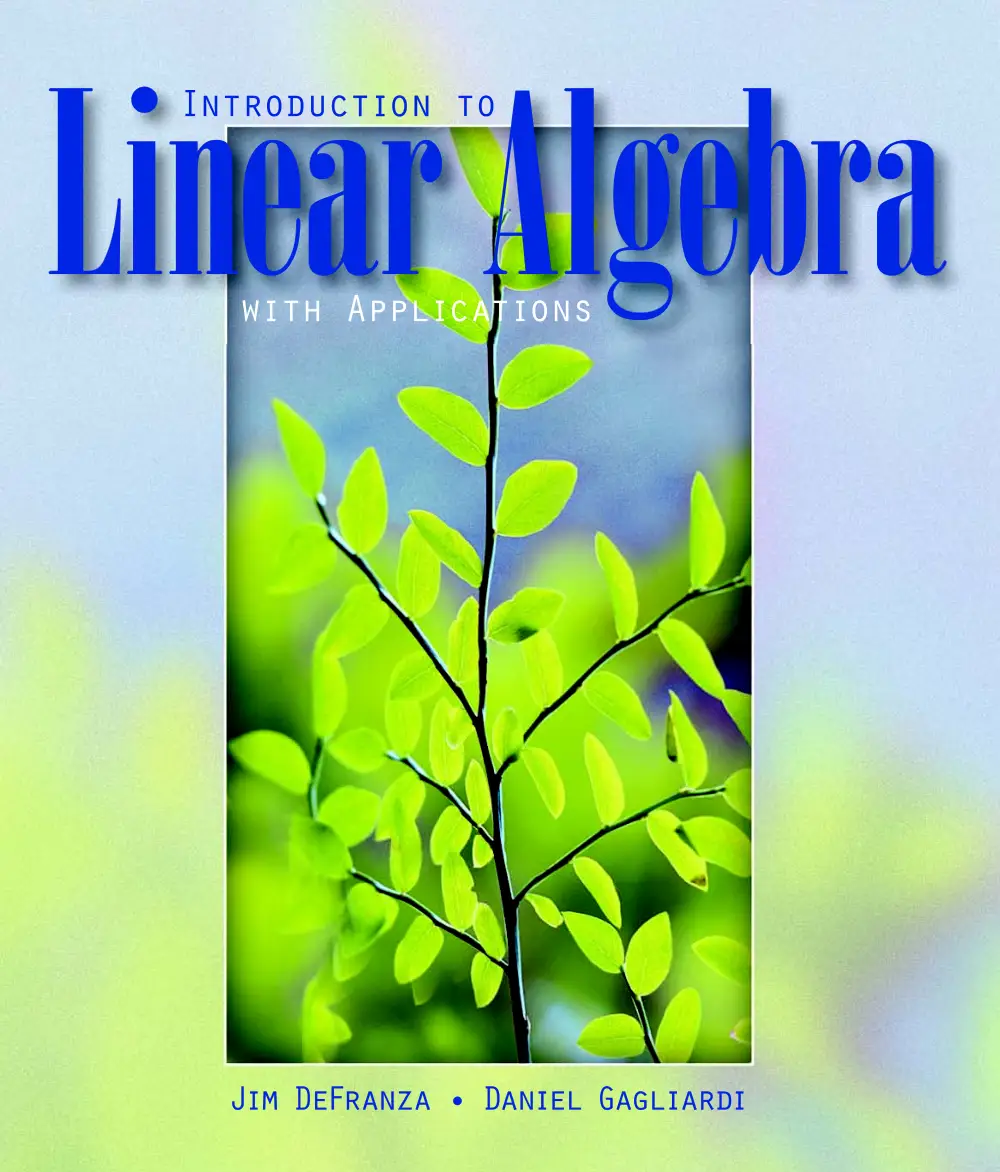
topic should be fully developed before readers move onto the next. The image of a tree
on the front cover of the text is a metaphor for this learning strategy. It is particularly
applicable to the study of mathematics. The trunk of the tree represents the material
that forms the basis for everything that comes afterward. In our text, this material is
contained in Chaps. 1 through 4. All other branches of the tree, representing more
advanced topics and applications, extend from the foundational material of the trunk or
from the ancillary material of the intervening branches. We have specifically designed
our text so that you can read it and learn the concepts of linear algebra in a sequential
and thorough manner. If you remain committed to learning this beautiful subject, the
rewards will be significant in other courses you may take, and in your professional
career. Good luck!
Jim DeFranza
jdefranza@stlawu.edu
Dan Gagliardi
gagliardid@canton.edu
xvi
Applications Index
Aircraft Design, 199
Astronomy, 61
Average Global Temperatures, 371
Balancing Chemical Equations, 1, 79, 84
Carbon Emissions, 321
Cellular Phone Subscribers, 86
Computer Graphics, 199, 255
Cumulative HIV Infections, 376
Data Compression, 401
Differential Equations, 185
Digital Transmissions, 127, 402
Economics, 82, 86, 87
Electrical Networks, 88, 191
Engineering, 185, 191
Epidemics, 87, 315
Exponential Growth and Decay, 186
Fitting Data with a Curve, 11, 61, 366, 372, 376
Fourier Approximation, 373
Infant Mortality Rates, 376
Least Squares Approximation, 321, 366
Linear Regression, 371
Markov Chains, 275, 310
Mass Transit Systems, 315
Mixing, 307, 310
National Health Care, 86
Networks, 79, 85, 89
Nutrition, 81, 85
Photosynthesis, 1
Plant Breading, 315
Population Distribution, 87, 275, 315
Powers of a Matrix, 287
Predator–Prey Models, 300
Projections, 265, 343, 345, 361, 365
Quadratic Forms, 385
Rotation of Axes, 385
Search Engines, 276
xvii
xviii
Applications Index
Signal Processing, 93
Singular Value Decomposition, 392
Systems of Differential Equations, 300
Thermal Equilibrium, 88, 310
Vibrating Spring, 192, 194
World Hydroelectricity Use, 376
World Population, 376
C H A P T E R
Systems of Linear
Equations and Matrices
CHAPTER OUTLINE
1.1
Systems of Linear Equations
2
1.2
Matrices and Elementary Row Operations
14
1.3
Matrix Algebra
26
1.4
The Inverse of a Square Matrix
39
1.5
Matrix Equations
48
1.6
Determinants
54
1.7
Elementary Matrices and LU Factorization
68
1.8
Applications of Systems of Linear Equations
79
I
n the process of photosynthesis solar energy
is converted into forms that are used by living
organisms. The chemical reaction that occurs in
the leaves of plants converts carbon dioxide and
water to carbohydrates with the release of oxygen.
The chemical equation of the reaction takes the
form
aCO2 + bH2O → cO2 + dC6H12O6
where a, b, c, and d are some positive whole
numbers. The law of conservation of mass states
that the total mass of all substances present before
and after a chemical reaction remains the same.
That is, atoms are neither created nor destroyed
Photograph by Jan Smith/RF
in a chemical reaction, so chemical equations must be balanced. To balance the pho-
tosynthesis reaction equation, the s