
MATH 218 Problems Solution Manual Complete, Spring 2013
American University of Beirut · Elementary Linear Algebra with Applications · 182 pages · with solution

Showing the first 10 of 182 pages. Download the PDF to see all of it.
More MATH 218 files
- Questions Fg · Fall 2015ProblemsView
- Problems Solving Session · Spring 2013ProblemsView
- Problems · Spring 2011ProblemsView
- Problems Solving Session · Fall 2011ProblemsView
- Problems · Spring 2011ProblemsView
- Problems · Spring 2011ProblemsView
- Problems · Spring 2011ProblemsView
- Problems · Spring 2011ProblemsView
Show the text of this problems
1.1 Systems of Linear Equations
1
Solutions to All Exercises
1
Systems of Linear Equations and
Matrices
Exercise Set 1.1
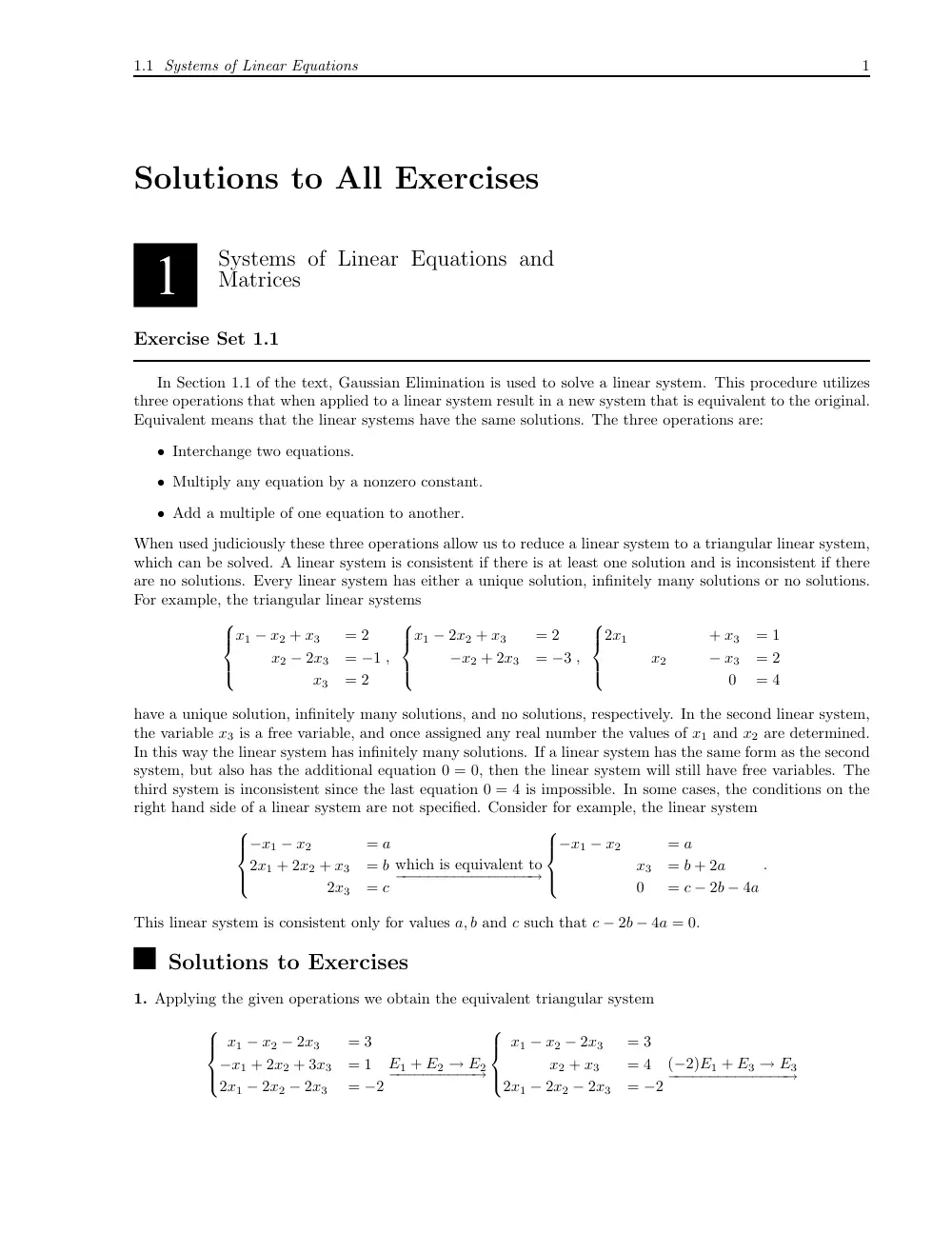
In Section 1.1 of the text, Gaussian Elimination is used to solve a linear system. This procedure utilizes
three operations that when applied to a linear system result in a new system that is equivalent to the original.
Equivalent means that the linear systems have the same solutions. The three operations are:
• Interchange two equations.
• Multiply any equation by a nonzero constant.
• Add a multiple of one equation to another.
When used judiciously these three operations allow us to reduce a linear system to a triangular linear system,
which can be solved. A linear system is consistent if there is at least one solution and is inconsistent if there
are no solutions. Every linear system has either a unique solution, infinitely many solutions or no solutions.
For example, the triangular linear systems
x1 − x2 + x3
= 2
x2 − 2x3
= −1
x3
= 2
,
x1 − 2x2 + x3
= 2
−x2 + 2x3
= −3 ,
2x1
+ x3
= 1
x2
− x3
= 2
0
= 4
have a unique solution, infinitely many solutions, and no solutions, respectively. In the second linear system,
the variable x3 is a free variable, and once assigned any real number the values of x1 and x2 are determined.
In this way the linear system has infinitely many solutions. If a linear system has the same form as the second
system, but also has the additional equation 0 = 0, then the linear system will still have free variables. The
third system is inconsistent since the last equation 0 = 4 is impossible. In some cases, the conditions on the
right hand side of a linear system are not specified. Consider for example, the linear system
−x1 − x2
= a
2x1 + 2x2 + x3
= b
2x3
= c
which is equivalent to
−−−−−−−−−−−−−−−−→
−x1 − x2
= a
x3
= b + 2a
0
= c − 2b − 4a
.
This linear system is consistent only for values a, b and c such that c − 2b − 4a = 0.
Solutions to Exercises
1. Applying the given operations we obtain the equivalent triangular system
x1 − x2 − 2x3
= 3
−x1 + 2x2 + 3x3
= 1
2x1 − 2x2 − 2x3
= −2
E1 + E2 → E2
−−−−−−−−−−→
x1 − x2 − 2x3
= 3
x2 + x3
= 4
2x1 − 2x2 − 2x3
= −2
(−2)E1 + E3 → E3
−−−−−−−−−−−−−−→
2
Chapter
1 Systems of Linear Equations and Matrices
x1 − x2 − 2x3
= 3
x2 + x3
= 4
2x3
= −8
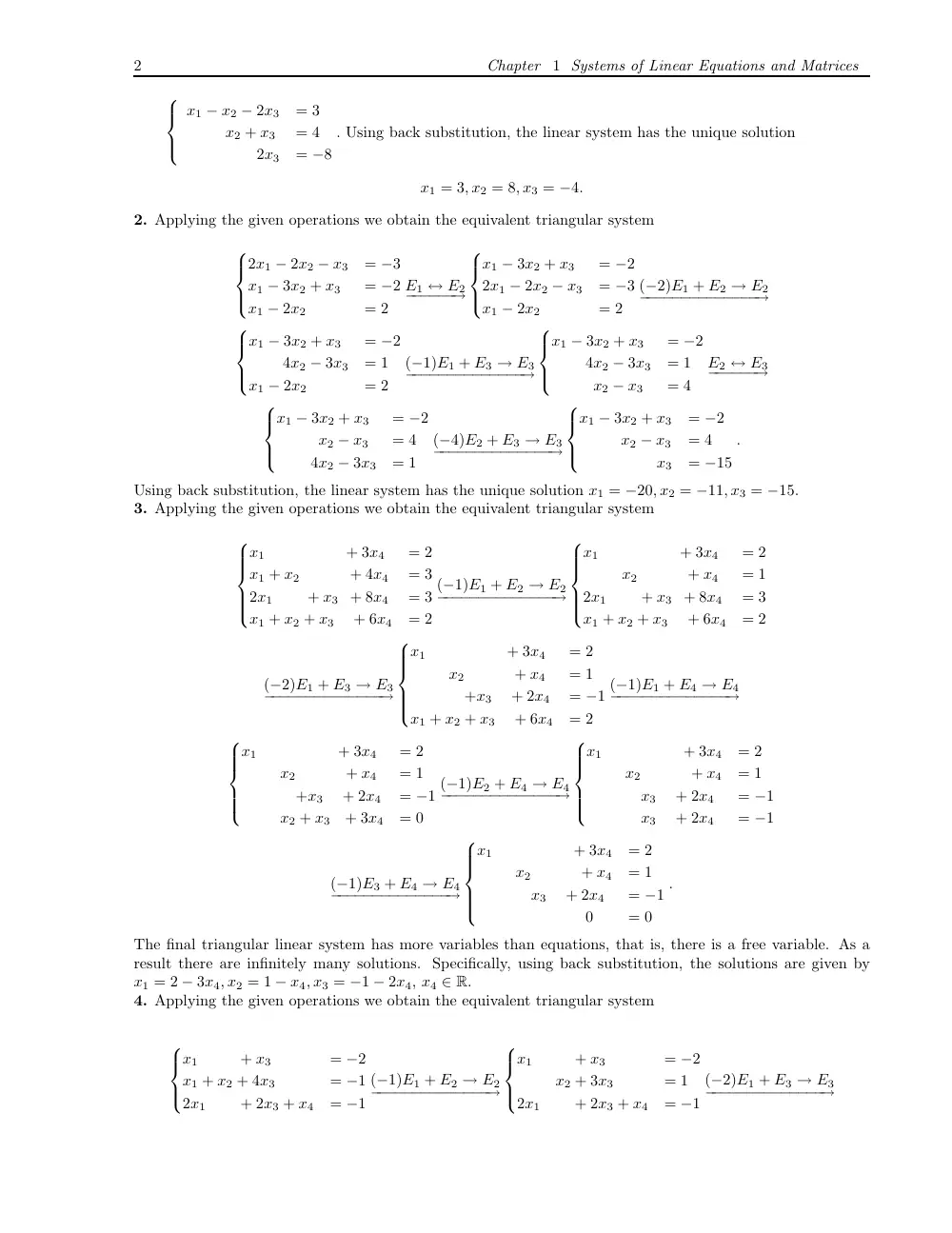
. Using back substitution, the linear system has the unique solution
x1 = 3, x2 = 8, x3 = −4.
2. Applying the given operations we obtain the equivalent triangular system
2x1 − 2x2 − x3
= −3
x1 − 3x2 + x3
= −2
x1 − 2x2
= 2
E1 ↔ E2
−−−−−−→
x1 − 3x2 + x3
= −2
2x1 − 2x2 − x3
= −3
x1 − 2x2
= 2
(−2)E1 + E2 → E2
−−−−−−−−−−−−−−→
x1 − 3x2 + x3
= −2
4x2 − 3x3
= 1
x1 − 2x2
= 2
(−1)E1 + E3 → E3
−−−−−−−−−−−−−−→
x1 − 3x2 + x3
= −2
4x2 − 3x3
= 1
x2 − x3
= 4
E2 ↔ E3
−−−−−−→
x1 − 3x2 + x3
= −2
x2 − x3
= 4
4x2 − 3x3
= 1
(−4)E2 + E3 → E3
−−−−−−−−−−−−−−→
x1 − 3x2 + x3
= −2
x2 − x3
= 4
x3
= −15
.
Using back substitution, the linear system has the unique solution x1 = −20, x2 = −11, x3 = −15.
3. Applying the given operations we obtain the equivalent triangular system
x1
+ 3x4
= 2
x1 + x2
+ 4x4
= 3
2x1
+ x3 + 8x4
= 3
x1 + x2 + x3
+ 6x4
= 2
(−1)E1 + E2 → E2
−−−−−−−−−−−−−−→
x1
+ 3x4
= 2
x2
+ x4
= 1
2x1
+ x3 + 8x4
= 3
x1 + x2 + x3
+ 6x4
= 2
(−2)E1 + E3 → E3
−−−−−−−−−−−−−−→
x1
+ 3x4
= 2
x2
+ x4
= 1
+x3
+ 2x4
= −1
x1 + x2 + x3
+ 6x4
= 2
(−1)E1 + E4 → E4
−−−−−−−−−−−−−−→
x1
+ 3x4
= 2
x2
+ x4
= 1
+x3
+ 2x4
= −1
x2 + x3
+ 3x4
= 0
(−1)E2 + E4 → E4
−−−−−−−−−−−−−−→
x1
+ 3x4
= 2
x2
+ x4
= 1
x3
+ 2x4
= −1
x3
+ 2x4
= −1
(−1)E3 + E4 → E4
−−−−−−−−−−−−−−→
x1
+ 3x4
= 2
x2
+ x4
= 1
x3
+ 2x4
= −1
0
= 0
.
The final triangular linear system has more variables than equations, that is, there is a free variable. As a
result there are infinitely many solutions. Specifically, using back substitution, the solutions are given by
x1 = 2 − 3x4, x2 = 1 − x4, x3 = −1 − 2x4, x4 ∈ R.
4. Applying the given operations we obtain the equivalent triangular system
x1
+ x3
= −2
x1 + x2 + 4x3
= −1
2x1
+ 2x3 + x4
= −1
(−1)E1 + E2 → E2
−−−−−−−−−−−−−−→
x1
+ x3
= −2
x2 + 3x3
= 1
2x1
+ 2x3 + x4
= −1
(−2)E1 + E3 → E3
−−−−−−−−−−−−−−→
1.1 Systems of Linear Equations
3
x1
+ x3
= −2
x2 + 3x3
= 1
x4
= 3
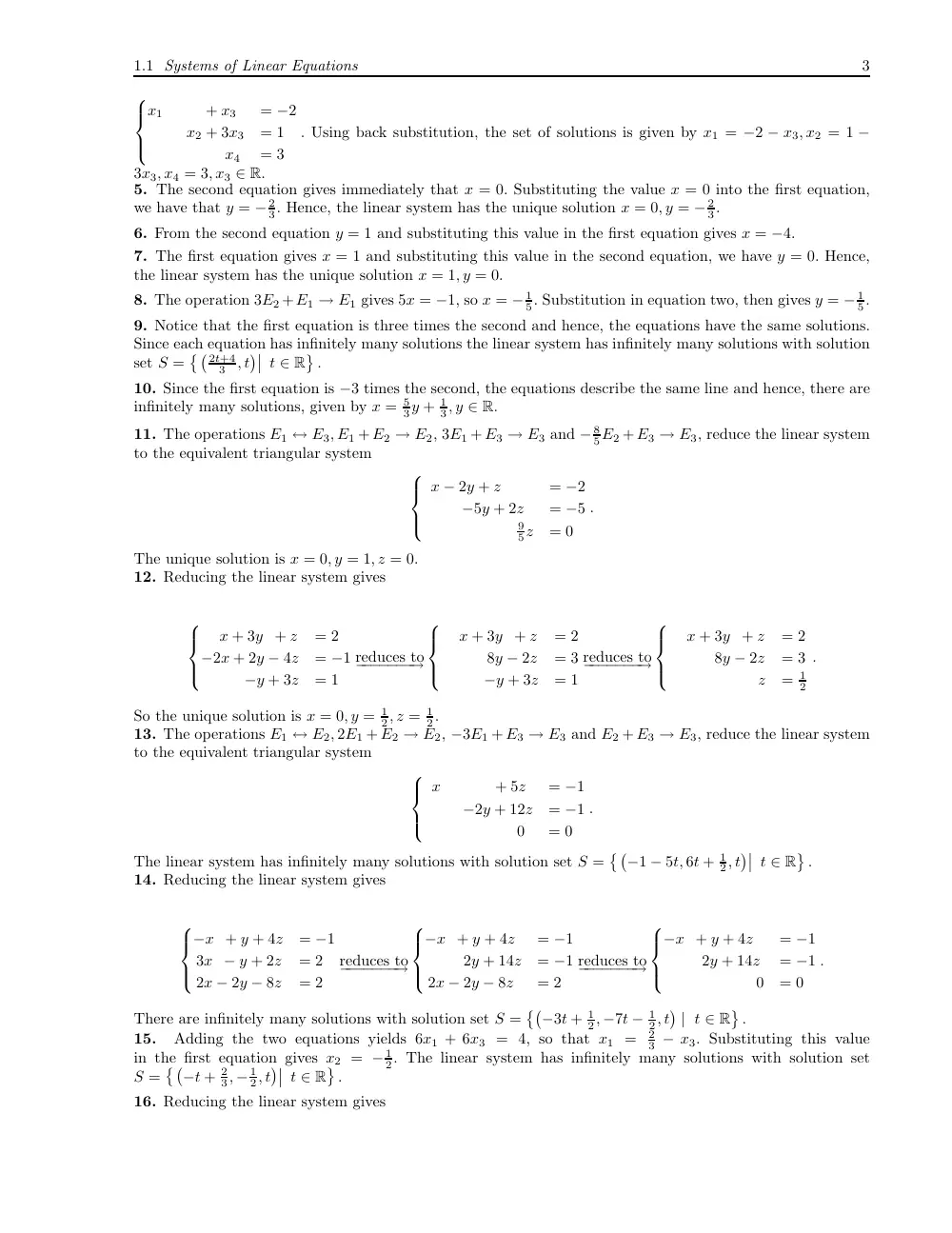
. Using back substitution, the set of solutions is given by x1 = −2 − x3, x2 = 1 −
3x3, x4 = 3, x3 ∈ R.
5. The second equation gives immediately that x = 0. Substituting the value x = 0 into the first equation,
we have that y = − 2
3. Hence, the linear system has the unique solution x = 0, y = − 2
3.
6. From the second equation y = 1 and substituting this value in the first equation gives x = −4.
7. The first equation gives x = 1 and substituting this value in the second equation, we have y = 0. Hence,
the linear system has the unique solution x = 1, y = 0.
8. The operation 3E2 +E1 → E1 gives 5x = −1, so x = − 1
5. Substitution in equation two, then gives y = − 1
5.
9. Notice that the first equation is three times the second and hence, the equations have the same solutions.
Since each equation has infinitely many solutions the linear system has infinitely many solutions with solution
set S =
�� 2t+4
3 , t
��� t ∈ R
�
.
10. Since the first equation is −3 times the second, the equations describe the same line and hence, there are
infinitely many solutions, given by x = 5
3y + 1
3, y ∈ R.
11. The operations E1 ↔ E3, E1 +E2 → E2, 3E1 +E3 → E3 and − 8
5E2 +E3 → E3, reduce the linear system
to the equivalent triangular system
x − 2y + z
= −2
−5y + 2z
= −5
9
5z
= 0
.
The unique solution is x = 0, y = 1, z = 0.
12. Reducing the linear system gives
x + 3y + z
= 2
−2x + 2y − 4z
= −1
−y + 3z
= 1
reduces to
−−−−−−−→
x + 3y + z
= 2
8y − 2z
= 3
−y + 3z
= 1
reduces to
−−−−−−−→
x + 3y + z
= 2
8y − 2z
= 3
z
= 1
2
.
So the unique solution is x = 0, y = 1
2, z = 1
2.
13. The operations E1 ↔ E2, 2E1 + E2 → E2, −3E1 + E3 → E3 and E2 + E3 → E3, reduce the linear system
to the equivalent triangular system
x
+ 5z
= −1
−2y + 12z
= −1
0
= 0
.
The linear system has infinitely many solutions with solution set S =
��
−1 − 5t, 6t + 1
2, t
��� t ∈ R
�
.
14. Reducing the linear system gives
−x + y + 4z
= −1
3x − y + 2z
= 2
2x − 2y − 8z
= 2
reduces to
−−−−−−−→
−x + y + 4z
= −1
2y + 14z
= −1
2x − 2y − 8z
= 2
reduces to
−−−−−−−→
−x + y + 4z
= −1
2y + 14z
= −1
0
= 0
.
There are infinitely many solutions with solution set S =
��
−3t + 1
2, −7t − 1
2, t
�
| t ∈ R
�
.
15.
Adding the two equations yields 6x1 + 6x3 = 4, so that x1 =
2
3 − x3. Substituting this value
in the first equation gives x2 = − 1
2. The linear system has infinitely many solutions with solution set
S =
��
−t + 2
3, − 1
2, t
��� t ∈ R
�
.
16. Reducing the linear system gives
4
Chapter
1 Systems of Linear Equations and Matrices
�
−2x1 + x2
= 2
3x1 − x2 + 2x3
= 1 reduces to
−−−−−−−→
�
−2x1 + x2
= 2
x2 + 4x3
= 8 .
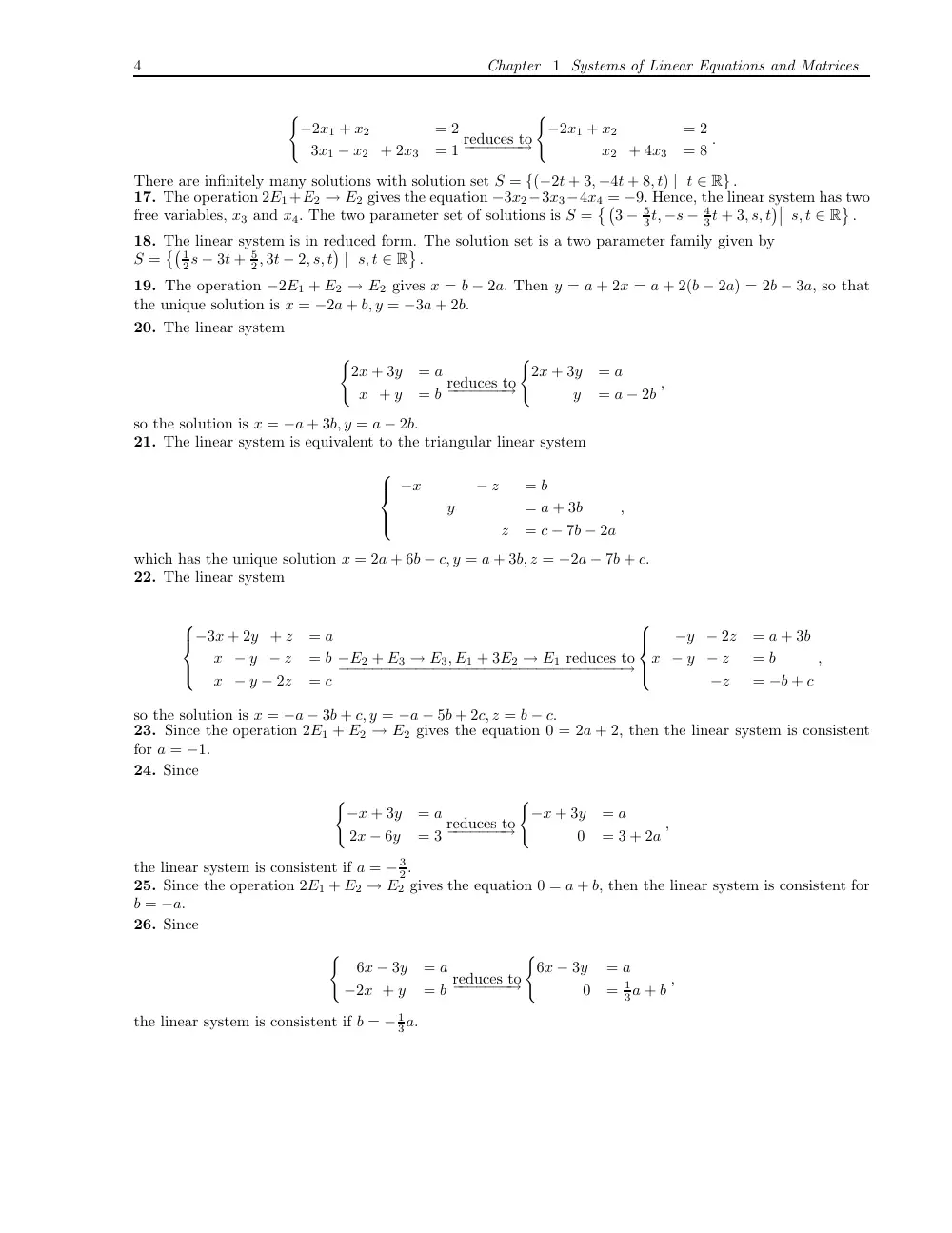
There are infinitely many solutions with solution set S = {(−2t + 3, −4t + 8, t) | t ∈ R} .
17. The operation 2E1+E2 → E2 gives the equation −3x2−3x3−4x4 = −9. Hence, the linear system has two
free variables, x3 and x4. The two parameter set of solutions is S =
��
3 − 5
3t, −s − 4
3t + 3, s, t
��� s, t ∈ R
�
.
18. The linear system is in reduced form. The solution set is a two parameter family given by
S =
�� 1
2s − 3t + 5
2, 3t − 2, s, t
�
| s, t ∈ R
�
.
19. The operation −2E1 + E2 → E2 gives x = b − 2a. Then y = a + 2x = a + 2(b − 2a) = 2b − 3a, so that
the unique solution is x = −2a + b, y = −3a + 2b.
20. The linear system
�
2x + 3y
= a
x + y
= b reduces to
−−−−−−−→
�
2x + 3y
= a
y
= a − 2b ,
so the solution is x = −a + 3b, y = a − 2b.
21. The linear system is equivalent to the triangular linear system
−x
− z
= b
y
= a + 3b
z
= c − 7b − 2a
,
which has the unique solution x = 2a + 6b − c, y = a + 3b, z = −2a − 7b + c.
22. The linear system
−3x + 2y + z
= a
x − y − z
= b
x − y − 2z
= c
−E2 + E3 → E3, E1 + 3E2 → E1 reduces to
−−−−−−−−−−−−−−−−−−−−−−−−−−−−−−−−−→
−y − 2z
= a + 3b
x − y − z
= b
−z
= −b + c
,
so the solution is x = −a − 3b + c, y = −a − 5b + 2c, z = b − c.
23. Since the operation 2E1 + E2 → E2 gives the equation 0 = 2a + 2, then the linear system is consistent
for a = −1.
24. Since
�
−x + 3y
= a
2x − 6y
= 3 reduces to
−−−−−−−→
�
−x + 3y
= a
0
= 3 + 2a ,
the linear system is consistent if a = − 3
2.
25. Since the operation 2E1 + E2 → E2 gives the equation 0 = a + b, then the linear system is consistent for
b = −a.
26. Since
�
6x − 3y
= a
−2x + y
= b reduces to
−−−−−−−→
�
6x − 3y
= a
0
= 1
3a + b ,
the linear system is consistent if b = − 1
3a.
1.1 Systems of Linear Equations
5
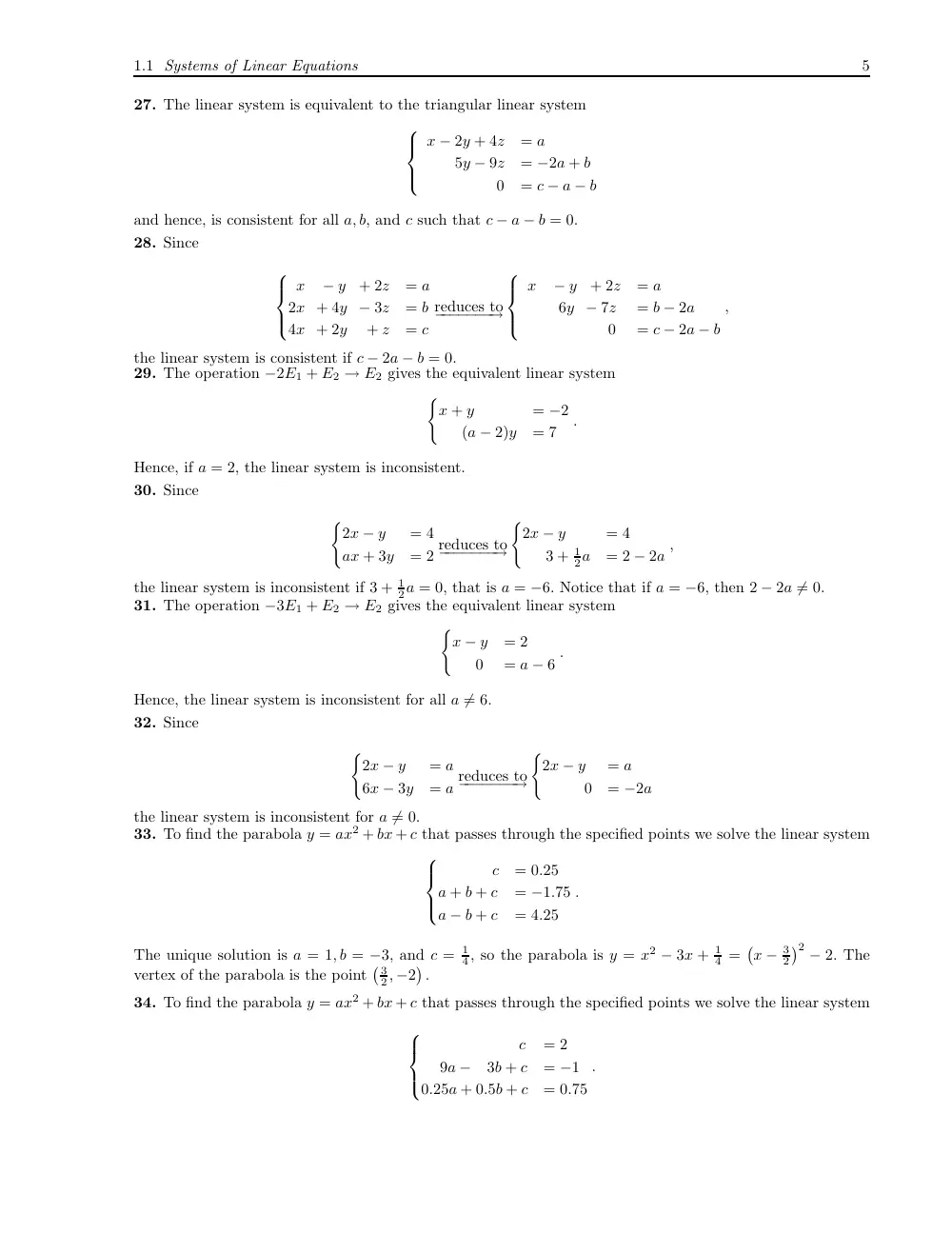
27. The linear system is equivalent to the triangular linear system
x − 2y + 4z
= a
5y − 9z
= −2a + b
0
= c − a − b
and hence, is consistent for all a, b, and c such that c − a − b = 0.
28. Since
x
− y
+ 2z
= a
2x + 4y − 3z
= b
4x + 2y
+ z
= c
reduces to
−−−−−−−→
x
− y
+ 2z
= a
6y − 7z
= b − 2a
0
= c − 2a − b
,
the linear system is consistent if c − 2a − b = 0.
29. The operation −2E1 + E2 → E2 gives the equivalent linear system
�
x + y
= −2
(a − 2)y
= 7
.
Hence, if a = 2, the linear system is inconsistent.
30. Since
�
2x − y
= 4
ax + 3y
= 2 reduces to
−−−−−−−→
�
2x − y
= 4
3 + 1
2a
= 2 − 2a ,
the linear system is inconsistent if 3 + 1
2a = 0, that is a = −6. Notice that if a = −6, then 2 − 2a ̸= 0.
31. The operation −3E1 + E2 → E2 gives the equivalent linear system
�
x − y
= 2
0
= a − 6 .
Hence, the linear system is inconsistent for all a ̸= 6.
32. Since
�
2x − y
= a
6x − 3y
= a reduces to
−−−−−−−→
�
2x − y
= a
0
= −2a
the linear system is inconsistent for a ̸= 0.
33. To find the parabola y = ax2 + bx + c that passes through the specified points we solve the linear system
c
= 0.25
a + b + c
= −1.75
a − b + c
= 4.25
.
The unique solution is a = 1, b = −3, and c = 1
4, so the parabola is y = x2 − 3x + 1
4 =
�
x − 3
2
�2 − 2. The
vertex of the parabola is the point
� 3
2, −2
�
.
34. To find the parabola y = ax2 + bx + c that passes through the specified points we solve the linear system
c
= 2
9a −
3b + c
= −1
0.25a + 0.5b + c
= 0.75
.
6
Chapter
1 Systems of Linear Equations and Matrices
The unique solution is a = −1, b = −2 and c = 2, so the parabola is y = −x2 − 2x + 2 = −(x + 1)2 + 3. The
vertex of the parabola is (−1, 3).
35. To find the parabola y = ax2 + bx + c that passes through the specified points we solve the linear system
(−0.5)2a − (0.5)b + c
= −3.25
a +
b + c
= 2
(2.3)2a
+ (2.3)b + c
= 2.91
.
The unique solution is a = −1, b = −4, and c = −1, so the parabola is y = −x2 + 4x − 1 = −(x − 2)2 + 3.
The vertex of the parabola is the point (2, 3).
36. To find the parabola y = ax2 + bx + c that passes through the specified points we solve the linear system
c
= −2875
a + b + c
= −5675
9a + 3b + c
= 5525
.
The unique solution is a = 2800, b = −5600, and c = −2875, so the parabola is y = 2800x2 − 5600x − 2875.
The x coordinate of the vertex is given by x = − b
2a, so x = 1. The y coordinate of the vertex is y = −5675.
37. a. The point of intersection of the three lines can be
found by solving the linear system
−x + y
= 1
−6x + 5y
= 3
12x + 5y
= 39
.
This linear system has the unique solution (2, 3).
b.
x
y
25
25
5
5
38. a. The point of intersection of the three lines can be
found by solving the linear system
2x + y
= 0
x + y
= −1
3x + y
= 1
4x + y
= 2
.
This linear system has the unique solution (1, −2).
b.
x
y
25
25
5
5
39. a. The linear system
�
x + y
= 2
x − y
= 0 has the unique solution x = 1 and y = 1. Notice that the two lines
have different slopes.
b.
The linear system
�
x + y
= 1
2x + 2y
= 2 has infinitely many solutions given by the one parameter set S =
{(1 − t, t) | t ∈ R}. Notice that the second equation is twice the first and the equations represent the same
line.
c. The linear system
�
x + y
= 2
3x + 3y
= −6 is inconsistent.
40. Using the operations dE1 → E1, bE2 → E2, followed by (−1)E2 + E1 → E1 gives (ad − bc)x = dx1 − bx2.
Since ad − bc is not zero, we have that x = dx1−bx2
ad−bc . In a similar way, we have that y = ax2−cx1
ad−bc .
41. a. S = {(3 − 2s − t, 2 + s − 2t, s, t) | s, t ∈ R}
b. S = {(7 − 2s − 5t, s, −2 + s + 2t, t) | s, t ∈ R}
1.2 Matrices and Elementary Row Operations
7
42. a. Let x4 = s, and x5 = t, so that x3 = 2 + 2s − 3t, x2 = −1 + s + t, and x1 = −2 + 3t.
b. Let x3 = s
and x5 = t, so that x4 = −1 + 1
2s + 3
2t, x2 = −2 + 1
2s + 5
2t, and x1 = −2 + 3t.
43. Applying kE1 → E1, 9E2 → E2, and −E1 + E2 → E2 gives the equivalent linear system
�
9kx +
k2y
= 9k
(9 − k2)y
= −27 − 9k .
Whether the linear system is consistent or inconsistent can now be determined by examining the second
equation.
a. If k = 3, the second equation becomes 0 = −54, so the linear system is inconsistent. b. If k = −3, then
the second equation becomes 0 = 0, so the linear system has infinitely many solutions. c. If k ̸= ±3, then the
linear system has a unique solution.
44. The linear system
kx + y + z
= 0
x + ky + z
= 0
x + y + kz
= 0
reduces to
−−−−−−−→
x +
ky +
z
= 0
(1 − k)y + (k − 1)z
= 0
(2 + k)(1 − k)z
= 0
.
a. The linear system has a unique solution if k ̸= 1 and k ̸= −2. b. If k = −2, the solution set is a one
parameter family. c. If k = 1, the solution set is a two parameter family.
Exercise Set 1.2
Matrices are used to provide an alternative way to represent a linear system. Reducing a linear system to
triangular form is then equivalent to row reducing the augmented matrix corresponding to the linear system
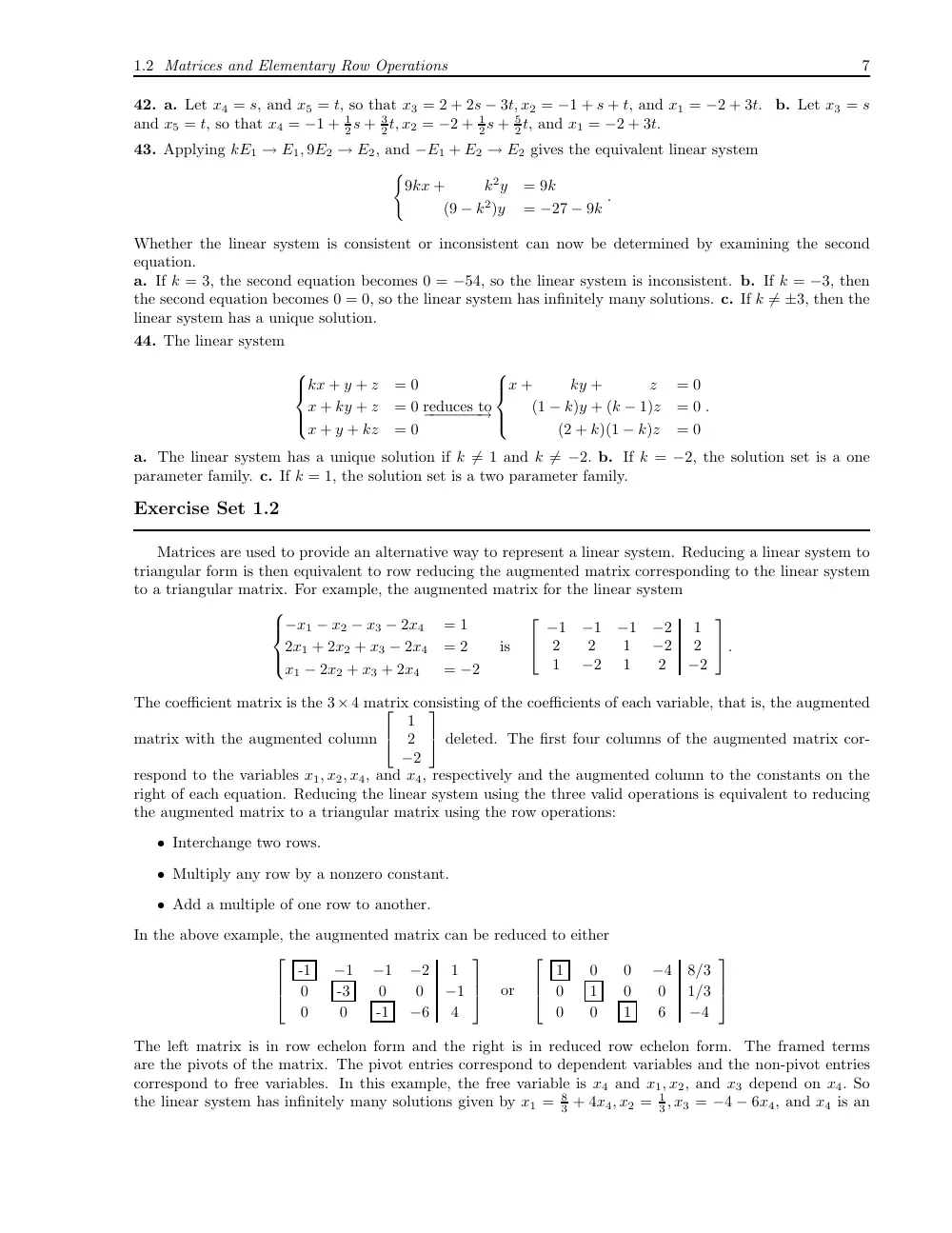
to a triangular matrix. For example, the augmented matrix for the linear system
−x1 − x2 − x3 − 2x4
= 1
2x1 + 2x2 + x3 − 2x4
= 2
x1 − 2x2 + x3 + 2x4
= −2
is
−1
−1
−1
−2
1
2
2
1
−2
2
1
−2
1
2
−2
.
The coefficient matrix is the 3×4 matrix consisting of the coefficients of each variable, that is, the augmented
matrix with the augmented column
1
2
−2
deleted. The first four columns of the augmented matrix cor-
respond to the variables x1, x2, x4, and x4, respectively and the augmented column to the constants on the
right of each equation. Reducing the linear system using the three valid operations is equivalent to reducing
the augmented matrix to a triangular matrix using the row operations:
• Interchange two rows.
• Multiply any row by a nonzero constant.
• Add a multiple of one row to another.
In the above example, the augmented matrix can be reduced to either
-1
−1
−1
−2
1
0
-3
0
0
−1
0
0
-1
−6
4
or
1
0
0
−4
8/3
0
1
0
0
1/3
0
0
1
6
−4
The left matrix is in row echelon form and the right is in reduced row echelon form. The framed terms
are the pivots of the matrix. The pivot entries correspond to dependent variables and the non-pivot entries
correspond to free variables. In this example, the free variable is x4 and x1, x2, and x3 depend on x4. So
the linear system has infinitely many solutions given by x1 = 8
3 + 4x4, x2 = 1
3, x3 = −4 − 6x4, and x4 is an
8
Chapter
1 Systems of Linear Equations and Matrices
arbitrary real number. For a linear system with the same number of equations as variables, there will be a
unique solution if and only if the coefficient matrix can be row reduced to the matrix with each diagonal entry
1 and all others 0.
Solutions to Exercises
1.
�
2
−3
5
−1
1
−3
�
2.
� 2
−2
1
3
0
1
�
3.
2
0
−1
4
1
4
1
2
4
1
−1
1
4.
−3
1
1
2
0
0
−4
0
−4
2
−3
1
5.
� 2
0
−1
4
1
4
1
2
�
6.
� 4
1
−1
1
4
−4
2
−2
�
7.
2
4
2
2
−2
4
−2
−3
−2
2
1
3
3
−3
−4
8.
3
0
−3
4
−3
−4
2
−2
−4
4
0
4
−3
2
−3
9. The linear system has the unique solution x =
−1, y = 1
2, z = 0.
10.
The linear system has the unique solution
x = 2, y = 0, z = − 2
3.
11. The linear system is consistent with free vari-
able z. There are infinitely many solutions given
by x = −3 − 2z, y = 2 + z, z ∈ R.
12. The linear system is consistent with free vari-
able z. There are infinitely many solutions given
by x = 4 + 1
3z, y = 4
3 − 3z, z ∈ R.
13. The variable z = 2 and y is a free variable,
so the linear system has infinitely many solutions
given by x = −3 + 2y, z = 2, y ∈ R.
14. The variables y and z are free variables, so
the linear system has infinitely many solutions
given by x = −1 − 5y − 5z, y ∈ R, z ∈ R.
15.
The last row of the matrix represents the
impossible equation 0 = 1, so the linear system is
inconsistent.
16.
The last row of the matrix represents the
impossible equation 0 = 1, so the linear system is
inconsistent.
17.
The linear system is consistent with free
variables z and w. The solutions are given by
x = 3 + 2z − 5w, y = 2 + z − 2w, z ∈ R, w ∈ R.
18.
The linear system is consistent with free
variables y and z. The solutions are given by
x = 1 − 3y + 3z, w = 4, y ∈ R, z ∈ R.
19.
The linear system has infinitely many so-
lutions given by x = 1 + 3w, y = 7 + w, z =
−1 − 2w, w ∈ R.
20. The linear system has infinitely many solu-
tions given by x = −1− 2
5z, y = 1+3z, w = 4
5, z ∈
R.
21. The matrix is in reduced row echelon form.
22. The matrix is in reduced row echelon form.
23.
Since the matrix contains nonzero entries
above the pivots in rows two and three, the ma-
trix is not in reduced row echelon form.
24. Since the pivot in row two is not a one, the
matrix is not in reduced row echelon form.
25. The matrix is in reduced row echelon form.
26. The matrix is in reduced row echelon form.
27. Since the first nonzero term in row three is
to the left of the first nonzero term in row two,
the matrix is not in reduced row echelon form.
28.
Since the matrix contains nonzero entries
above the pivots in rows two and three, the ma-
trix is not in reduced row echelon form.
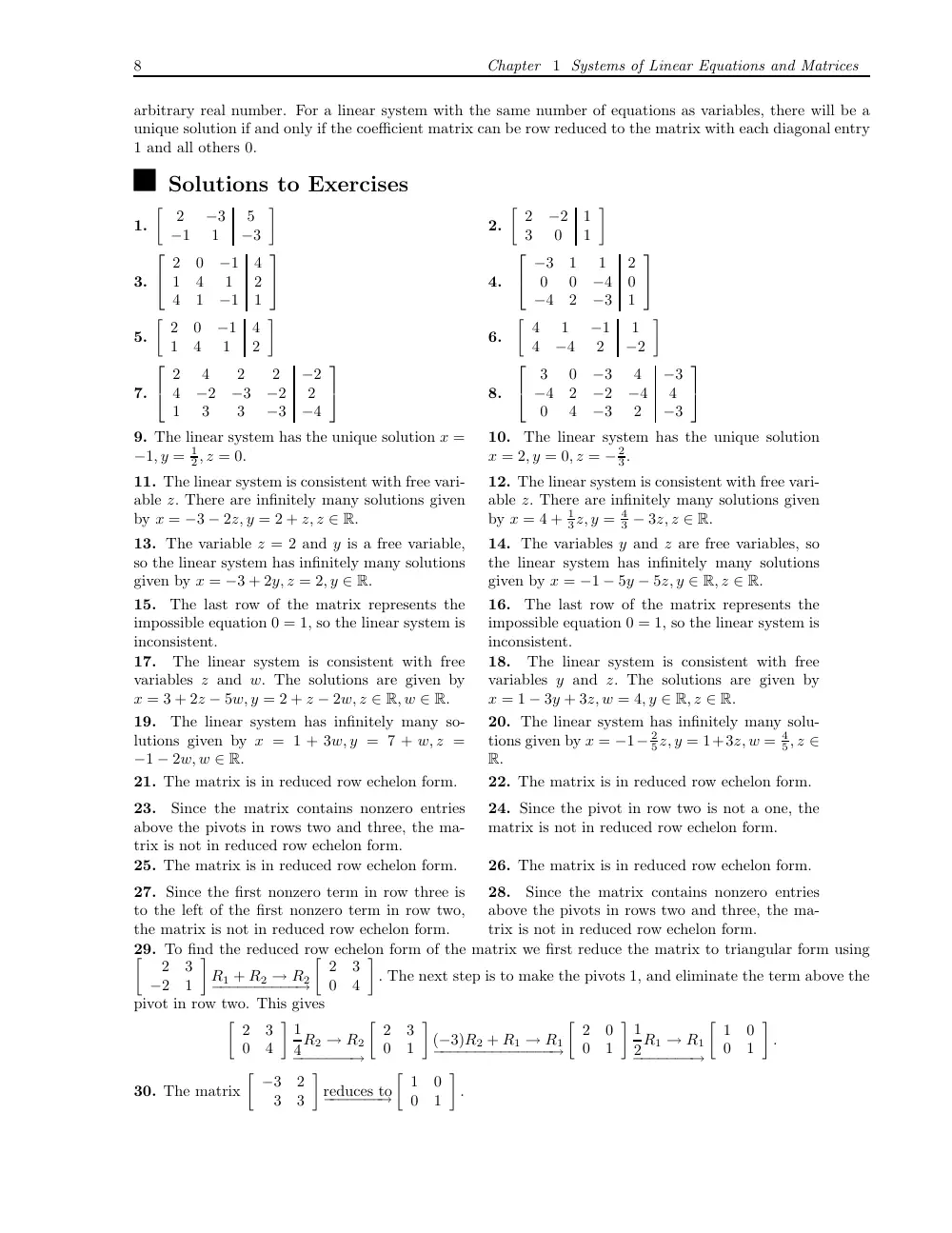
29. To find the reduced row echelon form of the matrix we first reduce the matrix to triangular form using
�
2
3
−2
1
�
R1 + R2 → R2
−−−−−−−−−−→
� 2
3
0
4
�
. The next step is to make the pivots 1, and eliminate the term above the
pivot in row two. This gives
�
2
3
0
4
� 1
4R2 → R2
−−−−−−−→
�
2
3
0
1
�
(−3)R2 + R1 → R1
−−−−−−−−−−−−−−→
�
2
0
0
1
� 1
2R1 → R1
−−−−−−−→
�
1
0
0
1
�
.
30. The matrix
� −3
2
3
3
�
reduces to
−−−−−−−→
� 1
0
0
1
�
.
1.2 Matrices and Elementary Row Operations
9
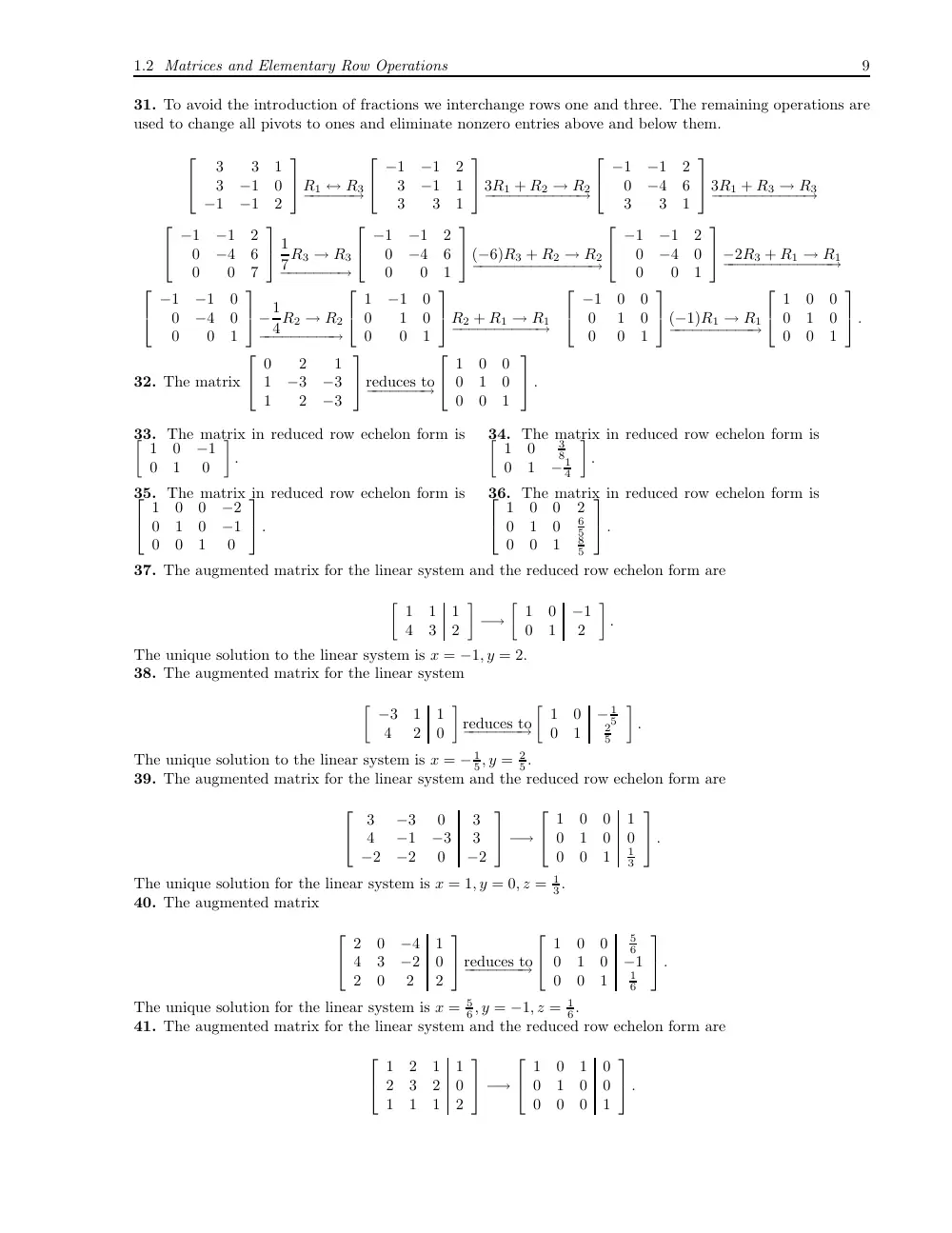
31. To avoid the introduction of fractions we interchange rows one and three. The remaining operations are
used to change all pivots to ones and eliminate nonzero entries above and below them.
3
3
1
3
−1
0
−1
−1
2
R1 ↔ R3
−−−−−−→
−1
−1
2
3
−1
1
3
3
1
3R1 + R2 → R2
−−−−−−−−−−−→
−1
−1
2
0
−4
6
3
3
1
3R1 + R3 → R3
−−−−−−−−−−−→
−1
−1
2
0
−4
6
0
0
7
1
7R3 → R3
−−−−−−−→
−1
−1
2
0
−4
6
0
0
1
(−6)R3 + R2 → R2
−−−−−−−−−−−−−−→
−1
−1
2
0
−4
0
0
0
1
−2R3 + R1 → R1
−−−−−−−−−−−−−→
−1
−1
0
0
−4
0
0
0
1
−1
4R2 → R2
−−−−−−−−−→
1
−1
0
0
1
0
0
0
1
R2 + R1 → R1
−−−−−−−−−−→
−1
0
0
0
1
0
0
0
1
(−1)R1 → R1
−−−−−−−−−−→
1
0
0
0
1
0
0
0
1
.
32. The matrix
0
2
1
1
−3
−3
1
2
−3
reduces to
−−−−−−−→
1
0
0
0
1
0
0
0
1
.
33. The matrix in reduced row echelon form is
� 1
0
−1
0
1
0
�
.
34. The matrix in reduced row echelon form is
�
1
0
3
8
0
1
− 1
4
�
.
35. The matrix in reduced row echelon form is
1
0
0
−2
0
1
0
−1
0
0
1
0
.
36. The matrix in reduced row echelon form is
1
0
0
2
0
1
0
6
5
0
0
1
8
5
.
37. The augmented matrix for the linear system and the reduced row echelon form are
�
1
1
1
4
3
2
�
−→
�
1
0
−1
0
1
2
�
.
The unique solution to the linear system is x = −1, y = 2.
38. The augmented matrix for the linear system
� −3
1
1
4
2
0
�
reduces to
−−−−−−−→
� 1
0
− 1
5
0
1
2
5
�
.
The unique solution to the linear system is x = − 1
5, y = 2
5.
39. The augmented matrix for the linear system and the reduced row echelon form are
3
−3
0
3
4
−1
−3
3
−2
−2
0
−2
−→
1
0
0
1
0
1
0
0
0
0
1
1
3
.
The unique solution for the linear system is x = 1, y = 0, z = 1
3.
40. The augmented matrix
2
0
−4
1
4
3
−2
0
2
0
2
2
reduces to
−−−−−−−→
1
0
0
5
6
0
1
0
−1
0
0
1
1
6
.
The unique solution for the linear system is x = 5
6, y = −1, z = 1
6.
41. The augmented matrix for the linear system and the reduced row echelon form are
1
2
1
1
2
3
2
0
1
1
1
2
−→
1
0
1
0
0
1
0
0
0
0
0
1
.
10
Chapter
1 Systems of Linear Equations and Matrices
The linear system is inconsistent.
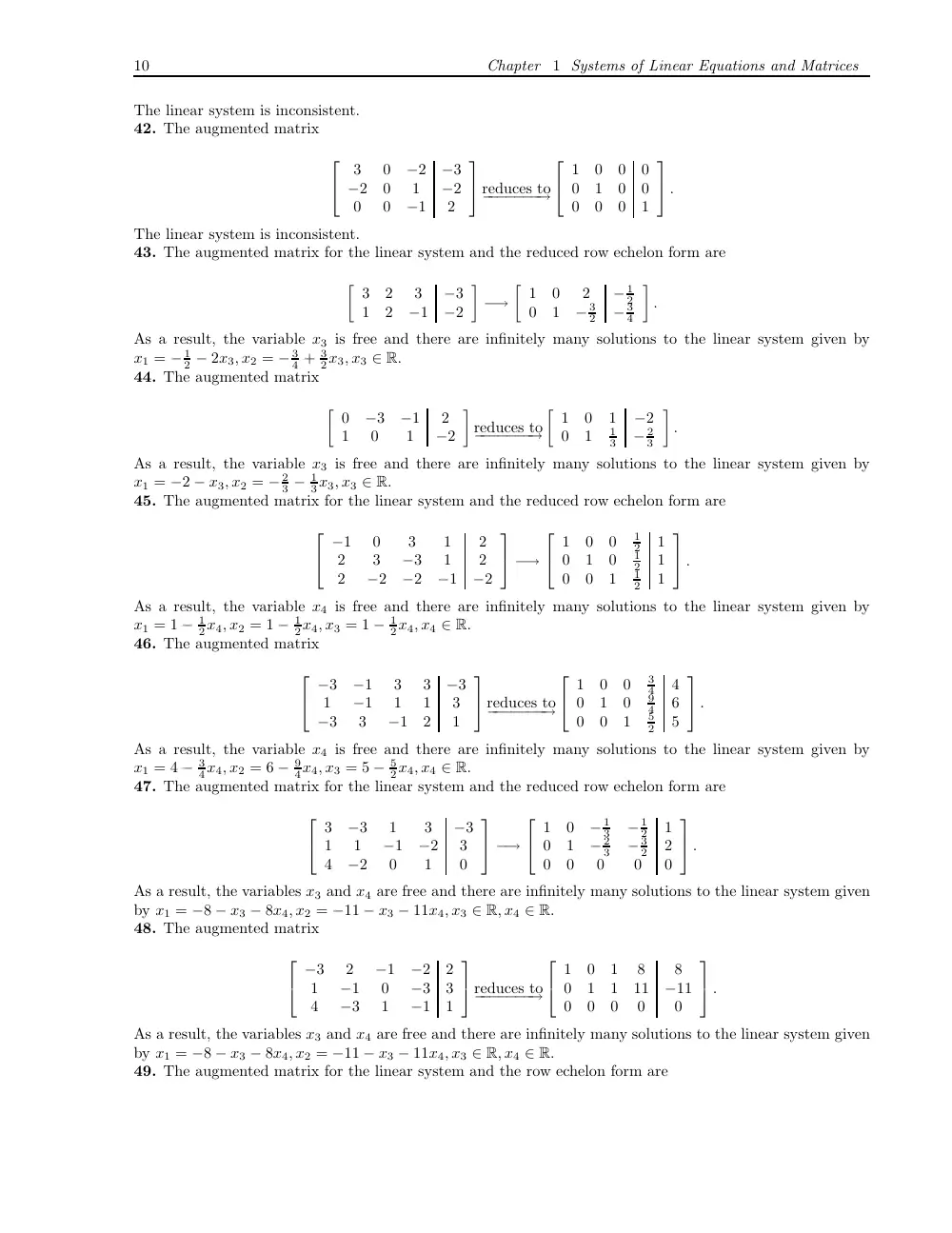
42. The augmented matrix
3
0
−2
−3
−2
0
1
−2
0
0
−1
2
reduces to
−−−−−−−→
1
0
0
0
0
1
0
0
0
0
0
1
.
The linear system is inconsistent.
43. The augmented matrix for the linear system and the reduced row echelon form are
�
3
2
3
−3
1
2
−1
−2
�
−→
�
1
0
2
− 1
2
0
1
− 3
2
− 3
4
�
.
As a result, the variable x3 is free and there are infinitely many solutions to the linear system given by
x1 = − 1
2 − 2x3, x2 = − 3
4 + 3
2x3, x3 ∈ R.
44. The augmented matrix
� 0
−3
−1
2
1
0
1
−2
�
reduces to
−−−−−−−→
� 1
0
1
−2
0
1
1
3
− 2
3
�
.
As a result, the variable x3 is free and there are infinitely many solutions to the linear system given by
x1 = −2 − x3, x2 = − 2
3 − 1
3x3, x3 ∈ R.
45. The augmented matrix for the linear system and the reduced row echelon form are
−1
0
3
1
2
2
3
−3
1
2
2
−2
−2
−1
−2
−→
1
0
0
1
2
1
0
1
0
1
2
1
0
0
1
1
2
1
.
As a result, the variable x4 is free and there are infinitely many solutions to the linear system given by
x1 = 1 − 1
2x4, x2 = 1 − 1
2x4, x3 = 1 − 1
2x4, x4 ∈ R.
46. The augmented matrix
−3
−1
3
3
−3
1
−1
1
1
3
−3
3
−1
2
1
reduces to
−−−−−−−→
1
0
0
3
4
4
0
1
0
9
4
6
0
0
1
5
2
5
.
As a result, the variable x4 is free and there are infinitely many solutions to the linear system given by
x1 = 4 − 3
4x4, x2 = 6 − 9
4x4, x3 = 5 − 5
2x4, x4 ∈ R.
47. The augmented matrix for the linear system and the reduced row echelon form are
3
−3
1
3
−3
1
1
−1
−2
3
4
−2
0
1
0
−→
1
0
− 1
3
− 1
2
1
0
1
− 2
3
− 3
2
2
0
0
0
0
0
.
As a result, the variables x3 and x4 are free and there are infinitely many solutions to the linear system given
by x1 = −8 − x3 − 8x4, x2 = −11 − x3 − 11x4, x3 ∈ R, x4 ∈ R.
48. The augmented matrix
−3
2
−1
−2
2
1
−1
0
−3
3
4
−3
1
−1
1
reduces to
−−−−−−−→
1
0
1
8
8
0
1
1
11
−11
0
0
0
0
0
.
As a result, the variables x3 and x4 are free and there are infinitely many solutions to the linear system given
by x1 = −8 − x3 − 8x4, x2 = −11 − x3 − 11x4, x3 ∈ R, x4 ∈ R.
49. The augmented matrix for the linear system and the row echelon form are
1.3 Matrix Algebra
11
1
2
−1
a
2
3
−2
b
−1
−1
1
c
−→
1
2
−1
a
0
−1
0
−2a + b
0
0
0
−a + b + c
.
a. The linear system is consistent precisely when the last equation, from the row echelon form, is consistent.
That is, when c − a + b = 0. b. Similarly, the linear system is inconsistent when c − a + b ̸= 0. c. For those
values of a, b, and c for which the linear system is consistent, there is a free variable, so that there are infinitely
many solutions. d. The linear system is consistent if a = 1, b = 0, c = 1. If the variables are denoted by x, y
and z, then one solution is obtained by setting z = 1, that is, x = −2, y = 2, z = 1.
50. Reducing the augmented matrix gives
� a
1
1
2
a − 1
1
�
→
� 2
a − 1
1
a
1
1
�
→
� 1
a−1
2
1
2
a
1
1
�
→
� 1
a−1
2
1
2
0
− a(a−1)
2
+ 1
1 − 1
2a
�
.
a. If a ̸= −1, the linear system is consistent.
b. If the linear system is consistent and a ̸= 2, then the
solution is unique. If the linear system is consistent and a = 2 there are infinitely many solutions.
c. Let
a = 1. The unique solution is x = 1
2, y = 1
2.
51. The augmented matrix for the linear system and the reduced row echelon form are
−2
3
1
a
1
1
−1
b
0
5
−1
c
−→
1
0
− 4
5
− 1
2a + 3
10b
0
1
− 1
5
1
5c
0
0
0
a + 2b − c
.
a. The linear system is consistent precisely when the last equation, from the reduced row echelon form, is
consistent. That is, when a+2b−c = 0. b. Similarly, the linear system is inconsistent when a+2b−c = 0 ̸= 0.
c. For those values of a, b, and c for which the linear system is consistent, there is a free variable, so that
there are infinitely many solutions. d. The linear system is consistent if a = 0, b = 0, c = 0. If the variables
are denoted by x, y and z, then one solution is obtained by setting z = 1, that is, x = 4
5, y = 1
5, z = 1.
52.
�
1
0
0
1
�
,
�
1
0
0
0
�
,
�
1
1
0
0
�
,
�
0
1
0
0
�
.
Exercise Set 1.3
Addition and scalar multiplication are defined componentwise allowing algebra to be performed on ex-
pressions involving matrices. Many of the properties enjoyed by the real numbers also hold for matrices. For
example, addition is commutative and associative, the matrix of all zeros plays the same role as 0 in the real
numbers since the zero matrix added to any matrix A is A. If each component of a matrix A is negated,
denoted by −A, then A + (−A) is the zero matrix. Matrix multiplication is also defined. The matrix AB
that is the product of A with B, is obtained by taking the dot product of each row vector of A with each
column vector of B. The order of multiplication is important since it is not always the case that AB and BA
are the same matrix. When simplifying expressions with matrices, care is then needed and the multiplication
of matrices can be reversed only when it is assumed or known that the matrices commute. The distributive
property does hold for matrices, so that A(B + C) = AB + AC. In this case however, it is also necessary
to note that (B + C)A = BA + CA again since matrix multiplication is not commutative. The transpose
of a matrix A, denoted by At, is obtained by interchanging the rows and columns of a matrix. There are
important properties of the transpose operation you should also be familiar with before solving the exercises.
Of particular importance is (AB)t = BtAt. Other properties are (A + B)t = At + Bt, (cA)t = cAt, and
(At)t = A. A class of matrices that is introduced in Section 1.3 and considered throughout the text are the
symmetric matrices. A matrix A is symmetric it is equal to its transpose, that is, At = A. For example, in
the case of 2 × 2 matrices,
A =
� a
b
c
d
�
= At =
� a
c
b
d
�
⇔ b = c.
12
Chapter
1 Systems of Linear Equations and Matrices
Here we used that two matrices are equal if and only if corresponding components are equal. Some of the
exercises involve showing some matrix or combination of matrices is symmetric. For example, to show that
the product of two matrices AB is symmetric, requires showing that (AB)t = AB.
Solutions to Exercises
1. Since addition of matrices is defined componentwise, we have that
A + B =
� 2
−3
4
1
�
+
� −1
3
−2
5
�
=
� 2 − 1
−3 + 3
4 − 2
1 + 5
�
=
� 1
0
2
6
�
.
Also, since addition of real numbers is commutative, A + B = B + A.
2. 3A − 2B = 3
�
2
−3
4
1
�
− 2
�
−1
3
−2
5
�
=
�
8
−15
16
−7
�
3. To evaluate the matrix expression (A + B) + C requires we first add A + B and then add C to the result.
On the other hand to evaluate A + (B + C) we first evaluate B + C and then add A. Since addition of real
numbers is associative the two results are the same, that is (A + B) + C =
�
2
1
7
4
�
= A + (B + C).
4. 3(A + B) − 5C = 3
��
2
−3
4
1
�
+
�
−1
3
−2
5
��
− 5
�
1
1
5
−2
�
= 3
� 1
0
2
6
�
− 5
� 1
1
5
−2
�
=
�
−2
−5
−19
28
�
5. Since a scalar times a matrix multiples each entry of the matrix by the real number, we have that
(A − B) + C =
−7
−3
9
0
5
6
1
−2
10
and
2A + B =
−7
3
9
−3
10
6
2
2
11
.
6. A + 2B − C =
−3
−3
3
1
0
2
0
−2
3
+ 2
−1
3
3
−2
5
2
1
2
4
−
−5
3
9
−3
10
6
2
2
11
=
0
0
0
0
0
0
0
0
0
7. The products are AB =
�
7
−2
0
−8
�
and BA =
�
6
2
7
−7
�
. Notice that, A and B are examples of matrices
that do not commute, that is, the order of multiplication can not be reversed.
8. 3(AB) = 3
� 7
−2
0
−8
�
=
� 21
−6
0
−24
�
and A(3B) =
�
3
1
−2
4
� � 6
0
3
−6
�
=
� 21
−6
0
−24
�
9. AB =
�
−9
4
−13
7
�
10. BA =
9
−7
−9
10
−2
−6
6
−9
−9
11. AB =
5
−6
4
3
6
−18
5
−7
6
12. AB =
5
5
1
−10
0
9
6
0
−2
13. First, adding the matrices B and C gives
A(B + C) =
�
−2
−3
3
0
� ��
2
0
−2
0
�
+
�
2
0
−1
−1
��
=
�
−2
−3
3
0
� �
4
0
−3
−1
�
=
� (−2)(4) + (−3)(−3)
(−2)(0) + (−3)(−1)
(3)(4) + (0)(−3)
(3)(0) + (0)(−1)
�
=
�
1
3
12
0
�
.
1.3 Matrix Algebra
13
14. (A + B)C =
� 0
−3
1
0
� �
2
0
−1
−1
�
=
� 3
3
2
0
�
15. 2A(B − 3C) =
�
10
−18
−24
0
�
16. (A + 2B)(3C) =
� 21
9
−6
0
�
17. To find the transpose of a matrix the rows
and columns are reversed. So At and Bt are 3×2
matrices and the operation is defined. The result
is 2At − Bt =
7
5
−1
3
−3
−2
.
18. Since Bt is 3×2 and 2A is 2×3, the expression
Bt − 2A is not defined.
19. Since A is 2 × 3 and Bt is 3 × 2, then the
product ABt is defined with ABt =
�
−7
−4
−5
1
�
20. BAt =
�
−7
−5
−4
1
�
21. (At + Bt)C =
−1
7
6
8
4
12
22. Since C is 2 × 2 and At + Bt is 3 × 2, the
expression is not defined.
23. (AtC)B =
0
20
15
0
0
0
−18
−22
−15
24. Since At is 3×2 and Bt is 3×2, the expression
is not defined.
25. AB = AC =
� −5
−1
5
1
�
26. If A =
� 0
2
0
5
�
and B =
� 1
1
0
0
�
, then
AB =
�
0
0
0
0
�
.
27. The product
A2 = AA =
�
a
b
0
c
� �
a
b
0
c
�
=
�
a2
ab + bc
0
c2
�
=
�
1
0
0
1
�
if and only if a2 = 1, c2 = 1, and ab + bc = b(a + c) = 0. That is, a = ±1, c = ±1, and b(a + c) = 0, so that A
has one of the forms
� 1
0
0
1
�
,
� 1
b
0
−1
�
,
� −1
b
0
1
�
, or
� −1
0
0
−1
�
.
28. Since AM =
� 2a + c
2b + d
a + c
b + d
�
and MA =
� 2a + b
a + b
2c + d
c + d
�
, then AM = MA if and only if 2a + c =
2a + b, 2b + d = a + b, a + c = 2c + d, bed = c + d. That is, b = c and d = a − b, so the matrices have the form
�
a
b
b
a − b
�
.
29. Let A =
�
1
1
0
0
�
and B =
�
−1
−1
1
1
�
. Then AB =
�
0
0
0
0
�
, and neither of the matrices are the
zero matrix. Notice that, this can not happen with real numbers. That is, if the product of two real numbers
is zero, then at least one of the numbers must be zero.
30. Let A =
� a
b
c
d
�
and B =
� e
f
g
h
�
, so that AB − BA =
� 1
0
0
1
�
if and only if
�
bg − cf
(af + bh − (be + fd)
(ce + dg) − (ag + ch)
cf − bg
�
=
� 1
0
0
1
�
. So bg − cf and cf − bg must b