
MATH 218 Problems, Spring 2011
American University of Beirut · Elementary Linear Algebra with Applications · 10 pages


More MATH 218 files
- Questions Fg · Fall 2015ProblemsView
- Problems Solution Manual Complete · Spring 2013Problems · with solutionView
- Problems Solving Session · Spring 2013ProblemsView
- Problems · Spring 2011ProblemsView
- Problems Solving Session · Fall 2011ProblemsView
- Problems · Spring 2011ProblemsView
- Problems · Spring 2011ProblemsView
- Problems · Spring 2011ProblemsView
Show the text of this problems
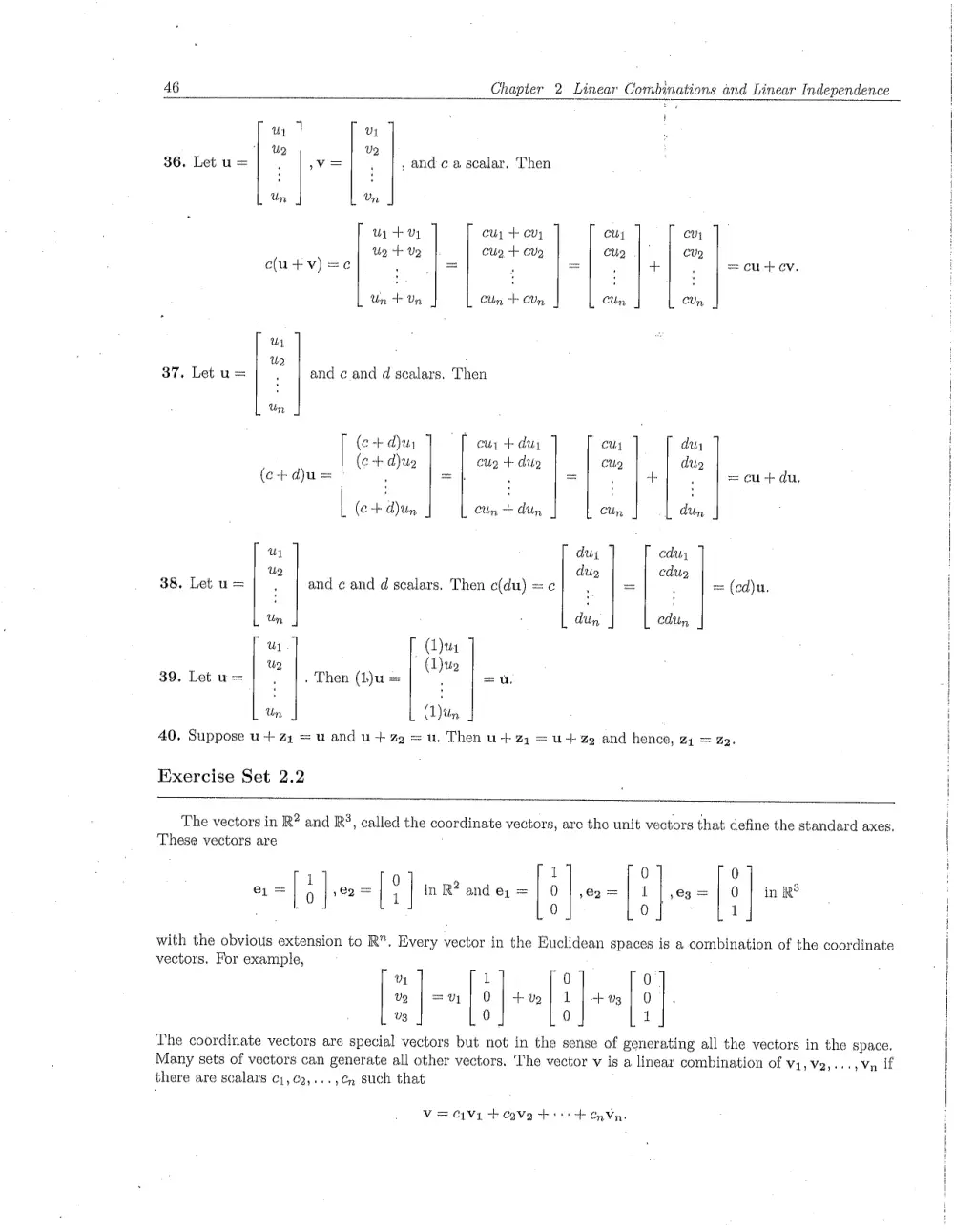
46 Chapter 2 Linear Combinations and Linear Independence
Uy V4
‘| Ue v2
36. Let u= . v= . , and c a scalar, Then
Un Un
Uy + V1 cu, + Cv, Cul cUy
U2 + U2 Cug + Cvg cug | v9
clu+v) =e . = = + =cu+ev,
Un + Un CUn + CUn, CUn CUn,
Uy
Ug
37, Letu= . and ¢ and d scalars, Then
Un,
(c+ d)ur “PT cur + duy cut duy
(e+ d)us Cug + duly Cu dug
(c+d)ju= =| . = J fet. =cu+ du.
(c+ d)un Clin + dun, CUn L dun
[ws | duy cduy
U2 dug cdug
38. Letu=| , and cand d scalars. Then c(du)=c}] , | = . = (ced)u.
L Un | dun Cdn,
[ts -] (1)tu
ue » (L)ug
39. Let u= . . Then (b)u = , =u.
Lun | (1)tn,
40. Suppose u+ 21 = u and u+22 =u. Then u+ 21 = u-+ Ze and hence, 21 = 29.
Exercise Set 2.2
The vectors in IR? and R', called the coordinate vectors, are the unit vectors that define the standard axes,
These vectors are
1 0 1 0 0
a=[5]e-[1] in R? andey=|0],e.=]| 1 |,eg= | 0 | in RS
0 0 . 1
with the obvious extension to R”. Every vector in the Euclidean spaces is a combination of the coordinate
vectors. For example,
V1 1 0 0
vg | =u] O | +ue] 1 | +23 | 0
U3 0 0 1
The coordinate vectors are special vectors but not in the sense of generating all the vectors in the space,
Many sets of vectors can generate all other vectors. The vector v is a linear combination of V1,Va,.0+,Vn if
there are scalars ¢1,¢2,...,, such that
V = CyVy + CQVQ + + CnVne
i
i
1
i
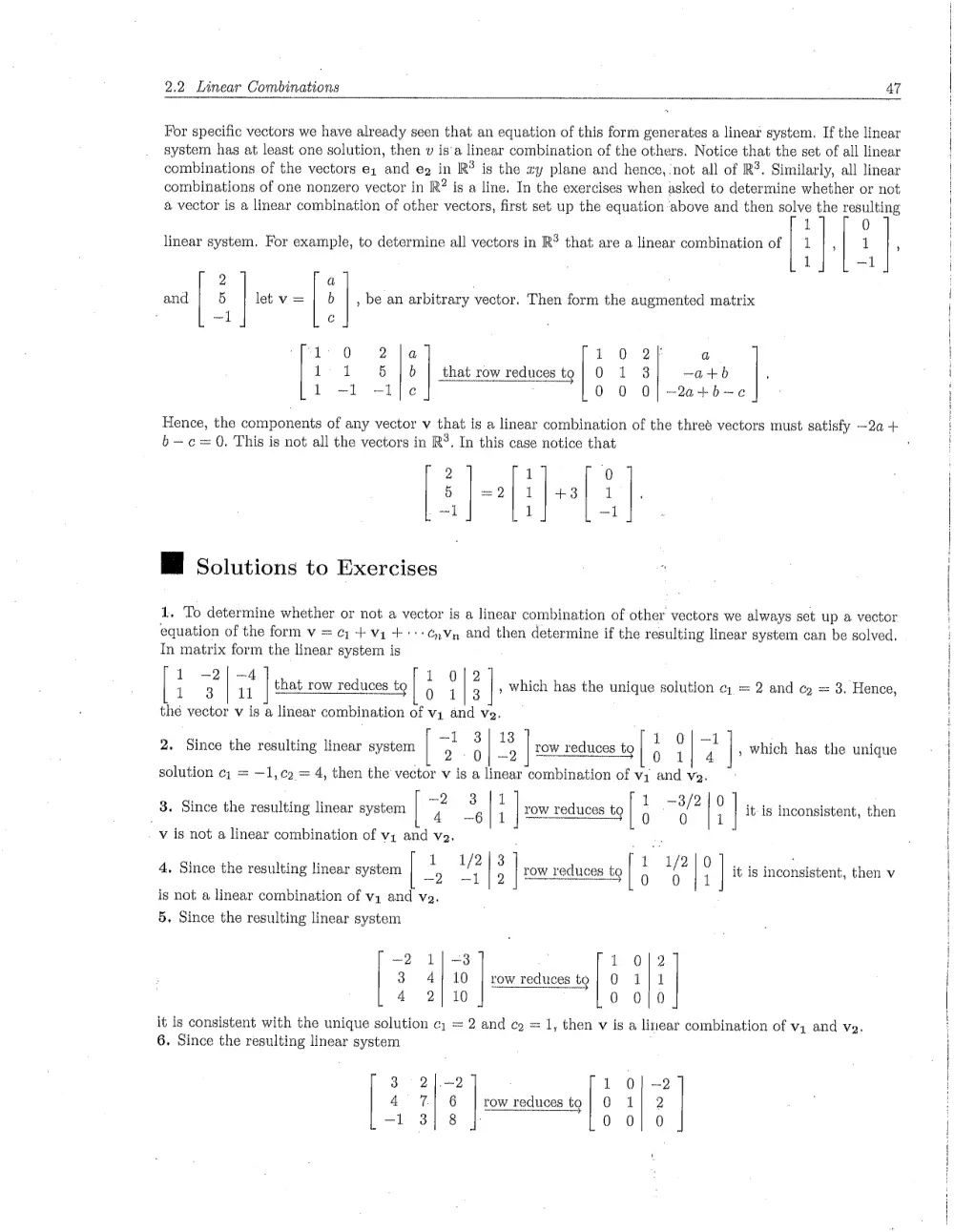
2.2 Linear Combinations 47
For specific vectors we have already seen that an equation of this form generates a linear system. If the linear
system has at least one solution, then v is’a linear combination of the others. Notice that the set of all linear
combinations of the vectors e, and eg in R® is the ay plane and hence, ‘not all of IR. Similarly, all linear
combinations of one nonzero vector in R? is a line, In the exercises when asked to determine whether or not
a vector is a linear combination of other vectors, first set up the equation ‘above and then solve the resulting
1 0
linear system. For example, to determine all vectors in R® that are a linear combination of | 1 },| 1 ;
1 -1
2 a
and 5 let v= | b |, be an arbitrary vector. Then form the augmented matrix
—1 c
‘10 24a 1 0 2} a
1 oi 5 | 6 | that row reducestg]| 0 1 3 —a+b
1 ~1 -lle 0 0 0] -2a+b-e
Hence, the components of any vector v that is a linear combination of the threé vectors must satisfy ~2a +
b-c=0. This is not all the vectors in R°. In this case notice that
2 1 0
5 | =2]/1)4+3] 1
-1 _ -1
M@ Solutions to Exercises
1, To determine whether or not a vector is a linear combination of other vectors we always set up a vector
equation of the form v = ¢ + v1 ++:+CnVn and then determine if the resulting linear system can be solved.
In matrix form the linear system is
1 -2|-4 1 0/2 . a. . aus _ _ ,
1 3 | ul that row reduces tg 01/3 , which has the unique solution cy = 2 and cg = 3. Hence,
the vector v is a linear combination of vz and ve.
. . —1 3) 18 1 0} -1 F .
2, Since the resulting linear system 2-9} —2 | to reduces ta oila)> which has the unique
solution ¢; = ~1, cz = 4, then the vector v is a linear combination of vz and v2.
3. Since the resulting linear system ? 3 i row reduces t 0 “Be 2 | , it is inconsistent, then
. v is not a linear combination of vz and ve. os
4, Since the resulting linear system 9 wa | ; row reduces to 4 a | , it is inconsistent, then v
is not a linear combination of vz and ve.
5, Since the resulting linear system
—-2 1|~-8 1 0;2
3 4] 10 | row reduces tg} 0 1] 1
4 2] 10 0 0/0
it is consistent with the unique solution c; = 2 and ce = 1, then v is a linear combination of v1 and vo.
6. Since the resulting linear system
38 2 ].-2 1 0} ~2
4 7] 6 | rowreducesto| 0 1] 2
—-1 3] 8 0 0} 0
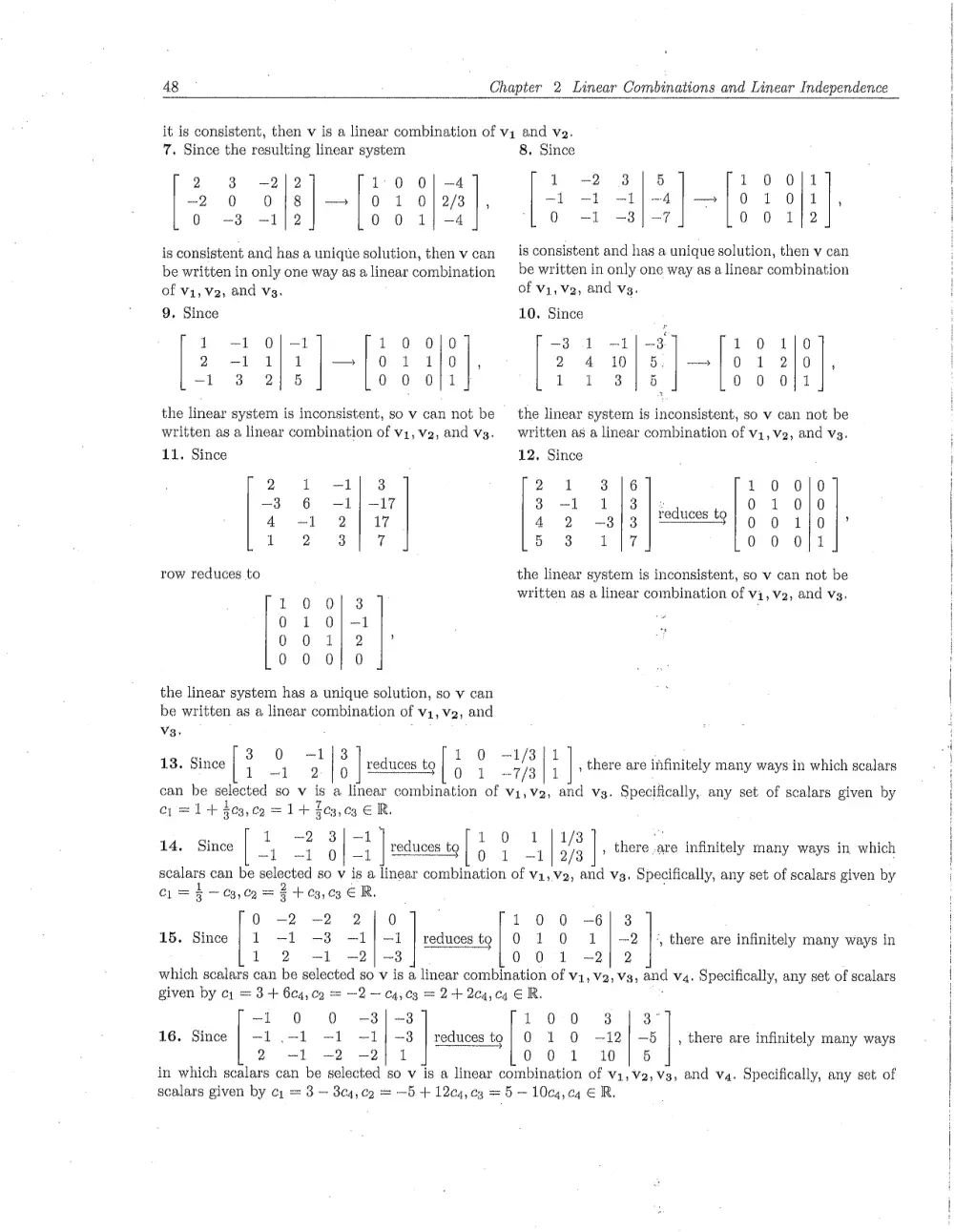
48 , Chapter 2 Linear Combinations and Linear Independence
it is consistent, then v is a linear combination of v1 and vg.
7, Since the resulting linear system
2 38 -2)2 1:0 0} -4
-2 0 O18 |—]0 1 0/2/3],
0 -38 +1) 2 0 0 1] -4
is consistent and has a unique solution, then v can
be written in only one way as a linear combination
of V1, V2, and v3.
9. Since
1 -1 0} -1 1 0 0/0
2 -1 1} il —};0 1 1/0],
-l 38 2) 5 0 0 0jf1
the linear system is inconsistent, so v can not be
written as a linear combination of v1, v2, and vg.
11. Since
2 1 -1) 3
-38 6 -1|-17
4 -1 2] 17
1 2 8 7
row reduces to
10 0} 3
0 ft 0}; -1
0 0 1/2 |?
0 0 0} 0
the linear system has a unique solution, so v can
be written as a linear combination of v1, v2, and
V3.
0 -1/3 1 0
; | 0 reduces tg 0 1
4: 3
13. Since 1-1 2
Cl = 1+ fos, ¢2 = 14+ 403,09 ER.
-2 3
-1 0
l
14. Since A - | sstuos to 0
scalars can be selected so v is a linear combination of v V1,,V2, and vg. Specifically, any set of scalars given by
C1 = = 03, Cg = 3 + 3,03 ER.
0 -2 -2 2] 0
15. Since | 1 -1 -—3 ~—1]} —1 | reduces t
1 2 -1 -2/]-3
—1/3
7/3
can be selected so v is a linear combination of v4, v:
0
8. Since
1 -2 385 1
-1 -1 -1)/-4 | — | 0
0-1 -3|=7 0
oO
HOO
nee
is consistent and has a unique solution, then v can
be written in only one way as a linear combination
of v1, V2, and vg.
10. Since
-3 1 -1/-3
1 0 1/0
2 4 10) 5 —|0 1 2/0],
1 1 3 5 0 0 Oj}!
the linear system is inconsistent, so v can not be
written ag a linear combination of vz, v2, and vg.
12, Since
2 1 3/16 1 0 0/0
8 -l 1)3 fe. 0 1 0/0
4 2 -313 reduces t 00 1lo}?
5 8 1/7 0 0 0f1
the linear system is inconsistent, so v can not be
written as a linear combination of vi, v2, and vg.
1} 1/3
1| 2/3
10 0 -6] 3
1 0 1 | -2 |; there are infinitely many ways in
00 1 ~-2) 2
, there are infinitely many ways in which scalars
2, and vg. Specifically, any set of scalars given by
iF there .are infinitely many ways in which
which scalars can be selected so v is a linear combination of v1, v2, Vs, a and v4. Specifically, any set of scalars
given by cy = 3 + 6c4, cg = ~2 ~ c4,¢3 = 24 2cy,c4 ER.
-1 0 O -3| 3 100 8 37
16. Since | —1 .—1 ~—1 ~—1]—-3 | reducesto| 0 1 0 -—12]—5 |, there are infinitely many ways
2 -1 -2 -2] 1 00 1 10] 5
in which scalars can be selected so v is a linear combination of v1, V2, Vs, and v4. Specifically, any set of
scalars given by cy == 3 — 8¢4,¢c2 = —5 + 12c4,c3 = 5 — 10cq4,c4 € R.
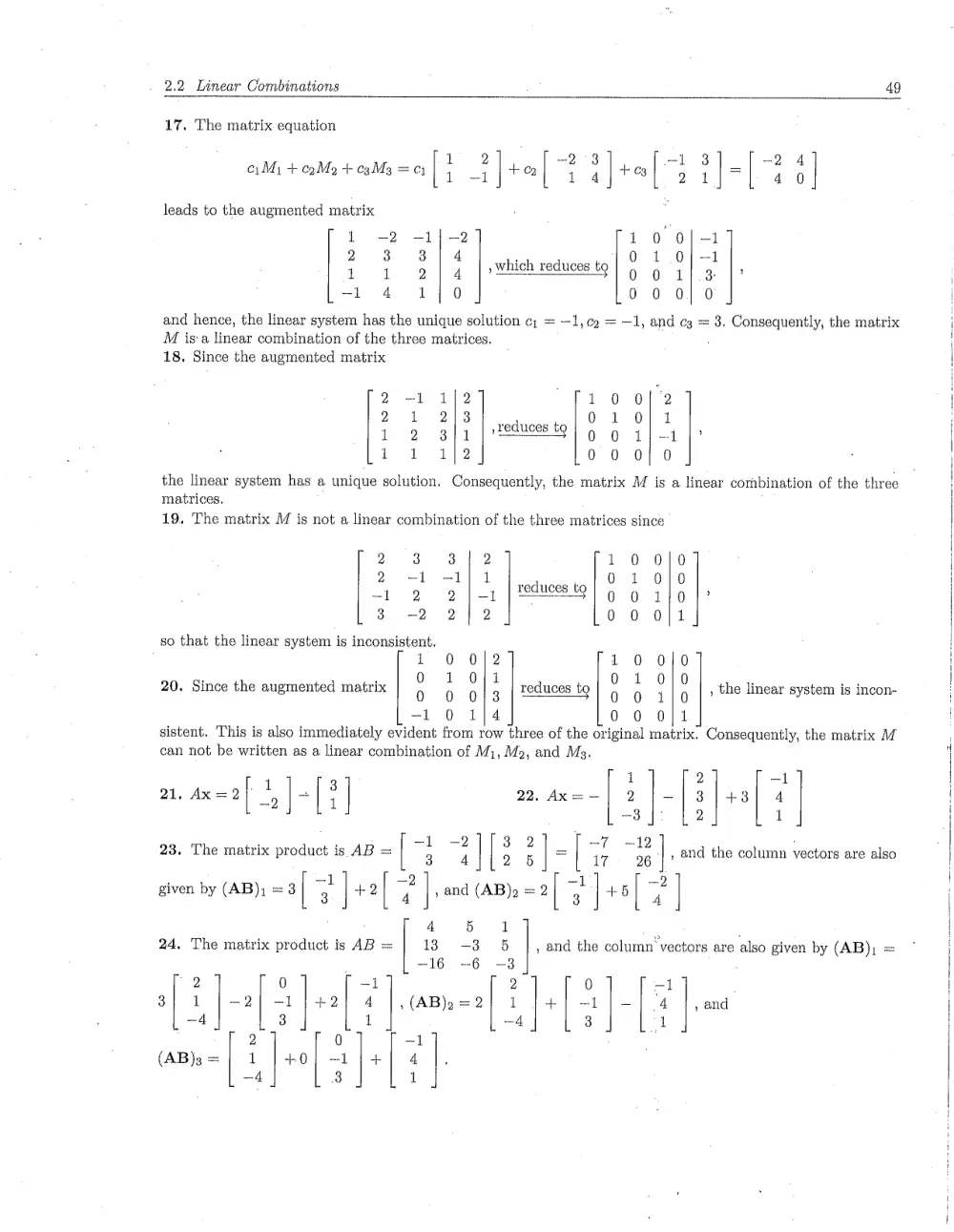
2.2 Linear Combinations 49
17, The matrix equation
1 2 —2 3 -1 3
cis + caMa + aM = es | i]+a| l i] tel 9 ‘]=| 40
leads to the augmented matrix
1-2 -1]-2 10
2 3 8/4 a | 0 1 .0f-1
1 1 9 4 , Which reduces to 00113 |?
-1 4 1/0 0 0 0) 0
and hence, the linear system has the unique solution c; = —1,cp = —1, and cg = 3. Consequently, the matrix
M is:a linear combination of the three matrices.
18. Since the augmented matrix
2-1 1/2 10 0} 2
2 1 213 reduces to O01 0) 1
162 87/1 |O—-->/0 0 Lf-1]?
1 1 142 0 0 0} 0
the linear system has a unique solution, Consequently, the matrix M is a linear combination of the three
matrices.
19, The matrix M is not a linear combination of the three matrices since
2 3 38 | 2 1 0 0}0
2-1 -1) 1 | aces to | 2 F 9] 0
-1 2 2 ]—1 | PEM Oo) 9 0 ilo}?
3-2 2 4} 2 00 0);1
so that the linear system is inconsistent.
1 0 0)2 10 0/0
‘ . . a) matrt 0 1 071 ae 0 1 0}0 ta lt cpakamy tat
20. Since the augmented matrix 0 0 013 reduces tg 00110 |? the linear system is incon-
-1 0 1/4 00 O}1
sistent. This is also immediately evident from row three of the original
can not be written as a linear combination of M), M2, and M3.
atrix. Consequently, the matrix M
5
1 3 1 2 —1
a. ax=2/ 1] =[ 9] 22, Ax=—| 2 |~|3]+43] 4
3B 2 1
23, The matrix product is AB = - i ; ; = u ie | , and the column vectors are also
~ ,and (AB)s = “I +6] “3
given by (AB), =3| 3 +2]
|
4
4 5 ot . :
24, The matrix product is AB = 3-3 5 |, and the column’ vectors are also given by (AB), =
-16 -6 -8
2 0 -1 2 0 -1
3] 1 |-2] -1 }+2]) 4 |,(AB)o=2}] 1 J+] -1]-—] 4 |, and
Ad dels fom] E STE]
2 0 -1
(AB)3 = 1 +0} —1 | + 4
-4 3 1
50 Chapter 2 Linear Combinations and Linear Independence
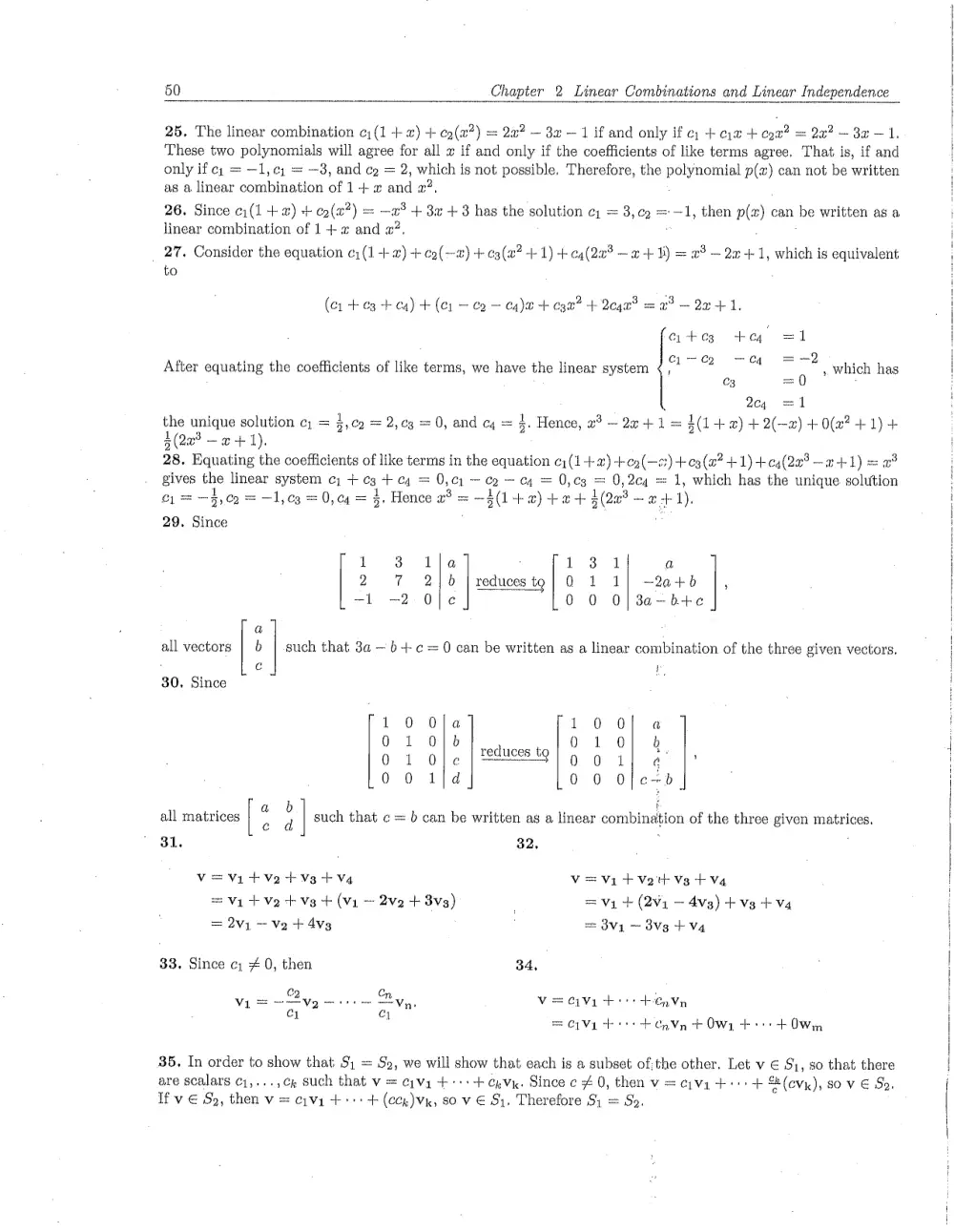
25, The linear combination ¢;(1 + 2) + c2(a?) = 2a? — 3x — 1 if and only if ce + cya + cpa? = Qa? ~ 8a — 1,
These two polynomials will agree for all x if and only if the coefficients of like terms agree. That is, if and
only if cy = —1,¢, = —8, and cz = 2, which is not possible. Therefore, the polynomial p(x) can not be written
as a linear combination of 1+ and «?,
26, Since ¢1(1 +a) + ¢p(a*) = —23 + 32 +3 has the solution cy = 3,¢, = —1, then p(x) can be written as a
linear combination of 1+ and z?,
27. Consider the equation ¢1(1- @) + ¢9(—x) + ¢3(a? +1) + c4(20° ~ a + 3) = o8 — 22 +1, which is equivalent
to
(er + 63 + ¢4) + (1 — cg — ca) + ca? + 2eqar?
After equating the coefficients of like terms, we have the linear system ¢ ~ 0°? which has
2c4 = 1
the unique solution c = 3,c2 = 2,c3 = 0, and cy = 4. Hence, a3 ~ 2@-+1 = $(1 +2) +2(—x) +0(a? +1) +
4 (20° —@ +1)
gan" — 6 : .
28. Equating the coefficients of like terms in the equation ¢(1-+2) +¢2(—s) +¢3 (a? +1) +¢4(223 —2 +1) = 28
gives the linear system ¢; + ¢3 + ¢4 = 0,¢1 — cz — cq = 0,3 = 0,2cq = 1, which has the unique solution
oO =~}, 02 = —1,c3 =0,c4 = $, Hence a3 = ~4(1 +2) +2 + 4(203 ~ 2 +1),
29, Since ,
1 3 lla 131 a
2 7 2/6 |reducestg| 0 1 1) —2a+b |,
-l -2 Ojfe 0 0 0] 38a-b+e
a
all vectors | 6 | such that 3a ~b+¢=0 can be written as a linear combination of the three given vectors.
c P
30, Since
1 0 O]a 10 0] a
QO 1 0}b -ecluces t 0 1 0} &
01 Ofc |RSS) 0 0 1] ef?
001 0 0 Ofe-b
all matrices ‘ ¥ such that ¢ = b can be written as a linear combination of the three given matrices,
31. 32, :
V=VitvVe+V3 + V4 V=VitvVatr Vs + v4
= V1 + ve + v3 + (v1 — Qve+ 3v3) : =Vy+ (2v1 _ 4vs) +V¥3 + V4
= 2v1 ~ vo + 4v3 == 38vy — 8v3 + v4
33, Since c; 40, then 34,
va = yg Byrn, V=C1V1 bi Henn
Cl Cl
= CrVa b+ CnVn + OW, +25: + OWm
35, In order to show that $1; = $2, we will show that each is a subset of;the other, Let v € $1, so that there
are scalars ¢1,...,¢, such that v = civa +:++ + cKVx. Since c 4 0, then v = @yva fee + £8 (evi); so Vv € Sp.
If v € Sg, then v = cyvy +++) + (Cex) VK, 80 V E S1, Therefore $1 = So.
2.3 Linear Independence 51
36. Let v € Sy, Then v = cyvy fr + Ce Ve = CV i FeV + O(V1 + V2), 80 VE Sp and hence, Sy C Sg.
Now let v € So, so
V = CLV be + RV + Chea (va + V2) = (C1 + Chet) V1 + (C2 + Cho1)V2a be + kV
and hence, v.€ S;. Therefore, Sp € $1. Since both containments hold, S, = So.
37, If Ags = cAj, then det(A) = 0, Since the linear system is assumed to be consistent, then it must have
infinitely many solutions.
38. If Aj = Ay + Ag, then det(A) = 0. Since the linear system is assumed to be consistent, then it must
have infinitely many solutions,
39. If f(x) = e® and g(x) = e?%, then fi(z) = e? = f(x), g'(x) -= 4e%*, and g(a) = 4e2*, Then
Qf" —3f' + f = 2% —3e™+e7=0 and 29" —39'+g= eat _ Bea” +e3” = 0, and hence f(z) and g(x)
are solutions to the differential equation. In a similar manner, for arbitrary constants c; and cg, the function
ei f(@) + cgg(a) is also a solution to the differential equation,
Exercise Set 2.3
In Section 2.3, the fundamental concept of linear independence is introduced. In R? and R®, two nonzero
vectors are linearly independent if and only if they are not scalar multiples of each other, so they do not lie
on the same line, To determine whether or not a set of vectors S = {v1,V2,..., Vi} is linearly independent
set up the vector equation
C1V1 + Cova +i + eKVE = 0.
If the only solution to the resulting system of equations is cy = cg = +': = cp = 0, then the vectors are
linearly independent, If there is one or more nontrivial solutions, then the vectors are linearly dependent.
For example, the coordinate vectors in Euclidean space are linearly independent. An alternative method, for
determining linear independence is to form a matrix A with column vectors the vectors to test, The matrix
must be a square matrix, so for example, if the vectors are in R‘, then there must be four vectors,
e If det(A) 4 0, then the vectors are linearly independent.
¢ If det(A) = 0, then the vectors are linearly dependent.
-1 2 . 3
For example, to determine whether or not the vectors 1 ,| 1 |, and 5 are linearly independent
3 2 —1
start with the equation
-1 2 3 0
C1 1 +eg] 1} +eg] 5 =| 0
3 2 -1 0
This yields the linear system
(cr + 209+ 303 =0 12 8]o] “ -1 2 3/0
cy + eg + Beg =(0 with augmented matrix 1 1 5 |0 | which reduces to,}| 0 1 1/0
8c, ++ 2ca-c3 == 0 3 2 -140 0 0 540
So the only solution is c) = co = cz; = 0, and the vectors are linearly independent. Now notice that the
coefficient matrix .
-1 2 38 1,0 0
A= 1 1 3 reduces further to. | 0.1 0 |,
3°02 -1 0..0 1
so that A is row equivalent to the identity matrix. This implies the inverse A~! exists and that det(A) # 0.
So we could have computed det(A) to conclude the vectors are linearly independent. In addition, since A~!
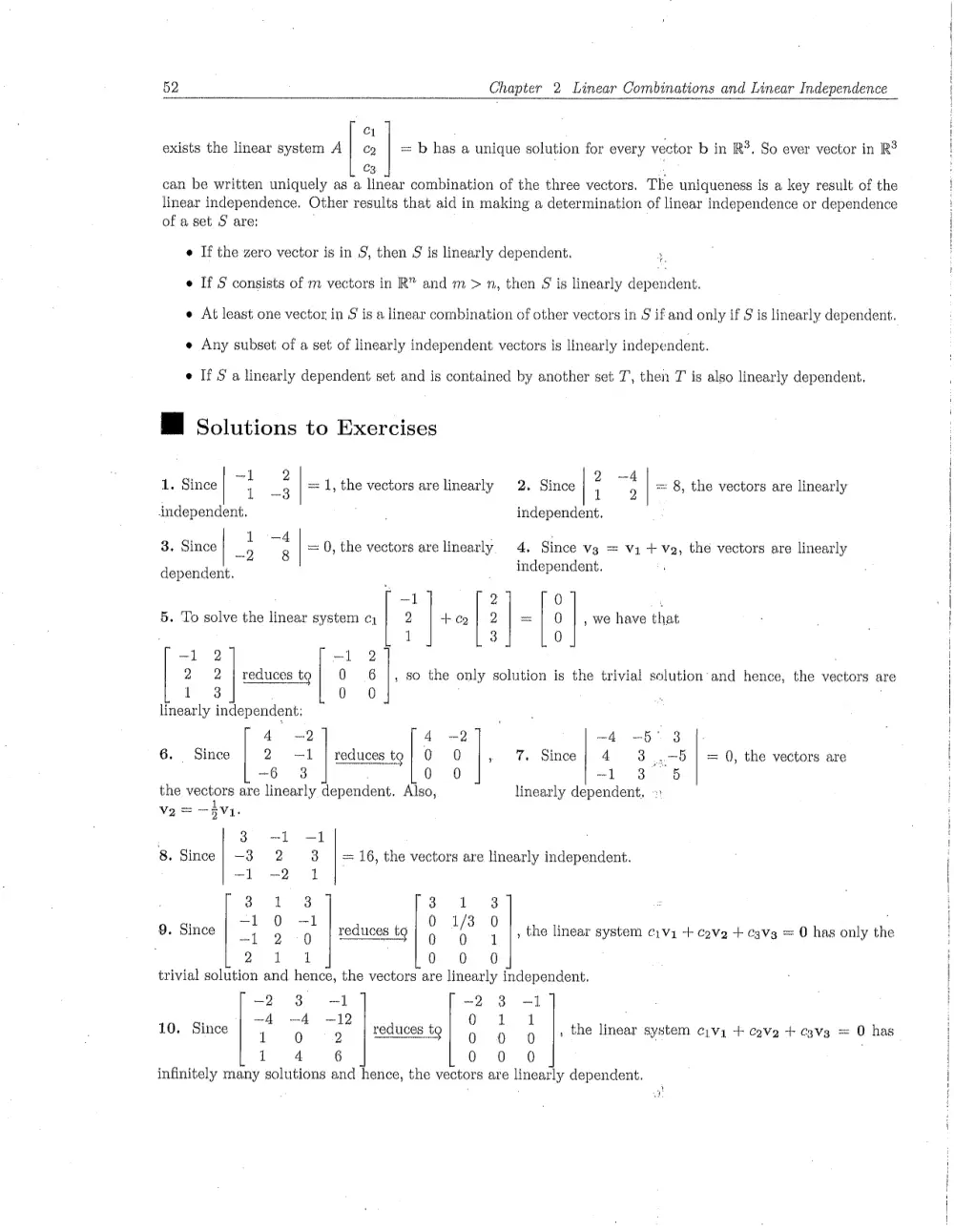
52 Chapter 2 Linear Combinations and Linear Independence
a
exists the linear system A | cg | = b has a unique solution for every vector b in IR°, So ever vector in R°
C3 :
can be written uniquely as a linear combination of the three vectors, The uniqueness is a key result of the
linear independence, Other results that aid in making a determination of linear independence or dependence
of a set S are:
¢ If the zero vector is in S, then S is linearly dependent. ,
¢ If.S consists of m vectors in R™ and m > n, then S$ is linearly dependent.
¢ At least one vector in S is a linear combination of other vectors in S if and only if $ is linearly dependent.
¢ Any subset of a set of linearly independent vectors is linearly independent.
e If S a linearly dependent set and is contained by another set T, then T is also linearly dependent,
@ Solutions to Exercises
1. Since a 3 | = 1, the vectors are linearly 2. Since ; - | == 8, the vectors are linearly
independent. : independent.
3. Since - - | = 0, the vectors are linearly 4, Since V3 = V1 + Va, the vectors are linearly
dependent independent,
Sd 2 0 ;
5. To solve the linear system cy, 2 -+co | 2 | =| 0 |, we have that
1 3 0
-1 2 -1 2
2 2 | reduces tg 0 6 |, so the only solution is the trivial solution and hence, the vectors are
1 8 . 0 0 : :
linearly independent:
4 2 4 —2 ~4 -B’
6. Since 2 -—1 | reduces tg} 0 0 » 7 Since | 4 3 ,.~5 | = 0, the vectors are
~6 38 0 0 -1 8 65
the vectors are linearly dependent. Also, linearly dependent,
Vva>= —dvy.
38-1 -1
8. Since] -3 2 8 | = 16, the vectors are linearly independent.
-l -2 21
3 1 8 3 1 8
9. Since +t 5 a reduces t ° 8 : , the linear system ¢,v1 + c2ve + ¢3vg3 = 0 has only the
2 1 1 0 0 0
trivial solution and hence, the vectors are linearly independent.
-—2 8 =1 -2 38 -1
10. Since i 3 a reduces t ; i ; , the linear system ev -++ cove + c3vg = 0 has
1 4 6 0 0 0
infinitely many solutions and hence, the vectors are linearly dependent.
2.38 Linear Independence
53
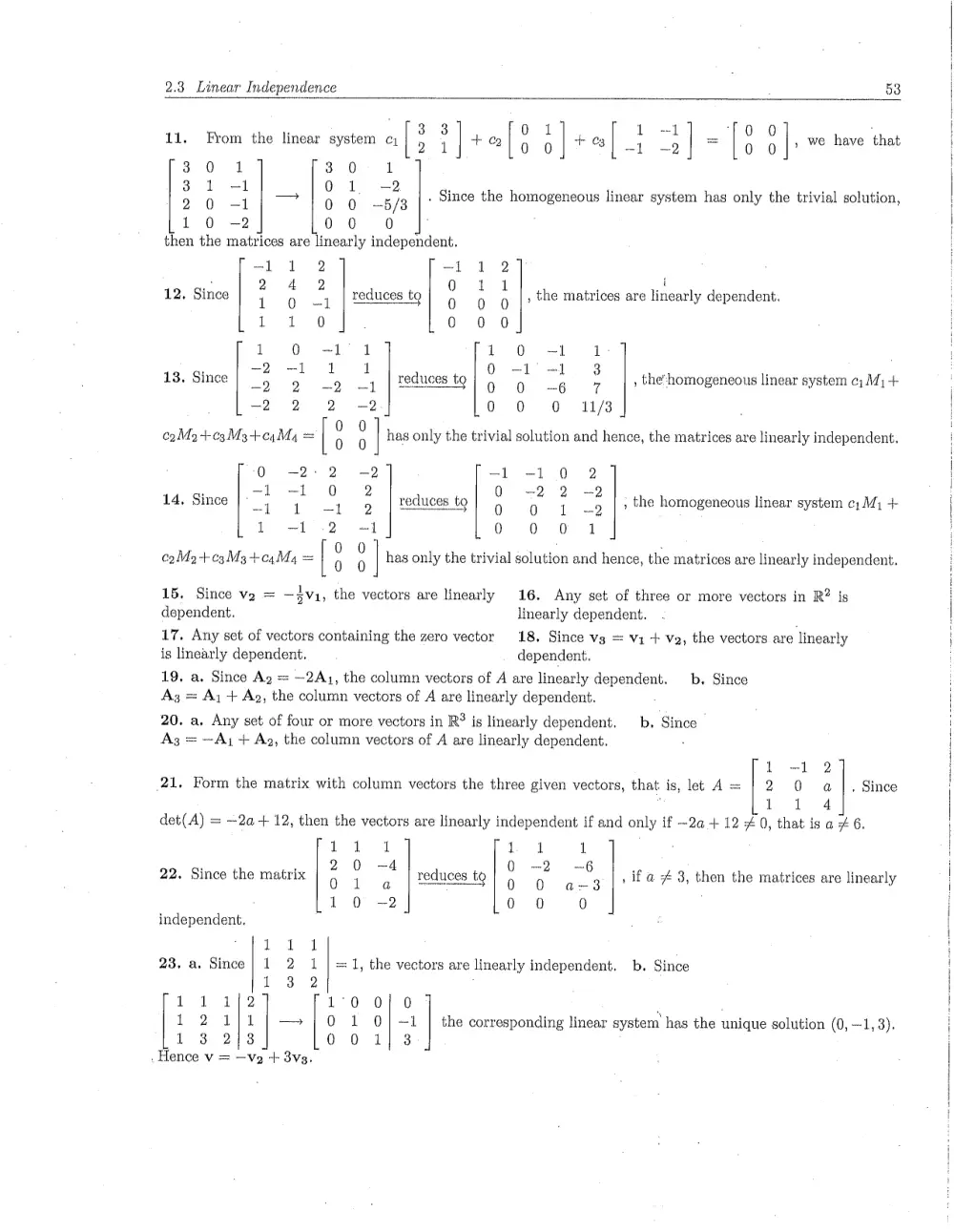
]+|
11. From the linear system ai [2 ]
3 0
301 _, ; 1
2 0 “/ 3
1 0
then the matrices are Linea ly independent.
-1 1 2 -1
. 2 4 2 0
12, Since 1 0 -1 reduces tg 0
1 1 0 0
fi 0 -1' 1 7
7 -2 -1 1 1 vances +
13, Since 2 9 2 4 reduces to
[oo 1 ~1 7.0 0
0 ojrel a | es E o> me have that
. Since the homogeneous linear system has only the trivial solution,
1 2
; 4 , the matrices are linearly dependent.
0 0
Fl O -1 1
0-1-1. 3 the*homogeneous linear system ce; M,+
00 -6 7 , the geneous linear system cM,
0 0 0 11/3
¢2Mo+¢3M3+¢e4My = 0 0 | has only the trivial solution and hence, the matrices are linearly independent.
0-2-2 ~2
1-1 0 2
-l 1 -1 2
1-1-2 -1 |
0 0
14, Since reduces tg
f-1 -1 0 2
; 7 : - ; the homogeneous linear system ¢,M, +
0 0 0 1
c9Mo+¢3M3+c4My = 0 0 has only the trivial solution and hence, the matrices are linearly independent.
15, Since vg =
dependent,
17. Any set of vectors containing the zero vector
-3¥1, the vectors are linearly 16.
Any set of three or more vectors in R? is
linearly dependent.
18, Since vg = vi + v2, the vectors are linearly
is linearly dependent. dependent,
19. a, Since Ag = ~2A4, the column vectors of A are linearly dependent. _b. Since
A3 = Ai + Ag, the column vectors of A are linearly dependent.
20. a, Any set of four or more vectors in R° is linearly dependent. _b, Since
Ag = —Ai + Ag, the column vectors of A are linearly dependent, :
1 -1 2
21, Form the matrix with column vectors the three given vectors, that is, let A= | 2 0 a |. Since
; 1 1 £4
det(A) = —2a + 12, then the vectors are linearly independent if and only if —2a+ 12 #0, that is a #6.
11 i
22. Since the matrix ; 0 ~4
1 0 —2
independent,
1 oii
23, a, Since| 1 2 1
1 3 2
tilt 1°0 0
t}—]o 1 ott
ta als 0 0 1] 8
. Hence v = —v2 + 3vz.
educes t 0
1 a | SNe) 0 aH8
== 1, the vectors are linearly independent. b.
Loi 1
-2 -6 : f .
, if a # 3, then the matrices are linearly
0 0 0
Since
the corresponding linear system has the unique solution (0,—~1, 3).
54 Chapter 2 Linear Combinations and Linear Independence
1 1 0/0 1 0 0/0
. Oo 1 ljoj} a 0 1 010 Le mmatrinac a ondent
24, a, Since 1111/0 reduces tg 00 110 , the matrices are linearly independent.
0 0 140 : 0 0 0)0
1 1 078 1 0 Oj1
b. Si oO 1145 reduces t O 1 O}2 the matri M = M, + 2M2 + 3M3. ¢. Since
spmee aa. a] 4 | EES] 9 go 1/3 fo me Mee 2 oF OMS. Ge
0 0 1/3 00 0)0
1 1 0/0 1 0 0/0
0 1 £1438 0 1 0/0 saan evatern ta | stakamt | a . .
-1 1113] 7100 tlo the linear system is inconsistent and hence, M can not be written
0 0 ijl 00 Of1
as a linear combination of M1, M2 and Mg.
1 2 0
25. Since | -1 0 3 | = 13, the matrix A is invertible, so that Ax = b has a unique solution for every
2 1 2
vector b,
38. 2 4
26. Since | 1 -1 4 | = 4, the matrix A is invertible, so that Ax = b has a unique solution for every
0 2 -4
vector b,
27. Since the equation cj (1) + ¢2(—2 + 4a”) + e3(2a) + e4(—12a + 8x) = 0, for all w, gives that ce) = ce =
¢3 = cg = 0, the polynomials are linear independent.
28. Since the equation ¢1(1) + ce(x) + c4(5 + 2x — 2?) = 0, for all a, gives that cy = co = cg = 0, the.
polynomials are linear independent.
29. Since the equation (2) + co(a) +.¢3(@?) + c4(3a — 1) = 0, for all x, gives that cy = CAs C2 = —3¢4,¢3 =
0,¢4 € R, the polynomials are linearly dependent,
30. Since the equation c(x3 — Qu? + 1) + c2(5x) + c3(@® — 4) + cx(a3 + 2x) = 0, for all 2, gives that
C1 = C2 = ¢3 = cq = 0, the polynomials are linear independent,
31, In the equation c, cosTa + cgsinmx = 0, if x = 0, then ¢ = 0, and if a= Bs then cg = 0. Hence, the
functions are linearly independent, :
32. Consider the equation ce” + cge7* + cge?* = 0 for all a. Let 2 = 0,2 = In2, and a = Ing to obtain
cy + C2 + ¢3 =0
the linear system ¢ 2c, + 3e2 +4c3; =0 . Since the only solution is the trivial solution the functions are
Ser + Ben + Bes = 0,
linearly independent.
33, In the equation crx + cox” + cge” = 0, if a =.0, then cz = 0. Now let x = 1, and « = —1, which gives the
linear system oe - 7 0° This system has solution c, = 0 and cg = 0. Hence the functions are linearly
independent,
34, Consider the equation c)a+cge*-+c3 sin rz = 0 for all «, Let w= 1,7 = 0, anda = 3 to obtain the linear
cy + ecg =)
system C2 =0 . Since the only solution is the trivial solution the functions are linearly
ger teen +03 = 0.
independent,
35. Suppose u and v are linearly dependent. Then there are scalars cy and cg, not both zero, such that:
au+bv = 0. Ifa 4 0, then u = —4y, Conversely, suppose there is a scalar c such that u = cv. Then
u—cv = 0 and hence, the vectors are linearly dependent.
Review Chapter 2 55
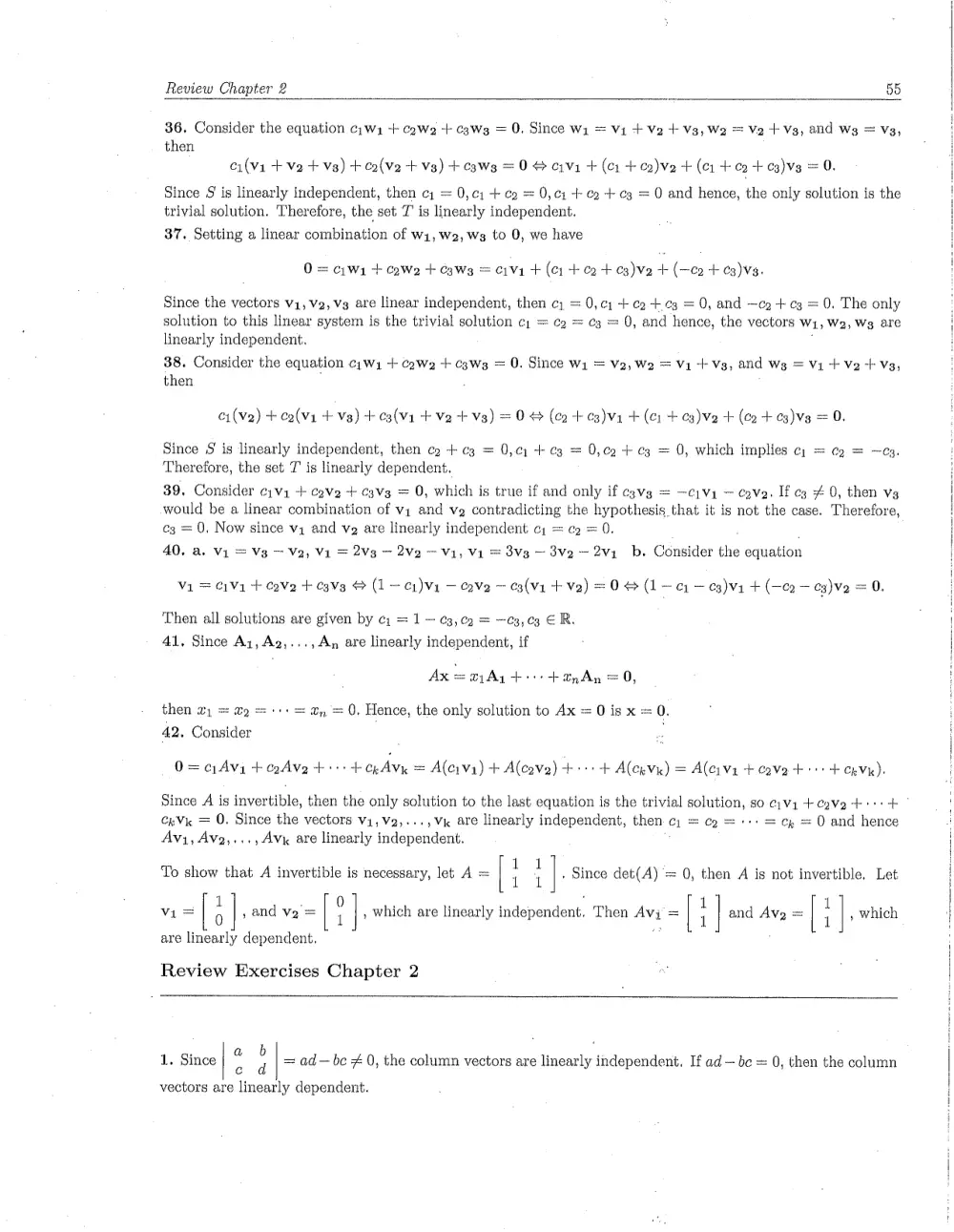
36. Consider the equation cjw1 + coW2 + c3W3 = 0, Since wi = v1 + V2 + V3, We = V2 + Vs, ald wg = Vs,
then
c1(va + V2 + Va) + ca(ve + v3) + c3wg = 0 & crv1 + (C1 + C2) V2 + (c1 + co + ¢3)V3 = 0.
Since S is linearly independent, then c, = 0,¢1 + co = 0,¢1 + ce + cg = 0 and hence, the only solution is the
trivial solution. Therefore, the set T is linearly independent.
37, Setting a linear combination of w1, we, ws to 0, we have
O = crwi + cgwa + Cgwg = crvi + (cr +02 + ¢3)V2 + (—c2 + ¢3)V3.
Since the vectors v1, V2, vg are linear independent, then ¢; = 0,c1 + ¢2-+¢3 = 0, and ~cg + c3 = 0. The only
solution to this linear system is the trivial solution c, = co = c3 = 0, and hence, the vectors wi, we, Wg are
linearly independent. :
38. Consider the equation cj wy + cew2 + ¢c3ws = 0. Since wi = V2, We = V1 + vg, and Wg = V1, + V2+V3,
then
c1(v2) + co(vi + v8) + c3(vi + V2 + v3) == 0 (co + 0¢3)v1 + (cr + ¢3)V2 + (co + ¢3)v3 = 0.
Since S is linearly independent, then cg + c3 = 0,c1 + ¢3 = 0,c2 + ¢3 = 0, which implies ¢) = cg = ~¢3.
Therefore, the set T is linearly dependent.
39, Consider ¢yv1 + cgv2 + ¢3vg = 0, which is true if and only if c3vg = —c1v1 ~ cave. If cz 4 0, then vg
would be a linear combination of vy and vg contradicting the hypothesis that it is not the case. Therefore,
c3 = 0. Now since v1 and ve are linearly independent c, = cz = 0.
40, a. V1 = V3 — Va, V1 = 2Vg — 2V2 ~ V1, Vi = 8V3 — 8v2 ~ 2v1_ b. Consider the equation
Vi = C1V1 + Cove + c3vg & (1 — c1)v1 — cave ~ ¢3(v1 + v2) = 0 & (1 — c1 — ¢3)v1 + (—e2 — ¢3)V2 =0,
Then all solutions are given by cy = 1 — ¢3,¢c2 = —c3,¢3 € R.
41, Since Ay, Ag,...,An are linearly independent, if
Ax = 0 Ay +++:+2nAn = 0,
then 2y = ag = = ay, = 0, Hence, the only solution to Ax = 0 isx = 0.
42, Consider :
0= cj Avy + coAve +:°°4 + Ch AV) = A(e1v1) + Alcove) eee + A(cevK) = A(eiva + Cove tee + ChVk)+
Since A is invertible, then the only solution to the last equation is the trivial solution, so e1v1 + cava + -
CkVk = 0. Since the vectors v1,Vv2,...,Vk are linearly independent, then ¢, = cg = +++ = cp = 0 and hence
Avi, Ave,...,AVx are linearly independent.
To show that A invertible is necessary, let A = t ' . Since det(A) ‘= 0, then A is not invertible. Let
V= 4 , and vg = , , which are linearly independent. Then Avy = t and Avg = , » which
are linearly dependent,
Review Exercises Chapter 2
1. Since : y = ad—be #0, the column vectors are linearly independent. If ad—- be = 0, then the column
vectors are linearly dependent.
i
:
i
|
|