
MATH 219 Final, Fall 2004
American University of Beirut · Linear Algebra I · 2 pages
More MATH 219 files
Show the text of this final exam
Math 219 — Fall 2004
Final Exam, February 1, 2005. Time: 2 1/2 hours
Remarks: For the final, please answer the problems in the examination booklets provided. You
may work on the problems in any order, but please make it clear which problem you are solving
on any given page.
Each problem below is worth 15 (fifteen) points, for a total of 135 points (and 10 bonus
points). The problems are arranged roughly in order of increasing difficulty. Make sure to budget
your time wisely.
Good luck!
1
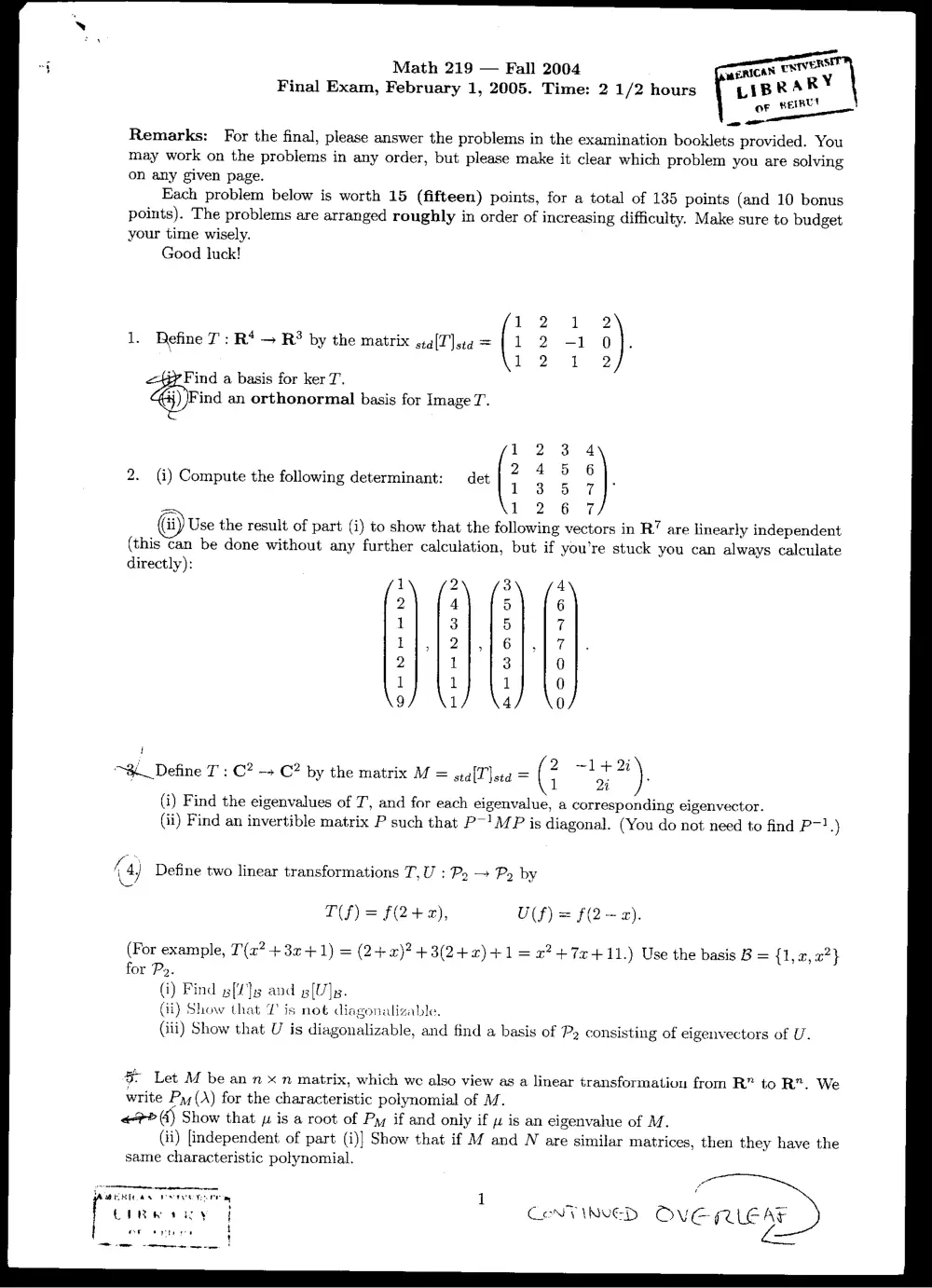
1. Define T : R* — RS by the matrix gg (T]sea = [1
: 1
iy Find a basis for ker T.
Find an orthonormal basis for Image T.
1
2. (i) Compute the following determinant: det ‘
1 2 7
(ii) Use the result of part (i) to show that the following vectors in R” are linearly independent
(this can be done without any further calculation, but if you're stuck you can always calculate
directly):
t
j 9 — %
™~34_Define T : C? ~+ C? by the matrix M = salT sea = (3 1+ ‘).
1 Zi
(i) Find the eigenvalues of T, and for each eigenvalue, a corresponding eigenvector.
(ii) Find an invertible matrix P such that P~1MP is diagonal. (You do not need to find P-}.)
(4) Define two linear transformations T,U : P, — P, by
T(f)=f2+2), U(f) = f(2~ 2).
(For example, T(z? + 32+1) = (2+2)?+3(24+2)41=22+7¢4 11.) Use the basis B = {1, 2, x?}
for P2.
(i) Find alL]s and 3[U]p.
Gi) Show that Z is not diagonalizable.
(iii) Show that U is diagonalizable, and find a basis of P2 consisting of eigenvectors of U.
5 Let Mbeannxn matrix, which we also view as a linear transformation from R” to R”. We
write Py (A) for the characteristic polynomial of M.
«ery Show that yz is a root of Py if and only if py is an eigenvalue of M.
(ii) [independent of part (i)] Show that if M and N are similar matrices, then they have the
same characteristic polynomial.
eee vey CeNTINVED OVE (UEAE
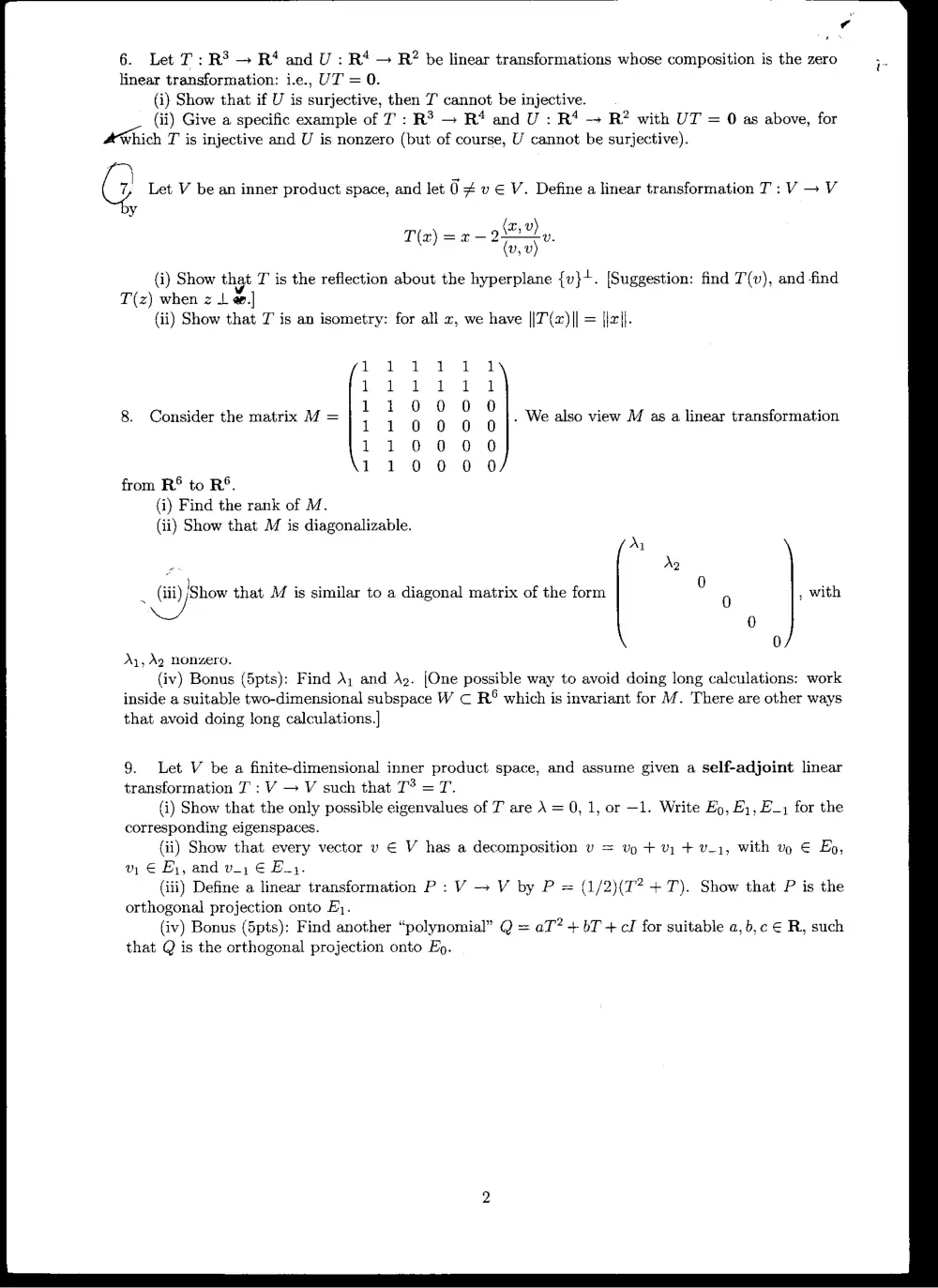
6. Let T: R° — R4 and U : R* — R? be linear transformations whose composition is the zero
linear transformation: i.e., UT = 0.
(i) Show that if U is surjective, then 1’ cannot be injective.
(ii) Give a specific example of T : R? — R4 and U : R4 — R? with UT = 0 as above, for
Which T is injective and U is nonzero (but of course, U cannot be surjective).
G Let V be an inner product space, and let 0 #v€YV. Define a linear transformation T:V — V
y
T(z) =2- one) v.
(i) Show that T is the reflection about the hyperplane {v}+. [Suggestion: find T(v), and find
T(z) when z 1 @.]
(ii) Show that J’ is an isometry: for all z, we have ||T'(«)|| = ||<|.
8. Consider the matrix M = . We also view M as a linear transformation
from R® to RS.
(i) Find the rank of M.
(ii) Show that M is diagonalizable.
. {ii} jShow that M is similar to a diagonal matrix of the form
Ay, Ag nonzero.
(iv) Bonus (5pts): Find A; and 2. [One possible way to avoid doing long calculations: work
inside a suitable two-dimensional subspace W C R® which is invariant for M. There are other ways
that avoid doing long calculations.]
9. Let V be a finitedimensional inner product space, and assume given a self-adjoint linear
transformation T: V — V such that T? = T.
(i) Show that the only possible eigenvalues of T are \ = 0, 1, or —1. Write Eo, FE, £_; for the
corresponding eigenspaces.
(ii) Show that every vector v € V has a decomposition v = vp + v1) + v-1, with up € Ep,
vw, € Ey, and v_; € Ey.
(iii) Define a linear transformation P : V — V by P = (1/2)(T? + T). Show that P is the
orthogonal projection onto Ey.
(iv) Bonus (5pts): Find another “polynomial” Q = aT? + bT + cI for suitable a,b,c € R, such
that Q is the orthogonal projection onto Ep.
c