
MATH 219 Final, Fall 2014
American University of Beirut · Linear Algebra I · 15 pages · Prof. Kamal Makdisi






Showing the first 10 of 15 pages. Download the PDF to see all of it.
More MATH 219 files
Show the text of this final exam
Math 219 — Fall 2014
Final Exam, December 15. TIME: 2.5 hours
GRADES (each problem is worth 12 points):
1
2
3
4
5
6
7
8
9
TOTAL/108
This exam booklet is also your answer sheet; please answer question 0 on this page,
and answer questions 1–9 inside the booklet. The problems are repeated inside the booklet.
There are extra blank sheets at the end for solutions. You can also use the back of any page for
solutions or scratchwork. If you need to continue a problem beyond the first page where it appears,
please INDICATE CLEARLY where the solution continues.
Read through the problems before starting, and decide which of them you wish to work on
first. Do as much of the exam as you can, and budget your time wisely. Each of questions 1–9
counts for 12 points. The exam is closed book, and calculators are not allowed. You may bring to
the exam one A4 sheet with handwritten notes or formulas on both sides.
Make sure to communicate your ideas by explaining all of your steps precisely and clearly.
Good luck!
0.
a) Your name:
b) Your AUB ID#:
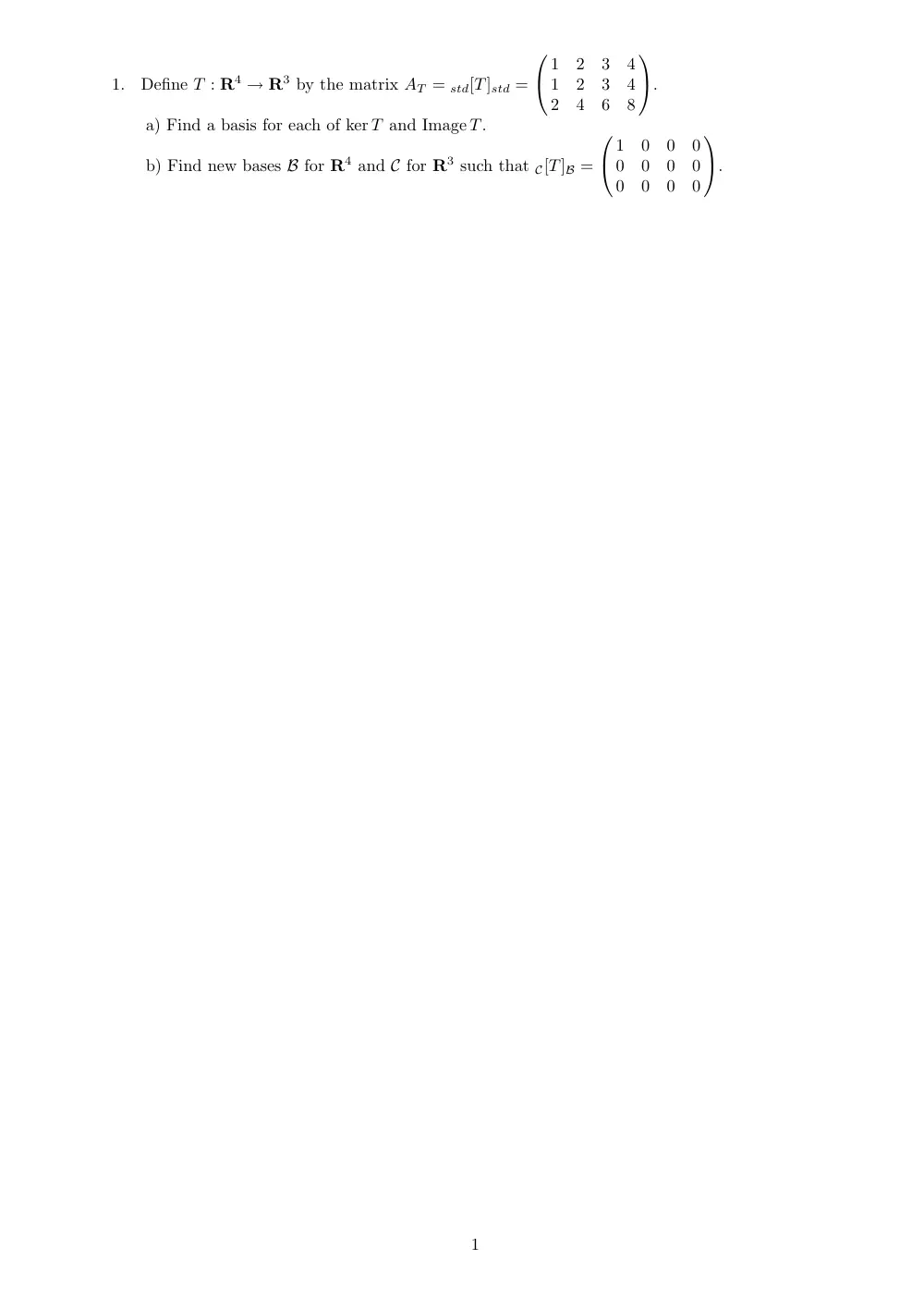
1.
Define T : R4 → R3 by the matrix AT = std[T]std =
1
2
3
4
1
2
3
4
2
4
6
8
.
a) Find a basis for each of ker T and Image T.
b) Find new bases B for R4 and C for R3 such that C[T]B =
1
0
0
0
0
0
0
0
0
0
0
0
.
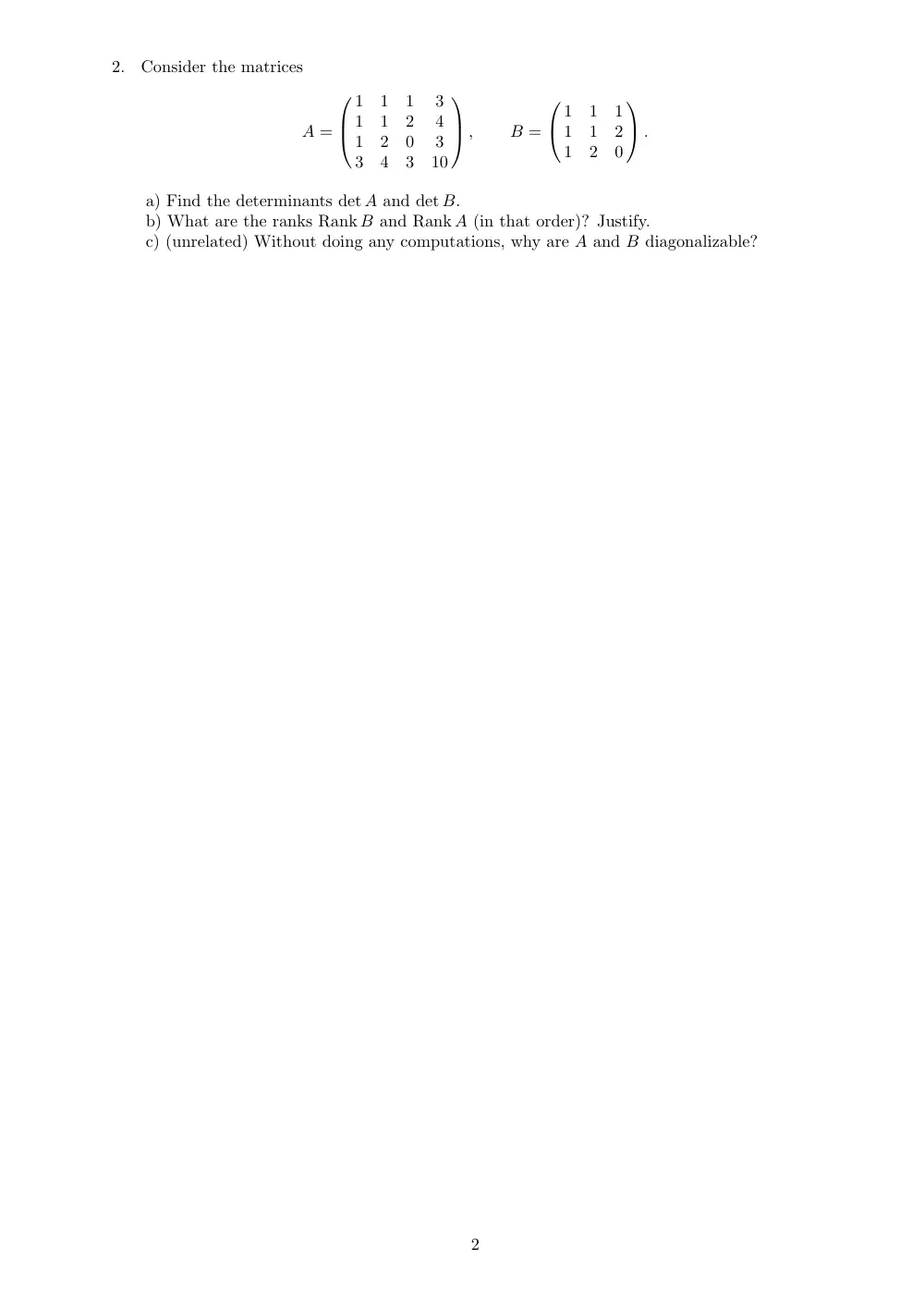
2.
Consider the matrices
A =
1
1
1
3
1
1
2
4
1
2
0
3
3
4
3
10
,
B =
1
1
1
1
1
2
1
2
0
.
a) Find the determinants det A and det B.
b) What are the ranks Rank B and Rank A (in that order)? Justify.
c) (unrelated) Without doing any computations, why are A and B diagonalizable?
3.
Let W = Span{(1, 1, 0, 0), (2, 0, 1, 0), (2, 0, 0, 1)} ⊂ R4. (We have written vectors as rows to
save space.) Find the orthogonal projection ProjW (30, 0, 0, 0) of the vector ⃗v = (30, 0, 0, 0). The
numbers have been arranged so that the final answer does not involve any fractions.
4.
Diagonalize the following two matrices, i.e., find the eigenvalues and a basis of eigenvectors:
Do this if possible over R, and if not possible over C.
A =
�
1
−2
1
3
�
,
B =
−2
1
1
1
−2
1
1
1
−2
.
i
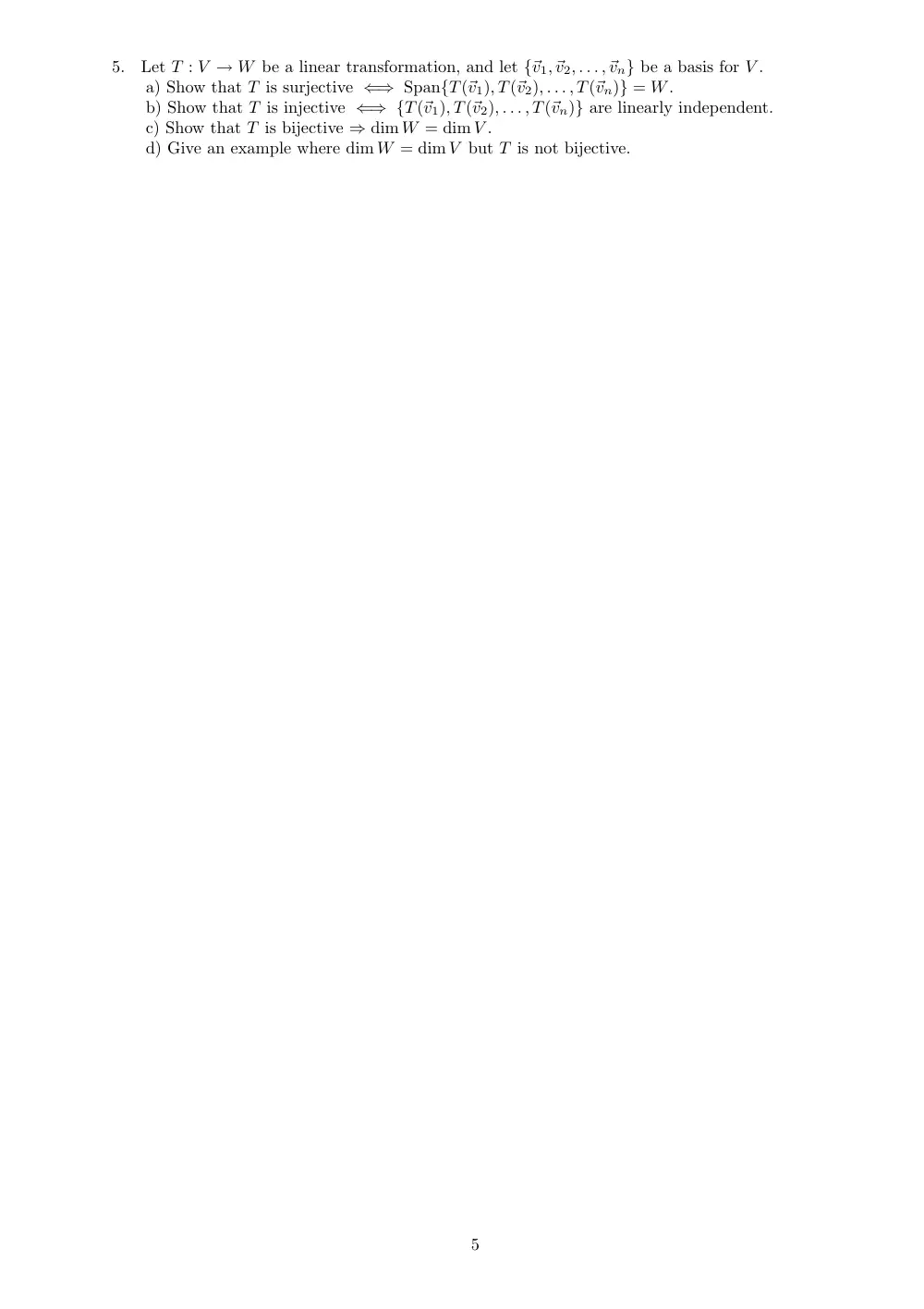
5.
Let T : V → W be a linear transformation, and let {⃗v1,⃗v2, . . . ,⃗vn} be a basis for V .
a) Show that T is surjective ⇐⇒ Span{T(⃗v1), T(⃗v2), . . . , T(⃗vn)} = W.
b) Show that T is injective ⇐⇒ {T(⃗v1), T(⃗v2), . . . , T(⃗vn)} are linearly independent.
c) Show that T is bijective ⇒ dim W = dim V .
d) Give an example where dim W = dim V but T is not bijective.
6.
Recall that P3 is the space of polynomials f(x) of degree at most 3. Define a linear transfor-
mation T : P3 → P3 by
T(1) = 6,
T(x) = 2x,
T(x2) = 4x + 2,
T(x3) = 12x2 + 6x
and extending linearly. (This comes from the general formula T(f) = (x + 1)2f ′′ − 4xf ′ + 6f, but
you can ignore this fact.)
a) Find the matrix B[T]B, where B is the basis B = {1, x, x2, x3} for P3.
b) Find a basis for each of Image T and ker T. Justify your reasoning. Make sure you give
elements of P3.
c) Find the eigenvalues of T, and, for each eigenvalue, find one eigenvector. Again, these should
be elements of P3.
d) Show that T is not diagonalizable.
7.
Which of the following matrices are equivalent? Which are similar? Explain.
�
0
0
0
0
�
,
�
0
1
0
0
�
,
�
1
0
0
0
�
,
�
0
1
1
0
�
,
�
1
0
0
−1
�
.
8.
Let V be a finite-dimensional inner product space over the field F (which can be R or C), and
let T : V → V be a self-adjoint linear transformation.
a) Assume F = C. Show that there exists a linear transformation S : V → V such that
S2 = T.
b) Assume F = R. Suppose that for all ⃗v ∈ V , ⟨⃗v, T⃗v⟩ ≥ 0. Show that the conclusion of part
(a) still holds about the existence of S.
9.
Let V and W be finite-dimensional vector spaces, and let T : V → W be an injective linear
transformation.
a) Show that there exists S : W → V such that S ◦ T = idV .
b) Show that if dim V = dim W, then T ◦ S = idW as well. (This can be done even if you were
not able to solve part (a); just accept part (a) and solve this part.)
ii
1.
Define T : R4 → R3 by the matrix AT = std[T]std =
1
2
3
4
1
2
3
4
2
4
6
8
.
a) Find a basis for each of ker T and Image T.
b) Find new bases B for R4 and C for R3 such that C[T]B =
1
0
0
0
0
0
0
0
0
0
0
0
.
1
2.
Consider the matrices
A =
1
1
1
3
1
1
2
4
1
2
0
3
3
4
3
10
,
B =
1
1
1
1
1
2
1
2
0
.
a) Find the determinants det A and det B.
b) What are the ranks Rank B and Rank A (in that order)? Justify.
c) (unrelated) Without doing any computations, why are A and B diagonalizable?
2
3.
Let W = Span{(1, 1, 0, 0), (2, 0, 1, 0), (2, 0, 0, 1)} ⊂ R4. (We have written vectors as rows to
save space.) Find the orthogonal projection ProjW (30, 0, 0, 0) of the vector ⃗v = (30, 0, 0, 0). The
numbers have been arranged so that the final answer does not involve any fractions.
3
4.
Diagonalize the following two matrices, i.e., find the eigenvalues and a basis of eigenvectors:
Do this if possible over R, and if not possible over C.
A =
�
1
−2
1
3
�
,
B =
−2
1
1
1
−2
1
1
1
−2
.
4
5.
Let T : V → W be a linear transformation, and let {⃗v1,⃗v2, . . . ,⃗vn} be a basis for V .
a) Show that T is surjective ⇐⇒ Span{T(⃗v1), T(⃗v2), . . . , T(⃗vn)} = W.
b) Show that T is injective ⇐⇒ {T(⃗v1), T(⃗v2), . . . , T(⃗vn)} are linearly independent.
c) Show that T is bijective ⇒ dim W = dim V .
d) Give an example where dim W = dim V but T is not bijective.
5
6.
Recall that P3 is the space of polynomials f(x) of degree at most 3. Define a linear transfor-
mation T : P3 → P3 by
T(1) = 6,
T(x) = 2x,
T(x2) = 4x + 2,
T(x3) = 12x2 + 6x
and extending linearly. (This comes from the general formula T(f) = (x + 1)2f ′′ − 4xf ′ + 6f, but
you can ignore this fact.)
a) Find the matrix B[T]B, where B is the basis B = {1, x, x2, x3} for P3.
b) Find a basis for each of Image T and ker T. Justify your reasoning. Make sure you give
elements of P3.
c) Find the eigenvalues of T, and, for each eigenvalue, find one eigenvector. Again, these should
be elements of P3.
d) Show that T is not diagonalizable.
6
7.
Which of the following matrices are equivalent? Which are similar? Explain.
�
0
0
0
0
�
,
�
0
1
0
0
�
,
�
1
0
0
0
�
,
�
0
1
1
0
�
,
�
1
0
0
−1
�
.
7
8.
Let V be a finite-dimensional inner product space over the field F (which can be R or C), and
let T : V → V be a self-adjoint linear transformation.
a) Assume F = C. Show that there exists a linear transformation S : V → V such that
S2 = T.
b) Assume F = R. Suppose that for all ⃗v ∈ V , ⟨⃗v, T⃗v⟩ ≥ 0. Show that the conclusion of part
(a) still holds about the existence of S.
8
9.
Let V and W be finite-dimensional vector spaces, and let T : V → W be an injective linear
transformation.
a) Show that there exists S : W → V such that S ◦ T = idV .
b) Show that if dim V = dim W, then T ◦ S = idW as well. (This can be done even if you were
not able to solve part (a); just accept part (a) and solve this part.)
9
Blank sheet.
10
Blank sheet.
11
Blank sheet.
12
Blank sheet.
13