
MATH 242 Final, Spring 2003
American University of Beirut · Topics in Algebra · 2 pages
More MATH 242 files
Show the text of this final exam
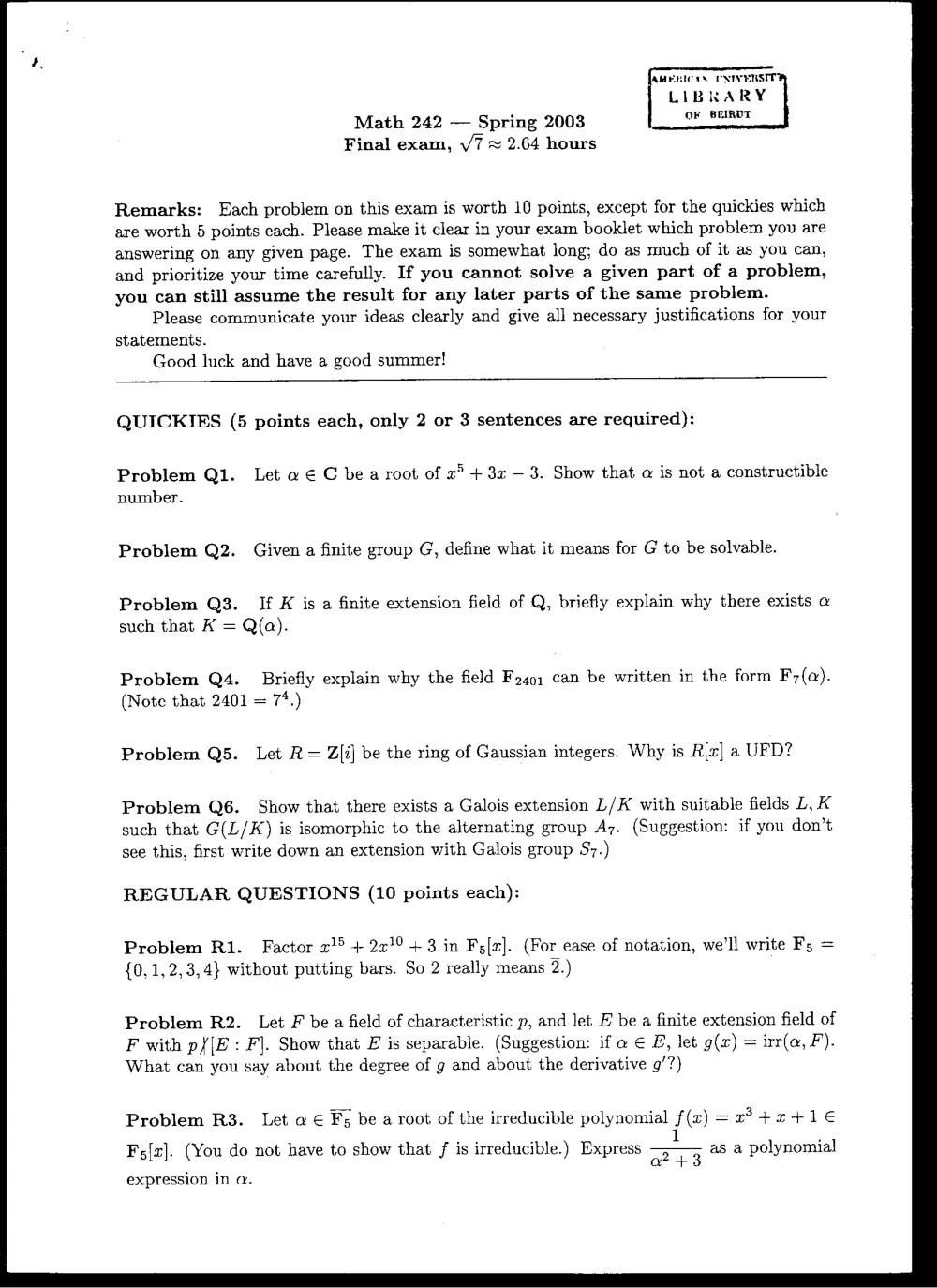
AMERICUS UNIVERSIT
LIBRARY
Math 242 — Spring 2003 OF BEIRUT
Final exam, V7 ~ 2.64 hours
Remarks: Each problem on this exam is worth 10 points, except for the quickies which
are worth 5 points each. Please make it clear in your exam booklet which problem you are
answering on any given page. The exam is somewhat long; do as much of it as you can,
and prioritize your time carefully. If you cannot solve a given part of a problem,
you can still assume the result for any later parts of the same problem.
Please communicate your ideas clearly and give all necessary justifications for your
statements.
Good luck and have a good summer!
QUICKIES (5 points each, only 2 or 3 sentences are required):
Problem Q1. Let a € C be a root of a + 3” — 3. Show that a is not a constructible
number.
Problem Q2. Given a finite group G, define what it means for G to be solvable.
Problem Q3. If K is a finite extension field of Q, briefly explain why there exists a
such that K = Q(a).
Problem Q4. Briefly explain why the field F249: can be written in the form F(a).
(Note that 2401 = 74.)
Problem Q5. Let R= Z[i] be the ring of Gaussian integers. Why is R[x] a UFD?
Problem Q6. Show that there exists a Galois extension L/K with suitable fields L, K
such that G(L/K) is isomorphic to the alternating group Az. (Suggestion: if you don’t
see this, first write down an extension with Galois group S7.)
REGULAR QUESTIONS (10 points each):
Problem R1. Factor 2)® + 223° + 3 in Fs[z]. (For ease of notation, we’ll write Fs =
{0,1,2,3,4} without putting bars. So 2 really means 2.)
Problem R2. Let F bea field of characteristic p, and let F be a finite extension field of
F with p}|E : F]. Show that E is separable. (Suggestion: if a € E, let g(x) = irr(q, F).
What can you say about the degree of g and about the derivative g’?)
Problem R3. Let a € Fs be a root of the irreducible polynomial f(z) =z? +2+16€
1
a2 +3
F;{z]. (You do not have to show that f is irreducible.) Express as a polynomial
expression in @.
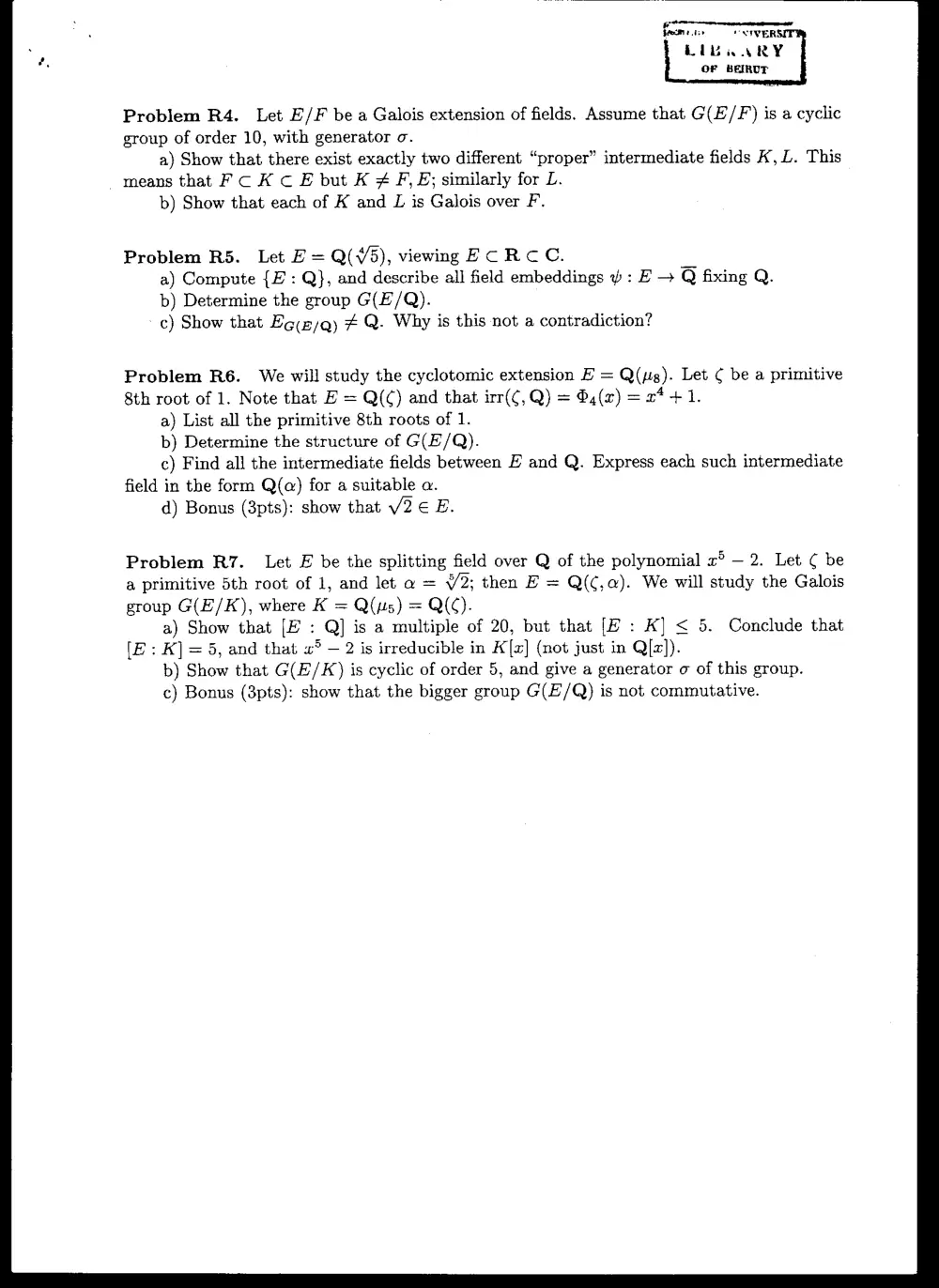
frome UNIVER!
LIBAARY
oF BEIRUT
Problem R4. Let E/F be a Galois extension of fields. Assume that G(£/F) is a cyclic
group of order 10, with generator o.
a) Show that there exist exactly two different “proper” intermediate fields K, L. This
means that F C K C E but K # F,£; similarly for L.
b) Show that each of K and L is Galois over F’.
Problem R5. Let E = Q(¥W5), viewing ECRCC.
a) Compute {£ : Q}, and describe all field embeddings y : E > Q fixing Q.
b) Determine the group G(£/Q).
-¢) Show that Egyz/qy # Q. Why is this not a contradiction?
Problem R6. We will study the cyclotomic extension EF = Q(yg). Let ¢ be a primitive
8th root of 1. Note that E = Q(¢) and that irr(¢,Q) = @4(2) = a4 +1.
a) List all the primitive 8th roots of 1.
b) Determine the structure of G(E/Q).
c) Find all the intermediate fields between E and Q. Express each such intermediate
field in the form Q(a) for a suitable a.
d) Bonus (3pts): show that V2 € EB.
Problem R7. Let E be the splitting field over Q of the polynomial z> — 2. Let ¢ be
a primitive 5th root of 1, and let a = </2; then FE = Q(¢,a). We will study the Galois
group G(E/K), where K = Q(is) = Q(¢).
a) Show that [E : Q] is a multiple of 20, but that [E : K] < 5. Conclude that
[E : K]=5, and that «° — 2 is irreducible in K[z] (not just in Q[z]).
b) Show that G(E/K) is cyclic of order 5, and give a generator o of this group.
c) Bonus (3pts): show that the bigger group G(£/Q) is not commutative.