
MATH 242 Final, Spring 2005
American University of Beirut · Topics in Algebra · 2 pages
More MATH 242 files
Show the text of this final exam
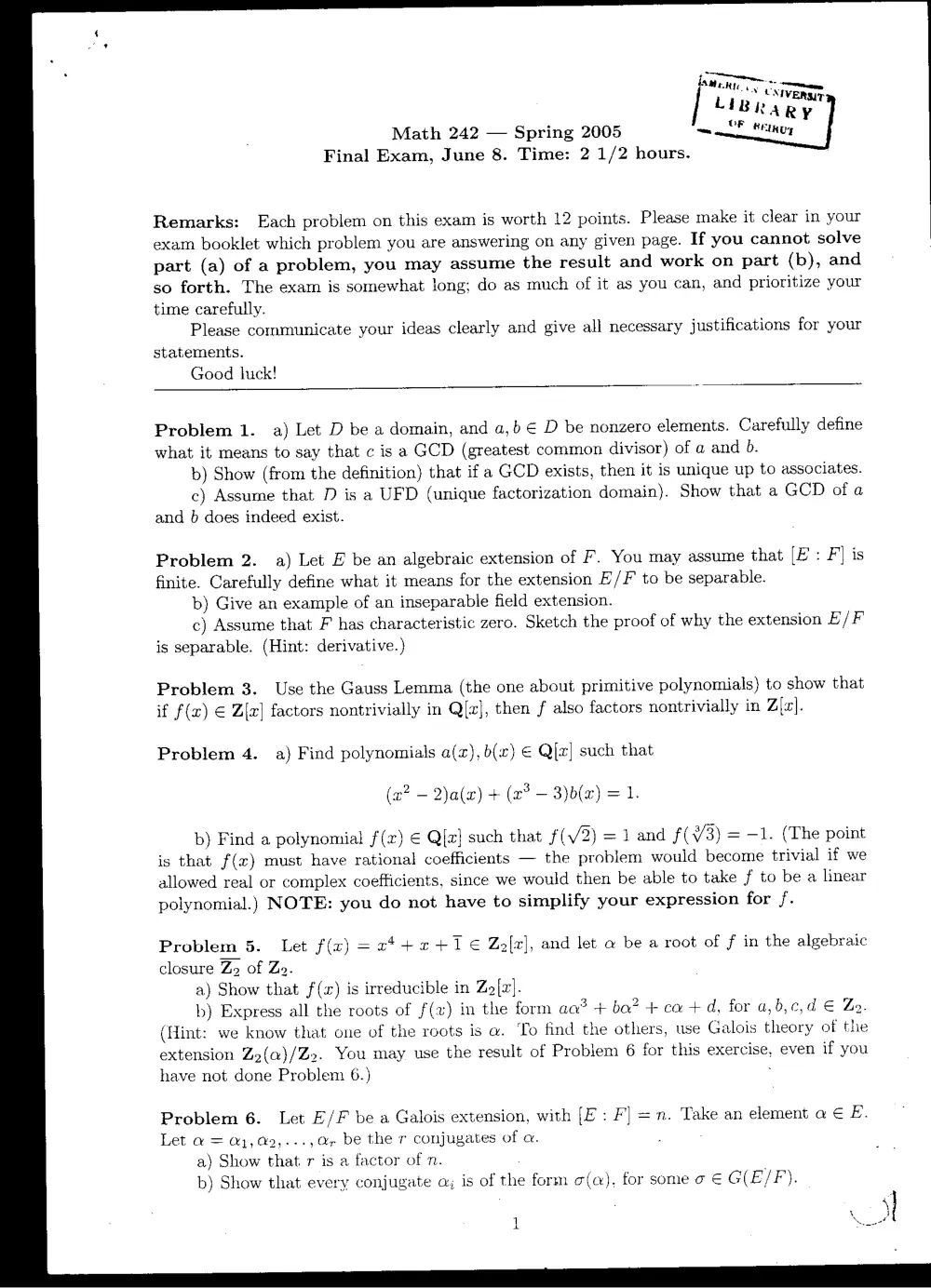
Math 242 — Spring 2005
Final Exam, June 8. Time: 2 1/2 hours.
Remarks: Each problem on this exam is worth 12 points. Please make it clear in your
exam booklet which problem you are answering on any given page. If you cannot solve
part (a) of a problem, you may assume the result and work on part (b), and
so forth. The exam is somewhat long; do as much of it as you can, and prioritize your
time carefully.
Please communicate your ideas clearly and give all necessary justifications for your
statements.
Good luck!
Problem 1. a) Let D be a domain, and a,b € D be nonzero elements. Carefully define
what it means to say that c is a GCD (greatest common divisor) of a and 6.
b) Show (from the definition) that if a GCD exists, then it is unique up to associates.
c) Assume that D is a UFD (unique factorization domain). Show that a GCD of a
and 6 does indeed exist.
Problem 2. a) Let £ be an algebraic extension of F. You may assume that [FE : F] is
finite. Carefully define what it means for the extension E/F to be separable.
b) Give an example of an inseparable field extension.
c) Assume that F has characteristic zero. Sketch the proof of why the extension E/F
is separable. (Hint: derivative.)
Problem 3. Use the Gauss Lemma (the one about primitive polynomials) to show that
if f(z) € Z{z] factors nontrivially in Q{z], then f also factors nontrivially in AGAR
Problem 4. a) Find polynomials a(x), b(x) € Q[z] such that
(x? — 2)a(x) + (x? — 3)b(x) = 1.
b) Find a polynomial f(x) € Q[z] such that f(V¥2) = 1 and f(4/3) = -1. (The point
is that f(x) must have rational coefficients — the problem would become trivial if we
allowed real or complex coefficients, since we would then be able to take f to be a linear
polynomial.) NOTE: you do not have to simplify your expression for f.
Problem 5. Let f(x) = «4+2c+1 € Zz[z], and let a be a root of f in the algebraic
closure Z of Zo.
a) Show that f(x) is irreducible in Ze[z].
b) Express all the roots of f(%) in the form ac® + ba? + ca +d, for a,b,c,d € Ze.
(Hint: we know that one of the roots is a. To find the others, use Galois theory of the
extension Z2(a)/Zy. You may use the result of Problem 6 for this exercise, even if you
have not done Problem 6.) :
Problem 6. Let E/F be a Galois extension, with [E : F] =n. Take an element a € E.
Let @ = @1,02,...,a, be the r conjugates of a.
a) Show that. r is a factor of n.
b) Show that every conjugate a; is of the form a(a), for some a € G(E/F).
1
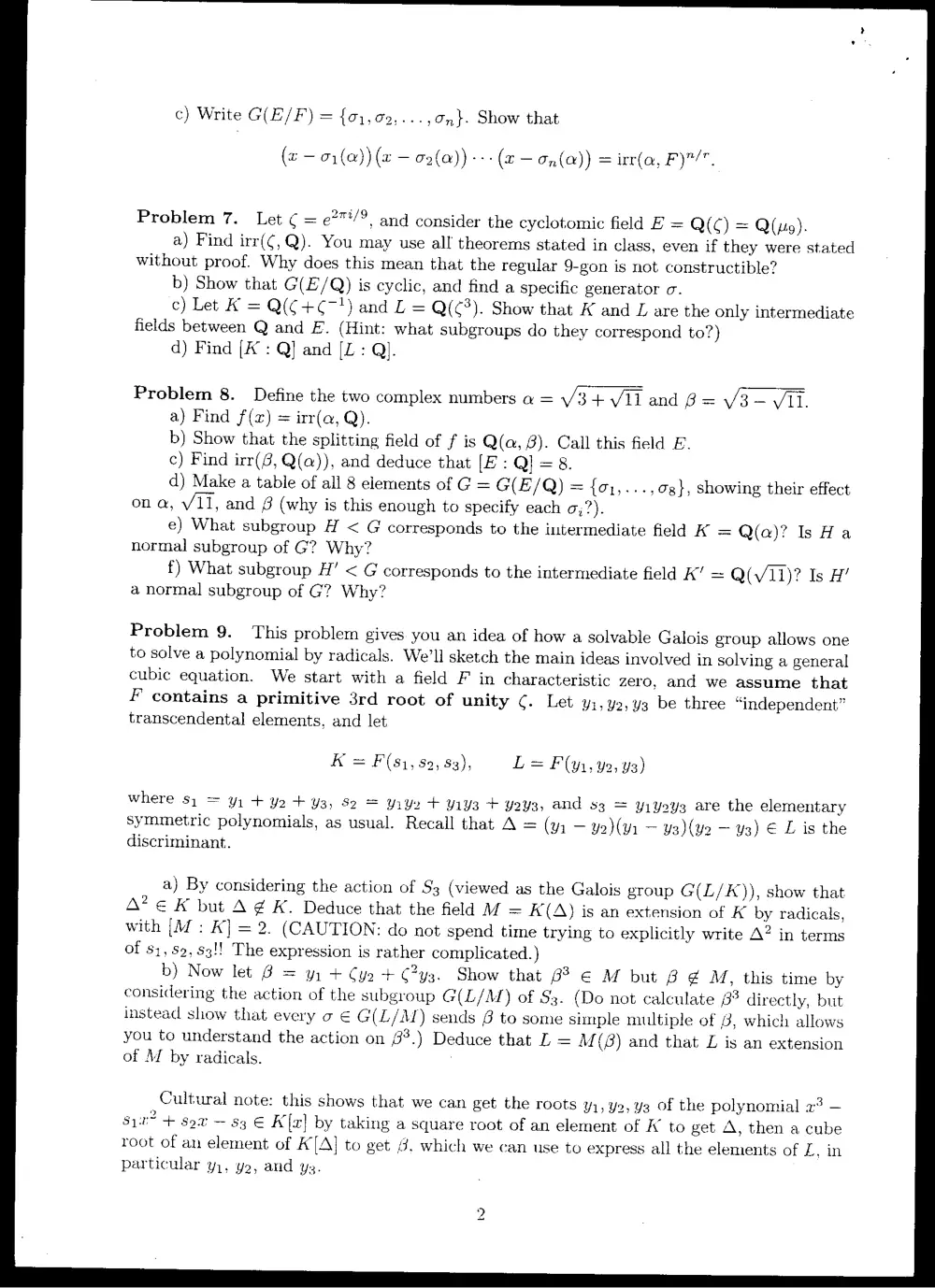
c) Write G(E/F) = {01,02,...,0}. Show that
(« — 1(a)) (w — o2(a))--- (@ —on(@)) = irr(a, FY”,
Problem 7. Let ¢ = e?"*/®, and consider the cyclotomic field EF = Q(¢) = Q(pi9).
a) Find irr(¢,Q). You may use all theorems stated in class, even if they were stated
without proof. Why does this mean that the regular 9-gon is not constructible?
b) Show that G(E£/Q) is cyclic, and find a specific generator co.
c) Let K = Q(¢+¢71) and L = Q(¢). Show that K and L are the only intermediate
fields between Q and E. (Hint: what subgroups do they correspond to?}
d) Find [K : Q] and [ZL : Q].
Problem 8. Define the two complex numbers a = \/3 + Vil and @ = V3- V1.
a) Find f(z) = irr(a, Q).
b) Show that the splitting field of f is Q(a, 8). Call this field F.
c) Find irr(G, Q(a)), and deduce that [E : Q] = 8.
d) Make a table of all 8 elements of G = G(E/Q) = {o1,..., 0g}, showing their effect
on a, V11, and @ (why is this enough to specify each Oi).
e) What subgroup H < G corresponds to the intermediate field K = Q(a)? Is Ha
normal subgroup of G? Why?
f) What subgroup H’ < G corresponds to the intermediate field K’ = Q(V11)? Is H’
a normal subgroup of G? Why?
Problem 9. This problem gives you an idea of how a solvable Galois group allows one
to solve a polynomial by radicals. We’ll sketch the main ideas involved in solving a general
cubic equation. We start with a field F in characteristic zero, and we assume that
F contains a primitive 3rd root of unity ¢. Let y:,y2,y3 be three “independent”
transcendental elements, and let
K = F(81, 52, 83), L= F(y, ys, ys)
where s) = y; + yo + ys, 82 = | y2 + y1y3 + yays, and sg = y1yey3 are the elementary
symmetric polynomials, as usual. Recall that A = (y, — yo}(y ~ ys)(ye — y3) € L is the
discriminant.
a) By considering the action of $3 (viewed as the Galois group G(L/K)), show that
A’ é K but A ¢ K. Deduce that the field M = (A) is an extension of K by radicals,
with [M : K] = 2. (CAUTION: do not spend time trying to explicitly write A? in terms
of 81, 82, 83!! The expression is rather complicated.)
b) Now let 6 = y1 + Cy2 + C?y3. Show that GB & M but B ¢ M, this time by
considering the action of the subgroup G(L/M) of S3. (Do not calculate 3° directly, but
instead show that every o € G(L/A1) sends 8 to some simple multiple of 8, which allows
you to understand the action on 6°.) Deduce that L = M() and that L is an extension
of M by radicals.
Cultural note: this shows that we can get the roots y1, ys, y3 of the polynomial 2? —
Sy? + sor — 83 € K(z] by taking a square root of an element of K’ to get A, then a cube
root of au element of A[A] to get 4. which we can use to express all the elements of L. in
particular y1, y2, and y3.
2