
MECH 310 Homework 2, Spring 2011
American University of Beirut · Thermodynamics I · 1 page · Prof. Mahmoud Al Hindi
Stuck on a question? A tutor can walk you through it.
More MECH 310 files
- Homework Assignment 1 Solution · Fall 2013Homework · with solutionView
- Homework Assignment 2 · Fall 2013HomeworkView
- Homework Assignment 3 Solution · Fall 2013Homework · with solutionView
- Homework 2 · Spring 2011HomeworkView
- Homework 3 · Spring 2011HomeworkView
- Essay Chapter 3 · Fall 2017ChapterView
- Exam 2 Solution Leen Alawieh · Fall 2017Exam · with solutionView
- Exam 1 Leen Alawieh With Solutions · Fall 2017Exam · with solutionView
Show the text of this homework
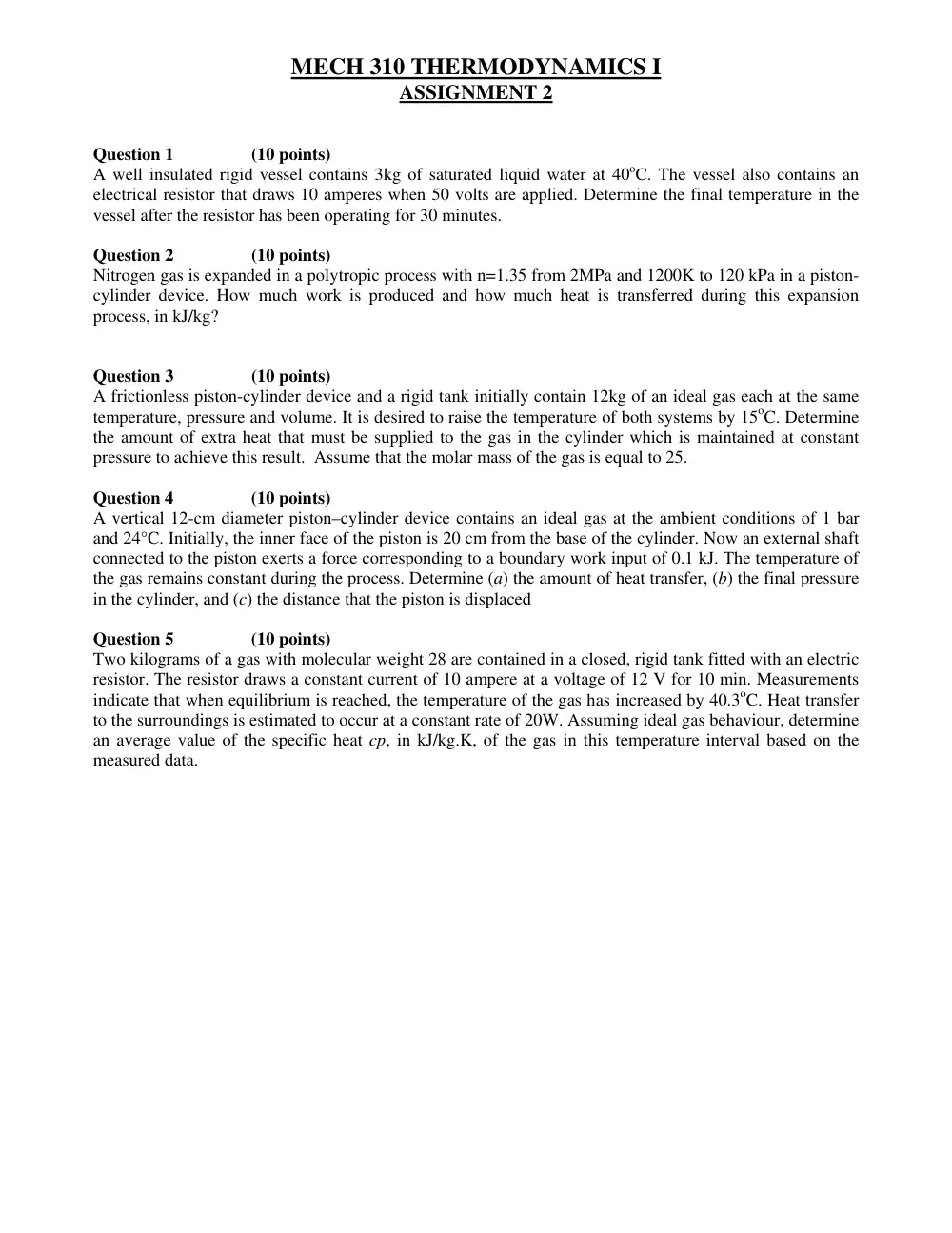
MECH 310 THERMODYNAMICS I
ASSIGNMENT 2
Question 1
(10 points)
A well insulated rigid vessel contains 3kg of saturated liquid water at 40oC. The vessel also contains an
electrical resistor that draws 10 amperes when 50 volts are applied. Determine the final temperature in the
vessel after the resistor has been operating for 30 minutes.
Question 2
(10 points)
Nitrogen gas is expanded in a polytropic process with n=1.35 from 2MPa and 1200K to 120 kPa in a piston-
cylinder device. How much work is produced and how much heat is transferred during this expansion
process, in kJ/kg?
Question 3
(10 points)
A frictionless piston-cylinder device and a rigid tank initially contain 12kg of an ideal gas each at the same
temperature, pressure and volume. It is desired to raise the temperature of both systems by 15oC. Determine
the amount of extra heat that must be supplied to the gas in the cylinder which is maintained at constant
pressure to achieve this result. Assume that the molar mass of the gas is equal to 25.
Question 4
(10 points)
A vertical 12-cm diameter piston–cylinder device contains an ideal gas at the ambient conditions of 1 bar
and 24°C. Initially, the inner face of the piston is 20 cm from the base of the cylinder. Now an external shaft
connected to the piston exerts a force corresponding to a boundary work input of 0.1 kJ. The temperature of
the gas remains constant during the process. Determine (a) the amount of heat transfer, (b) the final pressure
in the cylinder, and (c) the distance that the piston is displaced
Question 5
(10 points)
Two kilograms of a gas with molecular weight 28 are contained in a closed, rigid tank fitted with an electric
resistor. The resistor draws a constant current of 10 ampere at a voltage of 12 V for 10 min. Measurements
indicate that when equilibrium is reached, the temperature of the gas has increased by 40.3oC. Heat transfer
to the surroundings is estimated to occur at a constant rate of 20W. Assuming ideal gas behaviour, determine
an average value of the specific heat cp, in kJ/kg.K, of the gas in this temperature interval based on the
measured data.