
MECH 340 Final, Spring 2006
American University of Beirut · Engineering Materials · 7 pages




More MECH 340 files
- Final · Spring 2008Final examView
- Final · Summer 2006Final examView
- Exam 1 with Solution · Spring 2013Exam · with solutionView
- Exam 2 with Solution · Spring 2013Exam · with solutionView
- Exam 2 with Solution · Spring 2013Exam · with solutionView
- Exam 1 with Solution · Spring 2012Exam · with solutionView
- Exam 1 · Spring 2011ExamView
- Syllabus · Fall 2011LabView
Show the text of this final exam
Introduction To Materials Science, Chapter 1, Introduction
University of Virginia, Dept. of Materials Science and Engineering
18
Polymer
composite
materials:
reinforcing
glass
fibers
in
a
polymer matrix.
Composites
University of Virginia, Dept. of Materials Science and Engineering
24
Thin crystalline platelets grown from solution - chains fold
back and forth: chain-folded model
Polyethylene
The average chain length is much greater than the
thickness of the crystallite
University of Virginia, Dept. of Materials Science and Engineering
9
Cr, �-Fe, Mo have this crystal structure
Spring 2006
Final Exam
Tuesday, June 6, 2006
Duration: 3 hours
Open Book Exam
Write clearly your derivations and answers on the answer sheet
Name:
ID#:
Engineering Material
Spring 2006
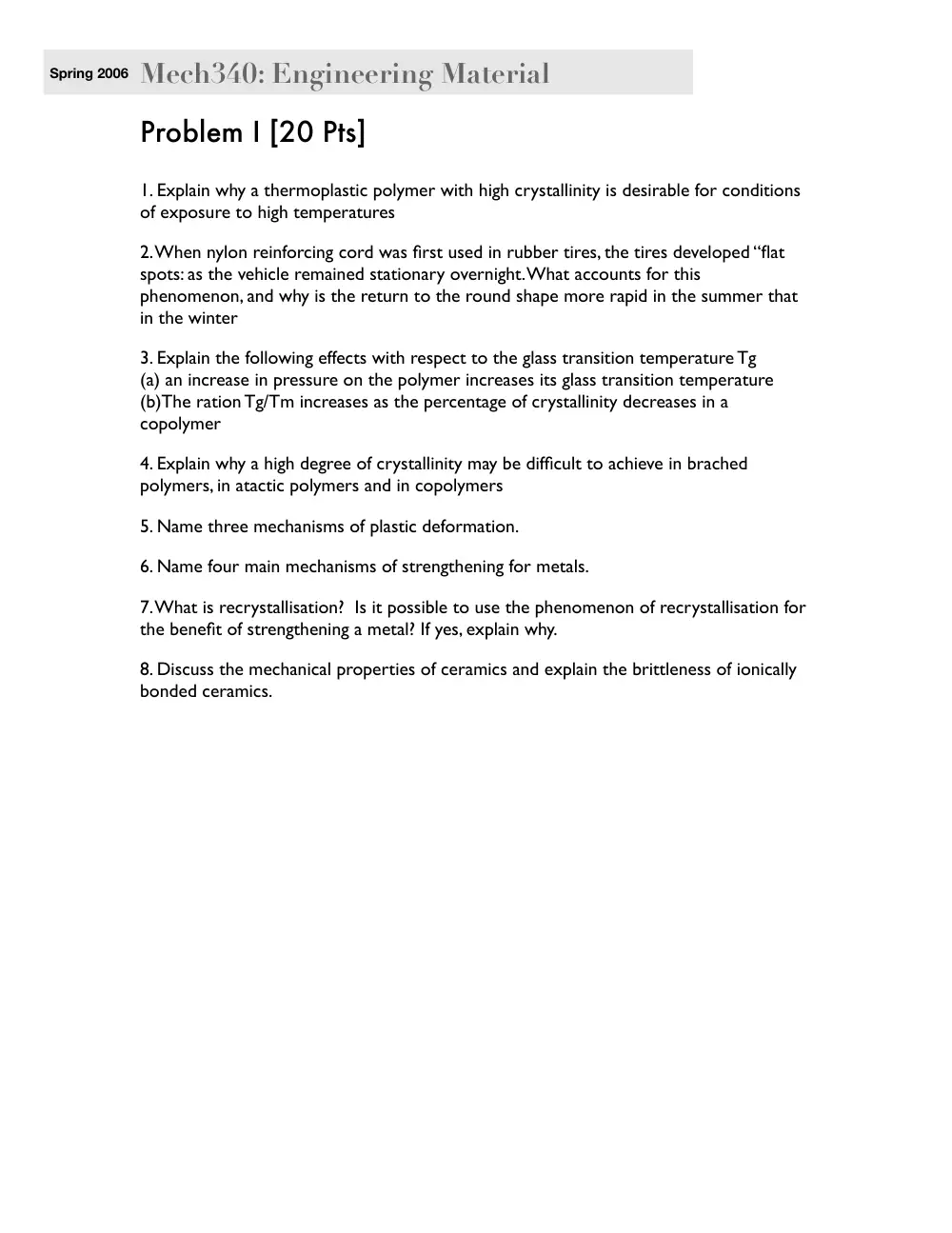
Problem I [20 Pts]
1. Explain why a thermoplastic polymer with high crystallinity is desirable for conditions
of exposure to high temperatures
2. When nylon reinforcing cord was first used in rubber tires, the tires developed “flat
spots: as the vehicle remained stationary overnight. What accounts for this
phenomenon, and why is the return to the round shape more rapid in the summer that
in the winter
3. Explain the following effects with respect to the glass transition temperature Tg
(a) an increase in pressure on the polymer increases its glass transition temperature
(b)The ration Tg/Tm increases as the percentage of crystallinity decreases in a
copolymer
4. Explain why a high degree of crystallinity may be difficult to achieve in brached
polymers, in atactic polymers and in copolymers
5. Name three mechanisms of plastic deformation.
6. Name four main mechanisms of strengthening for metals.
7. What is recrystallisation? Is it possible to use the phenomenon of recrystallisation for
the benefit of strengthening a metal? If yes, explain why.
8. Discuss the mechanical properties of ceramics and explain the brittleness of ionically
bonded ceramics.
Mech340: Engineering Material
Spring 2006
Problem II [15 Pts]
Shown below is a face-centred cubic unit cell.
===========================================================================&
!
"#!$%&&'()(*+,-.!/*01-),+/1*!$2((+!/$!&-13/4(4!,+!+2(!(*4!10!+2(!&,&(-5!
!
!
!
6%($+/1*!7!!
!
!
!
!
!
!
!
!
!
"78!),-9$5!
&
'8.>-&?(2.>&"$&,&@,A(BA(-%#(C&AD?"A&D-"%&A(226&&&
!
!
E
F
,&
,
,
!
!
+&
9&
G&
!
!
!
!
!
!
!
!
!
!
!
!
!
!
!
H,I&J#"%(&C.>-&%8(&)"22(#&"-C"A($&.@&%8(&$8,C(C&K2,-(&,AA.#C"-3&%.&%8(&,%.)"A&A.B.#C"-,%(&
$9$%()&3"L(-6&&
&
&
&
&
&
&
H/&),#M$I&
!
H?I&1,#M&ENN&O;;;P&C"#(A%".-$&"-&%8"$&D-"%&A(22&,-C&2,?(2&%8()&>"%8&%8("#&"-C"A($6&
H<&),#M$I&
&
HAI&7,2AD2,%(& %8(& ,%.)"A& K,AM"-3& @,A%.#& .@& %8"$& $%#DA%D#(& H$8.>& 9.D#& A,2AD2,%".-&
K#.A(CD#(I6&
&
&
&
&
&
&
&
H<&),#M$I&
&
HCI&QD#(& "#.-& D-C(#3.($& ,-& ,22.%#.K"A& K8,$(& %#,-$@.#),%".-& @#.)& @AA& H,D$%(-"%(I& %.& ?AA&
H@(##"%(I& .-& A..2"-3& ,%& R;/!76& & 7,2AD2,%(& %8(& K(#A(-%& A8,-3(& "-& ,%.)"A& $"G(&
,AA.)K,-9"-3&%8"$&%#,-$@.#),%".-S&,$$D)"-3&%8,%&%8(&L.2D)(&A8,-3(&"$&G(#.6&
H:&),#M$I&
&
!
!
6%($+/1*!:!!
!
!
!
!
!
!
!
!
!
":;!),-9$5!
&
H,I&T,)(&,22&K.$$"?2(&"-%(#$%"%",2&$"%($&"-&F77&,-C&!77&$%#DA%D#($6&&J8,%&,#(&%8(&(@@(A%"L(&
$"%($&@.#&,AA.)).C,%"-3&")KD#"%9&,%.)$&"-&(,A8&$%#DA%D#(U&&VC(-%"@9&H),#M&.D%I&.-(&
$DA8&(@@(A%"L(&"-%(#$%"%",2&$"%(&@.#&(,A8&.@&%8(&%>.&D-"%&A(22$&?(2.>6&&
&
H:&),#M$I&
(a) Write down the miller indices of the shaded plane according to the atomic co-
ordinate system given. (2 points)
(b) Mark ALL <111> directions in this unit cell and label them with their indices. (4
points)
(c) Calculate the atomic packing factor of this structure (show your calculation
procedure). (4 points)
(d) Pure iron undergoes an allotropic phase transformation from fcc (austenite) to bcc
(ferrite) on cooling at 912°C. Calculate the percent change in atomic size accompanying
this transformation, assuming that the volume change is zero. (5 points)
Mech340: Engineering Material
3/7
Spring 2006
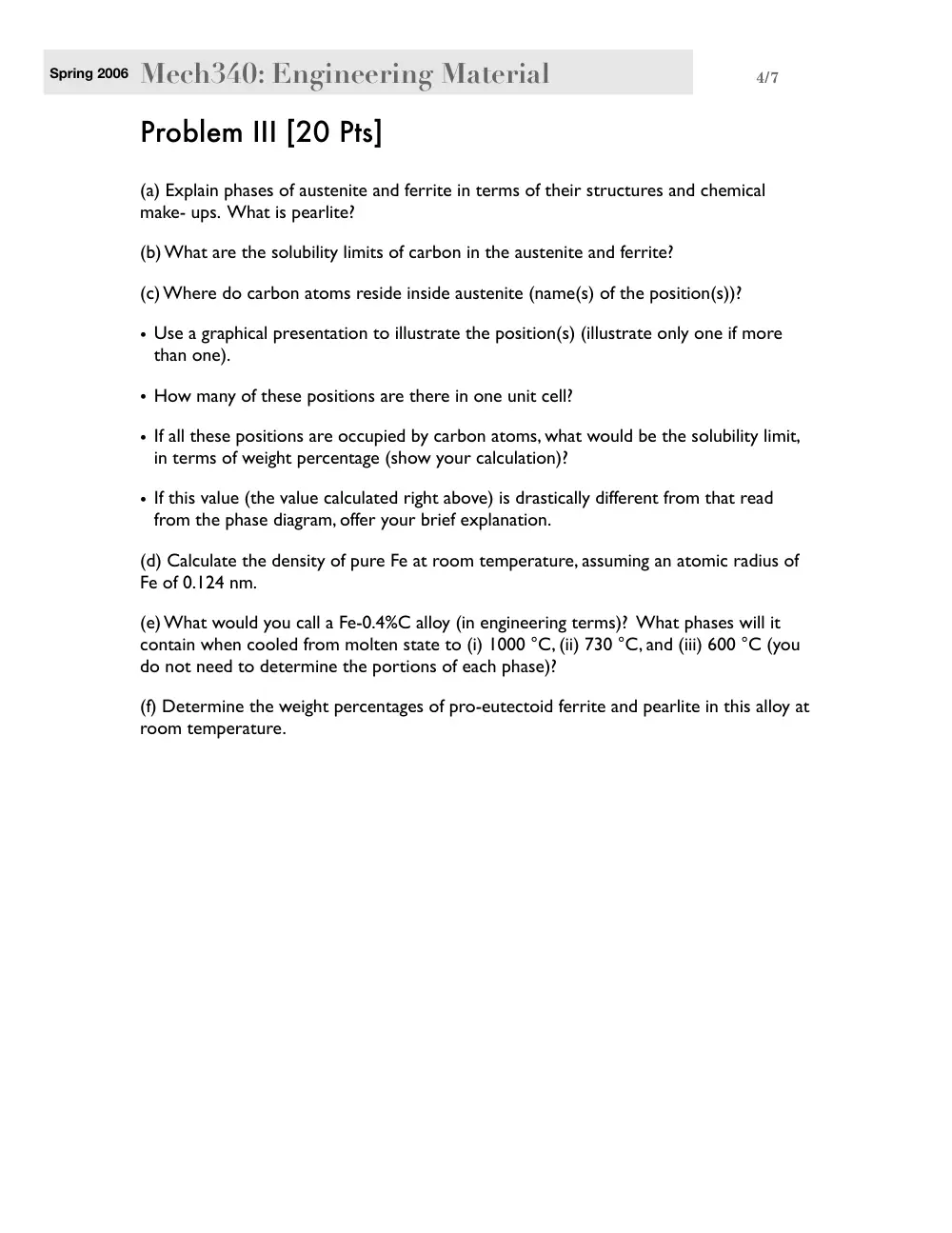
Problem III [20 Pts]
(a) Explain phases of austenite and ferrite in terms of their structures and chemical
make- ups. What is pearlite?
(b) What are the solubility limits of carbon in the austenite and ferrite?
(c) Where do carbon atoms reside inside austenite (name(s) of the position(s))?
• Use a graphical presentation to illustrate the position(s) (illustrate only one if more
than one).
• How many of these positions are there in one unit cell?
• If all these positions are occupied by carbon atoms, what would be the solubility limit,
in terms of weight percentage (show your calculation)?
• If this value (the value calculated right above) is drastically different from that read
from the phase diagram, offer your brief explanation.
(d) Calculate the density of pure Fe at room temperature, assuming an atomic radius of
Fe of 0.124 nm.
(e) What would you call a Fe-0.4%C alloy (in engineering terms)? What phases will it
contain when cooled from molten state to (i) 1000 °C, (ii) 730 °C, and (iii) 600 °C (you
do not need to determine the portions of each phase)?
(f) Determine the weight percentages of pro-eutectoid ferrite and pearlite in this alloy at
room temperature.
Mech340: Engineering Material
4/7
Spring 2006
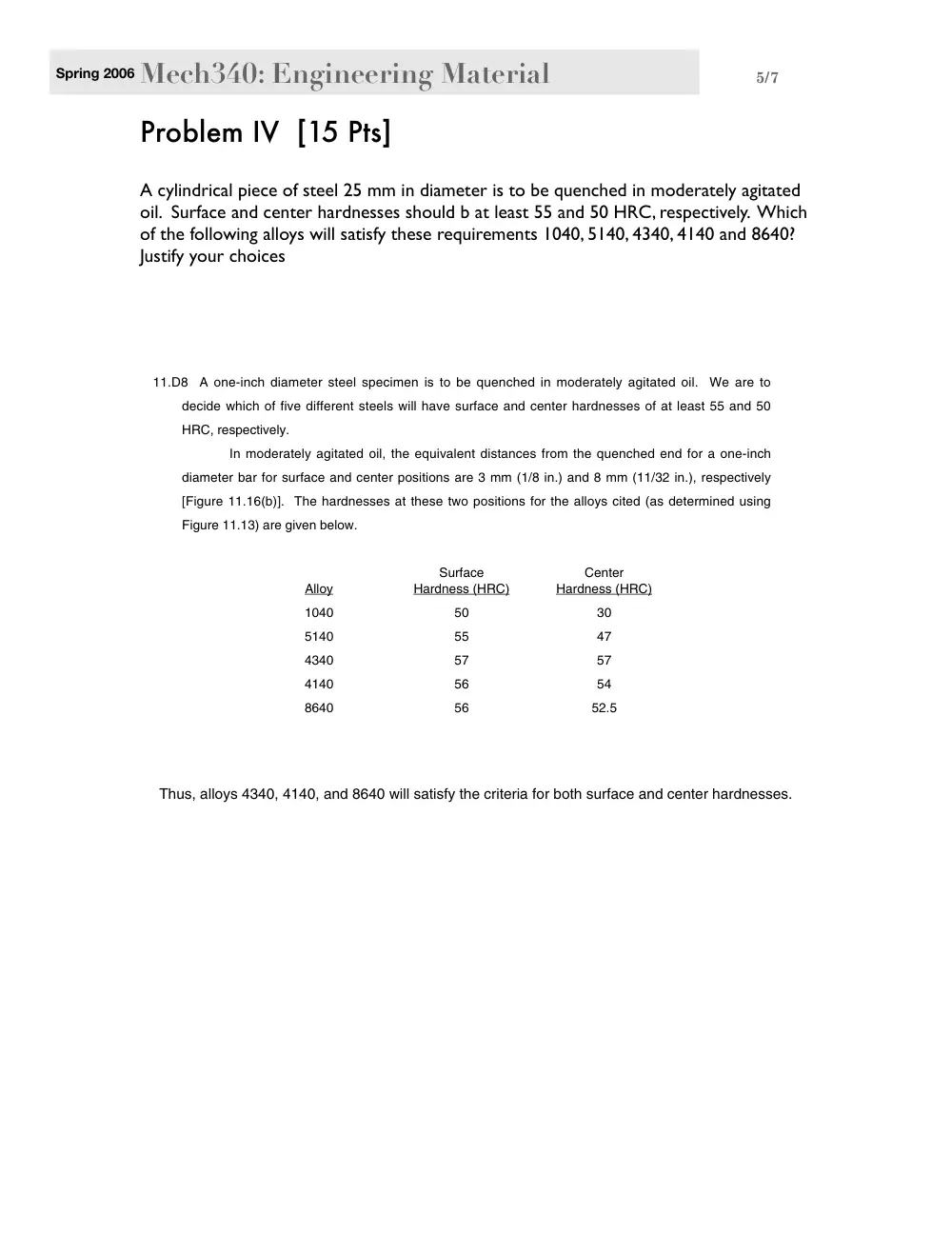
Problem IV [15 Pts]
A cylindrical piece of steel 25 mm in diameter is to be quenched in moderately agitated
oil. Surface and center hardnesses should b at least 55 and 50 HRC, respectively. Which
of the following alloys will satisfy these requirements 1040, 5140, 4340, 4140 and 8640?
Justify your choices
314
Tin would almost always be hot-worked. Even deformation at room temperature would be
considered hot-working inasmuch as its recrystallization temperature is below room temperature
(Table 7.2).
Tungsten is hard and strong at room temperature, has a high recrystallization temperature,
and experiences oxidation at elevated temperatures. Cold-working is difficult because of its
strength, and hot-working is not practical because of oxidation problems. Most tungsten articles are
fabricated by powder metallurgy, or by using cold-working followed by annealing cycles.
Most aluminum alloys may be cold-worked since they are ductile and have relatively low
yield strengths.
Magnesium alloys are normally hot-worked inasmuch as they are quite brittle at room
temperature. Also, magnesium alloys have relatively low recrystallization temperatures.
A 4140 steel could be cold-worked in an over-tempered state which leaves it soft and
relatively ductile, after which quenching and tempering heat treatments may be employed to
strengthen and harden it. This steel would probably have a relatively high recrystallization
temperature, and hot-working may cause oxidation.
11.D8 A one-inch diameter steel specimen is to be quenched in moderately agitated oil. We are to
decide which of five different steels will have surface and center hardnesses of at least 55 and 50
HRC, respectively.
In moderately agitated oil, the equivalent distances from the quenched end for a one-inch
diameter bar for surface and center positions are 3 mm (1/8 in.) and 8 mm (11/32 in.), respectively
[Figure 11.16(b)]. The hardnesses at these two positions for the alloys cited (as determined using
Figure 11.13) are given below.
Surface
Center
Alloy
Hardness (HRC)
Hardness (HRC)
1040
50
30
5140
55
47
4340
57
57
4140
56
54
8640
56
52.5
Thus, alloys 4340, 4140, and 8640 will satisfy the criteria for both surface and center hardnesses.
11.D9 (a) This problem calls for us to decide which of 8660, 8640, 8630, and 8620 alloys may be
fabricated into a cylindrical piece 57 mm (2-1/4 in.) in diameter which, when quenched in mildly
agitated water, will produce a minimum hardness of 45 HRC throughout the entire piece.
The center of the steel cylinder will cool the slowest and therefore will be the softest. In
moderately agitated water the equivalent distance from the quenched end for a 57 mm diameter bar
for the center position is about 11 mm (7/16 in.) [Figure 11.16(a)]. The hardnesses at this position
for the alloys cited (Figure 11.14) are given below.
Center
Alloy
Hardness (HRC)
8660
61
8640
49
8630
36
8620
25
Mech340: Engineering Material
5/7
Spring 2006
Problem V [10 Pts]
A solder manufacturer wishes to make a batch of solder having the eutectic
composition. On hand is a supply of 250 kd of electrical solder scrap containing 60 wt%
Sn-40wt% Pb, and 1250 kg of plumbing solder scrap containing 60wt%Pb -40wt%Sn. If all
o the scrap is to be melted, how much pure Sn should be added to achieve the desired
Sn composition.
Mech340: Engineering Material
6/7
Spring 2006
Problem VI [20 Pts]
Iron Titanate, FeTiO3 forms in the ilmenite crystal structure that consists of an HCP
arrangement of O2-
a.
What type of interstitial site will the Fe2+ ions occupy, explain.
b. Which type of interstitial site will the Ti4+ ions occupy, explain
c.
What fraction of the total tetrahedral sites will be occupied
d. What fraction of the total octahedral sites will be occupied
Mech340: Engineering Material
7/7